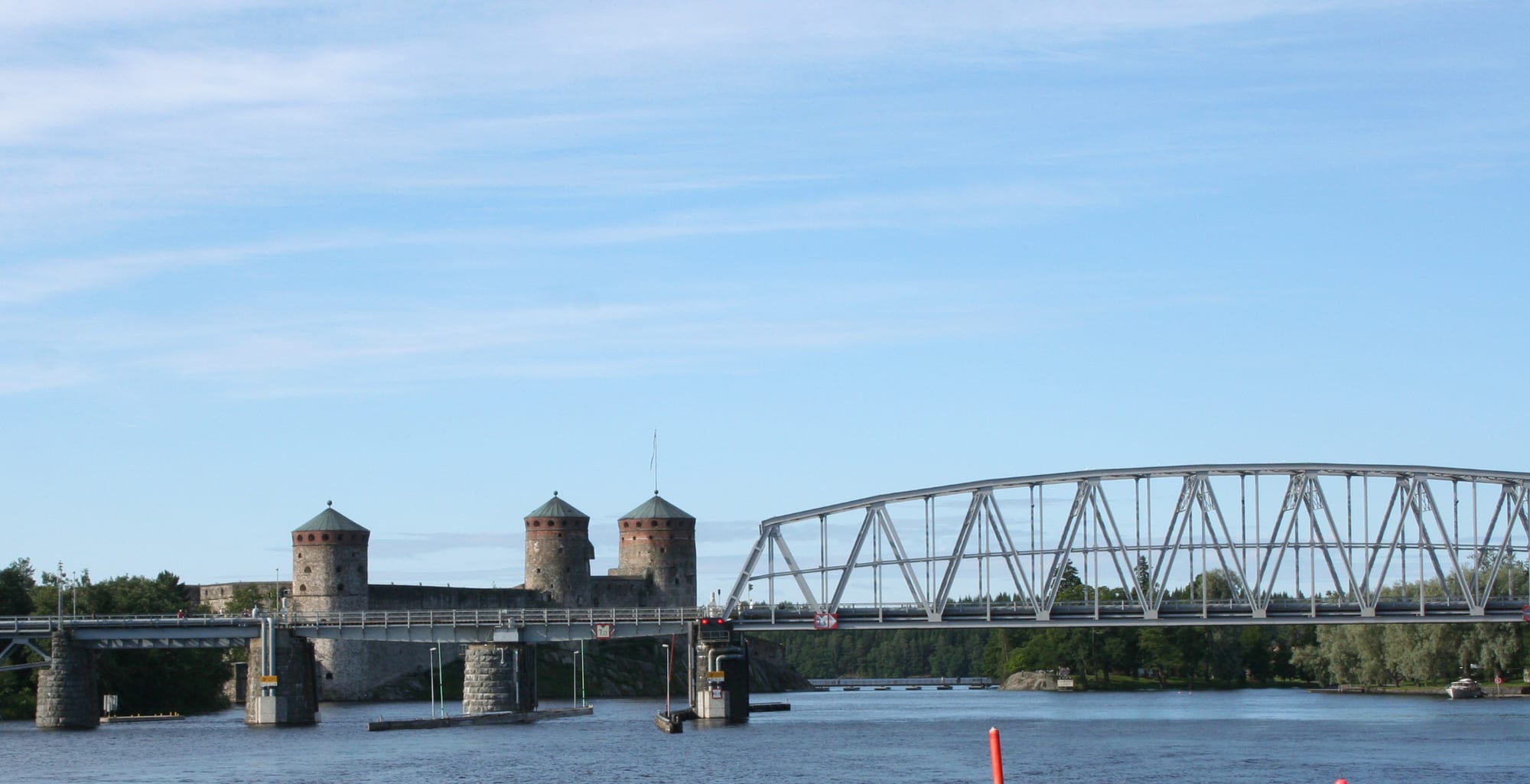
A grey stone castle with three round towers on an island beside a steel truss bridge over a calm blue strait

Lakeland, Finland

Savonlinna

Olavinlinna castle and the Kyrönsalmi railway bridge in Savonlinna. (ninara / Wikimedia Commons · CC BY-SA 2.0)

A lake town of islands and straits in the heart of the Saimaa Lakeland, known as the Capital of Saimaa. It grew around Olavinlinna, a castle founded in 1475 on the Swedish–Russian frontier, became a spa town after the Saimaa Canal brought visitors, and every July fills for the opera festival staged in the castle.

Neighbourhoods

  • The town centre and harbour
    • First-time visitors
    • Close to public transport
    • Boat trips

    The compact centre around the market square, with the passenger harbour beside it where the lake steamers and sightseeing boats tie up. The railway stop is on the square and the bus station a short walk away.

    Open in Maps
  • The castle and Riihisaari
    • Historic district
    • Museums

    The islands at the Kyrönsalmi strait, where Olavinlinna stands on its rock between Haukivesi and Pihlajavesi and the provincial museum on Riihisaari tells the story of Saimaa. The quietest, most atmospheric part of town outside festival nights.

    Open in Maps
  • Talvisalo and the islands
    • Quiet and residential
    • Lakes

    The islands strung between the straits west of the centre, Talvisalo and Vääräsaari among them, with homes, schools, sports grounds and shoreline paths.

    Open in Maps

Things to do

The castle and the town

  • Olavinlinnalandmark

    St Olaf's Castle, a three-tower fortress of the 15th century on an island in the Kyrönsalmi strait — the northernmost medieval stone fortress still standing, and the stage of the opera festival.

    Open in Maps
  • Riihisaari Museummuseum

    The provincial museum on an island near the castle, on the cultural history and nature of the Saimaa region, with an exhibition by the state forest service.

    Open in Maps
  • SS Salamaattraction

    A steam schooner of 1874 built for a Savonlinna steamship company, sunk in a collision in 1898, raised in 1971 and now a museum ship at the provincial museum.

    Open in Maps
  • Lake cruisestransit hub

    Sightseeing boats, some of them old lake steamers, leave the passenger harbour by the market square through the summer for trips around the town and its islands, with longer routes as far as Kuopio and Lappeenranta.

    Open in Maps

Short trips from the town

  • Kerimäki Churchlandmark

    In the village of Kerimäki, now part of Savonlinna, the largest wooden church in the world.

    Open in Maps
  • Punkaharjupark

    A narrow esker between the lakes Puruvesi and Pihlajavesi, an official Finnish national landscape protected since 1843, crossed by a scenic road chosen as Finland's 'Road of the Century' in 2017.

    Open in Maps
  • Linnansaari National Parkpark

    An island park in Lake Haukivesi, home to the critically endangered Saimaa ringed seal, reached by boat in summer, including cruises from Savonlinna.

    Open in Maps
  • Kolovesi National Parkpark

    A small national park of craggy cliffs and narrow waters shaped by the ice age, established in 1990 to protect the habitat of the Saimaa ringed seal.

    Open in Maps

Seasonal events

  • Savonlinna Opera FestivalJuly

    First held in 1912 under the soprano Aino Ackté, a month-long festival staged inside Olavinlinna with a total audience of around 60,000.

  • OperaGamesfirst weekend of July

    A three-day show-jumping competition held as the opera festival begins.

  • St Olaf's Day29 July

    The town's official birthday, named after the saint of its castle.

Eat and drink

Long-standing places and food districts in Savonlinna. Hours, ratings and directions come from your maps app, always current.

Savonlinna classics

  • Lörtsymarket

    The town's own pastry — a thin, half-moon fried pastry with a meat-and-rice or sweet apple filling, sold by street vendors with pickled cucumber and onion.

    Open in Maps
  • The market squaremarket

    The central square by the passenger harbour, the meeting point of the town and its lake boats in summer.

    Open in Maps

Food districts

  • Olavinkatu and the centreneighborhood

    Restaurants, cafés and bars along the main street and around the market square, busiest during the festival.

    Open in Maps
  • The castle shoreneighborhood

    Cafés and summer restaurants on the islands and shores around Olavinlinna.

    Open in Maps

Experience Savonlinna

History

The town owes its existence to its castle. In 1475 Erik Axelsson Tott founded Olavinlinna on a rocky island in the Kyrönsalmi strait, between the lakes Haukivesi and Pihlajavesi, to protect Savo and control the unstable border between the Kingdom of Sweden and Russia. It is the northernmost medieval stone fortress still standing. A town was founded beside it in 1639, but it struggled: after its town rights were withdrawn its population fell to between 100 and 150 people, and the border moved back and forth through the wars of the following century. In July 1812 a great fire destroyed 19 houses.

Growth came with transport. The Saimaa Canal opened in 1856 and the railway arrived in 1907, and steamships linked the town with the rest of the lake system and the coast; the steam schooner Salama, built in 1874 for a local steamship company, sank in 1898 and was raised in 1971 as a museum ship. The canal brought tourists to the Olavi spa, opened in 1896, and in the early 20th century Savonlinna was famous as a spa town.

In 1912 the soprano Aino Ackté organised the first opera festival in the castle, the beginning of the event for which the town is known today. In 2013 the neighbouring municipalities of Kerimäki and Punkaharju were joined to Savonlinna, bringing the world's largest wooden church and the Punkaharju ridge within its borders. A track realignment closed the old railway station in 2011, and the line westward towards Rantasalmi has since been cut.

Culture & Customs

The opera festival defines Savonlinna. First held in 1912 and revived as an annual event in 1967, it has grown into an internationally recognised month-long festival staged inside Olavinlinna, with a total audience of around 60,000, an estimated quarter of them from abroad. As the festival opens, on the first weekend of July, the town also holds the OperaGames, a three-day show-jumping competition, and the town's official birthday falls on St Olaf's Day, 29 July.

Savonlinna sits in Savo, whose people are known across Finland for a roundabout, joking manner of speech and a distinctive dialect. It calls itself the Capital of Saimaa, and lake life — steamers, cottages, rowing boats and evening swims — is at the centre of local identity. Old lake steamers still carry sightseeing passengers from the harbour every summer.

Art and education have their own traditions: one of the town's upper secondary schools, specialising in art subjects, was the first specialised high school in Finland and in all of the Nordic countries when it opened in 1967. In sport, the top-tier volleyball team Saimaa Volley plays some of its home matches in the town, and Basket Savonlinna has produced national team players.

Daily Life

About 31,000 people lived in Savonlinna at the start of 2025, down from about 34,700 at the end of 2017, and about 38,000 in the sub-region. The municipality is vast — about 3,600 square kilometres, more than a third of it water — and takes in the villages of Kerimäki, Punkaharju and Savonranta as well as the town itself, which is one of the two main centres of South Savo with Mikkeli and the seat of a hospital district.

Healthcare, education and tourism are prominent: besides the hospital district, the town has a university of applied sciences campus with laboratories for wood processing and electronics. The summer brings a surge of visitors and cottage residents, above all in July, while the rest of the year the town is quiet. The population has been falling for years.

Homes spread across the islands and shores around the straits, from flats in the centre to houses on Talvisalo and in the eastern suburbs. Life follows the seasons: boats, swimming and berry picking in summer, skiing and ice fishing on the frozen lakes in winter.

Food

The town's own speciality is the lörtsy, a thin, half-moon-shaped pastry invented in Savonlinna and an essential part of local food culture. The savoury version has a filling of meat and rice like a Finnish meat pie, and street vendors serve it with the same condiments — pickled cucumber and chopped raw onion, and sometimes a hot-dog sausage — folded around them like a taco. The sweet version holds apple jam and resembles a jam doughnut. Lörtsy are associated with South Savo but are now sold across Finland.

The wider Savo and Karelian table is close at hand. Karelian pies, thin rye-crust pastries most often filled with rice and spread with egg butter, are eaten throughout Finland, and kalakukko, fish, pork and bacon baked inside a rye loaf, is a traditional dish of Savo. Lake fish such as vendace, freshly fried or smoked, is sold at the market square, and summer brings bilberries, lingonberries and mushrooms from the forests.

Eating out centres on the market square by the harbour and the streets around it, and in summer on the cafés and terraces around the castle and the lake shores. The town is at its busiest during the July festival.

Planning tools

Budget

Savonlinna is reasonably priced most of the year, but hotels become expensive and fully booked during the opera festival in July. Opera tickets, lake cruises and trips to the national parks are the main extras; walking the town and the castle shores costs nothing.

Daily Budget Midrange
USD 150–290 (hotel or lakeside cottage, restaurant meals, a lake cruise, castle entry, hire car)
Daily Budget Shoestring
USD 70–110 (hostel or campsite, market snacks and lunch buffets, buses)

Book rooms months ahead for July, and consider a cottage outside town for a longer stay.

Best Time to Visit

June to August, when the lake boats run, the castle hosts the opera festival in July and the shores are at their best. Late August and September are quieter. Winter is cold and snowy, with frozen lakes and few visitors.

Suggested Number of Days

One or two days cover the town and the castle. Three to five allow time for the surrounding lakes and national parks; opera tickets, boat timetables and the distances between Saimaa's villages often decide the length of a stay.

First Visit
1–2 days
With Surroundings
3–5 days

Transportation

The centre is walkable, but the suburbs need local buses or a car. In summer the lake boats are both transport and attraction. A hire car is the practical way to reach Kerimäki, Punkaharju and the national parks, though a bus service runs to Kerimäki.

Roads wind around the lakes, so allow more time than map distances suggest.

Airport & Station Connections

Savonlinna Airport is about 15 km north of the centre, with more flights during the opera festival. Regional trains run to the town from Parikkala, stopping on the market square in the centre; the line west towards Rantasalmi is cut. Coaches run from Helsinki, about 335 km away, and from Mikkeli.

Walkability

Good. The centre, the market square, the harbour and the castle are all within a short walk, linked by bridges across the straits, and lakeside paths make walking pleasant. Suburbs and outlying villages are spread out and need transport.

Safety

Finland is consistently rated one of the safest countries in the world, with very low crime. Savonlinna is a quiet town. The hazards are outdoor ones: drowning, often linked to alcohol and small boats, cold water in early summer, thin lake ice in late autumn and spring, and elk on rural roads at dusk.

Wear a life jacket in rowing boats and canoes, keep off ice that has not been checked, and watch for elk on country roads. Check current official travel advice before travelling.

Climate

More continental than the coast, with long, cold winters and short, relatively mild summers. In Kuopio, further north in the Lakeland, average highs stay below freezing from November to March, and the lakes freeze over in winter.

Summer
short and relatively mild — in Mikkeli, about 104 km west, May and September average just under 10°C
Winter
long and cold — in Kuopio average highs stay below 0°C from November to March — with frozen lakes

Local Customs

People in Savo are known for a roundabout, joking way of talking. Otherwise customs are Finnish: reserve, punctuality and no expectation of tips. Sauna and lake swimming are part of ordinary summer life.

Respect private shorelines and cottages when boating or walking, and follow the everyman's right rules on camping and fires.

Common Payment Methods

The currency is the euro. Cards and contactless payment are accepted almost everywhere, including at most market stalls, and ATMs are found in the centre.