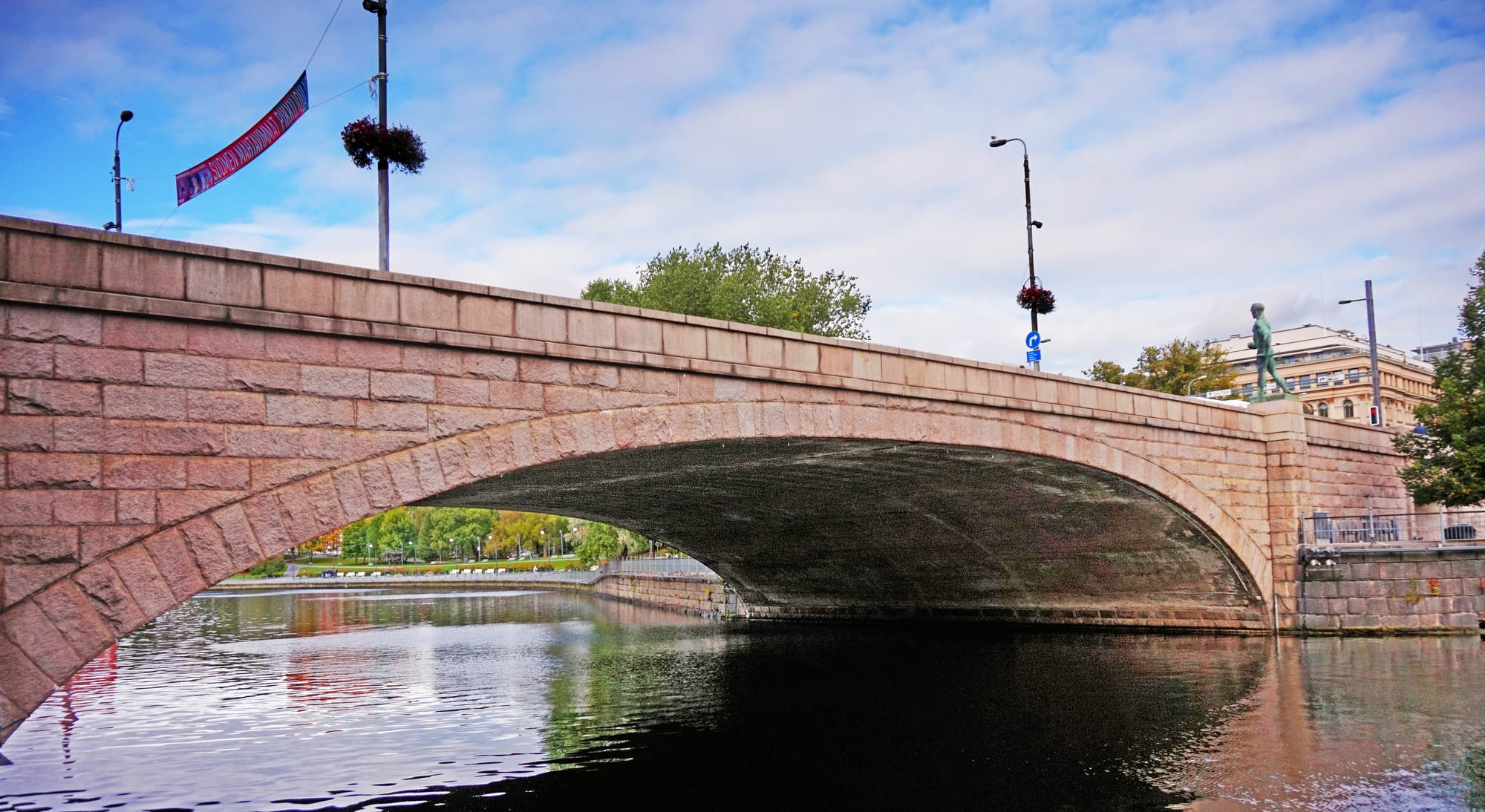
A pink granite arched bridge over dark still water, with a bronze statue on its parapet and city buildings behind

Lakeland, Finland

Tampere

Hämeensilta bridge over the Tammerkoski rapids in central Tampere. (Tiia Monto / Wikimedia Commons · CC BY-SA 4.0)

Finland's third city and the largest inland city in the Nordic countries, wedged between Lakes Näsijärvi and Pyhäjärvi on the Tammerkoski rapids. The rapids powered the cotton and paper mills that made it the 'Manchester of the North'; today the red-brick factories hold museums and offices, a tram runs to the university suburbs, and the city calls itself the sauna capital of the world.

Neighbourhoods

  • The city centre
    • First-time visitors
    • Shopping
    • Close to public transport

    The grid on the isthmus between the two lakes, crossed by Hämeenkatu from the central railway station over the rapids to Hämeenpuisto. The central square, the market hall, the cathedral, theatres and most restaurants are here, and the tram runs through it.

    Open in Maps
  • Finlayson and the Tammerkoski banks
    • Historic district
    • Museums
    • Best for food

    The red-brick mill quarters along the rapids — the Finlayson area on the west bank and the old Tampella works opposite — converted into museums, offices, cinemas, cafés and restaurants.

    Open in Maps
  • Pispala
    • Views
    • Saunas
    • Quiet and residential

    A former workers' district of steep lanes and small wooden houses on the highest esker in Finland, 2.5 km from the centre, with views over both lakes and Finland's oldest public sauna still in use. With Pyynikki it is often called the most beautiful part of the city.

    Open in Maps
  • Pyynikki
    • Walks
    • Nature
    • Historic homes

    A district and nature reserve on the Pyynikki ridge between the centre and Pispala, with pine woods, walking trails, the 1929 observation tower and its doughnut café, and a summer theatre.

    Open in Maps
  • Tammela
    • Students and nightlife
    • Local life
    • Markets

    A working-class district from the 1870s east of the centre, now popular with students of the nearby university. Its market square, Tammelantori, is known for mustamakkara kiosks, and some early 1900s wooden houses survive in Puu-Tammela.

    Open in Maps
  • Hervanta
    • Students
    • Close to public transport

    A large suburb of prefabricated blocks about 10 km south of the centre, home to over 26,000 people, a university campus and the Hermia technology centre. Its reputation has improved greatly, and the tram links it to town.

    Open in Maps

Things to do

Mills, churches and landmarks

  • Tammerkoskilandmark

    The rapids between the two lakes, with an 18-metre fall in water level, that powered the city's industry and still generate electricity, lined by red-brick factories.

    Open in Maps
  • Finlayson industrial arealandmark

    The historic mill area west of the rapids, where James Finlayson founded his cotton mill in 1820; the first electric light in the Nordic countries was lit in its production buildings in 1882.

    Open in Maps
  • Tampere Cathedrallandmark

    A National Romantic church famous for Hugo Simberg's frescoes of 1905–06, including versions of The Wounded Angel and The Garden of Death, which caused controversy in their day.

    Open in Maps
  • Kaleva Churchlandmark

    A modernist church in the Liisankallio district, designed by Reima and Raili Pietilä and built in 1964–66.

    Open in Maps
  • Tampere Central Library Metsolandmark

    The main city library, nicknamed Metso, 'capercaillie', because from above it resembles the bird, designed by Reima and Raili Pietilä.

    Open in Maps
  • Näsinneulaviewpoint

    The observation tower of 1970–71 above Lake Näsijärvi, the tallest free-standing structure in Finland, with the country's fastest public lifts and a revolving restaurant.

    Open in Maps

Museums

  • Vapriikki Museum Centremuseum

    A cluster of museums in the old Tampella factory, including natural history, the Finnish Ice Hockey Museum and Hall of Fame, and the Finnish Museum of Games.

    Open in Maps
  • Moomin Museummuseum

    Original illustrations by Tove Jansson, the creator of the Moomins, with miniatures and tableaux of the Moomin stories.

    Open in Maps
  • Noottimuseum

    A museum of Finland's relations with the East, opened in February 2025 in the Tampere Workers' Hall, in place of the Lenin Museum that closed in 2024.

    Open in Maps

Parks, views and lakes

  • Pyynikki observation towerviewpoint

    A 26-metre red-granite tower of 1929 on the Pyynikki ridge, with views over Näsijärvi and Pyhäjärvi and a café famous for its sugared doughnuts.

    Open in Maps
  • Pispalaneighborhood

    Steep streets of small wooden houses on the highest esker in Finland, widely considered with Pyynikki the most beautiful part of the city.

    Open in Maps
  • Viikinsaaripark

    An island in Lake Pyhäjärvi reached by summer boat, with a nature reserve, swimming shores, a chapel, a restaurant and a dance pavilion.

    Open in Maps
  • Särkänniemiattraction

    The city's biggest single attraction, an amusement park with more than 30 rides, an aquarium and a planetarium, beside Näsinneula and reachable by tram.

    Open in Maps

Saunas, markets and sport

  • Rajaportti saunaattraction

    In Pispala, the oldest public sauna in Finland still in use, operating since 1906.

    Open in Maps
  • Rauhaniemi beach and saunaattraction

    A public sauna and beach on the lake shore, reached by city bus.

    Open in Maps
  • Tampere Market Hallmarket

    The covered market of 1901 between Hämeenkatu and Hallituskatu, with food shops and many small cafés and restaurants.

    Open in Maps
  • Nokia Arenaattraction

    The arena by the railway station where the city's two leading ice hockey clubs, Tappara and Ilves, play, also used for concerts and EuroBasket 2025.

    Open in Maps

Seasonal events

  • TammerfestJuly

    The city's urban rock festival, held in the centre every July.

  • Tampere Theatre Festivalbeginning of August

    The oldest annual theatre festival in the Nordic countries, first held in 1969, with a couple of hundred performances by Finnish and international companies and a large fringe.

  • Blockfestusually August

    The largest hip hop event in the Nordic countries, held in the centre near Ratina Stadium.

Eat and drink

Long-standing places and food districts in Tampere. Hours, ratings and directions come from your maps app, always current.

Tampere classics

  • Mustamakkara at Tammelantorimarket

    The square in Tammela best known for kiosks selling mustamakkara, the city's black sausage of pork, pig's blood, crushed rye and flour.

    Open in Maps
  • Pyynikki tower doughnutscafe

    The café at the foot of the observation tower, the most traditional place for munkki, fresh sugared doughnuts.

    Open in Maps
  • Tampere Market Hallmarket

    A covered market where about 40 per cent of the stalls are cafés and restaurants.

    Open in Maps

Food districts

  • Laukontorimarket

    The lakeside market square in the centre, where mustamakkara is also sold and summer boats leave.

    Open in Maps
  • The Finlayson areaneighborhood

    Restaurants, cafés and bars in the converted red-brick mill buildings beside the rapids.

    Open in Maps

Experience Tampere

History

Settlers from the west began farming around the Tammerkoski rapids in the 7th century, but the population stayed small for centuries. Markets were held here from the 17th century, and in 1775 King Gustav III of Sweden founded a market town on the rapids, granting it full town rights on 1 October 1779. In 1809 it still had fewer than a thousand inhabitants.

Industry transformed it. In 1820 the Scottish industrialist James Finlayson founded a cotton mill on the rapids, and by 1850 it employed around 2,000 people in a town of 4,000. Paper, flax and engineering works followed, and in 1865 Fredrik Idestam opened a pulp mill on the rapids, the beginning of the Nokia company. The railway arrived in 1876, and the population grew from about 7,000 in 1870 to 36,000 in 1900, when a third of the residents were factory workers and more than half were women. In 1905 Lenin led a conference of Russian revolutionaries in the Workers' Hall, where at a later Bolshevik meeting he first met Stalin.

In the civil war of 1918 Tampere, Finland's leading industrial city, was a key Red stronghold; White forces under Mannerheim took it after the Battle of Tampere on 6 April, capturing about 10,000 Red prisoners. The city was bombed in the Second World War as a railway junction and arms-making centre, passed 100,000 people in 1950 and lost much of its textile industry in the depression of the early 1990s. Technology, the universities and services replaced it: a tram system opened in 2021 and the Nokia Arena the same year, and in 2023 the city won a smart-city prize at a world congress in Barcelona.

Culture & Customs

Tampere's industrial past gave it the nickname Manchester of the North, which became "Manse" in Finnish and lent its name to Manserock, the Finnish-language rock that grew up here. The city has been officially declared the Sauna Capital of the World for having the most public saunas, and Rajaportti in Pispala, open since 1906, is the oldest public sauna still in use in Finland. The Pispala district also produced writers such as the poet Lauri Viita.

Theatre runs deep: the Tampere Theatre Festival, first held in 1969, is the oldest annual theatre festival in the Nordic countries. Music ranges from Tammerfest's urban rock in July to Blockfest, the largest hip hop event in the Nordic countries, and a strong rock and metal scene. The Moomin Museum shows Tove Jansson's original illustrations, and the cathedral holds Hugo Simberg's frescoes.

Ice hockey is close to a civic religion. Tappara and Ilves are among the most successful clubs in Finland, Ilves becoming the first Tampere team to win the Finnish ice hockey championship, in 1936, and the Hakametsä arena was the first ice hockey arena built in the country; both clubs now play at the Nokia Arena. The rivalry with Turku is kept up mostly through jokes — about mustamakkara, the state of the Aura river and each other's accents.

Daily Life

About 263,000 people live in Tampere, the third most populous municipality in Finland, and about 428,000 in the metropolitan area, the second largest urban area in the country after Helsinki's. Tampere University, formed in 2019 from the merger of the city's university and its university of technology, is the second largest in Finland by enrolment, and students fill districts such as Tammela and Hervanta.

The economy has moved from textiles and heavy industry to technology, engineering, games and services, with the Hermia technology centre in Hervanta at the heart of the tech sector. Unemployment was 9.2 per cent in September 2023. The old mill buildings along the rapids now hold offices, museums and restaurants, and new building continues around the railway station, where the arena stands on a deck over the tracks.

Residents live in apartment blocks in the centre and inner districts, in wooden houses on the Pispala ridge, which is being heavily redeveloped, and in suburbs such as Hervanta, a district of prefabricated blocks home to over 26,000 people. Daily life is shaped by the lakes: swimming and cottages in summer, skating, skiing and ice swimming from the public saunas in winter.

Food

Tampere's signature is mustamakkara, a black sausage made by mixing pork, pig's blood, crushed rye and flour and stuffing it into animal intestines, much like the black puddings of northern England. It is a staple of the jokes Turku people make about Tampere, and the place to eat it is the kiosks at Tammelantori, the market square in Tammela, or at Laukontori by the lake in the centre.

A newer tradition is munkki, fresh sugared doughnuts sold in cafés across the city but most traditionally at the café of the Pyynikki observation tower. In the 1980s the city's old parish dishes were named as mustamakkara, barley bread, potato soup, kotikalja, a home-made small beer, sweetened lingonberry porridge and imelletty perunalaatikko, a sweetened potato casserole.

The Market Hall on Hämeenkatu, opened in 1901, is the centre of food shopping, and about 40 per cent of its outlets are cafés and restaurants. The converted mill buildings around the Finlayson area and along the rapids hold many of the city's restaurants and bars, and Näsinneula's revolving restaurant looks out over Lake Näsijärvi.

Planning tools

Budget

Cheaper than Helsinki, with good-value hotels and lunch buffets. Public saunas, the Pyynikki and Pispala ridges and the riverside mill quarters cost little or nothing; museum tickets, the amusement park and summer lake cruises are the main extras. Rooms are dearer during big hockey games, concerts and festivals.

Daily Budget Midrange
USD 150–270 (city hotel, restaurant dinners, museum tickets, a lake cruise)
Daily Budget Shoestring
USD 70–110 (hostel, lunch buffets and market food, a public sauna, tram and bus)

Weekday lunch menus are the best-value restaurant meals; the city's public saunas are an affordable way into local life.

Best Time to Visit

June to August, for lake boats, beaches, terraces and the festival season, ending with the Theatre Festival and Blockfest in August. Winter is cold and dark but has its own appeal: saunas and ice swimming, skating on Näsijärvi when the ice allows, ice hockey, and the Christmas market on the central square from mid-December.

Suggested Number of Days

Two or three days cover the centre, the ridges and the museums. Four or five allow time for lake trips and the surrounding Lakeland; summer boat timetables and big events such as hockey games or festivals can change what fits.

First Visit
2–3 days
With Surroundings
4–5 days

Transportation

A tram system opened in 2021, running from the centre to Hervanta and the university hospital, with an extension west to Lentävänniemi completed in 2025. City buses cover the rest. The centre is compact enough to walk, and summer boats run on both lakes, including to Viikinsaari.

Buy a public transport ticket that covers both the tram and the buses; in summer, cycling along the lake shores is a good alternative.

Airport & Station Connections

Tampere is a major rail hub: about 150 trains a day use the central station in the city centre, with direct services to Helsinki, Turku, Oulu, Jyväskylä and Pori. Tampere–Pirkkala Airport is about 13 km south-west of the centre. Long-distance buses connect with towns across Finland.

Walkability

Very good in the centre: Hämeenkatu runs straight from the station across the rapids, and the mill quarters, market hall, cathedral and library are all within a short walk. Pyynikki and Pispala are walkable from the centre but hilly. Pavements can be icy from December to March.

Safety

Finland is consistently rated one of the safest countries in the world, with very low crime. Tampere is safe by any standard, though the centre gets rowdy on weekend nights. The hazards are outdoor ones: cold water, thin ice on the lakes in autumn and spring, and slippery streets in winter.

Keep off lake ice unless it is known to be safe, take care on icy pavements, and do not mix alcohol with saunas or swimming. Check current official travel advice before travelling.

Climate

A humid continental climate with four clearly defined seasons. Summers are cool to warm; winters are cold, with average temperatures from December to February below -3°C and cold spells that can reach -30°C.

Summer
cool to warm — July is the warmest month, averaging about 16°C
Winter
cold — February averages about -7°C, and the lakes freeze

Local Customs

Sauna is central to local life, and each public sauna sets its own rules on bathing sessions and swimwear. People are reserved and direct, and tipping is not expected. Locals call the city Manse, and its hockey loyalties, Tappara or Ilves, run deep. The rivalry with Turku is a matter for jokes.

Follow each sauna's rules on swimwear and washing, and ask before photographing anyone in a sauna or at a swimming spot.

Common Payment Methods

The currency is the euro. Cards and mobile payment are accepted almost everywhere, including on public transport. ATMs are easy to find in the centre.