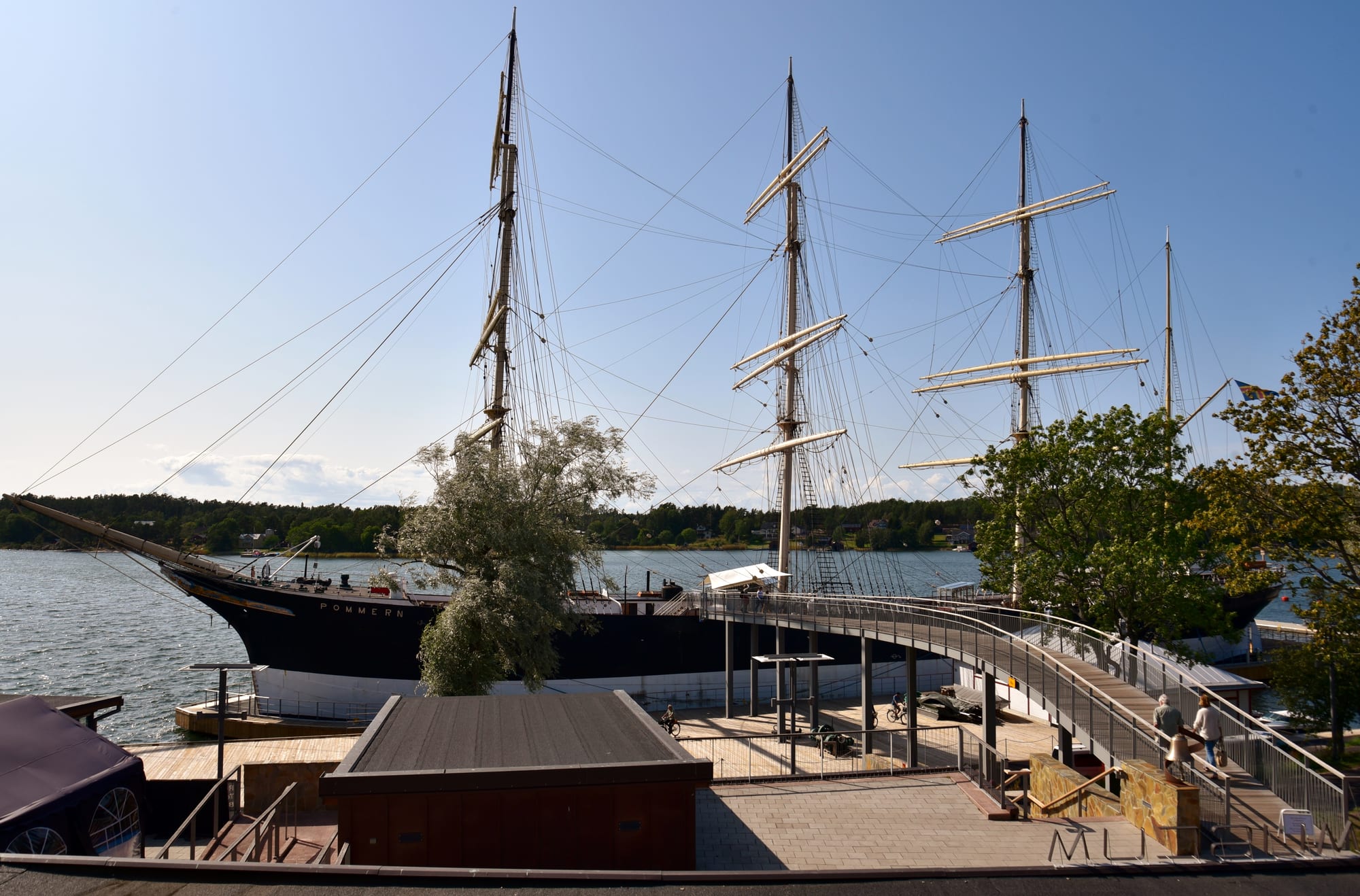
The black-hulled four-masted barque Pommern moored beside a curving walkway, with wooded shores across the water

Turku, Åland & the Southwest, Finland

Mariehamn

The four-masted barque Pommern, a museum ship of the Åland Maritime Museum, in Mariehamn's Western Harbour. (Bahnfrend / Wikimedia Commons · CC BY-SA 4.0)

The capital of Åland and its only town, a Swedish-speaking harbour town on a peninsula of the main island between two bays. Founded in 1861 under Russian rule and named after Empress Maria Alexandrovna, it grew on shipping and sail, and today lives on ferries, shipowning, government and summer visitors, with linden-lined streets, a maritime museum and the barque Pommern.

Neighbourhoods

  • The town centre
    • First-time visitors
    • Shopping
    • Cafés

    A small planned centre of shops, cafés and wooden houses around the main square, Torget, and the linden-lined Esplanade, with Lars Sonck's town hall and parish church. Everything here is a few minutes' walk from both harbours.

    Open in Maps
  • The Western Harbour
    • Museums
    • Ferries
    • Sailing

    Västerhamn, on the western side of the peninsula, is the international port, where the big ferries from Sweden, Estonia and mainland Finland dock. The Åland Maritime Museum and the barque Pommern are beside it, along with a sailing club marina and the park of the old spa era.

    Open in Maps
  • The Eastern Harbour
    • Boats and marinas
    • Best for food
    • Walks

    Österhamn faces the eastern bay, with one of the largest marinas in Scandinavia, the Maritime Quarter's boatbuilding sheds and the old steamer F.P. von Knorring, a restaurant since 1989. The park island of Lilla Holmen also belongs to the town.

    Open in Maps

Things to do

Maritime Mariehamn

  • Åland Maritime Museummuseum

    One of the two most important museums on the islands, on the Western Harbour, telling the story of Åland's seafaring and its sailing-ship owners.

    Open in Maps
  • Pommernattraction

    A steel four-masted barque built in Glasgow in 1903, bought by the Mariehamn shipowner Gustaf Erikson in 1923, twice a winner of the Great Grain Races and now a museum ship.

    Open in Maps
  • The Maritime Quarterattraction

    Sjökvarteret, on the Eastern Harbour, where boatbuilding traditions are kept alive; small ships including the galeas Albanus and the schooner Linden have been built here.

    Open in Maps
  • F.P. von Knorringattraction

    A passenger ship built in the Netherlands in 1928 and moored in the Eastern Harbour as a floating restaurant since 1989.

    Open in Maps

Museums and parks

  • Åland Museummuseum

    The Cultural History Museum of Åland and the Åland Art Museum under one roof, tracing the islands from prehistory to the present beside a collection of local art.

    Open in Maps
  • Lilla Holmenpark

    A small park island belonging to the town, known for its peacocks and rabbits.

    Open in Maps

Short trips from the town

  • Kastelholm Castlelandmark

    A medieval Swedish castle of the late 14th century in Sund, about 17 km north-east of Mariehamn, damaged in 1599, gutted by fire in 1745 and now a museum.

    Open in Maps

Seasonal events

  • Åland Autonomy Day9 June

    The islands' self-government day, marked with public celebrations in Mariehamn at which Åland pancakes are commonly served.

  • RockOfflast week of July

    A music festival held on Torget, the main square.

Eat and drink

Long-standing places and food districts in Mariehamn. Hours, ratings and directions come from your maps app, always current.

Mariehamn classics

  • Åland pancake in the town's caféscafe

    The Åland pancake, sold in cafés all over town — an oven-baked semolina pancake flavoured with cardamom, served with prune jam and whipped cream.

    Open in Maps
  • F.P. von Knorringrestaurant

    A restaurant aboard a 1928 Dutch-built passenger ship moored in the Eastern Harbour.

    Open in Maps

Food districts

  • The Eastern Harbourneighborhood

    Places to eat by the marina, including the restaurant ship F.P. von Knorring.

    Open in Maps
  • Torget and Torggatanneighborhood

    Cafés and places to eat around the main square in the small town centre.

    Open in Maps

Experience Mariehamn

History

Mariehamn was founded on 21 February 1861, when Åland still belonged to the Russian Empire, on farmland of the village of Övernäs in Jomala, on a peninsula between the bays of Slemmern and Svibyviken. It was named after Empress Maria Alexandrovna, the German-born wife of Tsar Alexander II — the name means Marie's Port. The old village's farms stood on the hill where the town hall was built in 1939; only one cottage, Övernässtugan, survives.

Around 1900 the town was a popular spa resort. A large spa hotel stood by the Western Harbour, with a bathhouse of 1889 and a sailing pavilion designed by Lars Sonck in 1895–1899, but the era ended abruptly in 1916, when the hotel burned down after being used by Russian soldiers in the First World War. The site is now Badhusparken. Sonck went on to design the parish church of St George (1927), the maritime college and the town hall.

Shipping made Mariehamn's fortune. Long after steam had taken over elsewhere, its owners kept sailing ships at sea: Gustaf Erikson bought the barque Pommern in 1923 and sailed it in the grain trade, winning the Great Grain Races in 1930 and 1937, and after the Second World War it was given to the town as a museum ship. When Finland became independent, Ålanders sought union with Sweden, and the League of Nations settled in 1921 that the islands would stay Finnish with autonomy, Swedish as their language and demilitarisation. Mariehamn became the seat of Åland's government and parliament, and in 1961, its centenary year, it took in land from Jomala, growing from 3 to 11.6 square kilometres.

Culture & Customs

Mariehamn is Swedish-speaking, and most residents have Swedish as their mother tongue. Åland has its own parliament, flag and postal service. Autonomy Day on 9 June is celebrated publicly in the town, often with Åland pancakes.

Seafaring is the core of local identity. The town's coat of arms, designed in 1951, reflects its maritime economy and its linden-lined parks, and the lindens of the esplanade have given it the nickname "the town of a thousand lindens". The Maritime Museum and the Pommern celebrate the sailing-ship era, the maritime college trains new generations, and the Maritime Quarter on the Eastern Harbour keeps traditional wooden boatbuilding alive. The town also has wooden villas by the builder Hilda Hongell and several early works by Lars Sonck.

Sailing and boating fill the summer, and the Eastern Harbour's marina is one of the largest in Scandinavia. Football draws crowds: IFK Mariehamn plays in Finland's top division and won its first national title in 2016. The RockOff festival takes over the main square in late July.

Daily Life

About 11,900 people lived in Mariehamn at the end of 2024, roughly 40 per cent of Åland's population, and the town has grown slowly but steadily from just over 10,000 in 1990. The old town districts lie on the peninsula between the harbours, while newer residential areas lie on land taken in from Jomala in 1961, and the town is also home to Åland's central hospital.

The economy rests on shipowning, tourism and trade. Viking Line has its headquarters here, many residents work at sea or in maritime businesses, and the ferries between Finland and Sweden call partly because Åland lies outside the EU customs zone, which allows duty-free sales on board. The Åland government, its parliament and public services are large employers, and around 1.5 million visitors come to the islands each year, most of them in summer.

The rhythm follows the seasons. Summer brings yachts, cruise passengers, cyclists and cottage visitors, and the cafés and restaurants stay busy; in winter the town is quiet, with the ferries, offices and schools setting the pace. Boats are part of ordinary summer life.

Food

The dish everyone associates with Mariehamn is the Åland pancake, ålandspannkaka — an oven-baked pancake traditionally made with semolina, eggs, sugar and cardamom, sometimes with pudding rice instead of semolina. It is served warm or cold with sviskonkräm, a prune jam, and whipped cream, which Ålanders call snömos, "snow mash". It is believed to have begun as a way of using up leftover porridge ingredients, and it is sold in cafés all over town.

Farming and fishing support a local food industry across the islands. Åland's Finnish name, Ahvenanmaa, is believed to mean "perch land", and fishing has been part of island life since the Stone Age.

Eating out is concentrated around the Eastern Harbour, where the restaurant aboard the steamer F.P. von Knorring looks over the marina, and in the small centre around Torget, which has cafés and places to eat. Many places keep summer hours only, and the ferries' restaurants and duty-free shops are part of the food and drink scene for travellers coming and going.

Planning tools

Budget

Prices are much like mainland Finland's, but summer brings the visitors: guesthouses and cottages fill up early in July and many close outside the season. Ferry fares are the main transport cost; the ferries call partly for duty-free sales, since Åland lies outside the EU customs zone.

Daily Budget Midrange
USD 160–290 (hotel or guesthouse, restaurant dinners, museum tickets, a ferry crossing)
Daily Budget Shoestring
USD 75–110 (hostel or campsite, café lunches, self-catering, a hired bicycle)

Book July stays well ahead, and check whether a ferry calls at Mariehamn itself or at another Åland port before booking.

Best Time to Visit

June to August, when the cafés, boats and museum ship are fully open, the harbours fill with yachts and the islands are at their busiest. Late spring and early autumn are quiet and mild by Finnish standards, but some services close for the season.

Suggested Number of Days

One or two days are enough for the town itself. Three to five allow time to explore the rest of the main island and the archipelago by car or bicycle, and ferry timetables in and out often decide the exact length of a stay.

First Visit
1–2 days
With Surroundings
3–5 days

Transportation

The town is small enough to walk, and bicycles can be hired at both harbours — the classic way to see the main island. Local bus lines serve the town, and taxis and hire cars cover the rest of Åland, whose islands are linked by bridges and their own ferries.

Ferries that cross at night often call at Långnäs, about 25 km from town, rather than Mariehamn; buses and taxis meet them.

Airport & Station Connections

Most visitors arrive by sea. The Western Harbour has daily ferries to Sweden, Estonia and mainland Finland, and the day ferries between Turku and Stockholm call here; a shorter crossing from Grisslehamn in Sweden lands at Eckerö, with a bus to town. Mariehamn Airport, about 3 km north-west of the centre, has flights from Helsinki, Turku and Stockholm; there is no airport bus.

Walkability

Excellent. The centre lies on a narrow neck of land a little over a kilometre wide between the two harbours, linked by the linden-lined Esplanade, and the streets are green and quiet. Walking and cycling routes lead out into the countryside.

Safety

Finland is consistently rated one of the safest countries in the world, with very low crime. Mariehamn is a quiet small town where crime is rare. The hazards are marine: wind and sudden weather for small boats and kayaks, cold water, and sea ice in winter, plus busy roads when a ferry unloads.

Wear a life jacket on small boats, check the marine forecast before paddling, and use lights on a bicycle on unlit island roads. Check current official travel advice before travelling.

Climate

A climate between oceanic and humid continental. The Baltic moderates the extremes: summers are cooler than in most of Sweden and Finland, while winters are milder, similar to those on the Swedish coast.

Summer
cool by Finnish standards; across Åland the annual mean is 6.6°C, and the highest temperature on record in Mariehamn is 31.3°C
Winter
mild for Finland, with snow on the ground on about 57 days in an average year across Åland; the record low in Mariehamn is −32.9°C

Local Customs

Swedish is the only official language of Åland, and most of Mariehamn's residents have it as their native language. Åland has its own flag, parliament and postal service. Tipping is not expected.

Swedish or English is the natural first choice here rather than Finnish. Ask before photographing people, and keep to marked paths and private-land rules when walking or cycling outside town.

Common Payment Methods

The currency is the euro. Most shops accept the main credit and debit cards, and ATMs are found in the centre. Duty-free prices apply on the ferries, not in town.