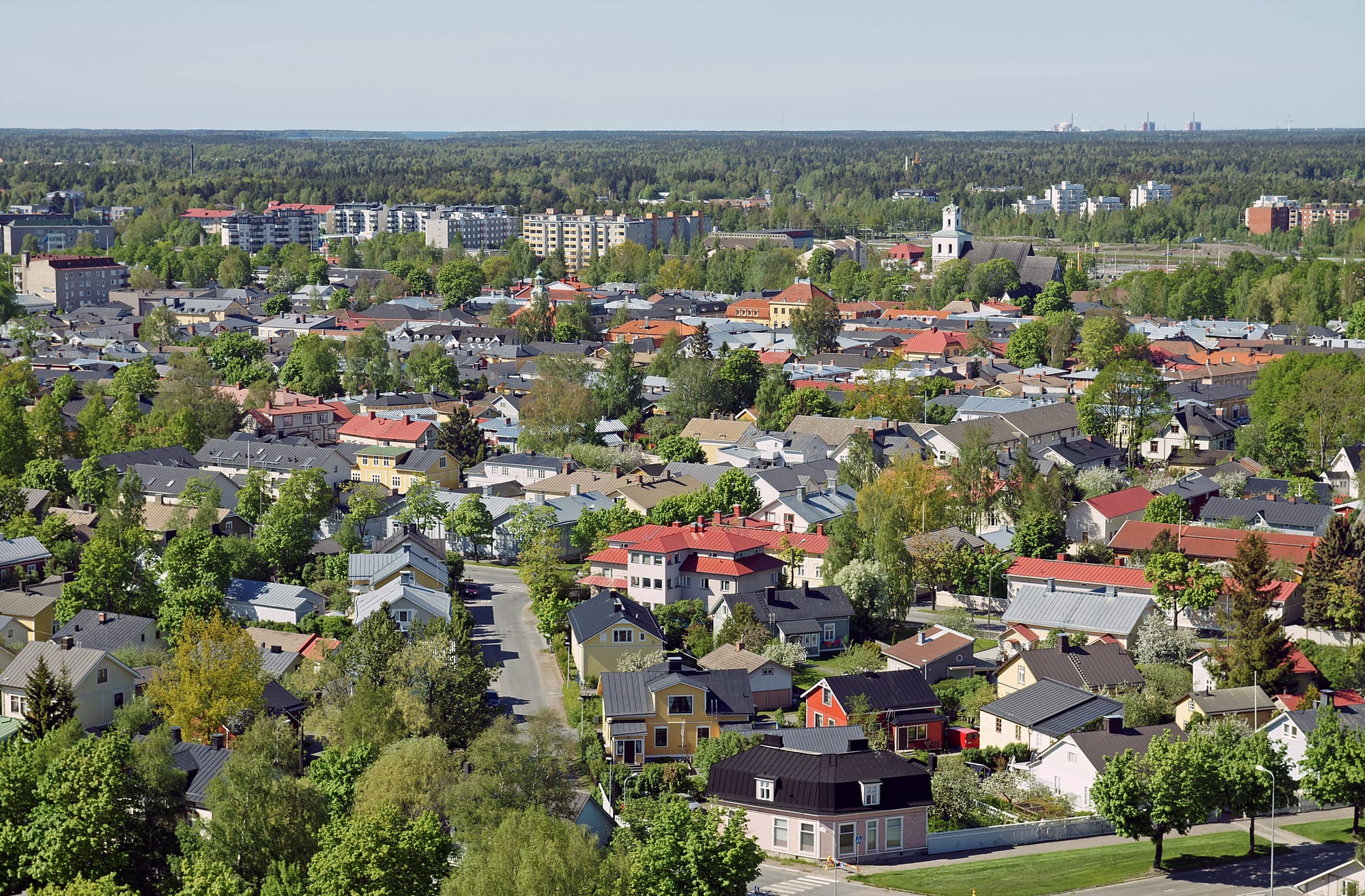
Rooftops of low wooden houses among green trees, with a white church tower and newer blocks beyond, seen from above

Turku, Åland & the Southwest, Finland

Rauma

Old Rauma's wooden houses seen from the town's water tower. (kallerna / Wikimedia Commons · CC BY-SA 3.0)

A port town on the Gulf of Bothnia in Satakunta, chartered in 1442, whose wooden centre, Old Rauma, keeps a medieval street plan and is a UNESCO World Heritage Site. Seafaring, bobbin lace and later paper mills and shipyards made it; today it is an industrial town and busy freight port with its own dialect, a famous ice hockey club and a lace festival every summer.

Neighbourhoods

  • Old Rauma
    • Historic district
    • First-time visitors
    • Shopping

    About 600 mostly one-storey wooden buildings on a medieval street plan, with the market square, the Old Town Hall, lace shops, cafés and museums. Around 800 people still live here, so it is a lived-in quarter rather than an open-air museum.

    Open in Maps
  • The modern centre
    • Close to public transport
    • Everyday shopping

    The newer streets around Old Rauma, with the intercity bus station, the local bus stops at Savila, everyday shops and pizza and kebab places. The largest supermarkets are in the north of the town.

    Open in Maps
  • The waterfront and archipelago
    • Nature
    • Summer
    • Boat trips

    The bay of Syväraumanlahti, with a wooden lookout tower and summer boats out to islands such as Kuuskajaskari and Reksaari and the lighthouse island of Kylmäpihlaja. Many islands are nature reserves, and there are few or no tourist services on them in winter.

    Open in Maps

Things to do

Old Rauma

  • Old Raumaneighborhood

    One of the only medieval towns in Finland, inscribed as a UNESCO World Heritage Site in 1991 for its wooden architecture and well-preserved medieval layout; most buildings date from after the fires of 1640 and 1682.

    Open in Maps
  • Church of the Holy Crosslandmark

    The grey granite church of the town's Franciscan friary, completed in the early 16th century beside the little Rauma river, with medieval murals in the choir and a white steeple that once guided seafarers.

    Open in Maps
  • Old Town Hallmuseum

    Built in 1776 in the centre of Old Rauma, the only old stone building in the quarter apart from the medieval church, and now a museum.

    Open in Maps
  • Marelamuseum

    The home of a ship-owner from the turn of the 20th century, furnished as it was at the height of Rauma's seafaring.

    Open in Maps
  • Kirstimuseum

    A small house museum in the old town whose residents included sailors, bobbin lace makers, a blacksmith and a firefighter.

    Open in Maps

Museums and the sea

  • Rauma Maritime Museummuseum

    The town's seafaring history, housed in the old building of the maritime school.

    Open in Maps
  • Kylmäpihlaja Lighthouselandmark

    A combined lighthouse and pilot station on a small island in the outer archipelago, about 10 km from the mainland, reached by summer boats and with a seafood restaurant in season.

    Open in Maps

Short trips from the town

  • Sammallahdenmäkilandmark

    A Bronze Age burial site of 33 granite cairns more than 3,000 years old, one of the most important in Fennoscandia and a UNESCO World Heritage Site since 1999.

    Open in Maps
  • Bothnian Sea National Parkpark

    A national park stretching along the coast, mostly at sea off the archipelago but including some of Rauma's islands.

    Open in Maps

Seasonal events

  • Rauma Lace Weekend of July

    Held since 1971, with lace exhibitions by local craftspeople across Old Rauma, culminating in the Night of Black Lace, when shops stay open late, shows and concerts run into the night and people dress in black lace.

  • Rauma Blueslate July

    A blues, soul and roots music festival held since 1986, moved from March to July in the early 1990s.

  • FestivoAugust

    The town's festival of classical music.

Eat and drink

Long-standing places and food districts in Rauma. Hours, ratings and directions come from your maps app, always current.

Rauma classics

  • Lapskoussi and topseilvellinkirestaurant

    The town's dishes from its seafaring past — lapskoussi, mashed potatoes with salted meat, and topseilvellinki, a sweet soup of rice and raisins usually served with pancakes.

    Open in Maps
  • Rauma Market Squaremarket

    The market square at the heart of Old Rauma, where fresh and smoked fish, fruit and vegetables are sold.

    Open in Maps

Food districts

  • Old Rauma's cafésneighborhood

    Cafés in the wooden houses of the historic centre, some in their inner yards, with patios open in summer.

    Open in Maps
  • Valtakatuneighborhood

    A central street running into Old Rauma, with pizza and kebab places, pubs and clubs.

    Open in Maps

Experience Rauma

History

Rauma received its town charter on 17 April 1442, under Swedish rule, around a Franciscan friary founded earlier in the century. The friary's stone church, the Church of the Holy Cross, survives, along with the ruins of the town's other medieval church, Holy Trinity. The friary was disbanded at the Reformation, and in 1550 Rauma nearly lost its townspeople when King Gustav Vasa founded Helsinki and ordered burghers from Rauma to move there; many stayed, especially since mostly men went.

Fires in 1640 and 1682 destroyed practically the whole wooden town, and it was rebuilt on the old medieval street plan, which is why Old Rauma still follows its medieval layout though its oldest houses date from the 18th century. Rauma lived on the sea, exporting goods mainly to Germany, Stockholm and the Baltic lands, and its sailors and ship-owners grew prosperous; from the 18th century the town also became known for high-quality bobbin lace. The Old Town Hall dates from 1776.

After the Second World War Rauma became an industrial town of shipbuilding, paper and pulp mills and metalworking, and its port grew into one of the largest in Finland. Old Rauma was inscribed on the UNESCO World Heritage List in 1991, and the Bronze Age cairns of Sammallahdenmäki followed in 1999, giving the town two World Heritage Sites. The Olkiluoto nuclear power station, about 20 km away, began commercial operation of its large third reactor in 2023.

Culture & Customs

Rauma has its own dialect of Finnish, rauman giäl, full of loanwords from Swedish, English and German picked up through seafaring and spelled with the letters g and b, unusual in Finnish. The writer and doctor Hj. Nortamo preserved its written form; in daily life it has largely merged into mainstream Finnish, and its strongest form is kept for folk events and as a hobby. The town is also the birthplace of Raumism, a view of the constructed language Esperanto as a vehicle for culture rather than simply an international auxiliary language.

Lace is the town's emblem. Lace Week has been held every summer since 1971, with exhibitions by local craftspeople across the old town, and it ends with the Night of Black Lace, when shops stay open late, concerts and shows run into the night and people dress in black lace. Rauma Blues has been held since 1986, and the Festivo classical music festival takes place in August. The house museums of the old town, Marela and Kirsti, show how ship-owners and sailors lived.

Ice hockey matters a great deal. Rauman Lukko, founded in 1936, plays in the top league and has won the Finnish championship twice, in 1963 and 2021, and its traditional arch-enemy is Ässät from Pori. Finnish baseball and orienteering also have local clubs.

Daily Life

About 39,000 people live in Rauma, the 29th most populous municipality in Finland, and about 65,000 in the wider sub-region. Around nine in ten speak Finnish as their first language and very few Swedish; about 9 per cent of residents had a foreign background in 2024, below the national average. Some 800 people live inside Old Rauma itself, and the rest in the newer districts and suburbs around it.

Industry sets the town's rhythm. The port is the fifth largest in Finland, handling almost six million tonnes of shipping a year, and serves freight ships only. Paper, pulp, shipbuilding and metalworking have been the main industries since the Second World War, and the Olkiluoto nuclear power plant stands next to Rauma in neighbouring Eurajoki.

Daily life is that of a compact Finnish town: work in the mills, the port and the services, lunch menus at midday, and evenings at the ice rink, the sports grounds or the summer cottage. Local buses are few, so most people drive or cycle, and in summer boats and the islands of the archipelago draw families out onto the water.

Food

Rauma's traditional dishes come from its seafaring past, and in the 1980s three of them were named the town's own: lapskoussi, mashed potatoes with salted meat; topseilvellinki, a sweet soup cooked from rice and raisins and usually served with pancakes; and Rauma gingerbread. The first two come from the seafaring past, whose traditions the town now markets to visitors, and that tourism has in turn widened the range of restaurants and cafés.

Everyday food follows the Finnish pattern of a hot lunch, often a set menu, and a simpler evening meal. The market square in the middle of Old Rauma sells fresh and smoked fish, fruit and vegetables, and cafés fill the old town's wooden houses, some in their inner yards. Along Valtakatu and in the newer streets, pizza and kebab places and burger chains provide the cheap meals.

In summer a seafood restaurant opens at the Kylmäpihlaja lighthouse, reached only by boat, and the islands of the archipelago are popular for picnics and day trips while the boats are running.

Planning tools

Budget

Rauma is cheaper than Turku, though still Nordic in price. Lunch menus, the market and fast food keep costs down; the main extras are summer boat trips to the islands and rooms during Lace Week, when the town fills up.

Daily Budget Midrange
USD 150–260 (hotel, restaurant dinners, museum tickets, an island boat trip)
Daily Budget Shoestring
USD 70–105 (guesthouse or campsite, lunch menus and fast food, local buses or a bicycle)

Book well ahead for Lace Week at the end of July; walking Old Rauma costs nothing.

Best Time to Visit

June to August, when the boats run to the islands, the old town's cafés spill outside and late July brings Lace Week and Rauma Blues. Old Rauma is attractive all year, but the archipelago has few or no services in winter.

Suggested Number of Days

One day covers the old town; two allow time for the museums and a slow look at the streets. Two or three days add the archipelago and the nearby Bronze Age site, and summer boat timetables decide how much of the coast can be seen.

First Visit
1–2 days
With Surroundings
2–3 days

Transportation

Old Rauma and the centre are best seen on foot. Local buses are very limited, with just a few lines, so a bicycle or a car is useful for anything outside the centre. In summer, boats run from the waterfront to several islands of the archipelago.

Check summer boat times before heading to the islands, and allow for the last boat back.

Airport & Station Connections

Rauma lies 92 km north of Turku and 50 km south of Pori, along the E8 coast road. Long-distance buses run directly to Turku and Pori, with a change at Huittinen for Tampere and Helsinki, from a bus station by the old town. The railway line is used for freight only; the nearest airport is at Pori, though most international travellers come via Helsinki or Turku.

Walkability

Excellent in the centre. Old Rauma covers only about 0.3 square kilometres of low wooden houses and narrow streets, and the bus station and modern shops are next to it. Cobbles can be uneven and slippery in winter.

Safety

Finland is consistently rated one of the safest countries in the world, with very low crime. Rauma is a quiet town; the Night of Black Lace brings crowds and late drinking in the old town. The hazards are on the water: wind and cold sea for small boats, and unsafe sea ice in winter.

Wear a life jacket on small boats, check the weather before going out to the islands and keep off sea ice. Check current official travel advice before travelling.

Climate

A humid continental climate with cold winters and warm summers, tempered by the sea; the average year-round temperature is about 5 to 6°C.

Summer
July is the warmest month, averaging about 15.5–16.5°C
Winter
February is usually the coldest month, averaging about -5°C

Local Customs

Old Rauma is a lived-in neighbourhood: its courtyards and houses are private homes. Locals are proud of the Rauma dialect, rauman giäl, whose strongest form survives mostly in folk events and as a hobby. Tipping is not expected, and people are reserved and punctual. Ice hockey loyalty runs deep, and the rival is Ässät of Pori.

Ask before photographing residents or stepping into courtyards, and keep voices down in the old town late at night.

Common Payment Methods

The currency is the euro. Cards and contactless payment are accepted almost everywhere, including small shops in the old town, and ATMs are found in the centre.