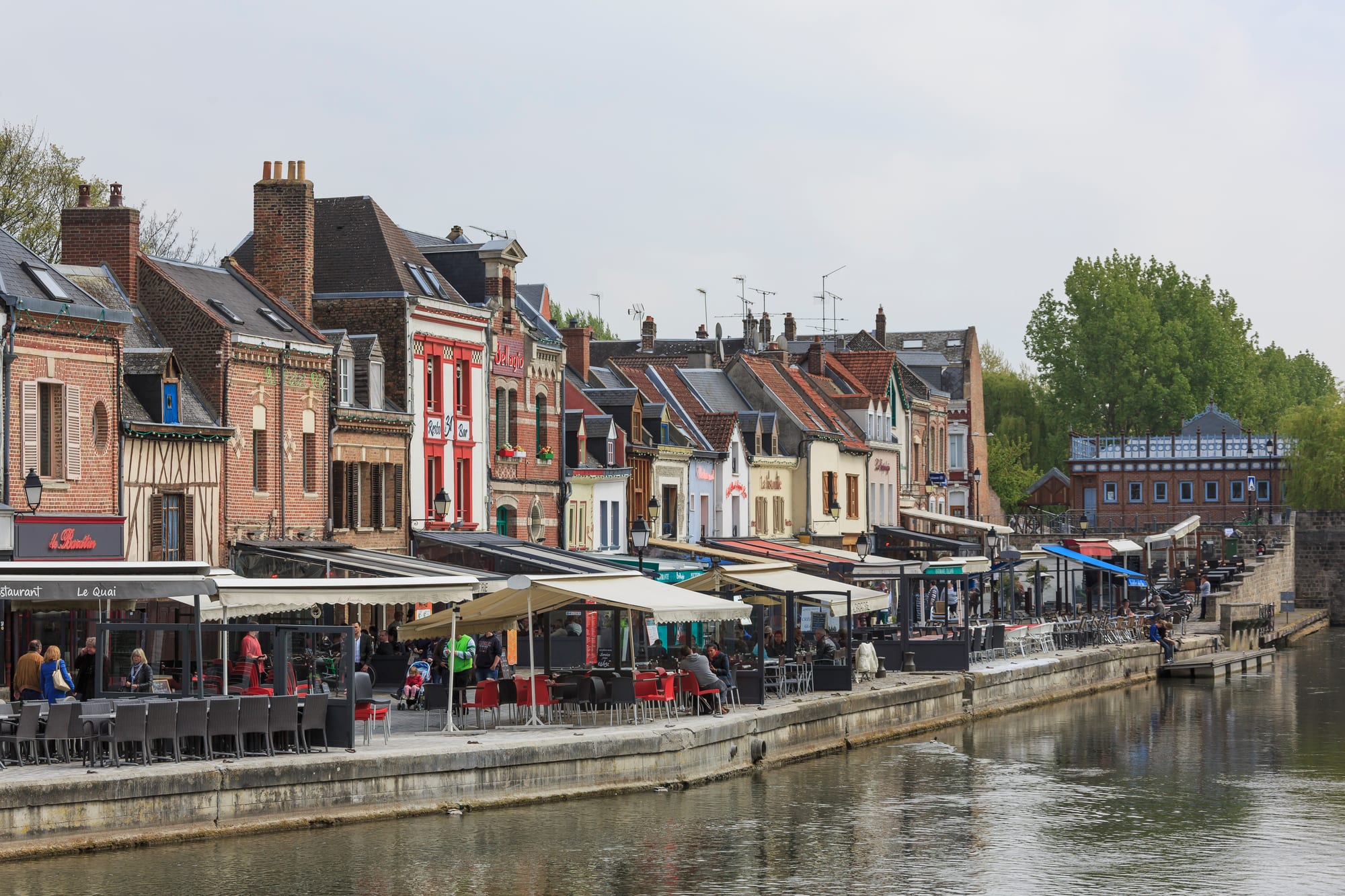
A row of narrow brick and half-timbered houses with café terraces along a stone quay beside calm river water

Hauts-de-France, France

Amiens

Restaurant terraces along the Quai Bélu by the Somme in the Saint-Leu quarter of Amiens. (CEphoto, Uwe Aranas / Wikimedia Commons · CC BY-SA 3.0)

The prefecture of the Somme and historic capital of Picardy, on the river Somme about 120 kilometres north of Paris. A Gaulish and Roman crossing town that grew rich enough to build France's largest Gothic cathedral, it was battered in both world wars and rebuilt with wider streets; today it is a university city of canals, floating market gardens and Jules Verne's adopted home.

Neighbourhoods

  • Saint-Leu
    • First-time visitors
    • Nightlife
    • Historic district

    The canal quarter at the foot of the cathedral, once the poor district of butchers, tanners and dyers, with old wooden and brick houses restored in the 1990s. University faculties and student housing fill it by day, and the bars and restaurants of the Place du Don and the Quai Bélu by night.

    Open in Maps
  • Cathedral and city centre
    • Shopping
    • Close to public transport

    The centre around the cathedral, the belfry and the town hall, largely rebuilt after the Second World War along wider streets. Auguste Perret's station and tower stand nearby.

    Open in Maps
  • Henriville
    • Quiet and residential
    • Architecture

    A 19th-century district south of the centre, built after the city walls came down, with brick townhouses and mansions in neoclassical, troubadour and neo-Gothic styles, including the house of Jules Verne.

    Open in Maps
  • Saint-Maurice
    • Students
    • Local life

    An old working-class and industrial district west of the citadel, beside the Somme canal, where the former dye works now hold the art school and the university, and the Jardin des Plantes is nearby.

    Open in Maps
  • Saint-Acheul
    • Quiet and residential
    • History

    An eastern district inhabited since prehistory, where 19th-century digs found the stone tools that gave the Acheulean period its name; it has a First World War cemetery and leads down to the hortillonnages.

    Open in Maps

Things to do

Famous landmarks

  • Amiens Cathedrallandmark

    Built almost entirely between 1220 and about 1270, the largest cathedral in France by volume, with nave walls 42 metres high beneath the vaults, a sculpted west front and a 240-metre floor labyrinth; a UNESCO World Heritage Site since 1981.

    Open in Maps
  • Belfrylandmark

    The town's civic belfry beside the market halls, with a stone base of 1406–10 and an 18th-century bell tower, gutted in the fire of May 1940 and restored in 1989–90.

    Open in Maps
  • Tour Perretlandmark

    Auguste Perret's 110-metre residential tower opposite the station, built in the post-war reconstruction and described as France's first skyscraper, topped since 2005 by a glass cube that changes with the light.

    Open in Maps
  • Citadellandmark

    The fortress built for Henri IV after the Spanish captured the city in 1597, on the hill above Saint-Leu, taken over by the university in a project by Renzo Piano.

    Open in Maps

Museums and culture

  • Musée de Picardiemuseum

    The main museum of Amiens and Picardy, founded in 1802 and housed in a palace purpose-built between 1855 and the 1860s, with collections from prehistory to the 19th century.

    Open in Maps
  • Maison de Jules Vernemuseum

    The house with a tower where Jules Verne lived from 1882 to 1900, now a museum of his life and work.

    Open in Maps
  • Chés Cabotans puppet theatreattraction

    A company keeping alive Amiens' tradition of wooden rod and string puppets, led by Lafleur, who speaks Picard, with a theatre in Saint-Leu.

    Open in Maps

Gardens and the river

  • Hortillonnagespark

    Some 300 hectares of former marshes east of the city, laid out in the Middle Ages as market gardens between canals and now mostly pleasure gardens, visited by boat.

    Open in Maps
  • Parc de la Hotoiepark

    A city park where the finals of ballon au poing, the traditional Picard team game, are played every 15 August.

    Open in Maps

Sport

  • Stade de la Licorneattraction

    The home of Amiens SC, a stadium for about 12,000 people next to the Zénith concert hall.

    Open in Maps

Short trips from the city

  • Australian National Memoriallandmark

    Edwin Lutyens' tower above the military cemetery at Villers-Bretonneux, the main memorial to Australians killed on the Western Front and the setting of the Anzac Day dawn service.

    Open in Maps
  • Lochnagar mine craterlandmark

    Near La Boisselle, the crater 100 metres wide left by a British mine fired on 1 July 1916, the opening day of the battle of the Somme.

    Open in Maps
  • Thiepval Memoriallandmark

    The memorial to more than 72,000 British and South African soldiers missing on the Somme between 1915 and 1918 with no known grave.

    Open in Maps

Seasonal events

  • Christmas marketDecember

    The largest Christmas market in northern France, filling the streets of the centre.

  • Cathedral in colourDecember and the summer months

    An evening show projecting the original medieval colours, revealed by laser cleaning, onto the sculpted west front of the cathedral.

  • Ballon au poing finals15 August

    The final stages of the Picard sports, above all ballon au poing, a ground-gaining game played by teams of six, in the Parc de la Hotoie.

Eat and drink

Long-standing places and food districts in Amiens. Hours, ratings and directions come from your maps app, always current.

Amiens classics

  • Macarons d'Amienscafe

    Small round almond-paste biscuits made with eggs and honey, a speciality whose fame goes back to the 16th century, sold by the city's pâtissiers and confectioners.

    Open in Maps
  • Brasseries of the centreneighborhood

    The places to find Picard dishes such as ficelle picarde, flamiche aux poireaux and duck pâté in pastry.

    Open in Maps

Food districts

  • Quai Bélu and Place du Donneighborhood

    The waterside heart of Saint-Leu's evenings, with restaurant and bar terraces facing the Somme below the cathedral.

    Open in Maps

Experience Amiens

History

Amiens began as Samarobriva, "the bridge on the Somme", the main settlement of the Ambiani, one of the principal tribes of Gaul; the Romans called it Ambianum after them, and the name stuck. It grew where the river narrows below a chalk spur, and a network of channels powered textile mills in the Middle Ages. The Normans sacked it in 859 and 882; Louis VI recognised its commune in 1113, and in 1185 it passed to the French crown. The wealth of the medieval town paid for the cathedral, raised almost entirely between 1220 and about 1270 after a fire destroyed its Romanesque predecessor.

In 1597 Spanish soldiers seized the city and held it through a six-month siege until Henri IV took it back and built the citadel. In the 18th and 19th centuries Amiens was famous for its velvet, and in 1802 Britain and France signed the Treaty of Amiens here. In the 19th century the walls came down for boulevards, the railway arrived in 1848, and Prussian troops occupied it in 1870. Jules Verne settled here in 1871, stayed until his death in 1905 and sat on the city council for fifteen years.

Both world wars hit hard. The Battle of Amiens in August 1918 opened the Hundred Days Offensive that ended the war. German bombing and fire in May 1940 destroyed most of the centre, and Royal Air Force raids followed in June 1944 before British troops liberated the city on 31 August. Pierre Dufau's plan rebuilt it with wider streets, and Auguste Perret designed the station and the tower opposite. President Emmanuel Macron was born in Amiens.

Culture & Customs

The cathedral dominates the city's identity. John Ruskin called it Gothic "pure, authoritative, unsurpassable", and Viollet-le-Duc "the Parthenon of Gothic architecture"; its west front, with more than 3,000 statues, gargoyles and chimeras, is lit in its rediscovered medieval colours on winter and summer evenings. Jules Verne is the other great name, remembered in his house with a tower and the circus named after him.

Picard identity runs deep. Lafleur, a rod-and-string puppet who speaks Picard and whose weaknesses are drinking, eating and doing nothing, stars in the Chés Cabotans theatre in Saint-Leu, keeping alive a puppet tradition that was hugely popular in the 19th century. Each 15 August the Parc de la Hotoie hosts the finals of ballon au poing, a game for teams of six in which players strike the ball with a bound hand. The Christmas market is the largest in northern France, and the concert hall La Lune des Pirates and the Zénith host music through the year.

In sport, Amiens SC, finalist in the Coupe de France in 2001, last played in Ligue 1 in 2020; the Gothiques ice hockey club have been national champions twice, and the Spartiates have won the French American football title three times. Amiens has the largest Muslim community in Picardy, and a large student population gives the city a young profile.

Daily Life

About 136,000 people lived in Amiens in 2023, making it the largest city of the Somme and the second of Hauts-de-France after Lille. It lost the title of regional capital when Picardy merged into Hauts-de-France in 2016, but remains the prefecture, the seat of a court of appeal and home to a university of more than 31,500 students and one of the largest university hospitals in France. The 15–24 age group is far larger than the departmental average.

Public services and trade employ most people; industry, long tied to car parts and tyres, provides about one job in six, while the textile industry that made the city rich for centuries has almost disappeared. Amiens has tried since the 1990s to draw telecoms and internet businesses. The housing is distinctive: the amiénoise, a terraced brick house of one or more storeys, lines whole streets of the old suburbs.

The contrast between the restored centre and the high-rise estates of the north, which saw riots at intervals from the 1990s to 2012, is a long-running issue, and the northern districts have been extensively redeveloped. Daily routines are those of a provincial French city — a midday meal, café terraces on the quays of Saint-Leu in summer, and weekends in the hortillonnages or on the Picardy coast.

Food

Amiens is known for several specialities. Macarons d'Amiens are small round biscuits of almond paste, eggs and honey, sometimes with apricot jam or vanilla, whose fame dates from the 16th century; tuiles amiénoises are curved chocolate and orange biscuits. Pâté de canard d'Amiens, duck pâté baked in pastry, is said to have been created in the city in 1643 and was already praised by Madame de Sévigné.

The savoury dishes are Picard. The ficelle picarde is a savoury crêpe rolled around a slice of ham and a creamed shallot duxelles and baked in cream under a layer of cheese, served as a starter or main course, and flamiche aux poireaux is a puff-pastry tart filled with leeks. The hortillonnages have supplied vegetables to the city's markets since the Middle Ages, and the Bay of Somme, downstream, provides salt-meadow lamb, cockles and samphire.

As elsewhere in the north, beer is the everyday drink, from the amber, malty bières de garde to local craft brews, and Maroilles, the cow's-milk cheese of the Thiérache, turns up baked in tarts. The terraces of the Quai Bélu and the Place du Don are where the city eats out in good weather.

Planning tools

Budget

Amiens is a moderately priced provincial city, with good-value lunch menus. Boat trips in the hortillonnages and museum entries are the main extras, along with a car or guided tour for the Somme battlefields.

Daily Budget Midrange
USD 120–220 (central hotel, restaurant dinners, museum entries and a hortillonnages boat trip, a hire car for the battlefields)
Daily Budget Shoestring
USD 65–100 (hostel or budget hotel, bakery lunches and brasserie menus, buses and regional trains)

Rooms near the Somme memorials are in demand around the commemorations of Anzac Day (25 April) and the opening of the Battle of the Somme (1 July).

Best Time to Visit

May to September is the season for the hortillonnages by boat, the terraces of Saint-Leu and the battlefields, and the cathedral's colour show runs on summer evenings. December brings the Christmas market and the show again. Winters are cold, grey and damp.

Suggested Number of Days

One or two days cover the city. Allow three or four to add the Somme battlefields and memorials to the east, which need a car or a tour, or a trip down the valley towards the Bay of Somme.

First Visit
1–2 days
With Surroundings
3–4 days

Transportation

The centre is compact and most visitors walk. A city bus network with dedicated bus lanes covers the wider metropolitan area — plans for a tram were dropped in 2014 — and bike hire is available. A ring road of motorways and main roads circles the city, and parking is plentiful.

The battlefields east of the city are poorly served by public transport; a car, a bicycle or a guided tour is the practical way to see them.

Airport & Station Connections

Amiens is about 120 kilometres north of Paris and 100 kilometres south-west of Lille. Regional trains run from Paris-Nord, and also link the city with Lille, Rouen, Calais and Laon. The TGV Haute-Picardie station, 45 kilometres away, is reached by bus. The nearest airport with regular flights is Beauvais-Tillé, about 45 minutes south by car and linked by bus; Paris Charles de Gaulle is reached by train or road.

Walkability

The cathedral, Saint-Leu, the belfry, the museums and the station are all within a short walk of one another, and the quays of Saint-Leu are largely traffic-free. The hortillonnages begin on the eastern edge of the centre; Henriville and the Jules Verne house are a few minutes south.

Safety

France is a safe country overall, with violent crime against visitors uncommon. The centre and Saint-Leu are calm. Some large housing estates on the northern edge have seen riots in the past but lie far from the sights. On the old front line east of the city, ploughs still turn up live shells.

Never touch rusted munitions found in fields or woods near the battlefields, and keep to the paths in the hortillonnages, which are private gardens. Check current official travel advice before travelling.

Climate

The typical oceanic climate of northern France: relatively mild winters, cool summers and rainfall spread through the year, with modest sunshine. The yearly mean at the nearby Glisy weather station is 11.1°C.

Summer
cool to mild on average, with occasional heatwaves; the record of 41.7°C was set in July 2019
Winter
cold and grey, around 3°C on average; the record low is −14.6°C, in January 2009

Local Customs

Greet shopkeepers with 'bonjour, madame' or 'bonjour, monsieur'. Service is included in restaurant prices, so tipping is modest — rounding up or a few euros for good service. Picard identity is a point of pride, kept up by the puppet Lafleur, local sports and the Picard names of places. The hortillonnages are private gardens, a few still worked, and should be treated as such.

Dress modestly and keep quiet inside the cathedral, and treat the war cemeteries and memorials with respect, especially during ceremonies.

Common Payment Methods

France uses the euro. Cards and contactless payment are accepted almost everywhere, and cash machines are easy to find in the centre. Carry a little cash for markets and small bakeries.