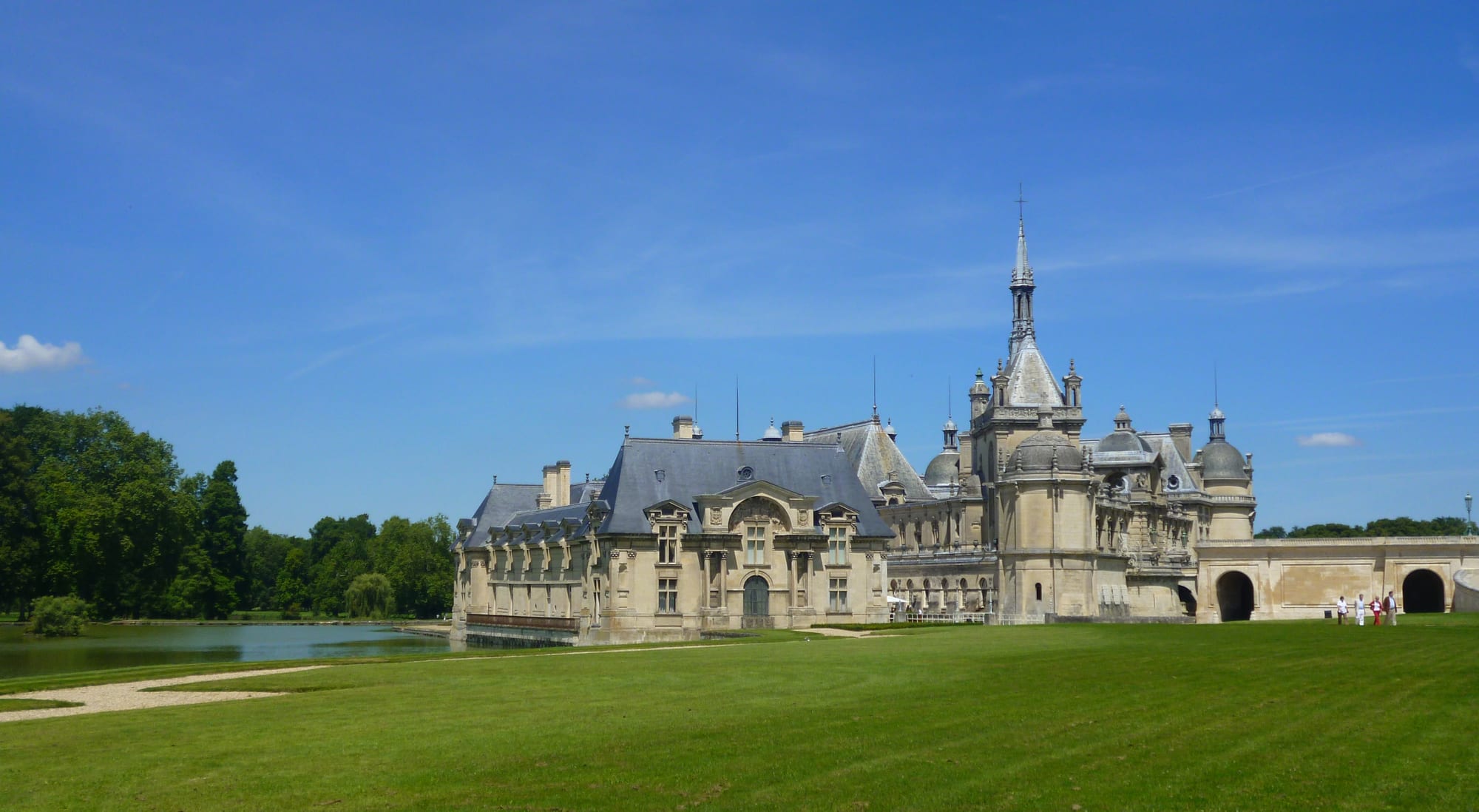
A pale stone château with slate roofs, domed towers and a tall spire beside a lake and a wide green lawn under a blue sky

Hauts-de-France, France

Chantilly

The Château de Chantilly, home of the Musée Condé, seen across the lawns beside its moat. (HALove / Wikimedia Commons · CC BY-SA 3.0)

A small town in the Nonette valley of the Oise, surrounded by forest about 38 kilometres north of Paris. It grew up around the château of the Montmorencys and the princes of Condé, who laid out its streets and Great Stables; today it is France's largest racehorse-training centre, home to the Musée Condé and the classic races, and a commuter town for Paris.

Neighbourhoods

  • Château and park
    • First-time visitors
    • Museums
    • Gardens

    The château in its moat, the Great Stables and the racecourse on the open lawn between them, with Le Nôtre's park and its Grand Canal stretching away from the château.

    Open in Maps
  • Rue du Connétable and the old town
    • Historic district
    • Best for food

    The main street laid out by the Grand Condé in 1673 and planned by his grandson in the 18th century, lined with the houses built for the princes' court officials in 1730–33 and with shops and cafés.

    Open in Maps
  • Avenue du Maréchal-Joffre and the station
    • Close to public transport
    • Quiet and residential

    The avenue that grew along the Paris road after the railway arrived in 1859, once lined with villas and gardens and now mostly residential.

    Open in Maps
  • The stables on the forest edge
    • Horse racing
    • Quiet and residential

    Forest land developed from 1890 with brick stables, trainers' houses and lodgings for lads and jockeys — the heart of France's largest racehorse-training community.

    Open in Maps

Things to do

The château and the horses

  • Château de Chantillylandmark

    The home of the Montmorencys, the princes of Condé and finally the Duke of Aumale, made up of two attached buildings, the Petit Château and the Grand Château, and a historic monument open to the public.

    Open in Maps
  • Musée Condémuseum

    The Duke of Aumale's collection inside the château, bequeathed to the Institut de France in 1897 on condition that it is never rearranged or lent; its old master paintings, mainly Italian and French, are among the most important in France, and its library holds some 200 illuminated manuscripts.

    Open in Maps
  • Great Stables and the Living Museum of the Horsemuseum

    The palatial stables built in the early 18th century for Louis Henri, Duke of Bourbon, by Jean Aubert, which have housed a museum of the horse since 1982.

    Open in Maps
  • Chantilly Racecourseattraction

    A flat-racing course on 65 hectares beside the forest, first used in 1834, with a grandstand of 1879; it holds the Prix du Jockey Club and the Prix de Diane and hosted the Prix de l'Arc de Triomphe in 2016 and 2017.

    Open in Maps

Parks and the forest

  • Chantilly Forestpark

    Some 6,344 hectares of forest surrounding the town, including the Commelles ponds, created by the monks of Chaalis in the 13th century.

    Open in Maps

Short trips from the town

  • Senlisattraction

    A historic town where the early French kings lived, drawn by the Chantilly forest, known for its Gothic cathedral and old monuments.

    Open in Maps
  • Royaumont Abbeylandmark

    A former Cistercian abbey near Asnières-sur-Oise, about 30 kilometres north of Paris.

    Open in Maps
  • Chaalis Abbeylandmark

    The remains of a Cistercian abbey at Fontaine-Chaalis near Ermenonville, whose monks dug the Commelles ponds.

    Open in Maps
  • Parc Astérixattraction

    A theme park at Plailly based on the Asterix comics, about 20 kilometres from the château and known for its many roller coasters.

    Open in Maps

Seasonal events

  • Prix du Jockey Clubearly June

    The French Derby, a Group 1 race over 2,100 metres for three-year-olds, run at Chantilly each year in early June.

  • Prix de DianeJune

    The French Oaks for three-year-old fillies, which draws more than 40,000 people for the racing and the fashion.

Eat and drink

Long-standing places and food districts in Chantilly. Hours, ratings and directions come from your maps app, always current.

Food districts

  • Rue du Connétableneighborhood

    The town's main street, with its cafés, bakeries and restaurants a short walk from the château and the Great Stables.

    Open in Maps
  • Pâtisseries for crème Chantillyneighborhood

    The town gave its name to crème Chantilly, sweetened whipped cream, which local pâtissiers and tea rooms serve with desserts.

    Open in Maps

Experience Chantilly

History

Chantilly first appears around 1223, when Guy IV of Senlis, the king's grand bouteiller, became its first lord; it was then little more than a rock in a marsh. His strong house was destroyed in the Jacquerie of 1358, rebuilt by Pierre d'Orgemont by 1394 and surrendered to Anglo-Burgundian forces in the Hundred Years' War. For most of the 15th to 17th centuries the estate was tied to the Montmorency family, and the town began as a few hamlets scattered outside the château.

The princes of Condé, cousins of the kings, made it their seat from the 17th century. The Grand Condé built a new road, now the rue du Connétable, in 1673; André Le Nôtre remade the river into the Grand Canal from 1663; and his maître d'hôtel François Vatel died here in 1671. A parish church was built in 1692, and Louis Henri, Duke of Bourbon, planned the town itself: he built the Great Stables in 1721 and sold plots for houses for court officials, built in 1730–33. Lace made here reached its peak in the 18th century.

The first races were held in 1834, and the railway of 1859 brought Parisian crowds and a large British racing community — 76 per cent of the jockeys, lads and trainers in 1911. The Duke of Aumale, son of Louis-Philippe and the last lord, had the château rebuilt in 1876–82 and left it with its collections to the Institut de France; it opened in 1898. In 1914–16 Joffre ran the French armies from Chantilly and in December 1915 hosted the Allied conference that planned the 1916 offensives. After the Second World War new housing drew Paris commuters, and the town lost almost all its remaining industry when the Guilleminot factories shut in 1992.

Culture & Customs

Chantilly's culture is aristocratic in origin and equestrian in practice. The Musée Condé, the Duke of Aumale's bequest, must stay exactly as he arranged it and may never be lent; its old master paintings are among the most important in France, and its library holds some 200 illuminated manuscripts. The 18th-century Great Stables house a living museum of the horse.

Racing shapes the town's year. The racecourse, owned by the Institut de France and run by France Galop, holds about two dozen meetings and nearly 200 races a year, and the June classics — the Prix du Jockey Club and the Prix de Diane — draw crowds of tens of thousands. Dozens of jockeys live in the town, leading trainers work from its yards, and a jockeys' school in neighbouring Gouvieux trains young riders.

The town gave its name to crème Chantilly and to Chantilly lace, made in the town since the 17th century. The château also hosts a concours d'élégance for classic cars, and the town's proximity to Paris and Charles de Gaulle airport makes it a regular conference venue.

Daily Life

About 10,600 people lived in Chantilly in 2023, and some 37,000 in the urban area it forms with six neighbouring communes, including Gouvieux and Lamorlaye. It is one of the larger urban areas of the Oise and falls within the wider metropolitan area of Paris.

The town has no large businesses or heavy industry. About 40 per cent of working residents commute to the Île-de-France, to Paris or the area around Charles de Gaulle airport. Locally, the economy rests on the château and its visitors, conferences and above all racing: trainers, stable lads, farriers and the jockeys' school make the area France's largest racehorse-training centre.

Life is quiet and comfortable. The rue du Connétable has its shops and cafés, and weekends bring walkers, riders and cyclists into the forest. The post-war apartment blocks of the Verdun district, built on the site of the old racecourse station, stand beside streets of villas and converted mansions.

Food

Chantilly's name is on menus worldwide through crème Chantilly, whipped cream aerated by whisking until it is light and fluffy and holds its shape, usually sweetened. Its invention is often credited to François Vatel, the maître d'hôtel of the Grand Condé, who died at Chantilly in 1671, though without evidence; the name is first linked with whipped cream in the mid-18th century. It is served here with desserts and pastries.

The rest of the table follows the north of France and the Paris region. Brasserie cooking — steak-frites, confit de canard, soupe à l'oignon — sits beside Picard dishes such as the ficelle picarde, a savoury crêpe rolled around ham and a creamed duxelles and grilled in cream under cheese, and the leek-and-cream tart called flamiche. Maroilles, the strong-smelling, orange-red-rinded cow's-milk cheese of Picardy and Nord-Pas-de-Calais, appears on cheese boards.

As in much of northern France, beer is popular alongside wine, and the regional bières de garde — copper or golden, and traditionally matured before drinking — are found in local bars. Eating out centres on the rue du Connétable, close to the château and the stables.

Planning tools

Budget

Chantilly lies in Paris's orbit and prices follow: rooms and restaurants cost more than elsewhere in Hauts-de-France, and race days and conferences push hotel rates up. The forest is free, while the château, park and Great Stables charge admission. Staying in Paris and coming out by train is a common alternative.

Daily Budget Midrange
USD 160–280 (hotel near the town centre, restaurant dinners, château and stables entries, a race-day ticket)
Daily Budget Shoestring
USD 80–120 (budget hotel or a day trip from Paris, bakery lunches, regional train tickets)

Race days in June fill the town; book rooms well ahead or come out from Paris for the day.

Best Time to Visit

May to September is best for the park, the forest and the racecourse, and June brings the Prix du Jockey Club and the Prix de Diane, the busiest days of the year. The château and museum make a good visit in any season; winters are cold, and the park is at its quietest.

Suggested Number of Days

Most visitors come for a day, often from Paris. Allow two or three to explore the forest and the nearby towns and abbeys at a gentler pace, or to add a race meeting.

First Visit
1 day
With Surroundings
2–3 days

Transportation

The town is small and walkable, and a small local bus network links the station with the residential districts. A car or a bicycle helps for the forest, the abbeys and Senlis.

The station, the town centre and the château are all within walking distance, so a car is not needed for the town itself.

Airport & Station Connections

Chantilly lies about 38 kilometres north of Paris. The Chantilly-Gouvieux station, opened in 1859 on the Paris–Lille line, has regional trains from Paris-Nord, 22 minutes away by express train, and is also served by RER line D. Paris Charles de Gaulle airport is about 30 kilometres away and Beauvais-Tillé about 54 kilometres.

Walkability

The town centre, the rue du Connétable, the Great Stables and the château are all within walking distance, and the racecourse lawn makes a pleasant route between them. The park and the forest invite much longer walks.

Safety

France is a safe country overall, with violent crime against visitors uncommon. Chantilly is a quiet, prosperous town. Race days bring large crowds, and racehorses in training are a common sight around the town.

Watch belongings in the race-day crowds, and give way to horses. Check current official travel advice before travelling.

Climate

A mild, fairly dry climate for northern France, with rainfall lowest in spring. The yearly mean at the nearby Creil weather station is 11.2°C.

Summer
warm on average, with occasional heatwaves; the record of 41.6°C was set in July 2019
Winter
cold, around 3.5°C on average; the record low is −21.6°C, in January 1985

Local Customs

Greet shopkeepers with 'bonjour, madame' or 'bonjour, monsieur'. Service is included in restaurant prices, so tipping is modest — rounding up or a few euros for good service. Race days at Chantilly are social occasions, and the Prix de Diane is known as much for its fashion as for the racing.

Many racegoers dress up for the big June meetings; ask before photographing horses and riders in the training areas.

Common Payment Methods

France uses the euro. Cards and contactless payment are accepted almost everywhere, and cash machines are found in the town centre. Carry a little cash for small purchases.