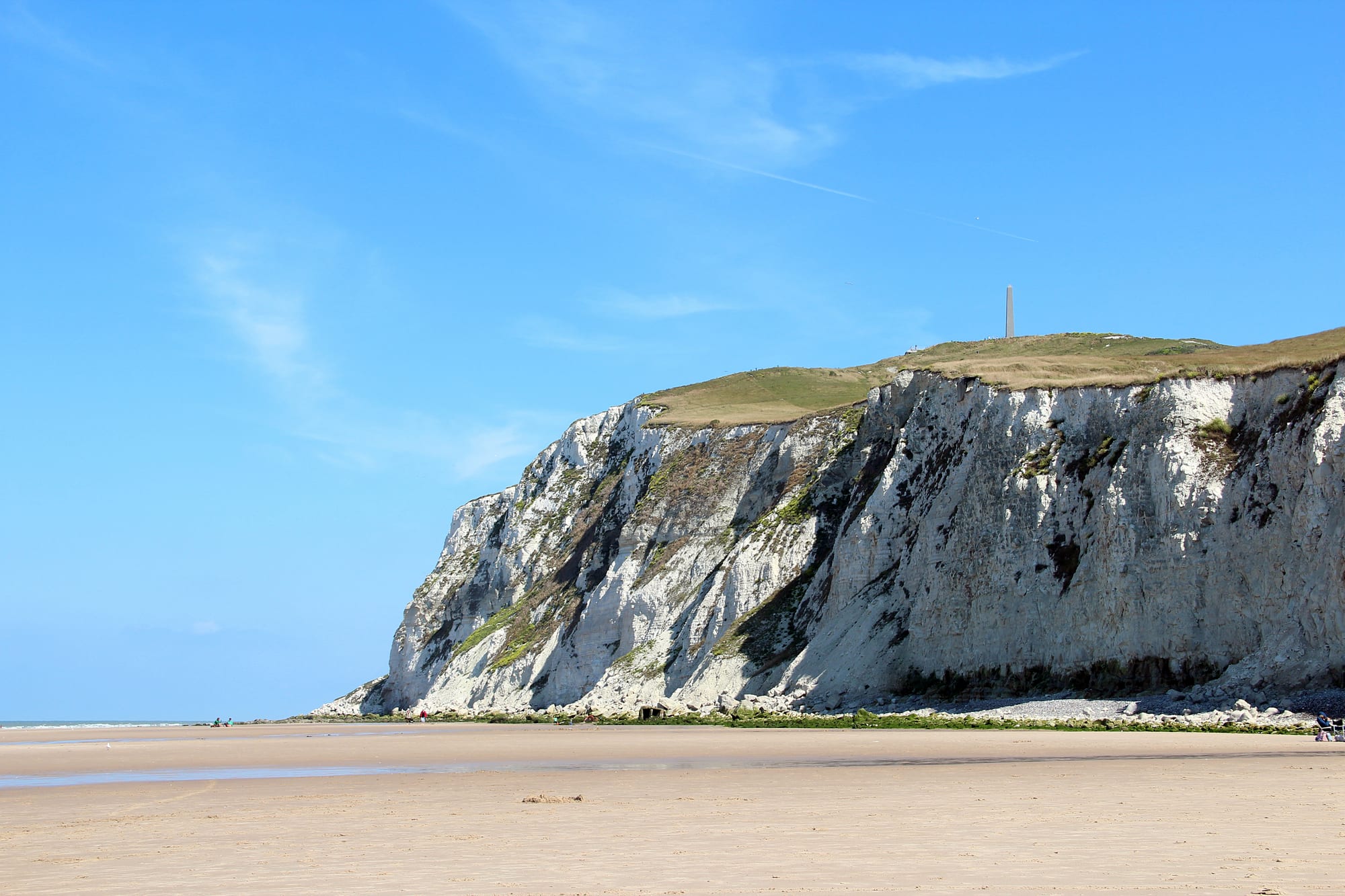
A white chalk headland topped with grass and a stone obelisk rising above a wide sandy beach under a blue sky

France

Hauts-de-France

Cap Blanc-Nez and its Dover Patrol memorial seen from the beach at Escalles, on the Opal Coast of Pas-de-Calais. (Jean-Pol GRANDMONT / Wikimedia Commons · CC BY 3.0)

France's northernmost region, between Paris, the Channel and the Belgian border — the former Nord-Pas-de-Calais and Picardy, merged in 2016. Flemish belfries and brick squares, the tallest Gothic cathedrals, chalk capes facing Dover, slag heaps turned into heritage and the memorials of the Somme mark a densely peopled borderland that every European war has crossed.

Explore Hauts-de-France

History

The plains between the Channel and the Ardennes have no natural defences, and their history is a list of invasions. Clovis won control of northern Gaul at Soissons in 486, and Hugh Capet was elected king at Senlis and crowned at Noyon in 987. In the 12th and 13th centuries Picardy's wheat lands paid for the first generation of Gothic cathedrals — Noyon, Laon, Soissons, Amiens, Beauvais — while the cloth towns of Flanders and Artois, Lille, Douai and Arras, grew rich on English wool and built belfries to proclaim their civic freedoms.

The English won at Crécy in 1346 and Agincourt in 1415, both fought here, and held Calais from 1347 to 1558. Flanders and Artois passed to the dukes of Burgundy and then to the Spanish Habsburgs; Louis XIV conquered them between 1659 and 1678, taking Lille in 1667, and Vauban ringed the new frontier with citadels. Coal, found near Valenciennes in the 18th century and under Lens in the 1840s, and the textile mills of Roubaix and Tourcoing turned the north into France's industrial engine, the world of Zola's Germinal; the Courrières pit explosion of 1906 killed 1,099 miners.

From 1914 to 1918 the Western Front ran through Artois, the Somme and the Aisne. The battle of the Somme in 1916 cost more than a million casualties, and the armistice was signed in a railway carriage in the forest of Compiègne on 11 November 1918 — the carriage in which Hitler received France's surrender in June 1940, days after 338,000 Allied troops had been lifted from Dunkirk. The last coal mine closed in 1990; the Channel Tunnel and high-speed rail, opened in 1993–94, made Lille a crossroads between Paris, London and Brussels.

Culture & Customs

Two popular cultures overlap here. North of the Artois hills people call themselves Ch'tis, after the sound of their Picard dialect, and the 2008 comedy Bienvenue chez les Ch'tis, the most-watched French film in the history of French cinemas, made a national joke of the south's dread of the grey north and of the warmth found on arrival. Around Dunkirk, Cassel and Hazebrouck the heritage is Flemish: place names in -ghem and -brouck, a fading West Flemish dialect, and estaminets, taverns with wooden table games. Picardy, to the south, is quieter and more rural, with its own Picard speech.

Festivals are communal and loud. Towns parade wickerwork giants — Gayant and his family in Douai each July, Reuze Papa and Reuze Maman in Cassel — a custom listed by UNESCO, as are the region's 23 belfries. Dunkirk's carnival fills the weeks before Lent with costumed bands, brass, umbrellas and a shower of smoked herrings thrown from the town hall, and the Braderie de Lille, on the first weekend of September, is Europe's largest flea market, when restaurants compete to build the highest heap of mussel shells.

Mining left brick terraces called corons, brass bands, pigeon racing, the feast of Saint Barbara on 4 December and a passion for football: Racing Club de Lens fills a 38,000-seat stadium in a town of 32,000. The Paris–Roubaix cycle race crosses the cobbled farm tracks each April. Remembrance is part of ordinary life too, from the upkeep of hundreds of Commonwealth cemeteries to the dawn service on Anzac Day at Villers-Bretonneux.

Daily Life

Hauts-de-France has almost six million people and one of the youngest populations in France. Lille has about 236,000 residents, but its metropolitan area, running through Roubaix and Tourcoing to the Belgian border, holds 1.2 million, and the old mining basin from Béthune through Lens to Valenciennes forms a second, looser conurbation of over a million. Amiens (about 134,000) is the chief city of the Picard half; Dunkirk, Calais, Boulogne-sur-Mer, Beauvais, Saint-Quentin, Arras and Compiègne have 40,000 to 90,000 each, and the south of the Oise is commuter country for Paris and Roissy airport.

The collapse of coal, steel and textiles left the region with some of the highest unemployment and poverty rates and the lowest life expectancy in mainland France. Reinvention is real all the same: the north is France's leading car-making region, with Toyota near Valenciennes and Renault at Douai and Maubeuge, and battery plants are opening at Douvrin, Douai and Dunkirk; the Mulliez family's retail groups — Auchan, first opened in Roubaix, Decathlon and Leroy Merlin — are national names. Boulogne is France's first fishing port, Calais its first passenger port, and the big farms of Picardy and Artois grow most of the country's potatoes and endives and half its sugar beet.

Everyday life is sociable and unpretentious: chips from a roadside baraque à frites, Sunday morning at Lille's Wazemmes market, weekends on the wide beaches of the Opal Coast, shopping across the Belgian border. Calais and its neighbours have lived for two decades with migrants trying to reach Britain, now mostly in small boats.

Food

This is beer country, and the kitchen shows its Flemish side. Carbonade flamande is beef braised in beer, often with gingerbread and brown sugar; potjevleesch, a Dunkirk dish, sets chicken, rabbit, pork and veal in a vinegary jelly and is eaten cold with chips; and the welsh, cheddar melted with beer over ham and bread, is a brasserie staple from Lille to the coast. Mussels and chips are the dish of the Braderie, and chips, fried twice and bought from a baraque à frites, are close to a regional emblem.

Picardy contributes the ficelle picarde, a pancake rolled around ham and mushrooms and baked in cream, the leek pie called flamiche, duck pâté in pastry from Amiens, and salt-meadow lamb, cockles and samphire from the Bay of Somme; Boulogne smokes herring. The cheeses are strong: Maroilles, a square, orange-rinded cheese made in the Avesnois since the Middle Ages and baked into tarts; its longer-cured cousin Vieux-Lille; the cone-shaped Boulette d'Avesnes; and Mimolette, the orange ball first made on Colbert's orders to replace Dutch imports. Endives, called chicons, are baked with ham and béchamel.

Sweets include the thin vanilla-filled waffles sold by Méert in Lille, tarte au sucre, the mint-flavoured bêtises de Cambrai, the almond macarons of Amiens and Picardy's tall brioche, gâteau battu; whipped crème Chantilly takes its name from the château. The local beers are bières de garde — amber, malty and cellar-aged, such as Jenlain, Ch'ti and 3 Monts — and genièvre, the juniper spirit of Houlle and Wambrechies, goes into the miner's laced coffee, the bistouille. The far south of the Aisne, around Château-Thierry, lies within the Champagne appellation.

Attractions & Natural Wonders

Lille's centre is Flemish in brick and carved stone: the Grand'Place and the arcaded Vieille Bourse of 1653, the lanes of Vieux-Lille, Vauban's star-shaped citadel and the Palais des Beaux-Arts, with La Piscine, an art museum around an Art Deco swimming pool, in neighbouring Roubaix. Arras has two arcaded squares of Flemish-Baroque gables, rebuilt after 1918, and at Lens the Louvre-Lens museum stands beside the twin slag heaps of Loos-en-Gohelle, part of the UNESCO-listed mining basin. Dunkirk has the beaches and museum of the 1940 evacuation.

The Somme battlefields spread around Albert and Péronne: Lutyens's Thiepval Memorial to 72,000 missing, the Lochnagar mine crater, the preserved trenches of the Newfoundland park at Beaumont-Hamel and the Australian memorial at Villers-Bretonneux. Further north are the Canadian memorial on Vimy Ridge and the Ring of Remembrance at Notre-Dame-de-Lorette. Amiens cathedral, begun in 1220, is the largest in France, its nave 42 metres high and its west front lit in its medieval colours on some evenings; below it lie the canals of Saint-Leu and the floating market gardens of the hortillonnages.

The Opal Coast runs from Calais, with Rodin's Burghers outside the town hall, past the chalk headland of Cap Blanc-Nez and Cap Gris-Nez, the closest point to England, to Boulogne's walled upper town and Nausicaá aquarium and the villas of Le Touquet. South of it the Bay of Somme has a seal colony, the Marquenterre bird reserve and the old port of Saint-Valery.

In the south, Chantilly pairs a moated château holding the Musée Condé — France's largest collection of old master paintings after the Louvre — with Le Nôtre's park, the 18th-century Great Stables and the racecourse. Nearby are Senlis, the imperial palace and Armistice clearing at Compiègne, the castle of Pierrefonds, Beauvais cathedral with the highest Gothic choir ever built, and the hilltop cathedral city of Laon.

Cities in Hauts-de-France

Planning basics

Budget

The north is one of the cheaper parts of France. Beer, chips and estaminet meals cost little, war memorials and cemeteries are free, the main gallery of the Louvre-Lens charges nothing, and hotels in Arras, Amiens, Lens or Saint-Quentin undercut the national average. Lille is mid-priced except during the Braderie on the first weekend of September and the big trade fairs, when rooms triple. Le Touquet is the one expensive resort, and Chantilly and Senlis, in Paris's orbit, charge accordingly.

Daily Budget Midrange
USD 130–240 (central hotel in Lille or a coast hotel, brasserie dinners, museum entries, a hire car for the battlefields)
Daily Budget Shoestring
USD 65–100 (hostel or budget hotel, friteries, markets and estaminet lunches, regional trains)

Regional trains link almost every town cheaply; save the hire car for the Somme battlefields and the two capes.

Safety

The region is safe, with ordinary big-city care needed around Lille's stations, in the Braderie crowds and in parts of Roubaix at night. Around Calais and Dunkirk, migrants trying to reach Britain camp near the port and tunnel approaches; drivers should keep vehicles locked and expect checks. The tide in the Bay of Somme comes in fast over mud and quicksand, and the chalk of the capes crumbles. On the old front line, ploughs still turn up live shells every year. Pas-de-Calais river valleys have flooded in recent winters.

Never touch or move rusted munitions found in fields or woods — report them at the nearest town hall — and cross the Bay of Somme only with a guide. Check current official travel advice before travelling.

Climate

Oceanic, cool and famously grey: rain falls often rather than heavily, with the hills of Artois and the Boulonnais the wettest part. The Channel coast is windy and bracing, the sea stays cool even in August, and the Picardy plain is a little drier and sunnier than Flanders. Summers are mild with the odd heatwave; winters bring frost, fog and occasional snow, more of it in the Avesnois and Thiérache hills.

Summer
mild, 20–24°C, with showers and long evenings; cooler and windier on the coast
Winter
cold, damp and overcast, 1–7°C, with frost, fog and a few days of snow

Transportation

Lille is one of Europe's rail crossroads: an hour from Paris Nord, about 35 minutes from Brussels and 1 hour 30 from London by Eurostar, with direct TGVs to Charles de Gaulle airport and the south that bypass Paris. Its two stations, Lille-Flandres and Lille-Europe, are five minutes' walk apart, and the driverless metro dates from 1983. Dense regional trains reach Arras, Lens, Calais, Dunkirk, Boulogne and Amiens; Chantilly is 25 minutes from Paris Nord. The Somme battlefields, the capes and the Bay of Somme need a car, a bicycle or a guided tour. Ferries from Dover dock at Calais and Dunkirk, and the Channel Tunnel shuttle arrives at Coquelles.

Amiens has no TGV to Paris — take the direct regional train from Paris Nord, then a regional train on to Albert for the battlefields.

Best Time to Visit

May to September for the coast, the Bay of Somme and the battlefields, where poppies flower in the field margins from June. The calendar draws visitors at other times: Dunkirk's carnival in February and March, the Paris–Roubaix race and Anzac Day at Villers-Bretonneux in April, the 1 July ceremonies on the Somme, Chantilly's classic races in June, the Braderie de Lille in early September, 11 November at Compiègne and the Christmas markets of Arras, Lille and Amiens. Rooms near the memorials fill months ahead of the anniversaries.