Rounded pink granite boulders in evening light beside a dark blue sea, with a stone lighthouse and a house behind

France

Brittany

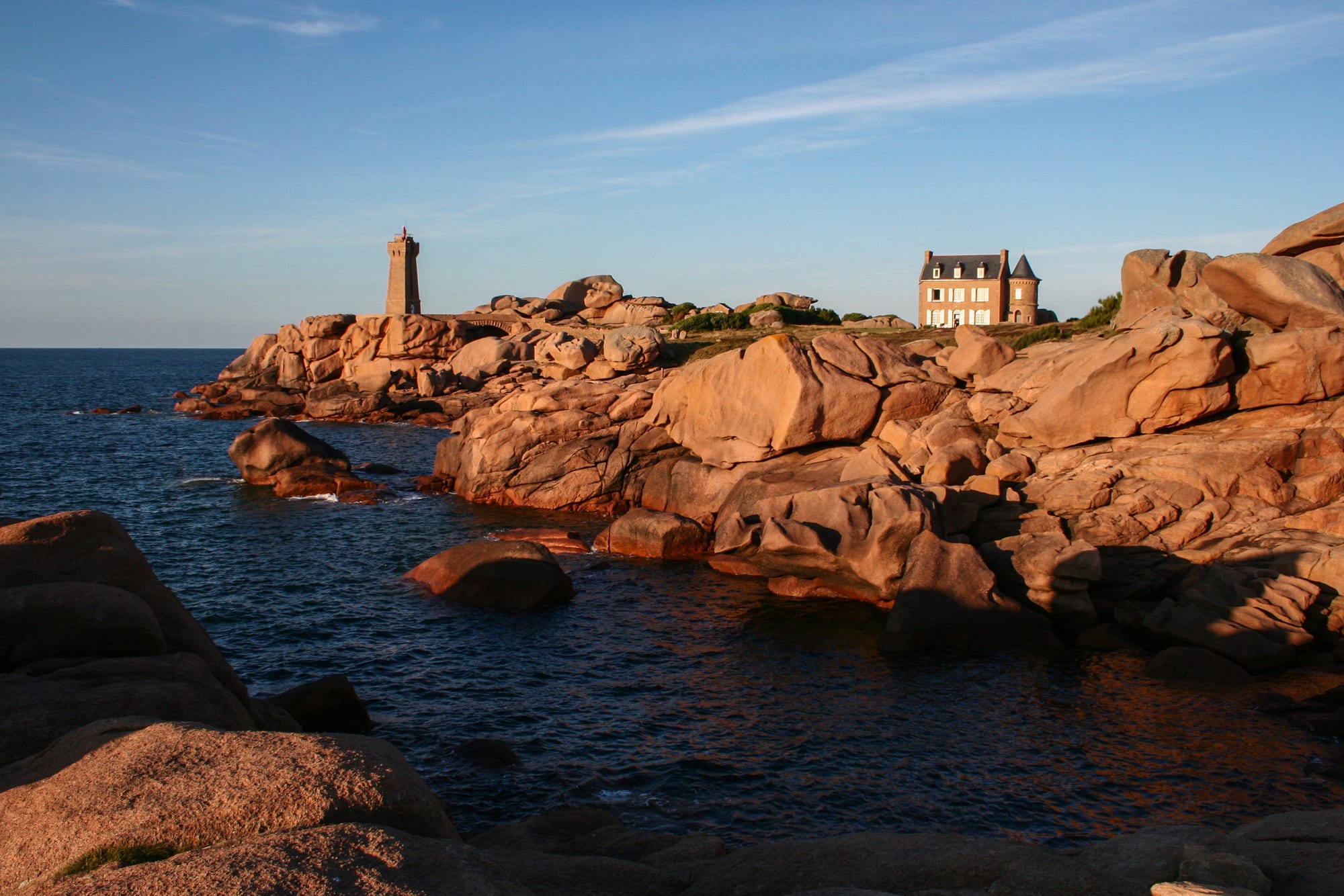
The Mean Ruz lighthouse among the boulders of the Pink Granite Coast at Ploumanac'h, northern Brittany. (Nono vlf / Wikimedia Commons · CC BY-SA 4.0)

France's westernmost peninsula, pushing into the Atlantic between the Channel and the Bay of Biscay — a Celtic land named by Britons who crossed the sea in the 5th century and an independent duchy until 1532, with its own language, music and saints, some 2,700 kilometres of granite coast, walled ports, prehistoric standing stones and a kitchen of buckwheat, salted butter, cider and shellfish.

Explore Brittany

History

Brittany's first monuments are among the oldest in Europe: the cairn of Barnenez dates from about 4800 BC, and the stone rows of Carnac are only a little younger. Caesar destroyed the fleet of the Celtic Veneti off the Morbihan coast in 56 BC. The name and the language came later, in the 5th and 6th centuries, when Britons from Wales and Cornwall crossed the Channel under monk-leaders — Malo, Brieuc, Corentin, Samson — remembered as the founding saints.

Nominoë defeated the Franks at Ballon in 845, and for nearly seven centuries Brittany was a kingdom and then a duchy. Its army was beaten at Saint-Aubin-du-Cormier in 1488; Duchess Anne was married to two French kings, and union with France followed in 1532, with Brittany keeping its parliament at Rennes and its exemption from the salt tax until 1789. Linen and sailcloth paid for the carved parish closes of Finistère, Jacques Cartier sailed from Saint-Malo in 1534 to claim Canada, and Louis XIV's ministers created the naval base at Brest and the East India Company port of Lorient.

The Revolution provoked the royalist Chouan risings, and the 19th century brought poverty, emigration to Paris and state schools that punished children for speaking Breton. German submarine bases made Brest and Lorient targets, and both, with Saint-Malo, were rebuilt from rubble after 1944. Since the 1960s intensive farming has transformed the economy, while the Amoco Cadiz oil spill of 1978 and a cultural revival led by musicians and the Diwan schools sharpened regional feeling. Nantes, the dukes' old capital, was placed in another region in 1941 and remains outside — a grievance still aired.

Culture & Customs

Breton identity is one of the strongest in France. The black-and-white Gwenn-ha-du flag, designed in the 1920s, flies from town halls, boats and festival crowds. Breton, a Celtic language close to Cornish and Welsh, is spoken by about 107,000 people, most of them elderly and in the west, while the east traditionally spoke Gallo, a Romance dialect; road signs are bilingual, and the Diwan schools teach several thousand children in Breton.

Music and dance carry the culture. The fest-noz, a night of communal chain and circle dances to the bombarde, the biniou bagpipe or a pair of unaccompanied singers, is listed by UNESCO and fills village halls most weekends; pipe bands called bagadoù compete each year, and the Festival Interceltique de Lorient in August draws Scots, Irish, Welsh and Galicians and several hundred thousand visitors. Quimper's Festival de Cornouaille and the Vieilles Charrues at Carhaix, France's largest rock festival, fill the rest of July.

Brittany was long the most devoutly Catholic part of France, and the landscape shows it: granite calvaries, thousands of chapels and holy wells, and the pardons, annual processions with banners and costume to a local saint, the largest at Sainte-Anne-d'Auray on 26 July. Lace coiffes, including the tall Bigouden headdress of Pont-l'Abbé, now come out only on such days. Legend is never far off — the Ankou, death's servant with his cart, the drowned city of Ys, and Merlin and Viviane in the forest of Paimpont, the Brocéliande of Arthurian romance. Bretons are reputed stubborn, sociable and sea-minded, and the sailor Éric Tabarly remains a regional hero.

Daily Life

About 3.4 million people live in the four departments, and the number is rising as retirees and home-workers move west. Rennes, the capital, has about 225,000 residents, some 70,000 students and two driverless metro lines; Brest (about 140,000) is the naval and university city of the far west; Quimper, Lorient, Vannes, Saint-Malo and Saint-Brieuc each have between 45,000 and 65,000. The interior around Carhaix and Pontivy is thinly peopled and ageing.

Farming dominates the countryside: Brittany raises more than half of the country's pigs and a large share of its poultry and milk. The price is nitrate run-off, which feeds the green algae that rot on some northern beaches each summer. The region lands close to half of France's fish, at Le Guilvinec, Lorient, Concarneau and Roscoff, and farms oysters at Cancale and in the Gulf of Morbihan. Food processing is the main industry, beside the navy at Brest — France's missile submarines are based at Île Longue, across the roadstead — shipbuilding at Lorient, telecoms research at Lannion and cyber-security at Rennes.

On the coast the tide sets the timetable: at the big spring tides whole families go out with rakes and buckets for the pêche à pied, gathering clams and cockles on the exposed flats. The crêperie is the default restaurant, and Sunday morning belongs to cyclists in the homeland of Bernard Hinault. Tourism brings the sharpest local issue: in some resorts and on the islands well over half the houses are second homes, and young Bretons struggle to rent where they grew up.

Food

The Breton staple is the galette, a thin pancake of buckwheat — blé noir, a crop of the late Middle Ages suited to poor acid soils — cooked on a cast-iron bilig and filled, classically, with ham, egg and cheese as the complète. Around Rennes the galette-saucisse, a grilled pork sausage rolled in a cold galette, is the market and football snack. Sweet crêpes are made of wheat flour and spread with salted butter and sugar or salted-butter caramel. Cider, poured into earthenware bowls, goes with both; chouchen is mead and lambig the local cider brandy.

Butter here is salted, a legacy of the duchy's exemption from the royal salt tax, and it defines the pastry: kouign-amann, invented at Douarnenez around 1860 from bread dough folded with butter and sugar until it caramelises; far breton, a dense baked custard with prunes; and the butter biscuits of Pont-Aven. Cheese, unusually for France, hardly features.

The sea supplies the rest. Cancale is known for oysters, the Belon river for flat oysters with a hazelnut taste, the bay of Saint-Brieuc for scallops, Le Guilvinec for langoustines and the bay of Mont-Saint-Michel for bouchot mussels grown on stakes; a plateau de fruits de mer piles them on ice with crab, whelks and winkles. Cotriade is the fishermen's stew of mixed fish and potatoes, and sardines are still canned at Douarnenez and Quiberon. Inland come kig ha farz, the Léon's boiled meats with a buckwheat dumpling cooked in a cloth bag, andouille from Guémené-sur-Scorff, and the pink onions of Roscoff, once sold door to door in Britain by the bicycle-riding Onion Johnnies.

Attractions & Natural Wonders

The north coast starts at Saint-Malo, the granite corsair city rebuilt stone by stone after 1944, where the rampart walk looks over beaches, tidal forts and the island tomb of Chateaubriand. Nearby are Cancale's oyster stalls, the Belle Époque villas of Dinard, the walled river town of Dinan and the cliffs of Cap Fréhel. Further west, the Pink Granite Coast around Perros-Guirec, Ploumanac'h and Trégastel is a shore of rose-coloured boulders followed on foot along the old customs officers' path, with boats to the gannet colony of the Sept-Îles; the car-free island of Bréhat lies just to the east.

Finistère, the "end of the earth", has the parish closes of Saint-Thégonnec and Guimiliau, the moors of the Monts d'Arrée, the cliffs of the Crozon peninsula and the Pointe du Raz, and the island of Ouessant with its lighthouses. Quimper, capital of Cornouaille, has a twin-spired Gothic cathedral, half-timbered streets and faïence potteries; close by are the granite weavers' village of Locronan, the walled island town of Concarneau and Pont-Aven, where Gauguin painted.

On the south coast the standing stones of Carnac — nearly 3,000 menhirs in rows running for four kilometres — are the centre of a megalithic landscape, listed by UNESCO in 2025, that includes the broken 20-metre menhir of Locmariaquer and the carved passage grave of Gavrinis. The Gulf of Morbihan, an inland sea dotted with islands, is toured by boat from the walled town of Vannes. From Quiberon, ferries cross in 45 minutes to Belle-Île, the largest Breton island, with Vauban's citadel at Le Palais, the harbour of Sauzon and the sea stacks of Port-Coton that Monet painted in 1886.

Rennes keeps the 17th-century Parlement de Bretagne, streets of leaning timber houses that escaped the fire of 1720, and the Saturday Marché des Lices; the border castles of Fougères and Vitré, Josselin's château on the Nantes–Brest canal and the forest of Paimpont lie inland. The GR34 coastal path links almost all of it, following the shore for some 1,700 kilometres.

Cities in Brittany

Planning basics

Budget

Brittany is moderately priced by French standards. A crêperie meal of a galette, a crêpe and a bowl of cider is one of the cheapest sit-down dinners in the country, and inland towns and chambres d'hôtes are good value. The coast is another matter in July and August: Saint-Malo, the Gulf of Morbihan and above all the islands — Belle-Île, Bréhat, Ouessant — fill up, raise their rates and need booking well ahead, ferry included. Seafood platters and lobster are the splurge.

Daily Budget Midrange
USD 140–260 (seaside hotel, seafood dinners, island ferries, a hire car)
Daily Budget Shoestring
USD 65–110 (hostel, campsite or simple chambre d'hôte, crêperies and markets, BreizhGo trains and buses)

The region's dual carriageways are all toll-free, and oysters cost least eaten at the producers' stalls on the quay at Cancale.

Safety

Crime is low, and the risks come from the sea. Tidal ranges here are among the largest in Europe, and every year walkers are cut off on sandbanks and tidal islands such as Saint-Malo's Grand Bé; at spring tides and in storms waves break over the Saint-Malo sea wall. Currents are strong off the headlands and in the mouth of the Gulf of Morbihan. On some northern bays, rotting green algae give off toxic hydrogen sulphide, and affected beaches are signposted and sometimes closed. Coast paths are slippery and unfenced.

Check the tide times before walking out to any island or sandbank, keep well back from the sea wall in a storm, and keep children and dogs away from banks of rotting seaweed. Check current official travel advice before travelling.

Climate

Oceanic: mild, windy and changeable, with the local saying that the weather is fine several times a day. Frost is rare on the coast, where camellias, hydrangeas and even palms grow, and summers seldom pass 25°C. The west is the wettest part — above all Brest and the Monts d'Arrée — while the south coast around the Gulf of Morbihan, Quiberon and Belle-Île is markedly sunnier and drier. Atlantic storms arrive between October and February.

Summer
mild, 18–24°C, breezy, with sunny spells and passing showers; sea 16–19°C, colder on the north coast
Winter
mild and wet, 4–10°C, with gales on the west coast; snow is rare

Transportation

The high-speed line opened in 2017 puts Rennes about 1 hour 30 from Paris Montparnasse, with TGVs continuing to Saint-Malo (2 hours 15), Vannes, Lorient, Quimper and Brest (about 3 hours 30). BreizhGo regional trains follow the north and south coasts; the interior, the headlands and the parish closes need a car or patience with buses. Ferries run from Quiberon to Belle-Île, Houat and Hoëdic, from Lorient to Groix, from Brest and Le Conquet to Ouessant, from Audierne to Sein and from the Pointe de l'Arcouest to Bréhat, where cars are not allowed. Ships from Plymouth, Portsmouth and Cork dock at Roscoff and Saint-Malo.

Book the Belle-Île ferry ahead in summer, and leave the car in Quiberon — bicycles, buses and hire cars are available on the island.

Best Time to Visit

May to September, with June and September the best balance of light, open ferries and empty coast paths. July and August bring the warmest sea and the festivals — the Vieilles Charrues at Carhaix in mid-July, Quimper's Festival de Cornouaille in late July and the Festival Interceltique de Lorient in early August — along with full resorts and island ferries that sell out. The great spring tides around the March and September equinoxes are a spectacle at Saint-Malo. From November to March many island hotels, crêperies and boat services close or thin out.