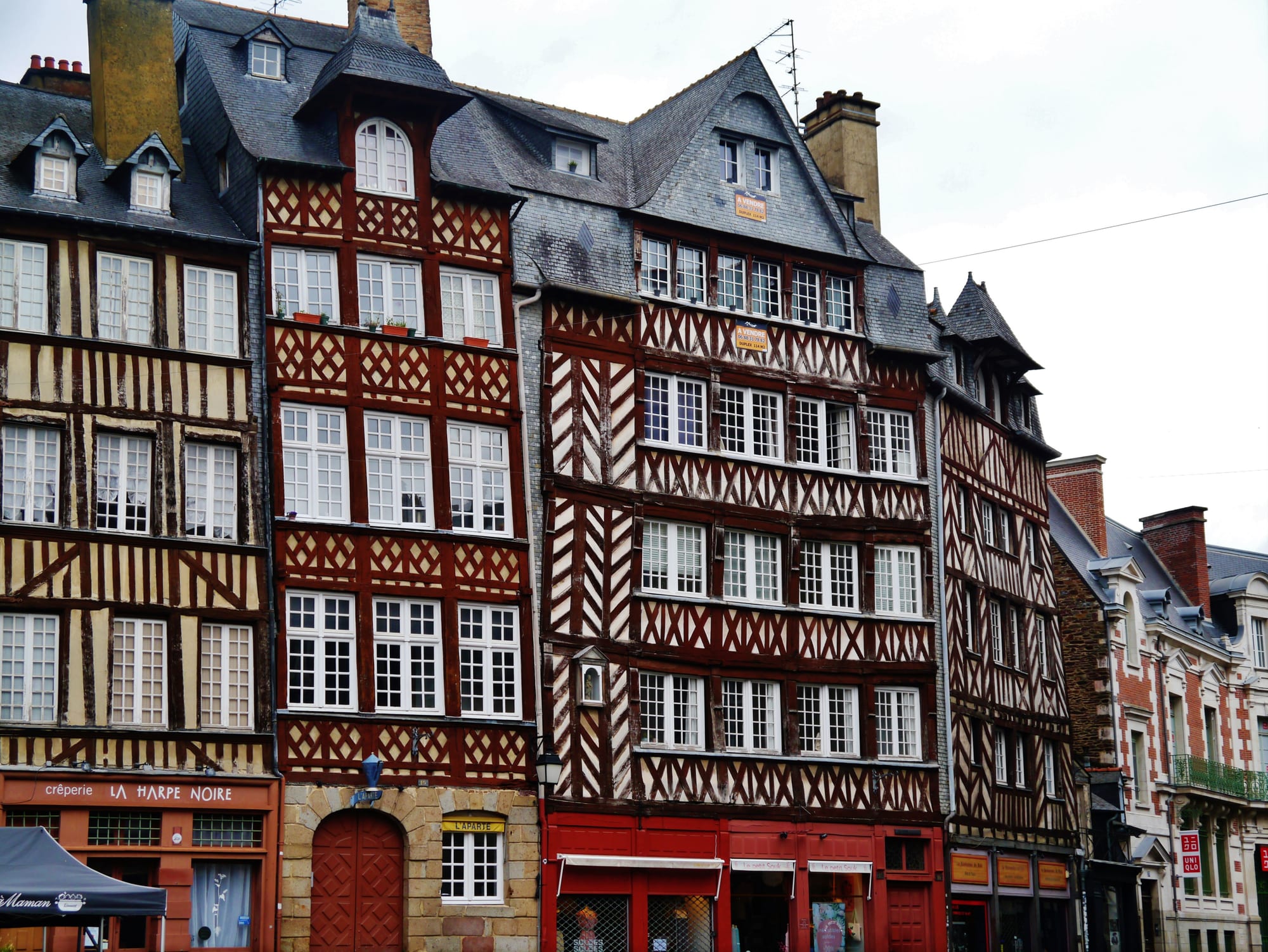
A row of tall half-timbered houses with red and ochre timbers, white windows and slate roofs on a Rennes square

Brittany, France

Rennes

Half-timbered houses on the Place du Champ-Jacquet in the old centre of Rennes. (Zairon / Wikimedia Commons · CC BY-SA 4.0)

The capital of Brittany, in the east of the region where the Ille meets the Vilaine. A Gallic and Roman town that became a ducal capital and then the seat of Brittany's parliament, it was rebuilt in stone after the fire of 1720. Today it is a fast-growing university and technology city with a half-timbered old centre, a big Saturday market and a busy nightlife.

Neighbourhoods

  • The historic centre
    • First-time visitors
    • Historic district
    • Architecture

    The old town on the hill north of the Vilaine, on the line of the former ramparts. Around the 17th-century Parlement, the streets rebuilt in stone after 1720 hold the city hall and the opera, while Rue Saint-Georges, Rue du Chapitre and the streets around the cathedral keep their colourful half-timbered houses.

    Open in Maps
  • Place Sainte-Anne and Rue Saint-Michel
    • Nightlife
    • Students and bars
    • Best for food

    The north-western corner of the old town around the Place Sainte-Anne and the Jacobin convent, now the convention centre. Rue Saint-Michel, nicknamed Rue de la Soif — the street of thirst — is known for its many bars, and the Place des Lices market square is next door.

    Open in Maps
  • Thabor and Saint-Hélier
    • Parks and gardens
    • Quiet and residential

    The quarter east of the centre around the Parc du Thabor and the abbey church of Saint-Melaine, with residential streets leading towards the old Oberthür printing works and its park.

    Open in Maps
  • South of the Vilaine and the station
    • Museums
    • Close to public transport

    The flatter, more modern south bank, with the Fine Arts Museum on the quay, the Champs Libres cultural centre, the 1922 covered market of Les Halles Centrales and the railway station, which both metro lines serve.

    Open in Maps

Things to do

Famous landmarks

  • Parlement de Bretagnelandmark

    The 17th-century seat of Brittany's parliament, begun in 1618 and opened in 1655, now the court of appeal; gutted by fire during a fishermen's protest in 1994, it was restored by 1999.

    Open in Maps
  • Rennes Cathedrallandmark

    The cathedral of Saint Peter in the old town, a monument historique since 1906, close to the half-timbered Rue du Chapitre.

    Open in Maps
  • Basilica of Saint-Sauveurlandmark

    A minor basilica in the old town dedicated to Our Lady of Miracles and Virtues.

    Open in Maps
  • Hôtel de Ville and the Opéralandmark

    The 18th-century city hall designed by Jacques Gabriel and, facing it across the Place de la Mairie, the Italian-style opera house inaugurated in 1836.

    Open in Maps
  • Place du Champ-Jacquetlandmark

    A square of tall half-timbered and Renaissance houses with a statue of the revolutionary mayor Jean Leperdit tearing up a conscription list.

    Open in Maps

Museums

  • Les Champs Libresmuseum

    A cultural centre designed by Christian de Portzamparc and opened in 2006 near the station, holding the city library, a science centre with a planetarium and the Museum of Brittany.

    Open in Maps
  • Museum of Brittanymuseum

    A museum of the region's social history inside the Champs Libres, whose first collections came from confiscations during the Revolution in 1794.

    Open in Maps
  • Musée des Beaux-Artsmuseum

    The city's fine arts museum on the Quai Émile Zola, with collections from ancient Egyptian antiquities to modern art.

    Open in Maps

Parks, markets and the canal

  • Parc du Thaborpark

    A public park of more than ten hectares near the centre, mixing French formal gardens, English-style lawns and a botanical garden with an orangery and a rose garden.

    Open in Maps
  • Marché des Licesmarket

    The big Saturday morning market on the Place des Lices and Place Rallier-du-Baty, one of the largest in France, selling Breton seafood, dairy, vegetables, cheese and meat.

    Open in Maps
  • Les Halles Centralesmarket

    A covered market of 1922 on the Place Honoré Commeurec, part of which has been converted into a contemporary art gallery.

    Open in Maps
  • Canal d'Ille-et-Rancetrail

    The 79 km canal linking the Vilaine at Rennes with Dinan, opened to navigation in 1832, which begins at the Mail lock in the city.

    Open in Maps

Music, sport and nights out

  • Roazhon Parkattraction

    The football stadium of Stade Rennais, first opened in 1912 and rebuilt in 2001 for nearly 30,000 spectators; Roazhon is the city's Breton name.

    Open in Maps
  • Rue Saint-Michelneighborhood

    The old-town street nicknamed Rue de la Soif for its row of bars, the centre of the city's student nightlife.

    Open in Maps

Short trips from the city

  • Paimpont Forestpark

    The forest around the village of Paimpont, also called Brocéliande, associated with the legends of Merlin and the Arthurian romances.

    Open in Maps
  • Vitréattraction

    A town to the east of Rennes, linked to the city by regional trains.

    Open in Maps
  • Fougèresattraction

    A sub-prefecture of Ille-et-Vilaine with about 20,000 inhabitants, north-east of Rennes.

    Open in Maps

Seasonal events

  • Festival TravellingFebruary

    The city's annual film festival.

  • MythosApril

    A festival of theatre, storytelling, myth and song.

  • Les Tombées de la NuitJuly

    A street-arts festival that takes over public spaces in the city each summer.

  • Les Rencontres Trans MusicalesDecember

    A three- or four-day music festival known for presenting new acts; its 2013 edition featured more than 80 groups and artists and drew over 62,000 people.

Eat and drink

Long-standing places and food districts in Rennes. Hours, ratings and directions come from your maps app, always current.

Rennes classics

  • Marché des Licesmarket

    The Saturday morning market where the region's seafood, milk, vegetables, cheese and meat are sold, and where a galette-saucisse is the traditional snack.

    Open in Maps
  • Crêperies of the old townneighborhood

    The half-timbered streets around the Place du Champ-Jacquet and the Place Sainte-Anne hold many crêperies serving galettes, crêpes and cider.

    Open in Maps

Food districts and bars

  • Les Halles Centralesmarket

    The 1922 covered market south of the Vilaine.

    Open in Maps
  • Rue Saint-Michel and Place Sainte-Anneneighborhood

    The bar street of Rennes, Rue de la Soif, and the square beside it, busiest on student nights.

    Open in Maps

Experience Rennes

History

By the 2nd century BC the Gallic Riedones had made their chief settlement at the meeting of the Ille and the Vilaine, and under Rome it became Condate Riedonum; the tribe's name eventually gave the city its own. The barbarian invasions later made the town shrink within a wall enclosing about nine hectares. In the Middle Ages Rennes became a fortress of the Breton March and then a capital of the duchy of Brittany, one of its major cities with Nantes and Vannes. During the War of the Breton Succession Henry of Grosmont besieged it in 1356–57, and Bertrand du Guesclin slipped into the city with supplies, putting new heart into its defenders.

After the union with France, Rennes became the parliamentary and administrative city of the province. The Parlement de Bretagne, begun in 1618, met here until the Revolution, and the city played an important role in the Stamped Paper Revolt of 1675. In 1720 a great fire destroyed the timber houses of the northern half of the city, which was rebuilt in stone on a grid plan, while the south kept more of its half-timbering. The railway arrived in 1857, and in 1899 the retrial of Alfred Dreyfus was held in Rennes.

German troops entered the city on 18 June 1940, and Allied bombing in 1943 and 1944 killed hundreds. After the war Rennes grew fast through rural migration and industry, including car manufacturing; in the 1980s it became a centre of telecommunications and high technology. From 2002 to 2008 it was the smallest city in the world with a metro, and in 1994 fire gutted the Parlement, which was restored by 1999.

Culture & Customs

Rennes is known as one of the most festive cities in France. In the 1980s it was a centre of French rock and new wave music, and the Transmusicales festival each December is known for presenting new acts. The calendar also includes the Travelling film festival in February, the Mythos festival of theatre, storytelling and song in April and the street-arts festival Les Tombées de la Nuit in July. The Champs Libres, with the regional library, a science centre and the Museum of Brittany, is the largest cultural institution in Brittany and receives more than a million visitors a year.

The city is labelled a city of art and history and has more than 90 buildings protected as historic monuments. The Parlement, the opera house of 1836, the 1920s Saint-Georges swimming pool with its mosaics and the half-timbered houses of the old streets give it a mix of classical grandeur and medieval charm.

Rennes lies in Upper Brittany, where Gallo was traditionally the local language, though Breton has always been spoken by migrants from the west; today Breton is taught in Diwan schools, bilingual classes and at the university, and the city adopted a plan to promote it in 2008. Football is followed closely: Stade Rennais plays at Roazhon Park, the stadium's name taken from the Breton name of the city.

Daily Life

The city had about 231,000 residents in 2023, and its metropolitan area, among the fastest-growing in France, had about 790,000. More than 70,000 students study here, making it one of the largest university centres in the country, with the Université de Rennes, Université Rennes 2 and several grandes écoles; in 2018 the magazine L'Express named Rennes the most liveable city in France.

The economy rests on car manufacturing, telecommunications, the digital sector and food processing. Orange is the largest private employer in the metropolitan area and Stellantis, with its plant at La Janais, the second; Rennes has the second-largest concentration of digital firms in France after Paris, and the newspaper Ouest-France is based here. A protected green belt around the ring road separates the dense city from its largely rural surroundings.

Rennes is divided into twelve quarters, from the historic centre and Thabor to outer quarters such as Villejean, Le Blosne and Maurepas. Daily life moves by metro, bus and bicycle, Saturday mornings revolve around the Marché des Lices, and evenings in term time belong to the students in the bars of the old town.

Food

The specialities of Rennes are those of Upper Brittany: the Breton galette, a savoury pancake of buckwheat flour; the sweet crêpe; and cider. The city's own emblem is the galette-saucisse, a grilled sausage wrapped in a buckwheat galette, first created in the 19th century and eaten at markets, outdoor events and football matches, where it is strongly associated with Stade Rennais.

The Marché des Lices, held every Saturday morning on the Place des Lices and among the largest markets in France, brings the produce of the region into the centre — seafood from the coast, milk, vegetables, cheese and meat from the farms of Ille-et-Vilaine. Les Halles Centrales, the covered market of 1922 south of the river, is the other traditional food hall.

The surrounding countryside also feeds the city's food industry, which has the third-highest innovation potential in the French agrifood sector, with firms such as Lactalis and Bridor. In the crêperies of the old town, a galette followed by a crêpe and a bowl of cider remains the classic inexpensive meal, while the bars of Rue Saint-Michel serve Breton beers and ciders to the student crowds.

Planning tools

Budget

Rennes is a reasonably priced city by French standards: crêperies and the market keep food costs down, and the metro and buses make a car unnecessary in the city. Prices rise for the big festivals and conferences.

Daily Budget Midrange
USD 140–240 (central hotel, restaurant dinners, museum entries, a day trip by train or car)
Daily Budget Shoestring
USD 70–110 (hostel or budget hotel, galettes and market food, metro and buses)

The Parc du Thabor, the old town, the Parlement square and the Saturday market cost nothing to enjoy.

Best Time to Visit

May to September for the warmest weather, outdoor terraces and the street-arts festival in July. The city is liveliest in term time, from September to June, when its students fill the bars; December brings the Transmusicales. Winters are mild but damp. Rennes is drier than western Brittany, with about half the rainfall of Quimper.

Suggested Number of Days

Two days are enough for the old town, the museums and the market. Three or four allow time for the surrounding towns and countryside of Ille-et-Vilaine. A Saturday stay adds the market; festival dates raise demand for rooms.

First Visit
2 days
With Surroundings
3–4 days

Transportation

Rennes has a driverless light metro of two lines, 28 stations and 23.5 km, with Line A opened in 2002 and Line B in 2022, backed by a network of 65 bus lines. The city launched France's first modern bike-sharing system in 1998, and a ring road, the Rocade, circles it. Within the centre, walking is easiest.

The Gares metro station serves both lines at the railway station; the old town is a short ride or a walk of a few minutes north.

Airport & Station Connections

Since 2017 the TGV has taken about 1 hour 27 minutes from Paris to Rennes station, which also has trains to Saint-Malo, Brest, Nantes, Lyon, Lille and other cities. Rennes–Saint-Jacques Airport is about 7 km south-west of the city centre. By road Saint-Malo is about 45 minutes away and Paris about four hours.

Walkability

The historic centre is compact and easy to explore on foot, with pedestrian streets around the cathedral, the Place des Lices and the Parlement. The station is a short walk south of the river, and the Parc du Thabor is within walking distance of the old town. Outer districts are best reached by metro or bus.

Safety

France is a safe country overall, with violent crime against visitors uncommon. Rennes is a calm city by day; the bar streets around Rue Saint-Michel and the Place Sainte-Anne are crowded and noisy late at night, especially on student nights; as anywhere, crowds at the market and at festivals call for an eye on bags and phones.

Keep bags closed in crowds, take the usual care around the late-night bar streets, and check for strikes or demonstrations before travel days. Check current official travel advice before travelling.

Climate

Oceanic, with mild temperatures, frequent cloud and much less rain than western Brittany. The average annual temperature at the airport is about 12.4°C, and rainfall averages about 680 mm a year.

Summer
mild to warm, with occasional heatwaves — the record of 40.5°C was set in July 2022
Winter
cool and damp, with rain on about 11 days in January; frosts occur, and the record low is −14.7°C

Local Customs

A 'bonjour' on entering a shop or café is expected. Service is included in restaurant bills, so tipping is modest — rounding up or leaving a little for good service. Rennes is a student city with an informal, sociable feel, and Breton signs and bilingual schools sit alongside French; locally the old language of the area was Gallo.

Keep noise down in residential streets late at night, and respect services in the cathedral and basilicas.

Common Payment Methods

The currency is the euro. Cards and contactless payment are accepted almost everywhere, including on the metro; a little cash is useful at the Saturday market and for small purchases. Cash machines are easy to find in the centre and at the station.