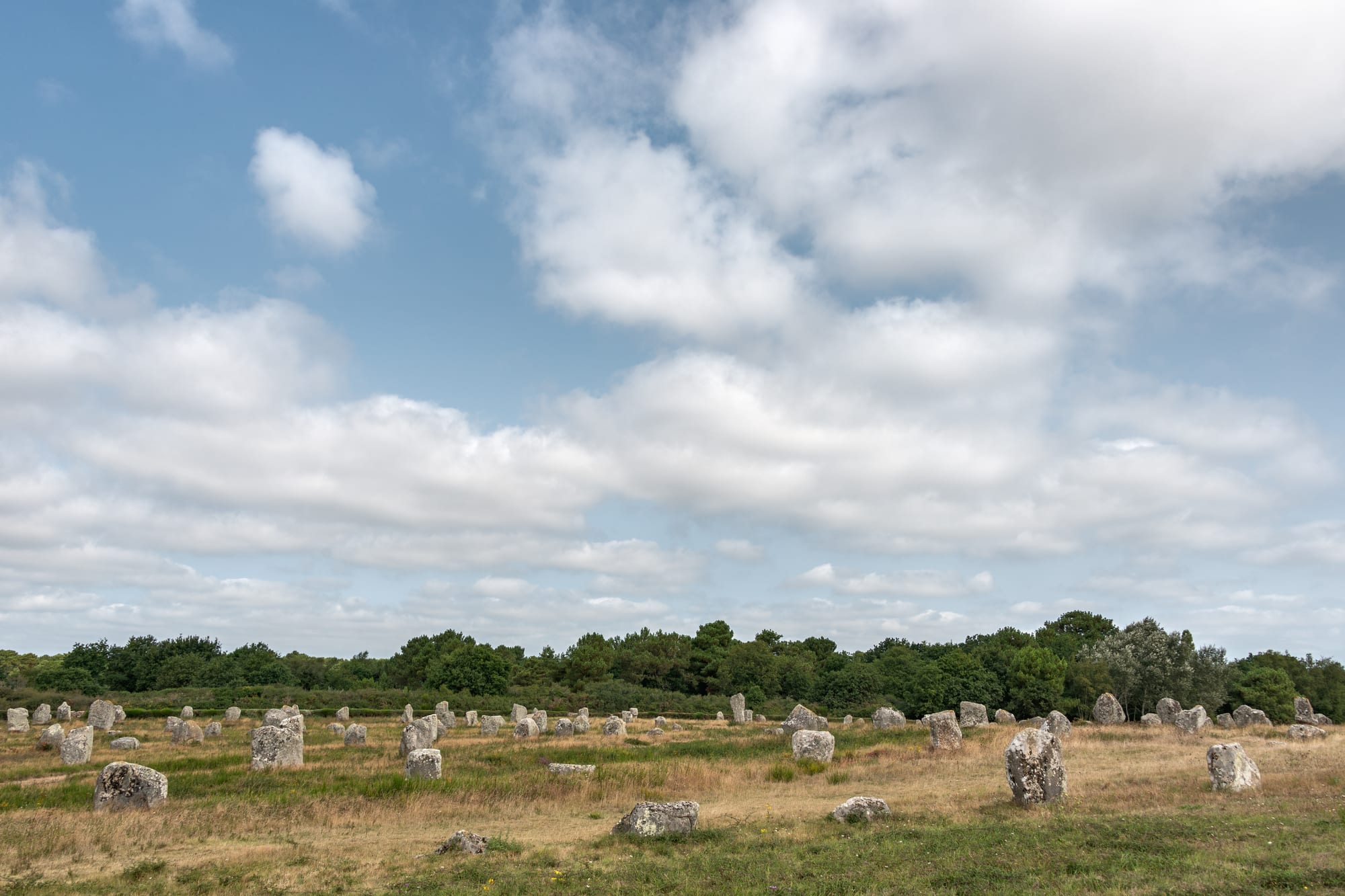
Rows of weathered grey standing stones in dry grass under a cloudy blue sky, with a line of trees behind

Brittany, France

Carnac

Standing stones of the Ménec alignments on the edge of Carnac. (Giorgio Galeotti / Wikimedia Commons · CC BY 4.0)

A small town on the south coast of Brittany, between Quiberon and the Gulf of Morbihan, surrounded by the Carnac stones — thousands of Neolithic menhirs set in long rows, listed by UNESCO in 2025. It is split between the old inland town of Carnac-Ville and Carnac-Plage, a resort built on former salt marshes in the early 20th century, whose five beaches fill each summer.

Neighbourhoods

  • Carnac-Ville
    • First-time visitors
    • Historic district
    • Museums

    The traditional town set back from the shore, grown from the old village around the 17th-century church of Saint-Cornély. The prehistory museum is here, and the stone rows and the Saint-Michel tumulus lie on its edges.

    Open in Maps
  • Carnac-Plage
    • Beaches
    • Nightlife
    • Families

    The seaside resort laid out from 1903 on the former salt marshes, with villas built in the early 20th century along the Grande Plage and neighbouring beaches. In summer its bars and clubs provide the town's nightlife.

    Open in Maps
  • The alignments
    • Prehistory
    • Walks

    The heath and woodland north of the town where the great stone rows of Ménec, Kermario and Kerlescan run for several kilometres along the D196 road, with campsites scattered in the woods nearby.

    Open in Maps
  • Saint-Colomban and the western beaches
    • Windsurfing
    • Beaches

    The western end of the shore towards the Pô headland and the bay of Plouharnel, where Saint-Colomban beach catches the strong westerly winds favoured by windsurfers.

    Open in Maps

Things to do

The stones

  • Ménec alignmentslandmark

    Eleven converging rows of menhirs stretching for about 1,165 metres, the tallest about 4 metres high at the western end, where the remains of a stone circle stand.

    Open in Maps
  • Kermario alignmentlandmark

    The 'house of the dead': 1,029 stones in ten rows about 1,300 metres long, fanning out east of Ménec, with a stone circle revealed by aerial photography.

    Open in Maps
  • Kerlescan alignmentslandmark

    A smaller group of 555 stones in thirteen lines, with a 39-stone circle at the western end where the tallest stones stand.

    Open in Maps
  • Saint-Michel tumuluslandmark

    The largest grave mound in continental Europe, built between 5000 and 3400 BC, 125 metres long and 12 metres high, which held jade axes and callaïs jewellery for a single burial.

    Open in Maps

Town and beaches

  • Musée de Préhistoire de Carnacmuseum

    The museum of prehistory, opened in 1881, holding the finds from the area's excavations, including finds from the Saint-Michel tumulus.

    Open in Maps
  • Église Saint-Cornélylandmark

    The parish church of the 17th century in Carnac-Ville, with a bell tower of 1639, dedicated to the saint who, in legend, turned an army to stone.

    Open in Maps
  • Grande Plagebeach

    The main beach of Carnac-Plage, lined with early 20th-century villas, one of the town's five beaches along with Men Dû and Beaumer to the east.

    Open in Maps
  • Saint-Colomban beachbeach

    The western beach of Carnac-Plage, the most popular with windsurfers for its exposure to strong westerly winds.

    Open in Maps

Short trips from the town

  • La Trinité-sur-Merattraction

    The port next door, separated from Carnac in 1864, with seafood restaurants along its quay, watersports competitions and some of the stone monuments within its boundaries.

    Open in Maps
  • Locmariaquer megalithslandmark

    A Neolithic complex at the western tip of the Gulf of Morbihan with the Er-Grah tumulus, the Table des Marchands dolmen and the great broken menhir.

    Open in Maps
  • Quiberonattraction

    The seaside resort at the tip of the Quiberon peninsula, joined to the mainland by a tombolo and known for its history of sardine fishing.

    Open in Maps
  • Gavrinislandmark

    A small island in the Gulf of Morbihan with a Neolithic passage tomb built around 4200–4000 BC, one of the oldest surviving buildings in the world.

    Open in Maps

Eat and drink

Long-standing places and food districts in Carnac. Hours, ratings and directions come from your maps app, always current.

Food districts

  • Carnac-Plage seafrontneighborhood

    Restaurants, crêperies, bars and clubs behind the Grande Plage, busiest in July and August.

    Open in Maps
  • La Trinité-sur-Mer quayneighborhood

    The harbour next door, whose quay is lined with seafood restaurants.

    Open in Maps
  • Carnac-Villeneighborhood

    The old town around the church, with crêperies and restaurants a short walk from the museum.

    Open in Maps

Experience Carnac

History

People lived near Saint-Colomban as early as about 450,000 years ago, on an ancient pebble beach beneath a cliff. Carnac's fame, though, comes from the Neolithic. Between about 4500 and 3300 BC local people raised more than 3,000 standing stones of local granite in rows and circles, alongside dolmens and burial mounds; the Saint-Michel tumulus, built between 5000 and 3400 BC, was the tomb of a ruling elite buried with jade axes from the Italian Alps and callaïs jewellery from Iberia. Later belief wove legends around the stones, among them the story that they were pagan soldiers turned to stone by Pope Cornelius — Saint Cornély, the town's patron.

The parish church of Saint-Cornély was built in the 17th century, its bell tower dated 1639. In June 1795 some 15,000 émigrés carried by British ships landed on the beaches of Légenèse and Ty Bihan and spread around Carnac, before Republican troops retook the town in early July and the expedition ended at Quiberon. In 1864 the fishermen of La Trinité-sur-Mer, finding the church too far from their port, won their own commune. The prehistory museum opened in 1881, and Zacharie Le Rouzic, a local who learnt archaeology on the job, became a recognised specialist on the megaliths.

In 1899 a Paris businessman and an engineer from Belle-Île founded the Société Carnac Plage, and in 1903 a resort was laid out on the salt marshes of Le Breno, making Carnac a town with two centres. Tourism grew strongly after the Second World War. Since 1991 the main stone rows have been fenced, and in 2025 the stones and hundreds of other monuments around Morbihan were listed as a UNESCO World Heritage Site.

Culture & Customs

The stones dominate Carnac's identity. They have drawn antiquarians, archaeologists and visitors for more than a century, and theories about them still divide researchers; the question of who raised them is still debated. Local tradition holds that their straight lines are a Roman legion turned to stone, by Pope Cornelius in one telling and by Merlin in a Breton Arthurian version. At the old pardon of Saint-Cornély, farmers from the surrounding villages brought their livestock on pilgrimage to the church and led them around it.

How the stones are looked after is a live issue. The fences put up in 1991 to protect the sites limit visits to organised tours, and the collective Holl a gevred — 'everyone together' in Breton — once occupied the Kermario visitor centre to demand local input into management plans. In June 2023 the destruction of 39 menhirs outside the protected area to build a DIY store drew criticism two years before the UNESCO listing.

The town supports the Breton language, translating council documents into Breton since 2008, and a share of its primary pupils attend bilingual classes. Summer culture is about the sea: sailing in the sheltered Bay of Quiberon, windsurfing at Saint-Colomban, and nights in the bars and clubs of Carnac-Plage.

Daily Life

Carnac's permanent population is about 4,200, but in July and August the town swells with holidaymakers and summer residents. About 71 per cent of its homes are second homes, one of the highest shares in Morbihan, and the permanent population is ageing. The town is the centre of a small urban unit of five communes, including La Trinité-sur-Mer, Plouharnel and Crac'h.

Tourism is the economy. Campsites fill the woods around the town and beside lakes such as the Étang du Moulin du Lac, the beaches and the sailing waters of the bay draw families, and the stones and the prehistory museum bring visitors year round; the museum alone received about 37,000 visitors in 2019. A thalassotherapy centre built on part of the drained salt pans adds a spa trade, while a few old salt pans survive, no longer worked.

The rhythm of life is seasonal. Out of season the two centres are quiet, while summer brings crowds to the beaches and the stones. The pressure to build, which led to the destruction of menhirs in 2023, remains a sensitive subject in a commune whose land holds monuments of world importance.

Food

Carnac eats like the rest of southern Brittany. A Breton galette is a savoury pancake made with buckwheat flour, followed by a sweet crêpe; kouign-amann, a round Breton cake of laminated dough layered with butter and sugar and baked until the sugar caramelises, is sold in local bakeries; and far breton, a dense baked dessert similar to a clafoutis batter with prunes or raisins, is a regional favourite.

The sea supplies the rest. Brittany offers a wide range of fresh seafood and fish, especially mussels and oysters, and the quay of neighbouring La Trinité-sur-Mer is lined with seafood restaurants. In the 19th century oyster beds and salt pans were laid out on Carnac's shore.

Cider is the traditional drink — Brittany is the second-largest cider-producing region in France, and Breton cider is traditionally served in a bowl or a cup — along with chouchen, a Breton mead made by fermenting honey in water, traditionally with buckwheat honey, and drunk chilled as an aperitif.

Planning tools

Budget

Carnac is a summer resort and prices follow the season: July and August are busy and expensive, with most rooms and campsite pitches booked well ahead, while spring and autumn are cheaper and calmer. Crêperies keep meals affordable, seafood platters are the splurge, and a car or bicycle is the usual way to reach the stones and beaches.

Daily Budget Midrange
USD 140–250 (hotel or guest house near the beach, seafood dinners, the museum and a guided tour of the stones, a hire car)
Daily Budget Shoestring
USD 70–110 (campsite pitch or simple room, crêperies and picnics, bicycle hire)

Many of the stones can be seen from the roadside and paths around the fenced sites; entry to the main rows is by organised tour.

Best Time to Visit

June and September give warm days, quieter beaches and easier access to the stones. July and August are the high season, when the town fills with holidaymakers and summer residents, and wind and waves bring sailors and windsurfers. Out of season the town is very quiet, as most houses are second homes.

Suggested Number of Days

One or two days cover the stone rows, the tumulus and the museum, with time on the beach. Three to five days allow for the wider megalithic landscape and the neighbouring coast. The season decides whether the beaches play a big part.

First Visit
1–2 days
With Surroundings
3–5 days

Transportation

The town, the beaches and the nearer stone rows can be covered on foot or by bicycle; a shared pedestrian and cycle path runs along the shore to La Trinité-sur-Mer. The alignments stretch for several kilometres along the D196, and a car or bicycle makes reaching them easier.

In summer, the seasonal 'Tire-Bouchon' train between Auray and Quiberon stops at Plouharnel-Carnac station, about 4 km north-west of the centre.

Airport & Station Connections

The nearest year-round railway station is Auray, about 12 km away, with connections to Paris and other parts of France. In summer the Auray–Quiberon line also stops at Plouharnel-Carnac. Most visitors arrive by car.

Walkability

Carnac-Ville and Carnac-Plage are separate centres, linked by roads and paths; each is easy on foot. The Ménec rows are close to the town, but Kermario and Kerlescan are further east along the road. The seafront path is flat and pleasant for walking and cycling.

Safety

France is a safe country overall, with violent crime against visitors uncommon. In Carnac the main risks come from the sea, where currents and conditions can change with the wind.

Swim at supervised beaches in summer, respect flags and warnings, and stay out of the fenced stone sites except on guided visits. Check current official travel advice before travelling.

Climate

Oceanic and windy, with mild summers and mild temperatures year round; the average annual temperature is about 12°C in Carnac and nearly 13°C at nearby Quiberon.

Summer
mild to warm and breezy; at nearby Quiberon the record high is 35.4°C, set in August 2003
Winter
mild and wet, with Atlantic storms; at nearby Quiberon the record low is −9.2°C

Local Customs

A 'bonjour' on entering a shop or café is expected, and service is included in restaurant bills, so tipping is modest. The town encourages the Breton language, with council documents translated into Breton and bilingual school classes. The stones are protected monuments, and the management of the sites remains a sensitive local subject.

Do not climb on or move the stones, keep to paths around the alignments, and dress modestly in the church.

Common Payment Methods

The currency is the euro. Cards and contactless payment are accepted in most shops, restaurants and campsites; a little cash helps at markets and small stalls. Cash machines are found in both Carnac-Ville and Carnac-Plage.