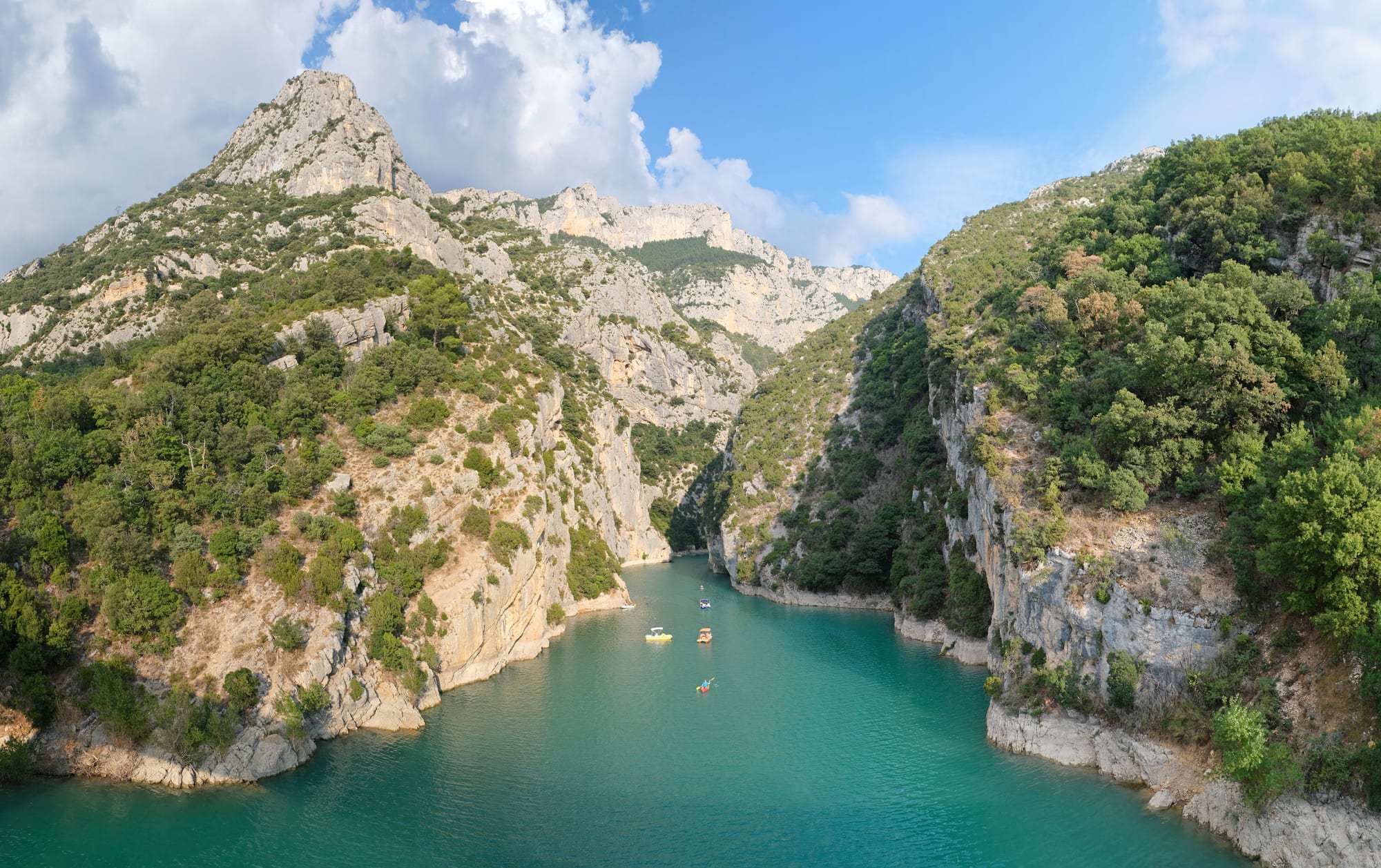
Turquoise river water between steep limestone cliffs and wooded slopes, with small pedal boats on the water

France

Provence & the Côte d'Azur

The mouth of the Verdon Gorge, seen from the Galetas bridge above the Lac de Sainte-Croix. (kallerna / Wikimedia Commons · CC BY-SA 4.0)

France's south-eastern corner, stretching from the Rhône delta to the Italian border and up into the southern Alps — Greek-founded Marseille, papal Avignon and Roman Arles, the hill villages and lavender of the Luberon, the Verdon Gorge, and the Riviera resorts of Nice, Cannes and Saint-Tropez.

Explore Provence & the Côte d'Azur

History

Greek sailors from Phocaea founded Massalia, now Marseille, around 600 BC, and it became a major trading port. Rome made the region its first province beyond the Alps — the Provincia that gave Provence its name — and founded Aix, as Aquae Sextiae, in 123 BC. Arles, Orange and Vaison-la-Romaine still have Roman arenas, theatres and arches.

In 1309 the papacy moved to Avignon, and seven popes lived there until 1376; the city stayed papal territory until the Revolution. The Counts of Provence held court at Aix, and under King René, in the 15th century, the town became a cultural centre. Provence passed to the French crown in the 1480s. Nice, however, belonged to Savoy until 1860, when it was ceded to France. In 1720 plague arrived by ship and killed much of Marseille's population, and in 1792 volunteers from the city made the Marseillaise famous on their march to Paris.

The Riviera was developed as a winter resort in the 19th century, largely by British visitors, and Cannes and Nice grew rapidly. Allied forces landed on the Var coast in August 1944. After Algerian independence in 1962 many returning French settlers made the region their home, and in recent decades high-tech industry, the Sophia Antipolis science park and tourism have transformed the coast.

Culture & Customs

Provençal, a form of Occitan, was revived in the 19th century by the poet Frédéric Mistral, who won the Nobel Prize for Literature in 1904, and the language survives in place names, songs and festivals. Nice has its own dialect, Niçard. At Christmas, Provençal families set out clay figurines called santons in the crib and eat thirteen desserts. Pétanque was invented at La Ciotat in the early 20th century and is played in village squares throughout the region.

The region has inspired many painters. Cézanne painted the Montagne Sainte-Victoire near Aix, Van Gogh worked in Arles and Saint-Rémy, and Matisse, Picasso, Chagall and Renoir settled on the Riviera. The Avignon Festival is one of the world's leading theatre festivals, and the Cannes Film Festival brings stars in May. Arles holds ferias with bullfights, and in the Camargue the gardians herd horses and black bulls; Roma pilgrims gather at Saintes-Maries-de-la-Mer each May.

Grasse is the centre of the French perfume industry, and the perfume skills of the Grasse area are recognised by UNESCO as intangible heritage. Marseille has a mixed, working-class identity shaped by immigration, as well as a passionate following for Olympique de Marseille.

Daily Life

About five million people live in Provence-Alpes-Côte d'Azur. Marseille, with about 870,000 residents, is the second-largest city in France; Nice has about 340,000, and Toulon, Aix-en-Provence, Avignon, Cannes and Antibes are the other main towns. Most people live along the coast and the Rhône, while the Alpine departments are thinly populated.

Tourism is the largest industry. Marseille's port, Toulon's naval base, aerospace and electronics, the Sophia Antipolis technology park near Antibes and the ITER fusion research project at Cadarache also provide jobs, and inland Provence produces wine, fruit, olive oil and lavender.

The rhythm of life is Mediterranean: early markets, long lunches and evenings outdoors. The region has sharp contrasts between wealthy coastal areas and poorer suburbs, especially in Marseille. Housing is expensive, and water shortages, wildfires and summer overcrowding are ongoing concerns.

Food

Provençal cooking is built on olive oil, garlic, tomatoes and herbs. Bouillabaisse is Marseille's fish stew, served with rouille, a saffron and garlic sauce, on toasted bread. Aïoli is a garlic mayonnaise served with cod and vegetables, pistou is a vegetable soup with basil and garlic, and daube provençale is beef stewed in red wine. Tapenade is a paste of olives, capers and anchovies, and panisse is fried chickpea flour.

Nice has its own specialities: socca, a thin chickpea pancake; pissaladière, an onion tart with anchovies and olives; salade niçoise; pan bagnat, a sandwich filled with the same ingredients; and ratatouille, a stew of summer vegetables. Sweets include the calissons of Aix, made of almond paste and candied melon, Marseille's navettes, boat-shaped biscuits, and the tarte tropézienne, a cream-filled brioche from Saint-Tropez. Banon is a goat's cheese wrapped in chestnut leaves, Cavaillon is known for melons, and black truffles are sold in winter markets in the Vaucluse.

Pastis, an aniseed spirit diluted with water, is Marseille's aperitif. Côtes de Provence rosé is the region's most famous wine, alongside the reds of Bandol, Châteauneuf-du-Pape and Gigondas, and the whites of Cassis.

Attractions & Natural Wonders

Marseille offers the Vieux-Port, the Basilica of Notre-Dame de la Garde, the Panier quarter, the MuCEM museum, the Château d'If and the Calanques, limestone inlets between Marseille and Cassis. Aix-en-Provence has the Cours Mirabeau, fountains and Cézanne's studio, with the Montagne Sainte-Victoire nearby. Arles has its Roman arena, and the Camargue has flamingos, rice fields and white horses. Les Baux-de-Provence and Saint-Rémy lie in the Alpilles.

Avignon's Palace of the Popes and the Pont Saint-Bénézet are UNESCO-listed, and Orange has a Roman theatre. Mont Ventoux rises to the north-east. In the Luberon, Gordes, Roussillon's ochre cliffs, Lourmarin, Bonnieux and the Abbey of Sénanque are the main highlights. Further east, the Verdon Gorge can be seen from its rim roads, from the Lac de Sainte-Croix or by kayak, with Moustiers-Sainte-Marie and the Valensole plateau's lavender nearby.

On the coast, Nice has the Promenade des Anglais, Vieux-Nice, the Castle Hill and the Matisse and Chagall museums. Villefranche, Èze and Menton lie to the east. Cannes has the Croisette and the Lérins Islands offshore, Antibes has the Picasso museum, and Saint-Paul-de-Vence and Grasse lie inland. Saint-Tropez has its port and citadel, the Esterel has red rocks, and Porquerolles is among the Hyères islands. The Mercantour and Écrins national parks and the fortified town of Briançon lie in the Alps.

Cities in Provence & the Côte d'Azur

Planning basics

Budget

The Côte d'Azur is among the most expensive places in France, with Cannes, Saint-Tropez and the villages near Nice charging very high summer prices, especially during the Cannes Film Festival and the Monaco Grand Prix. Marseille, Toulon and inland Provence are more reasonable, and the Alpine valleys and the Alpes-de-Haute-Provence are good value. Beach clubs and parking add up quickly.

Daily Budget Midrange
USD 180–370 (mid-range hotel, restaurant dinners, museums, a hire car for inland Provence)
Daily Budget Shoestring
USD 80–140 (hostel, bakery and market food, TER trains and regional buses)

Staying in Nice and taking the coastal train is far cheaper than sleeping in Cannes or Saint-Tropez in summer.

Safety

The region is safe for visitors, but theft is a greater problem than elsewhere in France. Phone and bag snatching and car break-ins are common in Marseille and Nice, and drug-related violence occurs in some northern districts of Marseille, which are away from the tourist areas. Wildfire risk is high in summer, and access to forests and the Calanques may be restricted on high-risk days.

Leave nothing visible in parked cars and check forest access rules before hiking in summer. Check current official travel advice before travelling.

Climate

Typically Mediterranean: long, hot, dry summers, mild winters and a great deal of sunshine, with the Riviera coast sheltered by the mountains and rarely freezing. The mistral, a cold north wind, blows down the Rhône valley and across Provence, sometimes for days. The southern Alps have snowy winters, and autumn storms can cause sudden flooding.

Summer
hot and dry, 28–35°C inland, a little cooler on the coast
Winter
mild on the coast, 7–14°C; colder inland, with snow in the Alps

Transportation

The TGV reaches Avignon, Aix and Marseille in about three hours from Paris and continues along the coast to Nice. Nice airport is one of the busiest in France. A coastal railway links Cannes, Antibes, Nice and Menton, and Nice and Marseille have trams. Summer traffic along the coast is very heavy, and Saint-Tropez has no station. A car is needed for the Luberon, the Verdon and the mountains.

Use the coastal train between the Riviera towns; boats from Sainte-Maxime avoid the Saint-Tropez traffic jams in summer.

Best Time to Visit

May, June and September are the best months, with warm seas and fewer crowds. Lavender is in bloom from late June to mid-July. July and August are very hot and crowded, especially on the coast. The Riviera is pleasant in winter, when Nice's Carnival and Menton's lemon festival take place in February, and the southern Alps are open for skiing.