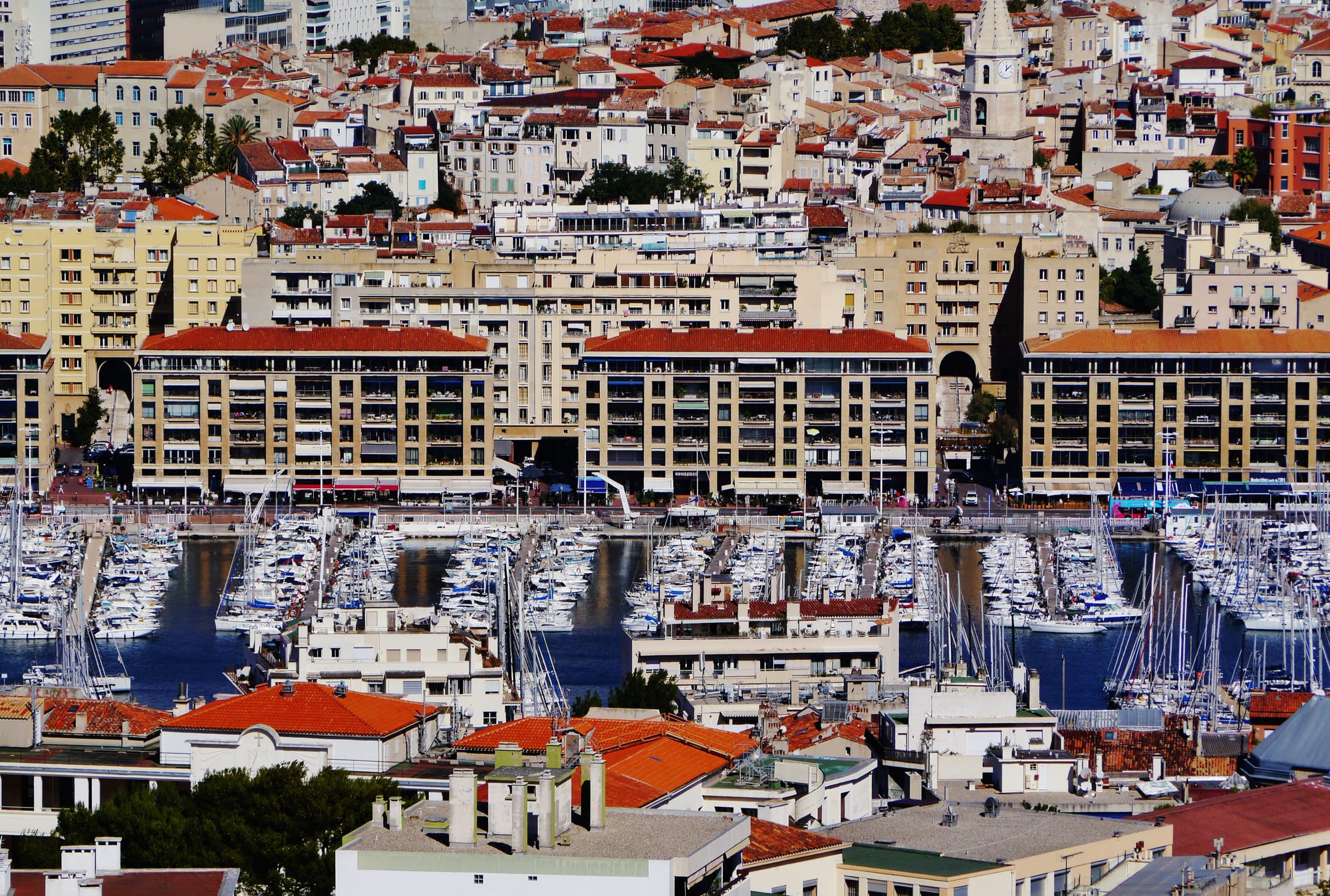
Rows of white yachts in the Old Port of Marseille below blocks of pale flats and a hillside of red-tiled roofs

Provence & the Côte d'Azur, France

Marseille

The Vieux-Port and the old town seen from the Basilica of Notre-Dame de la Garde. (Zairon / Wikimedia Commons · CC BY-SA 4.0)

France's oldest city and largest port, founded by Greek settlers around 600 BC on the Mediterranean east of the Rhône delta. Trade with the empire made it rich, and migration from around the Mediterranean made it a cosmopolitan city. Today its Old Port, hilltop basilica, waterfront museums and the Calanques national park sit beside sharp divides of wealth.

Neighbourhoods

  • Vieux-Port
    • First-time visitors
    • Best for food
    • Close to public transport

    The old harbour at the heart of the city, guarded by Fort Saint-Jean and Fort Saint-Nicolas and lined with dozens of cafés. The fish market is held on the Quai des Belges, boats leave for the islands and the Calanques, and the Canebière runs inland from its head.

    Open in Maps
  • Le Panier
    • Historic district
    • Street life

    The oldest part of the city, on the hill north of the Old Port, with steep lanes and the Vieille Charité. Its June festival fills the streets with concerts and outdoor bars.

    Open in Maps
  • Noailles and the Canebière
    • Markets
    • Local life
    • Close to public transport

    The busy streets just off the city's main boulevard, where the Noailles market brings together Lebanese bakeries, African spice stalls, Chinese and Vietnamese groceries and fish sellers — the most direct view of multicultural Marseille.

    Open in Maps
  • Cours Julien
    • Nightlife
    • Street art
    • Best for food

    A pedestrianised square and the streets around it near the Music Conservatory, full of bars, restaurants, small shops and murals, and named by Time Out in 2024 among the coolest neighbourhoods in the world.

    Open in Maps
  • La Joliette and Euroméditerranée
    • Modern architecture
    • Museums

    The old docks north of the cathedral, rebuilt since the 1990s into a business district with the CMA CGM tower, converted warehouses and shops, a short walk from the MuCEM.

    Open in Maps
  • The Corniche and Vallon des Auffes
    • Viewpoints
    • Seafront walks

    The coast road running south from the Old Port along the bay, past the Catalans beach to the tiny fishing harbour of the Vallon des Auffes and on towards the Prado beaches.

    Open in Maps
  • L'Estaque
    • Quiet and residential
    • Art history

    A small port at the far western end of the bay that became a favourite haunt of painters, including Renoir and Cézanne.

    Open in Maps

Things to do

Famous landmarks

  • Notre-Dame de la Gardelandmark

    The 19th-century Romano-Byzantine basilica on the hill south of the Old Port, known as la Bonne Mère and the symbol of the city, with a terrace looking over all of Marseille.

    Open in Maps
  • Old Portlandmark

    The harbour where the city began, still its centre, with the daily fish market on the Quai des Belges and a free ferry across the water.

    Open in Maps
  • Marseille Cathedrallandmark

    La Major, a gigantic Romano-Byzantine cathedral rebuilt in the second half of the 19th century beside the port, keeping parts of its medieval predecessor.

    Open in Maps
  • Abbey of St Victorlandmark

    One of the oldest places of Christian worship in Europe, whose fifth-century crypt and catacombs occupy an ancient Greek burial ground.

    Open in Maps
  • Fort Saint-Jeanlandmark

    The fort on the north side of the harbour mouth, linked by footbridges to the MuCEM and to Le Panier.

    Open in Maps
  • Canebièrelandmark

    The city's historic high street, running for about a kilometre from the head of the Old Port to the Réformés quarter.

    Open in Maps
  • Unité d'Habitationlandmark

    Le Corbusier's influential modernist apartment block of 1952, with a restaurant inside and the MaMo art gallery on the roof.

    Open in Maps

Museums

  • MuCEMmuseum

    The museum of European and Mediterranean civilisations, opened in 2013 on the waterfront beside Fort Saint-Jean.

    Open in Maps
  • Vieille Charitémuseum

    A former almshouse in Le Panier designed by the Puget brothers, with a baroque chapel in an arcaded courtyard, now home to an archaeology museum and a gallery of African and Asian art.

    Open in Maps
  • Marseille History Museummuseum

    The city's history from Greek and Roman times, including the hull of a 2nd-century ship, claimed to be the best-preserved vessel of its period in the world, beside the remains of the ancient port.

    Open in Maps
  • Palais Longchampmuseum

    A colonnaded 19th-century palace behind a cascading fountain that celebrates the arrival of the Canal de Marseille, housing the fine arts and natural history museums.

    Open in Maps
  • Musée Cantinimuseum

    A museum of modern art near the Palais de Justice, with works linked to Marseille and several by Picasso.

    Open in Maps

The coast and islands

  • Château d'Iflandmark

    The island fortress and former prison in the bay, made famous as a setting of The Count of Monte Cristo and reached by ferry from the Old Port.

    Open in Maps
  • Frioul archipelagopark

    Four islands in the bay, two of them joined by a mole built in 1822, served by ferries from the Old Port.

    Open in Maps
  • Plages du Pradobeach

    Artificial beaches and a seaside park in the south of the city, built in the late 1970s with spoil from the metro.

    Open in Maps
  • Parc Borélypark

    A large park near the sea with a botanical garden and the Château Borély, now a museum of decorative arts, fashion and ceramics.

    Open in Maps
  • Calanques National Parkpark

    The national park created in 2012, protecting limestone cliffs and inlets such as Sormiou, Morgiou and Sugiton between the city's southern districts and Cassis.

    Open in Maps

Sport, music and nights out

  • Stade Vélodromeattraction

    The home of Olympique de Marseille, seating around 67,000, and a venue for World Cup and European Championship matches.

    Open in Maps
  • Opéra de Marseilleattraction

    The opera house near the Old Port, rebuilt in Art Deco style behind its classical façade after a fire in 1919.

    Open in Maps
  • La Fricheattraction

    An extensive arts centre in a former match factory behind Saint-Charles station.

    Open in Maps

Short trips from the city

  • Cassisattraction

    A small port town east of the Calanques, known for its white wines and reached by road or by boat from the Old Port.

    Open in Maps
  • Aix-en-Provenceattraction

    The former capital of Provence, about 30 km north, with its plane-lined Cours Mirabeau and Cézanne's studio.

    Open in Maps

Seasonal events

  • Candlemas processionearly February

    A Black Madonna from the crypt of Saint-Victor is carried along Rue Sainte for the archbishop's blessing, a medieval tradition.

  • Fête du PanierJune

    The old quarter's neighbourhood festival, with concerts, street entertainment and outdoor bars.

  • Mondial la Marseillaise à PétanqueJuly

    The main pétanque competition, held since 1961 with the Parc Borély at its centre.

  • Marsataclate September

    A festival of electronic music.

  • Fiesta des SudsOctober

    A festival of world music concerts.

  • Marseille-Cassislast weekend of October

    A half marathon from Marseille over the hills to Cassis, ranked among the most prestigious in the world.

Eat and drink

Long-standing places and food districts in Marseille. Hours, ratings and directions come from your maps app, always current.

Marseille classics

  • Bouillabaisse on the Old Portneighborhood

    The Old Port is one of the main places to eat in the city, and its restaurants are where most visitors try the city's fish stew.

    Open in Maps
  • Vallon des Auffesneighborhood

    Seafood restaurants around the little fishing harbour below the Corniche.

    Open in Maps

Food districts and markets

  • Quai des Belges fish marketmarket

    The daily market where fishermen sell the local catch at the head of the Old Port.

    Open in Maps
  • Noailles marketmarket

    Also called the Marché des Capucins: Lebanese bakeries, African spices, Chinese and Vietnamese groceries, couscous and Caribbean food side by side near the Old Port.

    Open in Maps
  • Cours Julienneighborhood

    The square and surrounding streets packed with bars and restaurants, among the liveliest places to eat and drink in the city.

    Open in Maps

Experience Marseille

History

Greek settlers from Phocaea founded Massalia around 600 BC, and it became the leading Greek city of southern Gaul. It sided with Rome against Carthage and kept its independence and trade empire until 49 BC, when it backed the losing side in Caesar's civil war and was besieged and taken. It remained a major port under the Visigoths, declined after a sack in 739, joined the County of Provence in the 10th century, and suffered the Black Death and a sack by the Crown of Aragon before René of Anjou rebuilt its defences in the 15th century.

In 1720 the Great Plague killed a large part of the population, though numbers had recovered by mid-century. In 1792 volunteers from the city sang the new revolutionary anthem on their way to Paris, and it has been called the Marseillaise ever since. The 19th century brought industry and the colonial empire; new docks at La Joliette replaced the Old Port for trade, and Marseille became one of Europe's busiest ports by 1900. During the German occupation the northern quayside was destroyed in 1943, later rebuilt by Fernand Pouillon.

After 1962 French citizens from Algeria, Morocco and Tunisia arrived in large numbers; the port and docks declined in the 1970s after the oil crisis. Gaston Defferre was mayor from 1953 until 1986. The Euroméditerranée renewal project began in the 1990s, and the city was European Capital of Culture in 2013, opening the MuCEM and other new museums. Since the early 2020s it has struggled with a notable rise in drug trafficking and organised crime.

Culture & Customs

Openness to the Mediterranean has shaped Marseille for 2,600 years. Waves of Provençals, Italians, Armenians, Corsicans, Jews from North Africa, Maghrebis, Comorians, Vietnamese and Chinese have made it a cosmopolitan city, with the third-largest Jewish community on the continent and the second-largest Corsican and Armenian populations in France. Residents of many origins share a strong local identity, and the city stayed relatively calm during the riots that shook other French suburbs in 2005.

The arts range from the opera house and the theatres of La Criée and Le Gymnase to La Friche, a former factory turned arts centre. Painters from Renoir to Cézanne worked at L'Estaque. Marseille is also a capital of French hip hop — IAM, Fonky Family and Keny Arkana come from here — and of ragga through Massilia Sound System. The Marseille dialect, coloured by Provençal, Italian and Arabic, gives the city words such as 'fada' and 'peuchère'.

Football is close to a religion: Olympique de Marseille became the first French club to win the Champions League, and the Stade Vélodrome seats around 67,000. Pétanque is played everywhere, and the Mondial la Marseillaise à Pétanque each July is the sport's biggest competition. Sailing, water polo and the Marseille–Cassis road race complete the picture.

Daily Life

About 886,000 people lived in the city in 2023, making it the second-largest city proper in France, and about 1.9 million in the wider metropolitan area. The city is divided into 16 arrondissements and 111 informal quartiers; the south-east lies inside the Calanques National Park, making Marseille the only large French city with a national park within its limits.

The port remains the economic engine — the first in France, with about 45,000 jobs linked to it — alongside the shipping group CMA CGM, Airbus Helicopters, subsea engineering, oil refining, research centres at Luminy and Château-Gombert, and a growing service sector in the Euroméditerranée business district. Tourism and cruises bring millions of visitors. Unemployment, 13.1 per cent in 2022, remains above the national average, and youth unemployment is far higher in some districts.

The city is sharply divided between the poorer, largely Muslim northern districts and the richer south, though rich and poor neighbourhoods also sit side by side. Everyday life spills outdoors: markets in the morning, pétanque in the squares, the beaches in summer, and the whole city stopping for OM's matches.

Food

Bouillabaisse is Marseille's most famous dish: a fish stew made with at least three kinds of very fresh local fish, typically red rascasse, sea robin and conger, often with shellfish and sea urchins. Traditionally the fish is served on a platter separate from the broth, which comes with rouille — a mayonnaise of egg yolk, olive oil, red pepper, saffron and garlic — spread on toasted bread. In Marseille it is rarely made for fewer than ten people. Bourride is a soup of white fish and aïoli.

The everyday table is Provençal. Aïoli, a sauce of raw garlic, lemon juice, eggs and olive oil, is served with boiled fish, eggs and vegetables; anchoïade is a paste of anchovies, garlic and olive oil; tapenade is made from olives and capers. Soupe au pistou combines a sauce of basil, garlic and olive oil with a broth of pasta and vegetables, and pieds paquets is a dish of sheep's feet and offal. Cade is chickpea flour cooked into a mush, set, cut into blocks and fried, and fougasse is a flat Provençal bread, sometimes filled with olives, cheese or anchovies.

Navettes, boat-shaped biscuits tasting faintly of orange peel, have been made in the same shop since 1781. Pastis, flavoured with aniseed and spice, is the drink of the region. The fish market on the Quai des Belges and the Noailles market, with its Lebanese, North African and Asian stalls, show how the city eats today.

Planning tools

Budget

Marseille is cheaper than the Riviera and much of Provence's tourist country, with good-value street food and markets. Bouillabaisse is the exception, traditionally a large shared meal. Ferries and boat trips to the islands and the Calanques, museum tickets and taxis are the main extra costs.

Daily Budget Midrange
USD 170–330 (mid-range hotel, restaurant dinners, museums, boat trips to the islands and Calanques)
Daily Budget Shoestring
USD 75–130 (hostel bed, market food and street snacks, metro, tram and buses)

Use the free ferry across the Old Port and the public boats for the coast; a bouillabaisse is best shared by a group.

Best Time to Visit

May, June and September are warm and good for walking in the Calanques and swimming. July and August are hot, and access to the Calanques massif may be restricted on high fire-risk days. Winter is mild, and Marseille gets the most sunshine of any French city, though the mistral can blow cold and hard.

Suggested Number of Days

Two or three days cover the centre, the museums and a boat trip. Allow four or five to walk in the Calanques and see the nearby towns, and more in summer, when the beaches add time.

First Visit
2–3 days
With Surroundings
4–5 days

Transportation

Two metro lines cross the city and meet at Saint-Charles station and Castellane, and three tram lines serve 32 stations. More than a hundred bus lines cover the rest. There is a bike share scheme, a free ferry across the Old Port and boat services from the Old Port to the Frioul islands, the Calanques and Cassis. Driving in the centre is slow and parking difficult.

Buy tickets from the machines before boarding the metro, which uses turnstiles, and allow time for traffic on the coast roads in summer.

Airport & Station Connections

Marseille Provence Airport, one of the busiest in France, is at Marignane on the Étang de Berre, about 27 km north-west of the city. Saint-Charles station is reached in about three hours from Paris by TGV, with direct trains to Lyon, Nice, Montpellier and beyond, and has a long-distance bus station beside it. The Gare Maritime has ferries to Corsica, Sardinia, Algeria and Tunisia.

Walkability

The centre around the Old Port, Le Panier, the Canebière, Noailles and the Cours Julien is walkable, though Le Panier is steep and the climb to Notre-Dame de la Garde is long and hard in the heat. The city is large and hilly, so the metro, tram and buses are needed for the beaches, the Corniche and the Calanques.

Safety

France is a safe country overall, with violent crime against visitors uncommon. Marseille has a harder reputation: bag and phone snatching and car break-ins are common, and drug trafficking and related violence by organised criminal networks have risen notably since the early 2020s. The centre around the Old Port is busy and generally safe.

Carry few valuables, watch phones in crowds and on public transport, leave nothing in a parked car, avoid wearing rival football shirts on match days, and check fire-risk access rules before walking in the Calanques in summer. Check current official travel advice before travelling.

Climate

A hot-summer Mediterranean climate with mild winters, the most sunshine of any French city and the least rain of any large one. The mistral, a cold, dry wind from the Rhône valley, keeps the air clear; snow is infrequent.

Summer
hot and mostly dry — July and August days average around 28–30°C and nights about 19°C
Winter
mild — days around 12°C and nights about 4°C, with the mistral bringing cold, bright spells

Local Customs

Greet shopkeepers with 'bonjour'. Service is included in restaurant prices, so tipping is modest. The Marseillais are known for a colourful, exaggerating way of speaking, with words such as 'fada' (a little mad) and 'minot' (child), and for passionate loyalty to Olympique de Marseille. Pétanque is a serious pastime, and pastis is the aperitif.

Dress modestly in Notre-Dame de la Garde, La Major and Saint-Victor, and ask before photographing stallholders in the markets.

Common Payment Methods

The currency is the euro. Cards and contactless payment are accepted almost everywhere. Carry some cash for the markets of Noailles and the Quai des Belges. ATMs are easy to find in the centre.