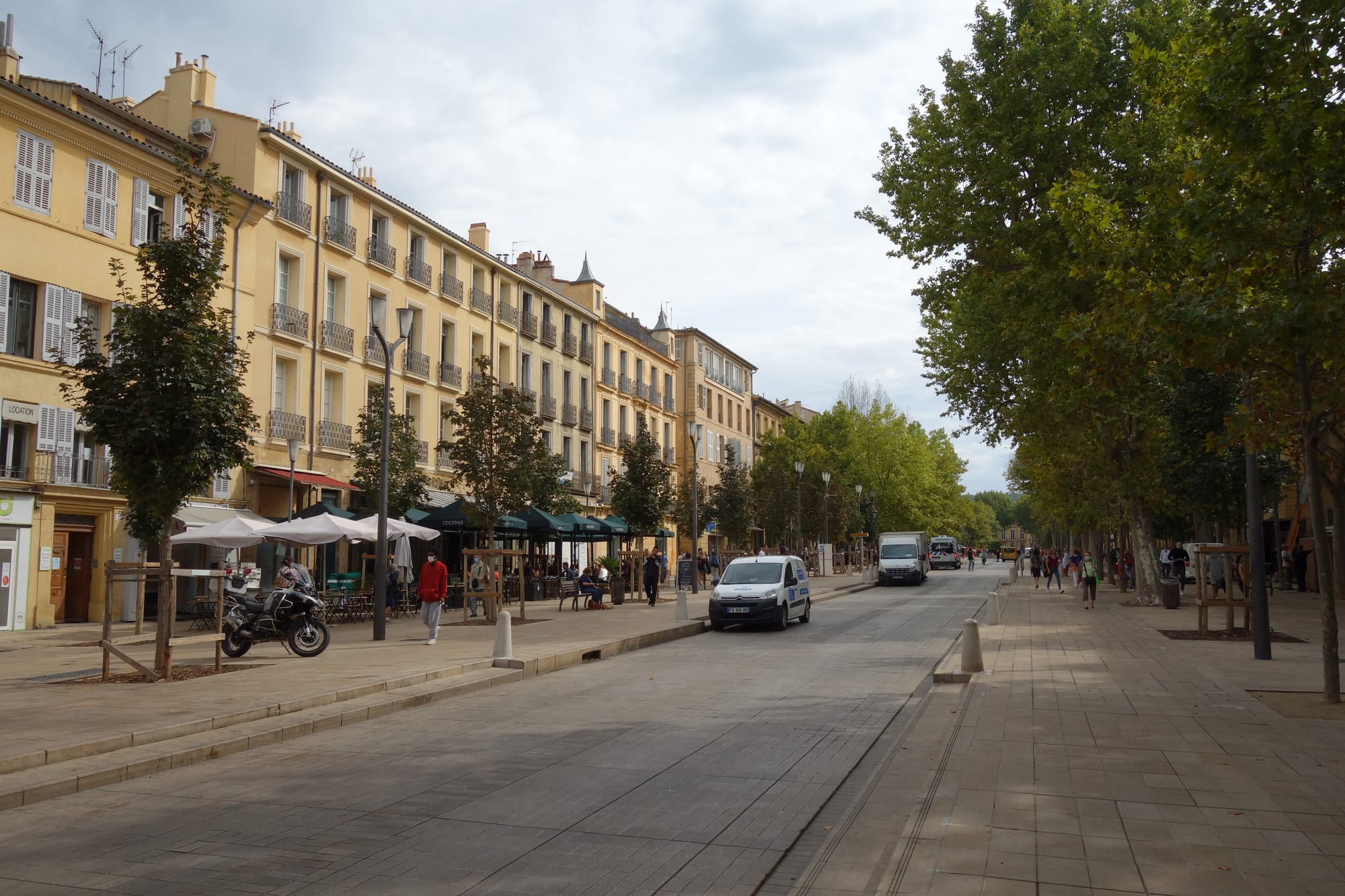
A wide avenue lined with plane trees on one side and pale yellow stone houses with café terraces on the other

Provence & the Côte d'Azur, France

Aix-en-Provence

The Cours Mirabeau, the plane-lined main avenue of Aix-en-Provence. (Pimlico27 / Wikimedia Commons · CC BY-SA 4.0)

A former capital of Provence on a plain above the Arc river, about 30 km north of Marseille, founded by the Romans around warm springs in 123 BC. Its parliament and nobility left an old town of 17th- and 18th-century mansions, plane-shaded avenues and fountains; today it is a university city of about 150,000, Cézanne's birthplace and home to an international opera festival.

Neighbourhoods

  • The old town
    • First-time visitors
    • Historic district
    • Markets

    North of the Cours Mirabeau, a mostly pedestrian tangle of narrow, irregular streets and 16th- to 18th-century mansions, with the cathedral, the town hall square and the morning markets. Most older street signs are in both Provençal and French.

    Open in Maps
  • Cours Mirabeau
    • Cafés
    • Close to public transport

    The main boulevard, following the line of the old city wall, with double rows of plane trees, fountains, banks along one side and cafés along the other. It is closed to through traffic and hosts markets several mornings a week.

    Open in Maps
  • Quartier Mazarin
    • Architecture
    • Quiet and residential
    • Museums

    The grid of streets south of the Cours Mirabeau, laid out for the gentry of Aix in the second half of the 17th century by Archbishop Michele Mazzarino, brother of Cardinal Mazarin. It holds fine town houses, the Fountain of the Four Dolphins, the church of Saint-Jean-de-Malte and the Musée Granet.

    Open in Maps

Things to do

Landmarks and fountains

  • Aix Cathedrallandmark

    The Cathedral of the Holy Saviour, on the site of the Roman forum, built and rebuilt from the 12th to the 19th century, mixing Romanesque, Gothic and Neo-Gothic work with parts of a 6th-century baptistery; a Romanesque cloister adjoins it.

    Open in Maps
  • Hôtel de Villelandmark

    The mid-17th-century town hall on its square, beside a clock tower of 1510 and the former corn exchange.

    Open in Maps
  • Fontaine de la Rotondelandmark

    The large fountain at the foot of the Cours Mirabeau, the best known in a city often called the city of a thousand fountains.

    Open in Maps
  • Pavillon Vendômelandmark

    A 17th-century pavilion in a formal French garden on Rue Célony, used for art exhibitions.

    Open in Maps

Cézanne and the museums

  • Cézanne's studiomuseum

    The painter's studio on the northern edge of town, used from 1902 until his death in 1906, where some of the original objects he painted in his still lifes can be seen.

    Open in Maps
  • Bastide du Jas de Bouffanlandmark

    The country house and grounds of Cézanne's father, his childhood home, now partly open to the public.

    Open in Maps
  • Musée Granetmuseum

    The city's museum of painting and sculpture, with Ingres's Jupiter and Thetis, a Rembrandt self-portrait and works by Cézanne, and the Planque collection of modern art nearby.

    Open in Maps
  • Fondation Vasarelymuseum

    A gallery devoted to the works of the Hungarian-born abstract painter Victor Vasarely.

    Open in Maps
  • Camp des Millesmuseum

    A former tile factory at Les Milles, within the commune, that became a French internment camp in 1939 and is now open to visitors.

    Open in Maps

Markets

  • Place Richelme marketmarket

    A small food market held every morning on the Place Richelme in the old town.

    Open in Maps
  • Saturday marketmarket

    The largest market of the week, spreading across the old town's squares, with flowers on the Place de l'Hôtel de Ville.

    Open in Maps

Music and performance

  • Grand Théâtre de Provenceattraction

    The modern theatre beside the Cité du Livre, one of the main venues of the opera festival.

    Open in Maps
  • Pavillon Noirattraction

    The dance centre designed by Rudy Ricciotti, home since 2007 to the Ballet Preljocaj.

    Open in Maps

Short trips from the city

  • Montagne Sainte-Victoiretrail

    The white limestone ridge east of the city, painted again and again by Cézanne, with the 19-metre Croix de Provence standing out on its ridge.

    Open in Maps
  • Marseilleattraction

    France's oldest city and largest port, about 30 km to the south and linked by frequent shuttle buses.

    Open in Maps

Seasonal events

  • Aix-en-Provence Festivallate June and July

    An international opera festival founded in 1948, with performances in the open-air theatre of the archbishop's palace and other venues.

  • Musique dans la RueJune

    A week of classical, jazz and popular concerts in streets and courtyards around the national Fête de la Musique.

  • Wine fair on the Cours Mirabeaulast Sunday in July

    An annual fair of local wine producers on the main avenue.

  • Blessing of the calissonsearly September

    A mass in French and Provençal at Saint-Jean-de-Malte to bless the calissons, held since the 17th century to mark the city's deliverance from plague, with a pageant of the calisson makers.

Eat and drink

Long-standing places and food districts in Aix-en-Provence. Hours, ratings and directions come from your maps app, always current.

Aix classics

  • Calissonsneighborhood

    The city's signature sweet, made by many local confectioners — a paste of candied fruit, especially melon and orange, and ground almonds under a thin layer of royal icing.

    Open in Maps
  • Chocolaterie de Puyricardrestaurant

    A well-known chocolate maker based in the hills north of the city.

    Open in Maps

Food districts and markets

  • Place Richelmemarket

    The daily morning food market, ringed by cafés and bars.

    Open in Maps
  • Cours Mirabeau cafésneighborhood

    The cafés along the main avenue, where Les Deux Garçons, built in 1792, was frequented by Cézanne, Zola and Hemingway.

    Open in Maps

Experience Aix-en-Provence

History

Aix was founded in 123 BC by the Roman consul Sextius Calvinus, after the destruction of the nearby Gallic hill fort of Entremont, and took its name, Aquae Sextiae, from its springs and its founder. In 102 BC the Romans under Gaius Marius defeated the Ambrones and Teutones nearby. The town became the metropolis of a Roman province in the 4th century, then was occupied by the Visigoths in 477 and plundered by Franks and Lombards in the following century.

In the Middle Ages Aix was the capital of Provence, and after the 12th century, under the houses of Barcelona and Anjou, it became an artistic centre and a seat of learning; Louis II of Anjou chartered its university in 1409. It passed to the French crown with the rest of Provence in 1487, and in 1501 Louis XII established the parliament of Provence here, which sat until 1789. The magistrates and nobles of the parliament built the mansions that still line the old town, and in the second half of the 17th century Archbishop Michele Mazzarino laid out the Quartier Mazarin to the south of the new Cours Mirabeau.

Paul Cézanne was born in Aix and made the Montagne Sainte-Victoire, which overlooks a small dam built by Émile Zola's father, a favourite subject throughout his life. In September 1939 a tile factory at Les Milles became an internment camp. The city was part of Marseille-Provence European Capital of Culture in 2013, and in 2019 lost the interior of its most famous brasserie, Les Deux Garçons, to fire.

Culture & Customs

Aix's culture rests on its painter and its music. Cézanne's studio, his father's house at the Jas de Bouffan and a walking trail through the places he knew draw visitors from around the world, and the Musée Granet holds works by him alongside Ingres, Rembrandt and the Planque collection of modern art. The composer Darius Milhaud was born in Aix, and the conservatoire named after him, designed by Kengo Kuma, opened for 2013.

The Aix-en-Provence Festival, founded in 1948, is an international festival devoted mainly to opera, staged each late June and July in the open-air theatre of the archbishop's palace, the restored 18th-century Théâtre du Jeu de Paume and the Grand Théâtre de Provence. In June, Musique dans la Rue fills streets and courtyards with concerts, and the Ballet Preljocaj has been based in the city since 1996.

Provençal traditions survive: older street signs are in Provençal and French, santons — hand-made crib figures — are still produced, and the calisson makers parade at the annual blessing of their sweets. Sport ranges from Provence Rugby to the handball club in the French top flight and the Argonautes, one of the country's most successful American football teams.

Daily Life

The commune had about 150,000 inhabitants in 2023, making it the second-largest town in the Bouches-du-Rhône after Marseille, with which it shares an urban area of almost two million people. It is a subprefecture and the seat of an important court of appeal, and a large share of residents are students of Aix-Marseille University, Sciences Po Aix, Arts et Métiers and many international programmes.

The economy has moved from flour-milling, hats and matches to tourism, education and research, opera and dance, software and the microchip industry at nearby Rousset. Olive oil, calissons, santons and the wines of the Coteaux d'Aix-en-Provence keep older trades alive, and many residents commute to Marseille on the frequent shuttle buses.

The old town is lived in as well as visited: residents shop at the morning markets, meet on café terraces and walk the pedestrian streets in the evening. Newer districts and suburbs spread out across the plain beyond the ring road. Traffic on the roads into the city and high housing costs are everyday concerns.

Food

Aix's best-known food is the calisson, a smooth, pale yellow paste of candied fruit — especially melon and orange — and ground almonds, topped with a thin layer of royal icing and usually shaped like an almond. The city has long been its home, and most of the world's supply is still made in Provence. Each September the sweets are blessed at Saint-Jean-de-Malte. Chocolate is made at Puyricard in the hills to the north, and saffron is grown organically near the city.

Markets are central to eating in Aix. A small food market fills Place Richelme every morning, and the bigger markets take over the old town's squares and the Cours Mirabeau several mornings a week, with the largest on Saturday. The cafés of the Cours Mirabeau, where Les Deux Garçons drew Cézanne, Zola and Hemingway, are the place to watch the city go by.

Olive oil is still pressed locally. The wines are those of the Coteaux d'Aix-en-Provence appellation, from vineyards between the city and the Durance, and the small Palette appellation just east of the city. Producers gather for a wine fair on the Cours Mirabeau on the last Sunday in July.

Planning tools

Budget

Aix is not a cheap town by the standards of inland Provence, and rooms are hardest to find during the opera festival in July. Cafés on the Cours Mirabeau charge more than those in the side streets. A city pass for 24, 48 or 72 hours covers many sights.

Daily Budget Midrange
USD 180–350 (mid-range hotel, restaurant dinners, museum tickets, a hire car for Sainte-Victoire and the villages)
Daily Budget Shoestring
USD 85–140 (hostel or budget hotel, market food and kebab shops, town buses)

Lunch menus and the side-street restaurants are cheaper than the Cours Mirabeau terraces.

Best Time to Visit

May, June and September are warm and lively. Late June and July bring the opera festival and the hottest weather; Aix is more extreme than Marseille because it lies inland. Winters are cool and sunny. The city has around 300 days of sunshine a year.

Suggested Number of Days

One or two days cover the old town and the museums. Allow three or four to walk in the Cézanne country east of the city or to use Aix as a base for the coast and inland Provence.

First Visit
1–2 days
With Surroundings
3–4 days

Transportation

The old town is mostly pedestrian, and large car parks stand around the one-way ring road that encircles it. An inexpensive municipal bus network covers the rest of the city, with park-and-ride and small electric shuttles for people with limited mobility. Frequent fast buses link the bus station with Marseille and the TGV station, and the central railway station has trains to Marseille, Pertuis and Briançon.

Park on the ring road and walk in: the narrow one-way streets of the centre are confusing to drive.

Airport & Station Connections

The Aix-en-Provence TGV station stands in open countryside at l'Arbois, about 16 km from the city, linked by frequent shuttle buses; the TGV from Paris takes about three hours. Marseille Provence Airport at Marignane is roughly as far from Aix as from Marseille. Motorways run to Avignon, Marseille and the Riviera.

Walkability

Excellent. The old town, the Cours Mirabeau and the Quartier Mazarin are compact and largely pedestrian, and the city slopes gently from north to south. Cézanne's studio is on the northern outskirts, and the paths to Sainte-Victoire start outside the city.

Safety

France is a safe country overall, with violent crime against visitors uncommon. As in other French cities, the main risks in Aix are pickpocketing and petty theft, especially in market crowds and on café terraces. Summer heat and wildfire risk affect walks in the hills.

Keep phones and bags close on busy terraces and at markets, and check forest access rules before walking on Sainte-Victoire in summer. Check current official travel advice before travelling.

Climate

A Mediterranean climate, warmer and more extreme than Marseille's because of the inland position, with plenty of sun and only about 58 days of rain a year. The city is partly sheltered from the mistral but still feels its cool gusts at times.

Summer
hot and dry — July averages about 24°C, with much hotter afternoons
Winter
cool and often sunny — January averages about 6°C

Local Customs

Greet shopkeepers with 'bonjour' and do not rush a meal. Service is included in restaurant prices, so tipping is modest. Aix is a city of students and of old families, and its Provençal heritage shows in bilingual street names, santon makers and the calisson blessing each September.

Dress modestly in the cathedral and churches, and keep voices low during services.

Common Payment Methods

The currency is the euro. Cards and contactless payment are accepted almost everywhere. Carry a little cash for market stalls. ATMs are easy to find in the centre and along the Cours Mirabeau.