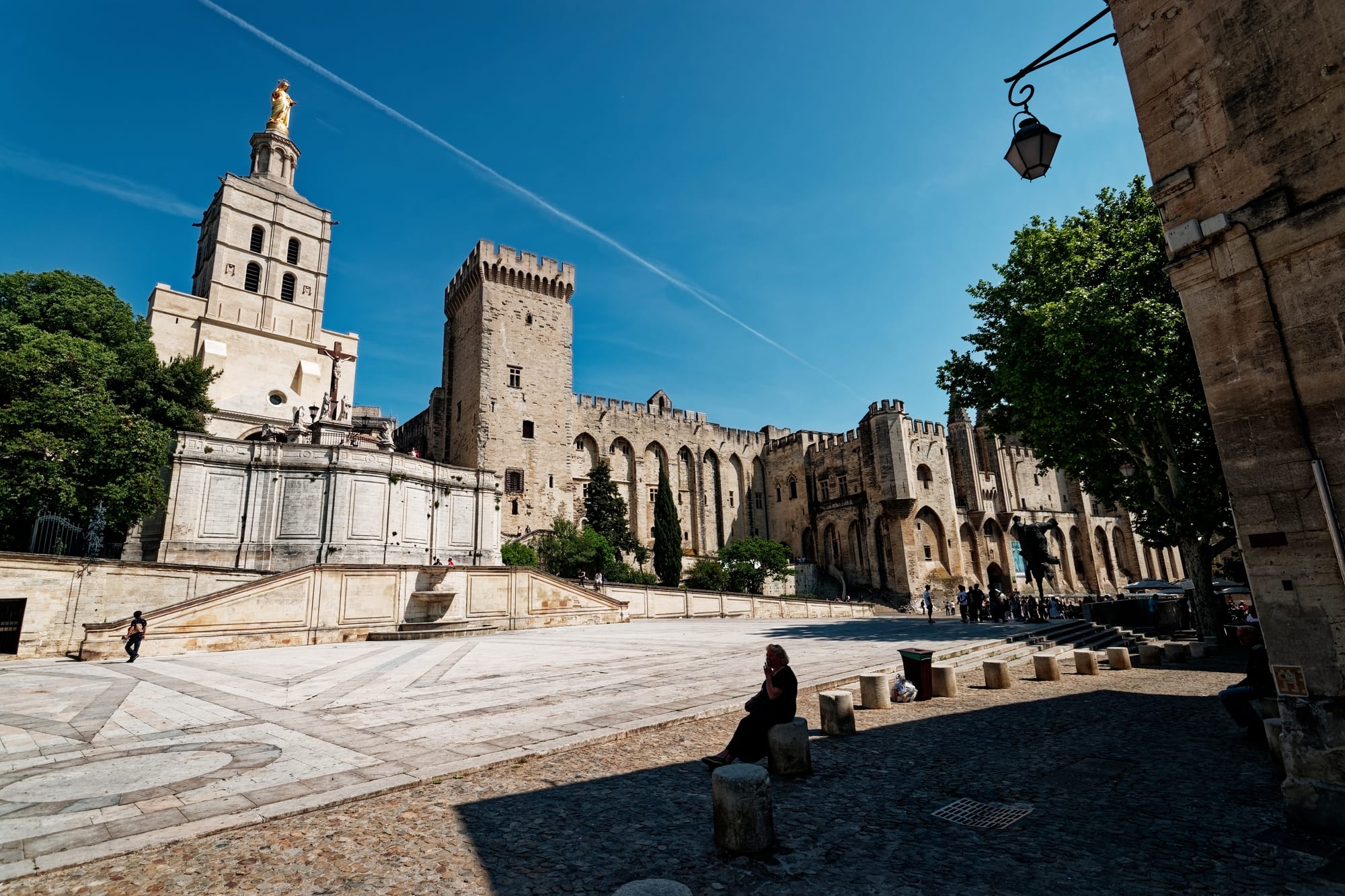
A wide paved square below the crenellated towers of the Palais des Papes, with the cathedral's gilded statue on the left

Provence & the Côte d'Azur, France

Avignon

The Place du Palais, with Avignon Cathedral on the left and the Palais des Papes beyond. (Txllxt TxllxT / Wikimedia Commons · CC BY-SA 4.0)

The capital of the Vaucluse, on the left bank of the Rhône a few kilometres above its meeting with the Durance. Seven popes lived here in the 14th century and left a vast Gothic palace, a cathedral, a broken bridge and four kilometres of walls; papal until 1791, it now lives on tourism, trade and one of the world's great theatre festivals.

Neighbourhoods

  • The papal quarter
    • First-time visitors
    • Historic district
    • Museums

    The northern end of the walled town, around the Place du Palais and the Rocher des Doms, the limestone outcrop above the Rhône where the city began. The palace, the cathedral, the Petit Palais museum and the start of the broken bridge are all within a few minutes' walk.

    Open in Maps
  • Place de l'Horloge and Rue de la République
    • Close to public transport
    • Cafés
    • Theatre

    The central square with the city hall and the opera house, and Rue de la République, which runs south from it to the main station. Nearby Place Pie, with the covered market, fills with young people in the evening.

    Open in Maps
  • Intra-muros
    • Quiet and residential
    • Local life

    The rest of the town inside the 14th-century walls, home to about 16,000 people, with Gothic churches, small squares, the university in the old Sainte-Marthe hospital and quiet streets well away from the crowds by the palace.

    Open in Maps
  • Villeneuve-lès-Avignon
    • Viewpoints
    • Quiet and residential

    A separate town across the Rhône in the Gard department, reached over the river and the island of La Barthelasse, with the 14th-century Fort Saint-André and the Tour Philippe-le-Bel facing Avignon.

    Open in Maps

Things to do

Papal Avignon

  • Palais des Papeslandmark

    One of the largest medieval Gothic buildings in Europe, built mainly between 1335 and 1364, where six papal conclaves were held; it was sacked in the Revolution and its frescoes were largely destroyed during later military use, but its vast stone halls remain.

    Open in Maps
  • Pont Saint-Bénézetlandmark

    The Pont d'Avignon of the song: a medieval bridge of 22 stone arches, abandoned in the 17th century after repeated flood damage, of which four arches and the chapel of Saint Nicholas survive.

    Open in Maps
  • Avignon Cathedrallandmark

    The Romanesque Notre-Dame des Doms beside the palace, topped since 1859 by a gilded statue of the Virgin, with the Gothic tomb of Pope John XXII inside.

    Open in Maps
  • Walls of Avignonlandmark

    Ramparts built under the popes from 1357, 4.3 km long with dozens of towers and restored by Viollet-le-Duc, still enclosing the old town.

    Open in Maps
  • Rocher des Domsviewpoint

    The garden on the limestone rock above the palace, 35 metres high, looking over the Rhône, the bridge and Villeneuve.

    Open in Maps
  • Place de l'Horlogelandmark

    The city's central square, with the neoclassical city hall, its Gothic clock tower, and the opera house.

    Open in Maps

Museums

  • Petit Palais museummuseum

    A museum at the end of the Place du Palais, opened in 1976, known for its Renaissance paintings of the Avignon school and Italian primitives.

    Open in Maps
  • Calvet Museummuseum

    The city's main museum, founded on a physician's bequest of 1810, with fine arts in an 18th-century town house and a separate lapidary museum of ancient sculpture in the former Jesuit chapel.

    Open in Maps
  • Angladon Museummuseum

    The Jacques Doucet collection, shown in the Hôtel de Massilian, an 18th-century town house on Rue Laboureur.

    Open in Maps
  • Collection Lambertmuseum

    A museum in the old town that houses exhibitions of contemporary art.

    Open in Maps

Markets and the river

  • Les Hallesmarket

    The covered market on Place Pie, with fresh produce, meat, fish and cheese.

    Open in Maps
  • Île de la Barthelassepark

    The large green island in the Rhône opposite the walls, reached by a free shuttle boat, with riverside paths and cycle routes.

    Open in Maps

Short trips from the city

  • Fort Saint-Andrélandmark

    A 14th-century fortress on the hill of Villeneuve-lès-Avignon, across the river, with views back to the palace.

    Open in Maps
  • Châteauneuf-du-Papeattraction

    A wine village 12 km north, below the ruins of a castle built for Pope John XXII, famous for its red wine.

    Open in Maps
  • Orangeattraction

    A town about 21 km to the north, known for its Roman theatre.

    Open in Maps
  • Pont du Gardlandmark

    A Roman aqueduct bridge of the first century AD over the river Gardon, one of the best preserved in the world and a UNESCO World Heritage Site.

    Open in Maps

Seasonal events

  • Festival d'AvignonJuly

    The theatre festival founded by Jean Vilar in 1947, the oldest in France, with productions in the courtyard of the Palais des Papes and across the city.

  • The Festival OffJuly

    The fringe that runs alongside the official festival, with many more shows in small theatres and halls across the town.

Eat and drink

Long-standing places and food districts in Avignon. Hours, ratings and directions come from your maps app, always current.

Avignon classics

  • Papalinesneighborhood

    Avignon's own chocolate, created in 1960 and named after the popes — a thin chocolate shell around a liqueur made from oregano of the Comtat.

    Open in Maps
  • Châteauneuf-du-Pape wineneighborhood

    The Rhône valley around the city is a major wine region, and the reds — and some whites — of Châteauneuf-du-Pape are sold in shops and wine bars all over town.

    Open in Maps

Food districts and markets

  • Les Halles d'Avignonmarket

    The covered market for local produce, cheeses and wines, with cooking classes on Saturday mornings.

    Open in Maps
  • Place Pie and the side squaresneighborhood

    The smaller squares off the main streets, where cafés and restaurants are used more by residents than those on Place de l'Horloge and the Place du Palais.

    Open in Maps

Experience Avignon

History

The city began on the Rocher des Doms, a limestone outcrop above the Rhône, and Greek writers knew it as a town of the region of Massalia, today's Marseille. It was long the capital of the Cavares, a Gaulish people who became Roman with the arrival of the legions around 120 BC; as Avennio it later became a Roman colony. In the Middle Ages it passed to the Holy Roman Empire in 1032, and in 1226, after siding with the Count of Toulouse in the Albigensian Crusade, it surrendered to Louis VIII after a three-month siege and had to pull down its walls. The first bridge, built between 1177 and 1185, was destroyed in the same siege.

In 1309 Pope Clement V settled here, and seven successive popes lived in Avignon until Gregory XI returned to Rome in 1377. Pope John XXII, elected in 1316, turned the old bishop's palace into the papal residence, and in 1348 Clement VI bought the town from Joanna I of Naples for 80,000 florins — the same year the Black Death killed almost two-thirds of its people. New walls followed from 1357. After 1378 the Western Schism brought rival popes back to Avignon, until the last of them was expelled from the city in 1403.

The city stayed a papal possession, ruled by legates and vice-legates, until the National Constituent Assembly voted to annex it to France in September 1791; in 1793 it became the capital of the new Vaucluse department. The railway to Marseille arrived in 1847, and the town spread far outside its walls in the 20th century. The first festival was held in 1947, the historic centre became a UNESCO World Heritage Site in 1995, and the TGV arrived in 2001.

Culture & Customs

The papal past is everywhere — the city calls itself the Cité des Papes, and 177 of its sites and buildings are listed historical monuments, from the palace to the chapels of its penitent brotherhoods. It is also known around the world through a children's song, Sur le pont d'Avignon, popularised by Adolphe Adam's comic opera of 1853, although the bridge itself is far too narrow for dancing. Picasso's Les Demoiselles d'Avignon, by contrast, has nothing to do with the city: it takes its name from a street in Barcelona.

The Festival d'Avignon, founded by Jean Vilar in 1947, is the oldest festival in France and one of the world's largest for the performing arts. For three weeks each July the official "In" stages theatre, dance and music in the courtyard of the palace and other historic sites, while the more bohemian "Off" fills the town's small theatres and halls with many more shows. Every summer about 100,000 people attend the festival.

Provençal is still part of the identity: the city is Avinhon in Provençal. The mistral is a constant topic, so much so that a medieval proverb called the city windy when it was not plague-ridden. Rugby league has a following, and Sporting Olympique Avignon is the local club.

Daily Life

The commune had a population of about 92,000 in 2023, of whom about 16,000 live inside the walls, and the Grand Avignon agglomeration, which crosses the Rhône into the Gard, about 200,000. As prefecture of the Vaucluse it is an administrative centre, and its university, created in 1984, occupies the 18th-century buildings of the former Sainte-Marthe hospital.

Tourism is a pillar of the economy, with about four million visitors coming to the city and its surroundings each year. The urban area also has some of the largest retail space in Europe for its size, centred on the Avignon Nord commercial zone, and a national-importance wholesale market built on the early fruit and vegetables of the Vaucluse. International tomato industry organisations and the Inter-Rhône wine body have their headquarters here.

Most residents live outside the walls, in districts that grew in the 20th century, when the population almost doubled between 1920 and 1975. Some southern districts between the walls and the Durance, such as Monclar and Saint-Chamand, lie in a sensitive urban zone where businesses that move in receive tax exemptions. Inside the walls daily life runs at its own pace — the morning market at Les Halles, coffee in the side squares — until July, when the festival takes over the whole town.

Food

Avignon's cooking belongs to the Mediterranean tradition, built on olive oil, onion softened in it and a wide range of herbs. The city's own speciality is the papaline, a small chocolate made of two thin layers of chocolate holding a liqueur of Comtat oregano, named after the popes but created only in 1960; the recipe for the oregano liqueur itself dates from 1870. The Vaucluse around the city is a great producer of early fruit and vegetables, and the city is the seat of international tomato industry organisations.

Les Halles on Place Pie is the place to see the local produce — fresh produce, cheeses and wines, as well as fresh fish and meat — and it offers cooking classes on Saturday mornings. The squares away from the palace hold the restaurants used by residents.

Wine is the great local product. The southern Rhône valley around Avignon is a major wine-growing region, and its most famous name is Châteauneuf-du-Pape, the village 12 km north where Pope John XXII built a castle; almost all its farmland is under vines, and it is best known for its red wines, though some whites are made too.

Planning tools

Budget

Avignon is moderately priced for Provence — cheaper than the Riviera, dearer than the villages around it. July is the exception: during the festival rooms are scarce and prices rise sharply. The walls, squares and riverside paths cost nothing.

Daily Budget Midrange
USD 170–330 (mid-range hotel, restaurant dinners, palace and museum tickets, a hire car for the villages)
Daily Budget Shoestring
USD 80–130 (hostel or budget hotel, market lunches, buses and trains)

Book a long way ahead for July; outside the festival a lunchtime fixed-price menu is usually the cheapest way to eat well.

Best Time to Visit

May, June and September are warm and lively without the July crush. July belongs to the festival, when the town is full and very hot. Winters are cool and quiet, and the mistral can make any season feel colder than the thermometer suggests.

Suggested Number of Days

The walled town can be seen in a day or two. Avignon is also a good base for the Rhône wine villages, the Roman towns and the Luberon, so many visitors stay four or five days; the festival is a reason to stay longer in July.

First Visit
1–2 days
With Surroundings
4–5 days

Transportation

The old town is best seen on foot. Outside the walls the Orizo network runs buses, a bus rapid transit line and the tram that opened in October 2019, and there is a bike share scheme and about 110 km of cycle paths. A free shuttle boat crosses the Rhône from the quay below the walls to the Île de la Barthelasse. A car is useful for the villages but a burden inside the walls; large car parks outside them are linked to the centre by shuttle.

Leave the car in one of the car parks outside the walls rather than driving into the narrow old town.

Airport & Station Connections

Two stations serve the city. Avignon TGV, opened in 2001, lies about 6 km south of the centre on the high-speed line, with trains from Paris in about two and a half hours, and is linked by a short rail line to the Avignon-Centre station just outside the walls, where regional trains stop. The A7 and A9 motorways pass close by. The main airport for the region is Marseille Provence.

Walkability

Very good inside the walls: the old town is compact, mostly flat apart from the climb to the Rocher des Doms, and the main sights are minutes apart. Streets are narrow and some are cobbled. The walk from the central station to the palace takes in Rue de la République and Place de l'Horloge.

Safety

France is a safe country overall, with violent crime against visitors uncommon. In Avignon the usual risks are pickpocketing in the crowds of the festival and theft from parked cars. The mistral can be strong enough to make walking on the walls and the bridge uncomfortable.

Keep bags closed and close in festival crowds, leave nothing in a parked car, and carry water in the summer heat. Check current official travel advice before travelling.

Climate

A hot-summer Mediterranean climate, less dry in summer than the coast because of the inland position, with mild-to-cool winters and plenty of sun. The mistral, the strong north wind, blows on 120 to 160 days a year.

Summer
hot — average temperatures reach about 30°C at the height of summer, and the record is 42.8°C, set in June 2019
Winter
cool — average temperatures fall to around 0°C at the coldest, and the mistral adds a chill

Local Customs

Greet shopkeepers with 'bonjour' on entering, and keep a meal unhurried. Service is included in restaurant prices, so tipping is modest. Locals are used to visitors, but a few words of French are appreciated.

Dress modestly and keep voices low in the cathedral and churches; a greeting and a few words of French go a long way.

Common Payment Methods

The currency is the euro. Cards and contactless payment are accepted almost everywhere. A little cash is useful at market stalls and the flea market on Place des Carmes. ATMs are easy to find inside the walls.