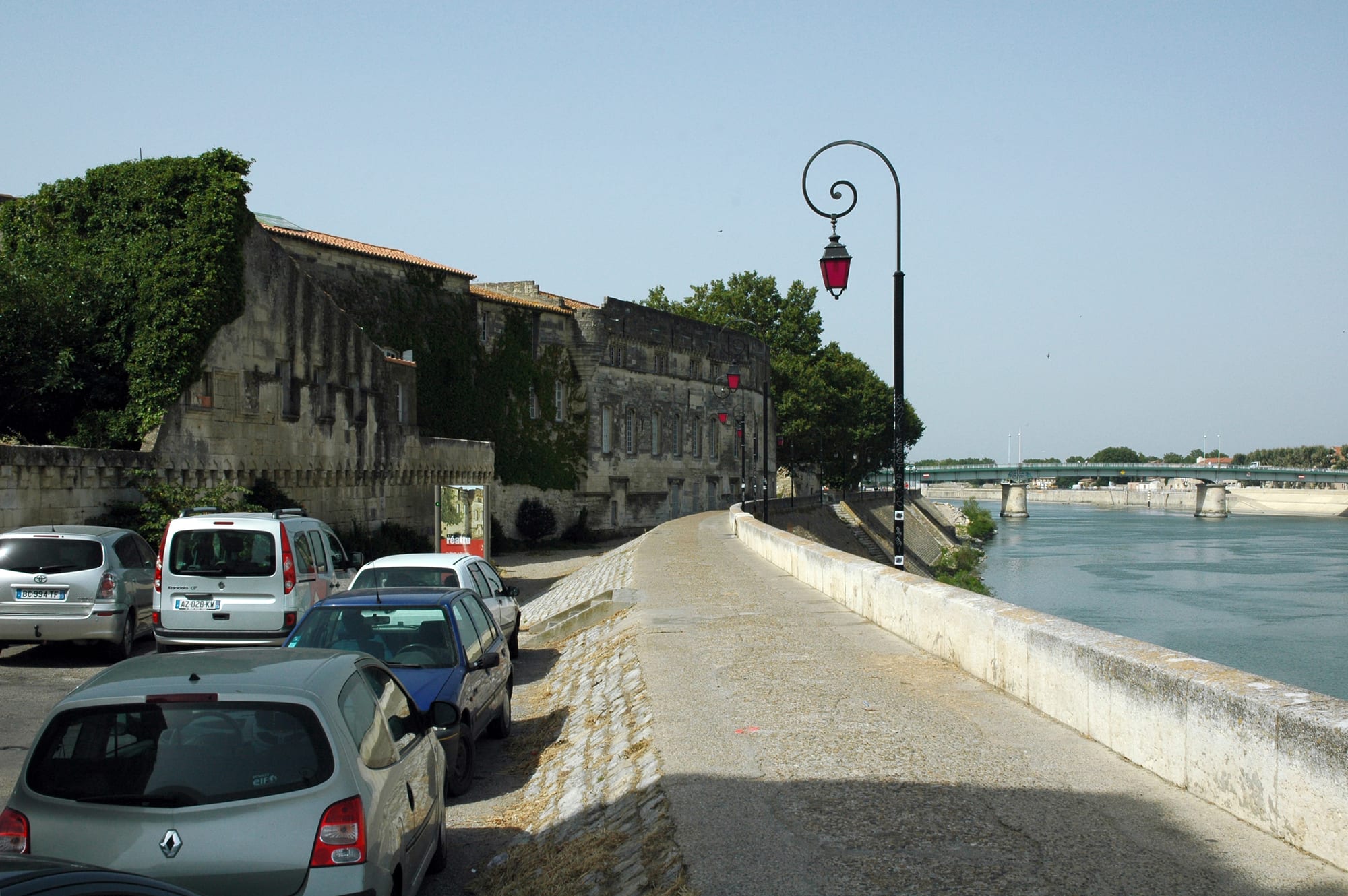
A stone riverside embankment with a curving street lamp beside the wide Rhône, old walls on the left and a bridge in the distance

Provence & the Côte d'Azur, France

Arles

The Quai Marx-Dormoy along the Rhône in Arles, in summer. (DimiTalen / Wikimedia Commons · CC0)

A town on the Rhône where the river forks to form the Camargue delta, founded as a Greek trading post and raised into a major Roman city whose arena, theatre and burial ground still stand. Van Gogh painted hundreds of works here in 1888–89; today Arles lives from tourism, photography, publishing and the bull festivals of its ferias.

Neighbourhoods

  • The old town
    • First-time visitors
    • Historic district
    • Best for food

    The quarters inside the medieval walls on a low rock above the left bank of the Rhône. The arena, the Roman theatre, Saint-Trophime and the Place du Forum lie within a few minutes' walk of each other along narrow lanes, and most restaurants, cafés and galleries are here.

    Open in Maps
  • Trinquetaille
    • Quiet and residential
    • River views

    The district on the right bank of the Grand Rhône, technically the top of the Camargue, reached by bridge from the old town. Once the site of a medieval castle and badly damaged by bombing in 1944, it is now mostly residential, with views back across the river to the old quays.

    Open in Maps
  • The station quarter and the Parc des Ateliers
    • Contemporary art
    • Close to public transport

    North and east of the walls, the area around the railway station and the former railway workshops, which now hold the LUMA Arles arts centre and Frank Gehry's steel-clad tower. It is a short walk from the Alyscamps and the old town.

    Open in Maps

Things to do

Roman and Romanesque Arles

  • Arles Amphitheatrelandmark

    A two-tiered Roman arena of about 90 AD that once held more than 20,000 spectators, with medieval towers on top; it now stages the bullfights of the ferias and summer concerts.

    Open in Maps
  • Roman Theatre of Arleslandmark

    A theatre of the reign of Augustus that seated about 8,000; quarried for stone in the Middle Ages, it keeps its stage area, seating and two standing columns, and the Venus of Arles was found here in 1651.

    Open in Maps
  • Alyscampslandmark

    The Roman and medieval necropolis just outside the old walls, the town's main burial ground for nearly 1,500 years, where Van Gogh and Gauguin painted side by side in 1888.

    Open in Maps
  • Church of St. Trophimelandmark

    The former cathedral, built between the 12th and 15th centuries, whose Last Judgement portal and cloister columns are counted among the finest Romanesque sculpture.

    Open in Maps
  • Arles Obelisklandmark

    A 4th-century Roman obelisk standing in the Place de la République in front of the town hall.

    Open in Maps

Museums and Van Gogh

  • Musée de l'Arles antiquemuseum

    The archaeological museum in a modern building of 1995 by Henri Ciriani, known for one of the best collections of Roman sarcophagi outside Rome.

    Open in Maps
  • Musée Réattumuseum

    An art museum in the former Grand Priory of the Order of Malta, holding works by the Arles-born painter Jacques Réattu, drawings by Picasso, sculpture and a large photography collection.

    Open in Maps
  • Museon Arlatenmuseum

    A museum of Provençal ethnography in a 15th-century town house on the rue de la République.

    Open in Maps
  • Fondation Vincent van Gogh Arlesmuseum

    A contemporary art foundation devoted to Van Gogh's work and legacy and to the time he spent in Arles.

    Open in Maps
  • LUMA Arlesattraction

    An arts centre in former railway workshops, built around a tower by Frank Gehry clad in reflective stainless steel panels, with exhibition spaces, a library and a café.

    Open in Maps
  • Place du Forumlandmark

    The square where Van Gogh set up his easel in September 1888 to paint Café Terrace at Night; the café was refurbished in 1990–91 to look like the painting.

    Open in Maps

Short trips from the town

  • Montmajour Abbeylandmark

    The ruins of a fortified Benedictine monastery about five kilometres north of the town, with rock-cut graves, a crypt and an unfinished church, often drawn by Van Gogh.

    Open in Maps
  • Barbegal aqueduct and millslandmark

    The remains of a Roman complex of 16 water wheels near Fontvieille, called the greatest known concentration of mechanical power in the ancient world.

    Open in Maps
  • Les Baux-de-Provenceattraction

    A village in the Alpilles north-east of Arles, on a rocky spur crowned by a ruined castle, which gave its name to bauxite.

    Open in Maps
  • The Camarguepark

    The wetland delta between the two arms of the Rhône, much of it inside the commune of Arles, with rice fields, salt pans, flamingos and the gardians' horses and bulls.

    Open in Maps
  • Saintes-Maries-de-la-Merattraction

    The seaside capital of the Camargue on the Mediterranean, where Roma pilgrims gather each May.

    Open in Maps

Seasonal events

  • Easter FeriaEaster, in April

    The bull festival that opens the French bullfighting season, with corridas in the arena, bull runs in the streets and crowds of several hundred thousand.

  • September Feriamid-September

    The Feria du Riz, a festival of the local land and of bullfighting culture, whose main event since 2005 has been the corrida goyesque.

  • Rencontres d'Arlessummer

    An international photography festival held every summer since 1970, founded by the Arles photographer Lucien Clergue, the writer Michel Tournier and the historian Jean-Maurice Rouquette.

Eat and drink

Long-standing places and food districts in Arles. Hours, ratings and directions come from your maps app, always current.

Arles classics

  • Gardianerestaurant

    The Camargue's stew of bull meat with olives and red wine, a traditional dish of Arles and Camargue cooking.

    Open in Maps
  • Saucisson d'Arlesmarket

    The town's dry sausage, said to have been invented by an Arles charcutier named Godart in 1655.

    Open in Maps

Markets and squares

  • Arles marketmarket

    One of the major open-air markets of the region, held on Saturday and Wednesday mornings, with marinated olives and cheeses.

    Open in Maps
  • Cafés of the Place du Forumcafe

    The old-town square of café terraces where Van Gogh painted his night café, with more cafés along the nearby rue du Président Wilson.

    Open in Maps

Experience Arles

History

Greek merchants from Massalia sailed up the Rhône in the 6th century BC and found a hill rising out of the marshes, the first point upstream from the sea where the river could be crossed, at the meeting of the routes from Italy to Spain. Rome took the town in 123 BC and rewarded it for backing Julius Caesar against Pompey with the possessions of Marseille, which had chosen the other side. Founded as a colony for veterans of the Sixth Legion, it gained an amphitheatre, a theatre, a circus, baths built by Constantine I and a full circuit of walls, and in 395 it became the seat of the Praetorian Prefecture of the Gauls.

After the empire fell, Arles remained a great religious centre and the seat of church councils. After a revolt in 735–739 it was sacked and brought to heel by the Carolingians, and in the 10th century it gave its name to the Kingdom of Burgundy-Arles; in 1178 the Emperor Frederick Barbarossa was crowned in its cathedral. In the 12th century Arles became a free city governed by an elected podestat, and in 1239 it joined the county of Provence. An important Jewish community lived here from Roman times until a pogrom in 1484 and its expulsion at the end of the 15th century.

The town prospered as a Rhône port until the railways took the river trade in the 19th century. Vincent van Gogh arrived on 21 February 1888 and stayed until May 1889, painting over 300 works. Bombing in 1944 destroyed more than a quarter of the town's housing, around the bridges and the station. The Roman and Romanesque monuments were listed as a UNESCO World Heritage Site in 1981.

Culture & Customs

Arles thinks of itself as a capital of Provençal culture and of the Camargue. Its gardians, the mounted herdsmen who raise the delta's horses and black bulls, are part of the town's image, and the arena holds both the bloodless courses camarguaises, in which men try to snatch a tassel from a bull's horns, and the Spanish-style corridas of the two ferias. The Easter feria opens the French bullfighting season and brings crowds of several hundred thousand into the streets. The Provençal poet Frédéric Mistral was born near the town, and the Museon Arlaten is devoted to Provençal ethnography.

The town has a long connection with painters — Van Gogh above all, as well as Gauguin, Picasso and Jacques Réattu — and since 1970 it has been a centre of photography through the Rencontres d'Arles, co-founded by the local photographer Lucien Clergue. The publisher Actes Sud is based here, and in recent years the LUMA Foundation, the Fondation Vincent van Gogh Arles and the Lee Ufan Foundation have added contemporary art spaces and galleries. Arles was part of Marseille-Provence 2013, the European Capital of Culture year.

The Gipsy Kings, the flamenco-pop band, come from Arles. Jeanne Calment, the oldest person whose age has been documented, was born, lived and died here, reaching 122.

Daily Life

The commune had about 52,000 residents in 2023, spread over the largest territory of any commune in metropolitan France, about 759 square kilometres. Besides the town itself it includes villages and hamlets across the Camargue, such as Salin-de-Giraud, Raphèle-lès-Arles and Le Sambuc. From 2001 to 2020 the town was led by a Communist mayor.

Tourism is the town's main activity, and publishing and the arts organisations that have settled here add to it. Arles is also a river port and transshipment point on the Rhône, and the Camargue around it grows cereals, vegetables and, since the late 1940s, rice, alongside salt works and cattle farms. Outer districts such as Barriol and Le Trébon have been the subject of urban renewal schemes.

The old town's day revolves around its squares and the markets on Wednesday and Saturday mornings, one of the largest open-air markets in the region. Summer evenings fill the terraces, while the ferias and the photography festival bring sudden crowds. The mistral sweeps through in winter, and drought is a growing local concern.

Food

Arles cooks from the Camargue. Gardiane, also called daube camarguaise, is the signature dish — a stew of Camargue bull meat with olives and red wine from the delta's vineyards. The bull meat itself has a protected designation of origin, Taureau de Camargue. Camargue rice, grown in the delta since at least the Middle Ages and widely since the 1940s, carries a protected geographical indication, and the September feria is the Feria du Riz, the rice feria.

The saucisson d'Arles, a dry sausage, is said to have been invented in the town in 1655 by a charcutier named Godart. The Wednesday and Saturday markets sell marinated olives and cheeses, and the restaurants of the old-town side streets and the Place du Forum serve Provençal cooking alongside the Camargue dishes. Salt from the Camargue's salt pans is another product of the delta.

Pastis is the usual aperitif, and local wines are poured with meals.

Planning tools

Budget

Arles is cheaper than the Riviera resorts and roughly in line with the other towns of the lower Rhône. Prices rise and rooms fill during the ferias at Easter and in September and during the summer photography festival. Many of the Roman sites can be visited on a combined ticket, and the market and riverside walks cost nothing.

Daily Budget Midrange
USD 160–300 (mid-range hotel, restaurant dinners, monument and museum tickets, a hire car for the Camargue)
Daily Budget Shoestring
USD 75–130 (hostel bed, market food and bakery lunches, walking and regional buses)

Book well ahead for the feria weekends and the Rencontres d'Arles; outside them, rooms are much easier to find.

Best Time to Visit

Late spring and early autumn are the most comfortable seasons, and they bring the two ferias at Easter and in September. Summer is the season of the photography festival, concerts in the arena and courses camarguaises, but the town is busy and hot. Winters are cool and quiet, with the mistral at its strongest.

Suggested Number of Days

The old town is compact, and a day or two covers its monuments and museums. Allow three or four days to include the countryside and the coast as well; a car or bicycle makes the surrounding area much easier to see.

First Visit
1–2 days
With Surroundings
3–4 days

Transportation

The old town is walked rather than driven. Regional buses, mostly run under the Zou! name, link Arles with towns across the Bouches-du-Rhône; some drivers take only cash. Bicycles can be hired in town for the flat country around the town, but the Camargue and the Alpilles are most easily explored by car.

Have cash ready when buying a bus ticket from the driver.

Airport & Station Connections

The Gare d'Arles, north of the old town, has trains to Avignon, Nîmes, Marseille, Paris, Bordeaux and regional destinations. There is no commercial airport in Arles; Marseille Provence Airport is about an hour's drive away, and Nîmes–Garons airport is also nearby. The A54 motorway between Salon-de-Provence and Nîmes passes the town.

Walkability

Very good. The Roman monuments, churches, museums and squares of the old town lie within a small area of narrow, often cobbled lanes, and the station, the Alyscamps and LUMA Arles are a short walk from the centre. Montmajour Abbey, the Pont Van-Gogh and the Camargue need a bicycle, bus or car.

Safety

France is a safe country overall, with violent crime against visitors uncommon. In Arles the usual concerns are pickpocketing in feria and festival crowds and theft from parked cars, and the Camargue marshes bring mosquitoes in the warmer months.

Leave nothing visible in a parked car, keep bags closed in festival crowds, and carry insect repellent for the Camargue. Check current official travel advice before travelling.

Climate

A hot-summer Mediterranean climate with a mean annual temperature of about 14.6°C. Rain, about 636 mm a year, falls fairly evenly from September to May. The mistral, a cold north wind, blows often and above all in winter, and can bring sudden hard frosts.

Summer
hot, dry and very sunny; the town's weather station recorded 42.8°C in June 2019
Winter
cool to mild, with frequent mistral; the annual mean at the town's station is 15.2°C

Local Customs

A greeting of 'bonjour' on entering a shop or café is expected, and service is included in restaurant bills, so tipping is modest. Bullfighting divides opinion: the ferias include Spanish-style corridas in which the bulls are killed, while in the courses camarguaises the bull is not harmed and men try to snatch a tassel from its horns. Saint-Trophime is a working church.

Dress modestly and keep quiet inside Saint-Trophime during services, and greet shopkeepers before asking for anything.

Common Payment Methods

The currency is the euro. Cards and contactless payment are accepted in most shops, restaurants and museums, and ATMs are easy to find in the old town. Some bus drivers and market stalls take cash only, so a small amount is useful.