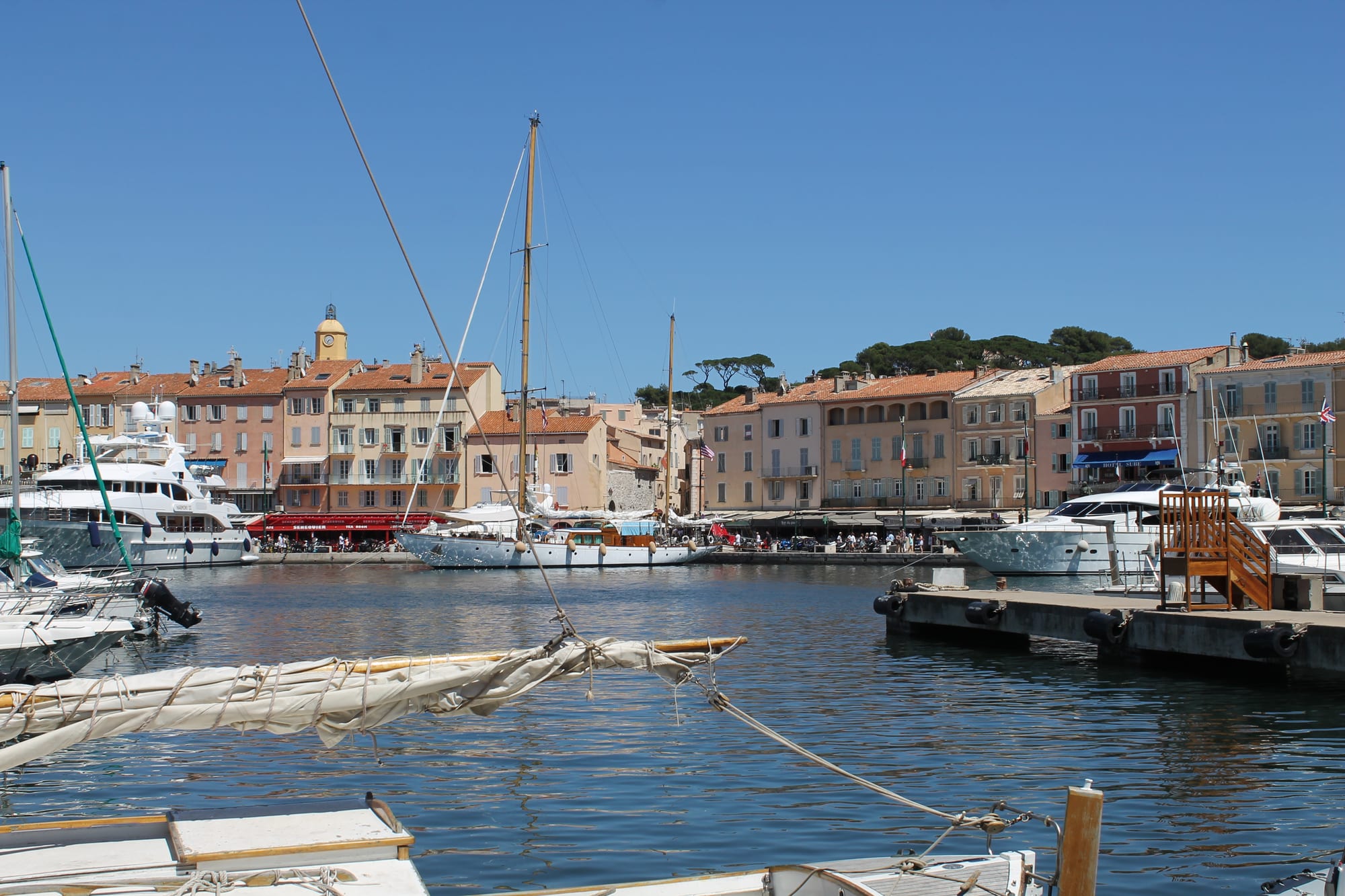
Yachts and sailing boats moored in a calm harbour in front of a row of pastel houses with a yellow bell tower

Provence & the Côte d'Azur, France

Saint-Tropez

The harbour of Saint-Tropez, with the quayside houses and the church bell tower behind. (Kev22 / Wikimedia Commons · CC BY-SA 4.0)

A small town on the Gulf of Saint-Tropez in the Var, a fortified port and fishing village until the early 20th century. Painters led by Paul Signac came first, then the films and singers of the 1950s and 1960s made it one of the best-known resorts of the Riviera, with a yacht harbour, a hilltop citadel and the long sands of Pampelonne nearby.

Neighbourhoods

  • The old port and La Ponche
    • First-time visitors
    • Historic district
    • Harbour views

    The heart of the town: the harbour quays lined with pastel houses, cafés and boutiques, and behind them the old fishermen's quarter of La Ponche, with one of the 15th-century towers at its entrance, narrow lanes and a small beach below the citadel hill.

    Open in Maps
  • Place des Lices
    • Local life
    • Cafés
    • Markets

    The square of plane trees and white sandy ground just south of the old port, once the haunt of painters at its Café des Arts. Locals play pétanque under the trees, and the surrounding streets hold cafés, restaurants and shops at slightly gentler prices than the waterfront.

    Open in Maps
  • The peninsula and Pampelonne
    • Beaches
    • Quiet and residential

    South and east of the town, the wooded peninsula runs past villas and the bays of Les Canebiers and Les Salins to the long sandy beach of Pampelonne, shared with Ramatuelle and lined with beach clubs.

    Open in Maps

Things to do

The town

  • The Citadellandmark

    A fortress built from the 1590s on the hill above the town, now holding a maritime museum, with views from its ramparts over the town, the gulf and the Massif des Maures.

    Open in Maps
  • Musée de l'Annonciademuseum

    A museum of painting in a former chapel of the White Penitents, with works by Signac, Matisse, Bonnard, Derain and other painters drawn to the town from the 1890s onwards.

    Open in Maps
  • Place des Liceslandmark

    The 19th-century square under century-old plane trees, painted by Signac, Matisse and Camoin, where locals often play pétanque and tournaments are held in summer.

    Open in Maps
  • Musée de la Gendarmerie et du Cinémamuseum

    The old gendarmerie building made famous by Louis de Funès's Gendarme films, now a museum of the gendarmerie and the town's film history, opened in June 2016.

    Open in Maps
  • Église Notre-Dame-de-l'Assomptionlandmark

    The 18th-century parish church in Italian Baroque style, its bell tower crowned by a campanile; inside is a bust of Saint Torpes surrounded by old blunderbusses of the Bravade.

    Open in Maps

Beaches and the coast

  • Pampelonne beachbeach

    A long, mostly sandy beach about 5 km south-east of the town, divided between Saint-Tropez and Ramatuelle, with beach clubs, water sports and the clothing-optional Tahiti beach at its northern end.

    Open in Maps
  • The town beachesbeach

    La Ponche, La Fontanette and La Glaye, small in-town beaches, and the larger Plage de la Bouillabaisse at the western edge of the commune.

    Open in Maps

Short trips from the town

  • Gassinattraction

    A hill village perched on a rock less than 4 km from the sea, one of the Most Beautiful Villages of France.

    Open in Maps
  • Ramatuelleattraction

    The village behind Pampelonne, whose commune holds most of the famous beach clubs.

    Open in Maps
  • Port Grimaudattraction

    A lagoon town built by the architect François Spoerry in the 1960s on the marshes of the Giscle, where most houses have their own boat mooring; it is often called the Venice of Provence.

    Open in Maps
  • Grimaudattraction

    A perched village above the gulf, dominated by its partly restored 11th-century castle.

    Open in Maps
  • Sainte-Maximeattraction

    The resort across the gulf, reached in season by passenger boat from Saint-Tropez's port.

    Open in Maps

Seasonal events

  • Les Bravadesmid-May

    A three-day festival for the patron saint, Torpes, held for more than 450 years: militias in period costume fire muskets into the air, and parade the saint's bust to band music.

  • Les Voiles de Saint-Tropezlate September to early October

    A nine-day regatta in the gulf that brings together around 300 classic and modern sailing yachts.

Eat and drink

Long-standing places and food districts in Saint-Tropez. Hours, ratings and directions come from your maps app, always current.

Saint-Tropez classics

  • Tarte tropéziennecafe

    A halved brioche filled with crème pâtissière and buttercream and topped with pearl sugar, created by the Polish-born pastry cook Alexandre Micka, whose original shop still trades in the town.

    Open in Maps
  • Sénéquiercafe

    A café and pâtisserie between the church and the port, founded in 1887, whose terrace appears in films from And God Created Woman to the Gendarme series.

    Open in Maps

Food districts

  • The harbour quaysneighborhood

    Cafés and restaurants line the quays facing the yachts — the most watched and the most expensive tables in town.

    Open in Maps
  • Around the Place des Licesneighborhood

    Bars, cafés and restaurants around the plane-tree square and the lanes a block or two inland from the port.

    Open in Maps

Experience Saint-Tropez

History

Pliny the Elder recorded the place in antiquity as Athenopolis, a possession of Greek Marseille, and in 31 BC the Romans invaded the region. The town takes its name from Torpes, an early Christian martyr whose headless body, legend says, drifted ashore here in a boat with a rooster and a dog. From 890 to 972 the area was held from the Muslim stronghold of Fraxinet, until the Count of Provence began attacking them in 976 and in 980 built a tower where the Suffren tower now stands.

Saint-Tropez was refounded in 1470, when the Genoese gentleman Raphaël de Garezzio arrived with settlers from the Italian Riviera in return for exemption from tax; walls and two towers from that time still stand. The town became a small self-governing republic with its own fleet and militia, which beat off a Spanish fleet in June 1637, and a citadel was built above it from the 1590s. Louis XIV ended its tax privileges in 1672. Its shipyards built tartanes and three-masted ships, and the port lived from fishing and from trade in cork, wine and wood.

Paul Signac arrived in 1892 and drew Matisse, Bonnard, Marquet and others after him; pointillism and fauvism both developed here. Coco Chanel and Elsa Schiaparelli came in the 1920s. On 15 August 1944 Operation Dragoon landed on this coast, and Saint-Tropez was the first town on it to be liberated, though the German army dynamited its quays. In 1956 And God Created Woman, starring Brigitte Bardot, made the town internationally famous, and the Gendarme comedies with Louis de Funès followed from 1964.

Culture & Customs

Saint-Tropez holds a lasting place in the history of modern painting. Signac's arrival turned the fishing village into a gathering place for Neo-Impressionist and Fauve painters, a story told through the collection of the Musée de l'Annonciade, and later artists such as Bernard Buffet and David Hockney also lived and worked here. Painters returned again and again to the harbour and the Place des Lices, where the Café des Arts was a meeting place between 1890 and 1940.

Cinema and pop music made the town a myth in the 1950s and 1960s. The New Wave film-makers, the singers of the yé-yé years and Brigitte Bardot brought international jet-setters in their wake, and the Gendarme films turned the town's battles over topless bathing into comedy; the old gendarmerie is now a museum of cinema. The town has since appeared in many songs, films and television series.

Beneath the glamour, old traditions persist. The Bravades in May, held for more than 450 years, honour Saint Torpes with musket salutes and costumed militias, and a second bravade in June recalls the 1637 victory over the Spanish fleet. Pétanque is often played under the plane trees of the Place des Lices, and the Voiles de Saint-Tropez regatta at the end of September keeps the port's sailing tradition alive.

Daily Life

Saint-Tropez had about 3,600 residents in 2023, a figure that fell by nearly a fifth between 2017 and 2023. The resident town is tiny compared with the summer crowds, and in July and August the roads into it are routinely jammed.

Tourism is the main economy — hotels, restaurants, beach clubs, boutiques, yacht services and the regattas. The commercial port that once built three-masted ships has become a harbour of about 800 berths for pleasure boats and ferries, and fashion boutiques have traded beside the harbour since the 1950s. Around the old centre, small flats and houses give way, on the peninsula towards Ramatuelle, to large private villas.

The town keeps a village rhythm outside summer: more than a thousand pupils in its schools, pétanque on the square, the market and the cafés of the harbour. In season the harbour, the beaches and the clubs stay busy late into the night.

Food

The town's own sweet is the tarte tropézienne, a halved brioche filled with a mix of crème pâtissière and buttercream and topped with pearl sugar. The Polish-born pastry cook Alexandre Micka, who settled in Saint-Tropez after the Second World War, first made it in the early 1950s; Brigitte Bardot took a liking to it while filming And God Created Woman and suggested the name, which Micka registered as a trademark in 1973. His original shop still trades.

Beyond that, Saint-Tropez eats like the rest of Provence: olive oil, garlic, tomatoes and herbs, fish from the gulf, and summer vegetables. Restaurants on the quays and around the Place des Lices serve Provençal and Mediterranean cooking, and the beach clubs of Pampelonne have their own long-lunch culture.

Côtes de Provence rosé, the region's best-known wine, is the usual summer drink. Pastis remains the aperitif of the café terraces, and Sénéquier by the port, founded in 1887, is a local institution.

Planning tools

Budget

Saint-Tropez is one of the most expensive places on the French coast, especially in July and August, when hotel rates, beach clubs, parking and waterfront cafés reach Riviera peaks. Prices ease a block or two back from the harbour and drop sharply outside summer. Many visitors save by staying in Sainte-Maxime, Gassin or other towns around the gulf.

Daily Budget Midrange
USD 260–480 (mid-range hotel, restaurant dinners, a museum or two, beach and boat trips)
Daily Budget Shoestring
USD 110–180 (room or campsite elsewhere on the gulf, bakery and market food, buses and the passenger boat)

Sleeping across the gulf and arriving by passenger boat avoids both summer room rates and the traffic on the roads into town.

Best Time to Visit

May, June and September bring warm weather and thinner crowds, along with the Bravades in May and the Voiles regatta at the end of September. July and August are the high season of beach clubs, yachts and very heavy traffic. Winter is mild and quiet, and many places close.

Suggested Number of Days

The town itself is small and a day or two is enough. Allow three or four days to include the beaches and the villages of the peninsula and the gulf; summer traffic makes every journey slower, so plans need slack.

First Visit
1–2 days
With Surroundings
3–4 days

Transportation

The old town is best on foot, and the roads into Saint-Tropez are badly congested in summer. Minibuses shuttle between the town and the Pampelonne beaches, and scooters, bicycles and taxis are common. Passenger boats cross the gulf to Sainte-Maxime and Port Grimaud, and in summer there are boats along the coast to Cannes, Nice and Saint-Raphaël.

Leave the car in the large car park at the edge of town and walk in; in season, travel by boat or two wheels where possible.

Airport & Station Connections

There is no railway station: the nearest is Saint-Raphaël-Valescure, about 39 km away, linked by bus and by boat. Buses also run from Toulon. The small La Môle airport lies about 15 km to the south-west, Toulon–Hyères Airport about 52 km away, and Nice Côte d'Azur Airport about 95 km away. The last stretch of road along the gulf is slow in summer.

Walkability

Very good within the town: the harbour, La Ponche, the Place des Lices, the citadel and the museums are all a few minutes apart on narrow streets where cars are a hindrance. The coastal path runs out towards the Canebiers bay and quieter beaches. Pampelonne is about 5 km away, so most people take the minibus, a bicycle or a taxi.

Safety

France is a safe country overall, with violent crime against visitors uncommon. In Saint-Tropez the main risks are theft from cars and of bags on crowded beaches and quays in summer, and wildfire in the dry season, when access to forests can be restricted.

Leave nothing visible in a parked car, watch belongings on the beaches, and check forest access rules before walking in summer. Check current official travel advice before travelling.

Climate

A hot-summer Mediterranean climate, with daytime heat in summer tempered a little by the sea. The annual mean temperature is about 15.6°C, summers are very sunny, rain falls mostly in autumn and winter, and fog is rare.

Summer
hot, dry and very sunny — in nearby Hyères, summer maximum temperatures often pass 30°C
Winter
mild, with an average temperature of about 8°C and most of the year's rain falling in autumn and winter

Local Customs

Greet shopkeepers and café staff with 'bonjour'; service is included in bills, so tipping is a modest extra for good service. Topless sunbathing is common on the Pampelonne beaches, and part of Tahiti beach is clothing-optional, but swimwear belongs on the beach rather than in the streets and churches. The Bravades are a religious festival as well as a spectacle.

Cover up away from the beach, keep quiet in the church, and expect muskets to be fired into the air during the Bravades.

Common Payment Methods

The currency is the euro. Cards and contactless payment are accepted almost everywhere, from boutiques to beach clubs, and ATMs are easy to find in the town centre. A little cash is useful for markets, bakeries and minibuses.