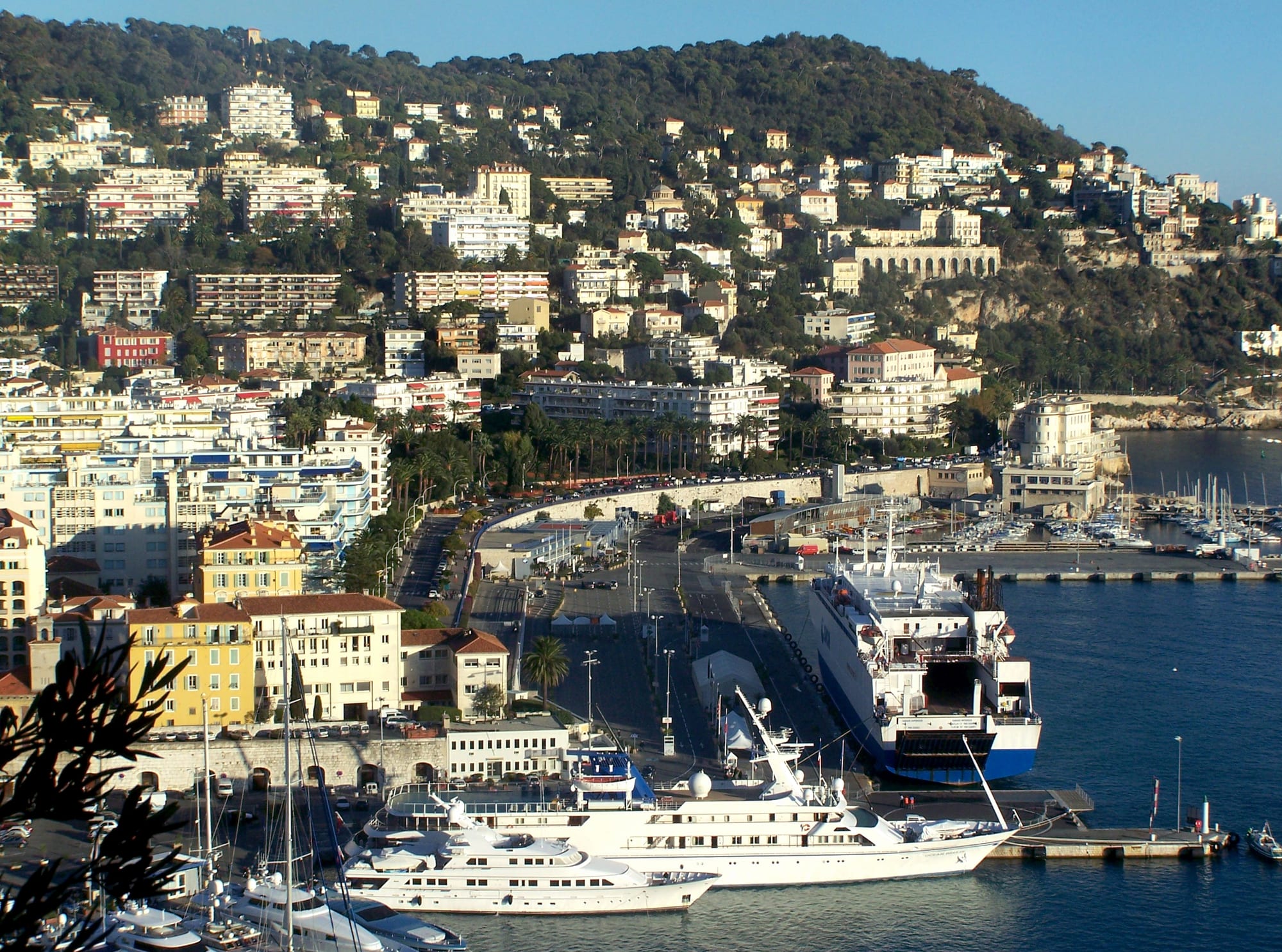
Nice harbour seen from above, with a white ferry and yachts at the quays and pastel buildings climbing a wooded hill

Provence & the Côte d'Azur, France

Nice

The port of Nice seen from Castle Hill, with the hills east of the harbour behind. (Florian Pépellin / Wikimedia Commons · CC BY-SA 4.0)

The capital of the French Riviera, on the curving Baie des Anges between the airport and Castle Hill, with the Alps rising behind. Founded by Greeks, held by Savoy until 1860 and then made famous by wintering aristocrats, it is now France's fifth-largest city — a pebble beach, an Italianate old town, a busy port and museums of Matisse and Chagall.

Neighbourhoods

  • Vieux Nice
    • First-time visitors
    • Historic district
    • Best for food

    The old town at the foot of Castle Hill, a maze of lanes between ochre-coloured houses that was once enclosed by the medieval walls. Nice Cathedral faces Place Rossetti, and the Cours Saleya runs along its sea side with its daily flower and food market.

    Open in Maps
  • Promenade des Anglais and the centre
    • Beaches
    • Close to public transport

    The seafront promenade and the streets behind it, between Place Masséna and the hotels further west. Pedestrian streets, the shops of Avenue Jean Médecin and the main tram lines are all here, and the public pebble beaches lie directly below the promenade.

    Open in Maps
  • Port Lympia
    • Local life
    • Best for food
    • Ferries

    The harbour east of Castle Hill, dug from 1745 around a marshy spring. Ferries leave for Corsica, and the streets around it hold many restaurants.

    Open in Maps
  • Cimiez
    • Museums
    • Quiet and residential
    • Roman remains

    A hill district north of the centre, built over the Roman town of Cemenelum and later a favourite of winter visitors including Queen Victoria. The Musée Matisse, the archaeological museum and its Roman ruins and the Chagall museum on the way up make it the museum quarter.

    Open in Maps

Things to do

Famous landmarks

  • Promenade des Anglaislandmark

    The seafront walk along the Baie des Anges, begun by the city's English winter colony and named in 1823, running for several kilometres from the old town towards the airport.

    Open in Maps
  • Castle Hillviewpoint

    The hill between the old town and the port, where the castle once stood; little remains of it, but its terraces and park give the classic view over the bay and the harbour.

    Open in Maps
  • Place Massénalandmark

    The city's main square, lined with red-ochre buildings in the Italian style, palms and stone pines, and the stage for the carnival parade in February.

    Open in Maps
  • Nice Cathedrallandmark

    The Baroque Cathédrale Sainte-Réparate on Place Rossetti in the heart of the old town.

    Open in Maps
  • St Nicholas Orthodox Cathedrallandmark

    A Russian Orthodox cathedral with onion domes, opened in 1912 for the large Russian community that had settled in Nice by the end of the 19th century.

    Open in Maps
  • Opéra de Nicelandmark

    The opera house of the old town, built at the end of the 19th century to designs by François Aune and still staging a regular programme.

    Open in Maps

Museums

  • Musée Matissemuseum

    A museum in Cimiez devoted to Henri Matisse, who spent many years living and painting in Nice.

    Open in Maps
  • Musée Marc Chagallmuseum

    The national museum of Marc Chagall's work, above all the paintings inspired by religion, with stained glass windows by the artist.

    Open in Maps
  • MAMACmuseum

    The museum of modern and contemporary art, opened in 1990 on the covered course of the Paillon, with much space given to the School of Nice.

    Open in Maps
  • Musée des Beaux-Artsmuseum

    The city's fine arts museum, in a mansion built in 1878 for a Russian princess, first opened as the Palais des Arts Jules Chéret and holding paintings by Chéret.

    Open in Maps
  • Musée Massénamuseum

    A municipal museum in one of the last grand 19th-century villas on the Promenade des Anglais.

    Open in Maps
  • Archaeological museum and Roman ruins of Cimiezmuseum

    The remains of Roman Cemenelum, with its baths and amphitheatre, beside the archaeological museum that holds finds from the site.

    Open in Maps

Markets and the waterfront

  • Cours Saleyamarket

    The long open square behind the seafront in the old town, with a daily market of flowers, fruit and vegetables and an antiques market.

    Open in Maps
  • Port Lympiaattraction

    The old harbour, with its fishing boats, yachts and ferries to Corsica, a short walk from the old town round the foot of Castle Hill.

    Open in Maps

Music, sport and nights out

  • Allianz Rivieraattraction

    The stadium in the Var valley where OGC Nice play their home matches in Ligue 1.

    Open in Maps
  • Place Rossetti and the old town at nightneighborhood

    The old town's squares fill with restaurant terraces and ice-cream makers by day and with young people and visitors after dark.

    Open in Maps

Short trips from the city

  • Villefranche-sur-Merattraction

    A seaside resort just east of Nice, on a bay that is one of the deepest natural harbours of any port in the Mediterranean.

    Open in Maps
  • Èzeattraction

    A seaside commune on the Riviera between Nice and Monaco.

    Open in Maps
  • Monacoattraction

    The independent principality about 13 km along the coast, reached by train or bus, with its casino, harbour and old town on the Rock.

    Open in Maps
  • Saint-Paul-de-Venceattraction

    One of the oldest medieval towns on the Riviera, inland from the coast, well known for its modern and contemporary art.

    Open in Maps
  • Antibesattraction

    A walled port town west along the coast, with an old town, sandy beaches nearby and the Picasso museum.

    Open in Maps

Seasonal events

  • Nice CarnivalFebruary

    One of the world's great carnivals, with the carnival parade on Place Masséna.

  • Paris–NiceMarch

    The eight-day professional cycling stage race from the Paris region, which ends either in Nice or on the Col d'Èze above the city.

  • Nice Jazz Festivalsummer

    A jazz festival first held in 1948 and staged every year since 1974.

  • Bastille Day14 July

    France's national day is marked in Nice with a military procession on Place Masséna and fireworks over the bay.

Eat and drink

Long-standing places and food districts in Nice. Hours, ratings and directions come from your maps app, always current.

Nice classics

  • Socca in the old townneighborhood

    Socca, a thin pancake of chickpea flour, is the city's street snack, sold hot in and around the old town and the Cours Saleya.

    Open in Maps
  • Port Lympia restaurantsneighborhood

    The streets around the harbour hold many restaurants, socca among their specialities.

    Open in Maps

Food districts and markets

  • Cours Saleya marketmarket

    The old town's daily market of flowers, fruit and vegetables, ringed by café and restaurant terraces.

    Open in Maps
  • Vieux Nice restaurantsneighborhood

    Traditional restaurants and ice-cream makers around Place Rossetti and the lanes of the old town, serving pissaladière, stuffed vegetables and other local dishes.

    Open in Maps

Experience Nice

History

People lived in the Nice area long before the city: the Terra Amata site has some of the earliest evidence of the use of fire. Greek colonists from Phocaea founded the town around 350 BC and named it Nikaia, after Nike, the goddess of victory, to mark a win over the neighbouring Ligurians. It became a busy trading port, while the Romans built their own town, Cemenelum, on the hill of Cimiez, now a district of the city. Saracens sacked it in the 9th century.

In 1388 the commune placed itself under the protection of the Counts of Savoy, becoming the County of Nice, and Italian replaced Latin as its official language in 1561. French armies took it in 1792, but after 1814 it returned to Piedmont-Sardinia, and only in 1860, under the Treaty of Turin, was it ceded to France, after a plebiscite whose irregularities were evident. About a quarter of the population left for Italy, and Giuseppe Garibaldi, born in Nice in 1807, strongly opposed the cession.

From the late 18th century English aristocrats wintered here, building the Promenade des Anglais, and Russian nobles and Queen Victoria followed. American paratroopers liberated it on 30 August 1944. After the war tourism and building drove a long boom under the mayors Jean and Jacques Médecin. The Treaty of Nice was signed here in 2001. On 14 July 2016 a truck was driven into the Bastille Day crowd on the promenade, killing 86 people, and in 2020 three people were killed in an attack at the Notre-Dame de Nice basilica. In 2021 UNESCO listed the city as a World Heritage Site, "Nice, Winter Resort Town of the Riviera".

Culture & Customs

Nice's light has drawn painters for well over a century. Henri Matisse and Marc Chagall both have museums here, and Niki de Saint Phalle, Yves Klein, Arman and Sacha Sosno worked here too; the MAMAC gives much space to the School of Nice. Composers and writers came too: Friedrich Nietzsche spent six winters in Nice and wrote Thus Spoke Zarathustra here, and Anton Chekhov finished Three Sisters in the city.

The local identity is distinct. Niçard, or Nissart, is an Occitan dialect with strong Italian influences, still spoken by a minority and seen on bilingual street signs, and the city's unofficial anthem is Nissa la Bella. Folk music and the farandole, an open-chain community dance, survive at local festivals. Since 1860 a cannon on Castle Hill has been fired at noon, a tradition going back to Sir Thomas Coventry, who wanted to remind residents to have lunch on time. In recent decades immigrants have come from North and West Africa and South-East Asia.

The Nice Carnival in February is one of the city's great occasions, with its parade on Place Masséna, and the jazz festival fills summer evenings. OGC Nice play in Ligue 1 at the Allianz Riviera, the Paris–Nice cycle race ends in or above the city each March, and the city also has a top-flight ice hockey club.

Daily Life

About 358,000 people lived in the city at the 2023 census, making it the fifth-largest commune in France, and nearly one million live in the wider urban area. It is the prefecture of the Alpes-Maritimes and the largest French city that is not a regional capital. The population has changed little since the 1970s, as people moving in are balanced by natural decline.

Tourism is the leading industry: the city has the second largest hotel capacity in France and receives about four million visitors a year, and the airport is the country's third busiest. Business parks, the Acropolis convention centre, Côte d'Azur University and the Sophia Antipolis technology park near Antibes provide much of the rest of the work. Since 2026 the mayor has been Éric Ciotti.

Most people live in flats, in the dense streets of the centre and the port, or in the hill neighbourhoods and valleys that spread inland. Days follow a Mediterranean rhythm, with early markets, long lunches and evenings outdoors, and the seafront fills with runners, cyclists and walkers year round. Housing costs, summer crowds and traffic on the coastal roads are constant local concerns.

Food

Niçois cooking is close to that of Provence but also to Liguria and Piedmont across the border, built on olive oil, anchovies, fruit and vegetables; the city has around 200 recipes of its own. Socca is a thin pancake made from chickpea flour. Pissaladière is an onion tart with anchovies or anchovy paste, descended from a Ligurian kind of pizza. Farcis niçois are vegetables stuffed with breadcrumbs, meat — generally sausage and minced beef — and herbs.

Salade niçoise, in its traditional form, is a tomato salad with eggs, tuna or anchovies, olives and often lettuce; traditionalists leave out cooked vegetables such as potatoes and green beans. Pan bagnat is a sandwich of pain de campagne filled with a salade niçoise. Ratatouille, daube, barbajuan, tapenade and fougasse complete the list of local specialities. Local fish — mullet, bream, sea urchins, anchovies and poutine, the tiny young fish of the coast — is used so much that a proverb says fish are born in the sea and die in oil.

The Cours Saleya market is the place to see the produce, and the old town's lanes and the streets round the port hold the traditional restaurants. Wine is made in the city itself, at wineries such as Château de Bellet, and Provence's rosé is on most lists.

Planning tools

Budget

Nice is expensive by French standards, but cheaper than Cannes, Saint-Tropez or Monaco, which makes it the usual base for the Riviera. Rooms cost most in July and August and during the February carnival. Public beaches, the promenade, Castle Hill and the markets are free, and the trams and regional buses make a car unnecessary.

Daily Budget Midrange
USD 190–370 (mid-range hotel, restaurant dinners, museums, trains along the coast)
Daily Budget Shoestring
USD 85–140 (hostel bed, socca and market lunches, trams, buses and the coastal train)

A fixed-price lunch menu is often much cheaper than dinner, and the coastal train or regional bus is far cheaper than taxis for trips along the Riviera.

Best Time to Visit

May, June and September are warm without the midsummer crowds. July and August are hot, dry and busy, the season for beach life and the jazz festival. Winter is mild and sunny on many days — the weather that first made Nice a resort — and February brings the carnival. Spring warms up slowly, and October and November can be rainy.

Suggested Number of Days

Two or three days cover the city itself. Nice is the natural base for the whole Riviera, so most visitors stay longer and add the other coastal towns and the hill villages by train or bus; a week passes easily.

First Visit
2–3 days
With Surroundings
5–7 days

Transportation

Three tram lines are the backbone: line 1 takes a U-shaped route through the centre between the north-west and the north-east, and line 2 runs west from the centre to the airport and east to the port. The Lignes d'Azur buses cover the rest of the city, regional buses reach the villages, and TER trains link the coastal towns from Cannes to the Italian border. The narrow-gauge Chemins de Fer de Provence line runs inland to Digne. A car is a burden in the congested, one-way centre.

Validate tram and bus tickets on boarding, and check for strike action before travel days, as strikes regularly disrupt French transport.

Airport & Station Connections

Nice Côte d'Azur Airport, the third busiest in France, lies about 7 km west of the city centre on the Promenade des Anglais; tram line 2 runs from both terminals into the centre. Direct TGV trains from Paris reach Nice-Ville station in a little under six hours, and Marseille is about two and a half hours by train. Ferries sail from the port to Corsica, and the A8 motorway links the city with Italy and the rest of France.

Walkability

The centre is very walkable: Place Masséna, the old town, the promenade and the port are all within a short walk of each other, and a pedestrian zone runs east from Place Masséna. The promenade itself is flat for kilometres. Cimiez and Castle Hill involve steep climbs or stairs, though a lift runs most of the way up Castle Hill.

Safety

France is a safe country overall, with violent crime against visitors uncommon. In Nice the main problem is theft — phone and bag snatching on the promenade, in the old town and on public transport, and break-ins into parked cars. Strikes and demonstrations can disrupt transport.

Keep phones and bags out of reach on busy streets and on the tram, leave nothing visible in a parked car, and swim with care where the beach shelves steeply. Check current official travel advice before travelling.

Climate

A hot-summer Mediterranean climate, with mild winters, dry sunny summers and most rain in autumn and winter. Frost is unusual and snow is rare. September usually stays warm, while spring warms up slowly.

Summer
warm to hot and dry — July and August average highs are about 27°C, and days rarely pass 32°C
Winter
mild — days of 11 to 17°C and cool nights of 4 to 9°C, with sunny spells and rainy spells

Local Customs

Shopkeepers expect a 'bonjour' on entering and an 'au revoir' on leaving, and an attempt at French is appreciated. Service is included in restaurant prices, so tipping is modest — rounding up or leaving a little extra for good service. Nice has its own dialect, Niçard (Nissart), seen on some bilingual street signs, and a strong local identity shaped by centuries under Savoy. A cannon fired from Castle Hill marks noon each day.

Cover shoulders and avoid beachwear in churches and away from the seafront, and keep voices low inside the cathedral and the Orthodox cathedral.

Common Payment Methods

The currency is the euro. Cards and contactless payment are accepted almost everywhere, including on transport ticket machines. Carry a little cash for market stalls, small bakeries and socca stands. ATMs are easy to find in the centre.