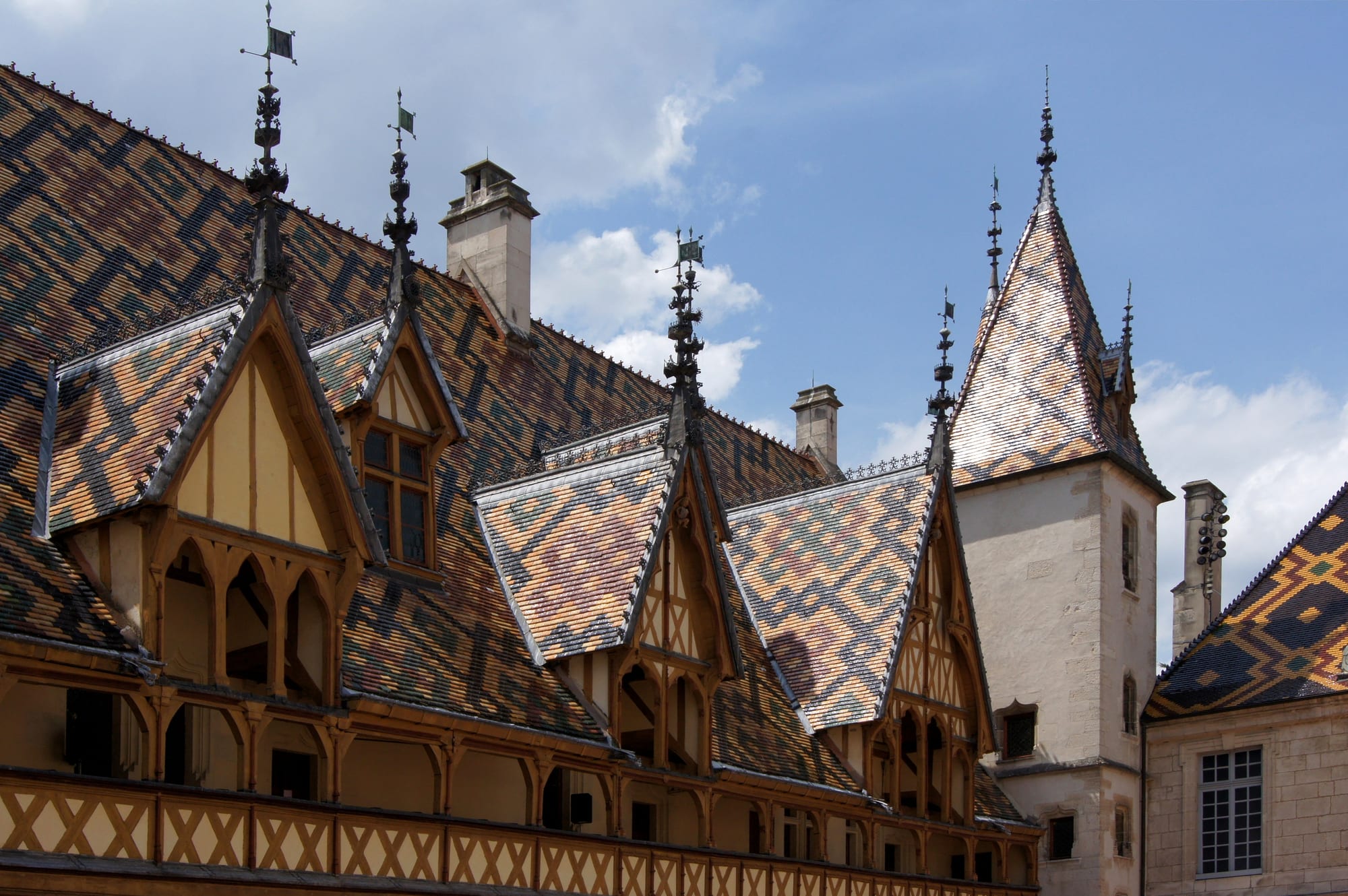
Steep roofs of glazed tiles in diamond patterns with dormers, iron finials and a slender tower under a blue sky

Burgundy & Franche-Comté, France

Beaune

The glazed-tile roofs around the courtyard of the Hôtel-Dieu in Beaune. (Jebulon / Wikimedia Commons · Public domain)

A walled town on the plain below the Côte d'Or, south of Dijon, widely seen as the wine capital of Burgundy. It grew from a Gaulish spring and a Roman fort into a ducal town, its 15th-century Hôtel-Dieu has glazed patterned roofs, and the famous November wine auction is held in the covered market opposite. Today négociants' cellars, shops and restaurants fill the old centre inside the ramparts.

Neighbourhoods

  • The old town inside the ramparts
    • First-time visitors
    • Historic district
    • Best for food

    The extensive centre ringed by walls, towers and a one-way boulevard, holding the Hôtel-Dieu, the covered market, the church of Notre-Dame and the cellars of many wine houses.

    Open in Maps
  • The boulevards and the station side
    • Close to public transport
    • Quiet and residential

    The one-way ring road along the ramparts, largely remodelled with fewer traffic lanes and new green spaces, cycle lanes and footpaths. Beyond it are residential streets and the railway station, with a hypermarket on the outskirts near the motorway.

    Open in Maps

Things to do

Famous landmarks

  • Hôtel-Dieu (Hospices de Beaune)museum

    The almshouse founded in 1443 by the ducal chancellor Nicolas Rolin as a hospital for the poor, one of the finest examples of 15th-century Burgundian architecture and now a museum, with its glazed-tile roofs and Rogier van der Weyden's Last Judgement altarpiece.

    Open in Maps
  • Church of Notre-Damelandmark

    The main church of the old centre, dating from the 12th century, with a western portal that may be older.

    Open in Maps
  • The rampartslandmark

    Walls, towers and bastions that still surround the old town, modernised with bastions in 1636 and walkable along the encircling boulevard.

    Open in Maps

Wine, mustard and museums

  • Marché aux Vinsattraction

    A wine house in the centre where visitors taste a range of Burgundy wines.

    Open in Maps
  • Moutarderie Fallotattraction

    A family-owned mustard maker producing in Beaune since 1840, with around thirty mustards, some of them flavoured.

    Open in Maps
  • Musée du Vin de Bourgognemuseum

    A museum of Burgundy wine in the town.

    Open in Maps
  • Musée Mareymuseum

    A museum named after Étienne-Jules Marey, the Beaune-born scientist and pioneer of chronophotography.

    Open in Maps

Short trips from the town

  • Pommardattraction

    A wine village on the Côte de Beaune just south of the town.

    Open in Maps
  • Meursaultattraction

    One of the world's most famous wine villages, a short drive south along the Côte.

    Open in Maps
  • Puligny-Montrachetattraction

    Another of the famous wine villages of the Côte de Beaune, farther south.

    Open in Maps
  • Nuits-Saint-Georgesattraction

    The small wine town of the Côte de Nuits, on the Route des Grands Crus north towards Dijon.

    Open in Maps
  • Clos de Vougeotlandmark

    A walled grand cru vineyard created by Cistercian monks, with the château that has been the headquarters of the Confrérie des Chevaliers du Tastevin since 1945.

    Open in Maps

Seasonal events

  • Hospices de Beaune wine auctionThird Sunday of November

    The charity auction of wines from the Hospices' own vineyards, France's main wine auction, held in the covered market.

  • Les Trois GlorieusesNovember

    A three-day festival of Burgundy food and wine set up in 1934 by the Confrérie des Chevaliers du Tastevin, of which the auction is part.

Eat and drink

Long-standing places and food districts in Beaune. Hours, ratings and directions come from your maps app, always current.

Food districts and markets

  • Saturday marketmarket

    The weekly Saturday-morning market at the covered halles opposite the Hôtel-Dieu, with a wide variety of goods, including food.

    Open in Maps
  • Restaurants around Place Carnotneighborhood

    The central square and the streets around it hold many of the town's restaurants and wine bars.

    Open in Maps

Beaune classics

  • Wine-house cellarsneighborhood

    Many Burgundy producers and négociants keep their cellars beneath the old centre, as they have since Roman times, and several offer tastings.

    Open in Maps

Experience Beaune

History

Beaune takes its name from Belena, the Latinised Gaulish name of a spring around which the first settlement grew, itself linked to Belenos, a god of fast-flowing water. The Romans built a fort here in the first century AD, and the vine was already making the area prosperous by the 13th century. In 1203 a charter granted the commune its rights and privileges, and the town became closely tied to the Dukes of Burgundy, whose castle and walls guarded it.

Its most famous building came from the ducal court. In 1443 Nicolas Rolin, chancellor of the Duke of Burgundy, and his wife Guigone de Salins founded the Hôtel-Dieu as a hospital for the poor, commissioning the Flemish painter Rogier van der Weyden to paint a Last Judgement for it. Donations gave the Hospices vineyards of their own, and the sale of their wine paid for the charity's work. The town walls were last modernised in 1636 with bastions on their weakest sides. The Great Winter of 1709 destroyed crops across the area, and Beaune stockpiled grain while nearby villages rioted against requisitions.

The Hospices' wine auction, first held in the 19th century, gained a world reputation from 1924, and a school of viticulture opened in 1884. At the end of the First World War the American army ran a university for its soldiers in the town. In 2015 Beaune was included in the UNESCO listing of the Climats of Burgundy.

Culture & Customs

Wine is the town's culture. Beaune has no grand cru vineyard of its own, but many of Burgundy's major négociants are based here, along with wine-industry suppliers, institutes and schools, and the cellars of producers large and small lie beneath the old streets. The year turns on the vineyard calendar and culminates in November, when the Hospices auction draws buyers and visitors from around the world as part of the Trois Glorieuses, created in 1934 by the Confrérie des Chevaliers du Tastevin.

The town's heritage is shown off in its glazed patterned roofs — Beaune is the main centre of this Burgundian tile style — and in the Hôtel-Dieu; the town attracts around 400,000 visitors a year. Étienne-Jules Marey, a pioneer of chronophotography and an influential figure in the history of cinema, was born here. The mathematician Gaspard Monge, inventor of descriptive geometry, was another native.

Local manners are those of a small, prosperous provincial town used to visitors: greetings are expected in every shop and cellar, tastings are taken seriously, and the Saturday market is as much a social event as a shopping trip.

Daily Life

About 20,000 people lived in Beaune in 2023, making it the second town of the Côte-d'Or, and about 50,600 in the wider Beaune Côte et Sud area in 2022. The population has been falling slightly. Beaune is a sub-prefecture, and its economy rests on wine — production, trade, equipment and services — and on tourism, alongside the shops and services of a market town.

Behind the image of wealth, most residents are workers or office and shop employees, incomes are modest, and around a fifth of homes are social housing. Short-term holiday lets have become a local issue, as owners of flats in the centre rent to visitors rather than to year-round residents. The boulevard around the ramparts has been rebuilt with fewer traffic lanes to calm the centre.

The weekly rhythm is set by the Saturday-morning market and the year by the vineyards, from pruning in winter to the harvest in early autumn, when seasonal workers and visitors fill the town.

Food

Beaune eats and drinks Burgundy. Restaurants serve the region's classics: bœuf bourguignon, beef braised in red wine; œufs en meurette, eggs in a red-wine sauce; escargots, snails baked in their shells with parsley butter; jambon persillé, a marbled ham with parsley; and gougères, savoury choux pastries made with cheese. Époisses, a pungent washed-rind cow's-milk cheese, also appears on local cheese boards.

The Saturday-morning market at the covered halles opposite the Hôtel-Dieu is the town's larder, with a wide variety of food. Mustard is made here too: the Fallot family has produced it in Beaune since 1840, with around thirty varieties, some of them flavoured.

Wine is the centre of everything. The Côte de Beaune around the town produces red Pinot Noir and white Chardonnay, and some of the world's most famous wine villages, such as Meursault and Puligny-Montrachet, lie just to the south; and the Route des Grands Crus runs north through Nuits-Saint-Georges to Gevrey-Chambertin. Many houses in town offer tastings in their cellars, and kir, white wine with blackcurrant liqueur, is a classic aperitif.

Planning tools

Budget

Beaune is one of the more expensive places in the region for rooms and tastings, especially around the November auction and in summer, and the top wines are costly. Lunch menus are far cheaper than dinners, and staying in Dijon, a short train ride away, can lower the cost.

Daily Budget Midrange
USD 150–290 (mid-range hotel or chambre d'hôte, restaurant dinners, a wine tasting, a hire car or bike)
Daily Budget Shoestring
USD 70–120 (budget hotel or guest room, market and bakery food, regional trains, a growers' tasting)

Small growers often charge less for tastings than the big houses in town.

Best Time to Visit

May to October for walking and cycling in the vineyards, with the harvest in September and October. The auction weekend in November is the town's busiest moment, when rooms must be found well ahead. Winter is cold and quiet.

Suggested Number of Days

The old town can be seen in a day or two. Three or four days allow time for the wine villages north and south along the Côte; the number depends mostly on how many tastings are planned and whether a car or bike is used.

First Visit
1–2 days
With Surroundings
3–4 days

Transportation

The old town is small and best seen on foot. Regional trains run along the Côte to Dijon, and guided and self-guided bike tours leave from Beaune into the vineyards. The wine villages are otherwise reached by car, taxi or organised tour.

Saturday-market crowds make the centre slow to drive and park in; arrive early or come by train.

Airport & Station Connections

Beaune's railway station has regional trains from Dijon and a TGV service on the Strasbourg–Dijon–Marseille route, with more TGVs at Dijon. The nearest large airport is Lyon-Saint Exupéry, and the A6 motorway passes the edge of town.

Walkability

Very good: the old town inside the ramparts is compact and lies on the plain, and the boulevard around the ramparts makes an easy circuit. The wine villages are better reached by bike or car.

Safety

France is a safe country overall, with violent crime against visitors uncommon. Beaune is a quiet, well-kept town; the main risk for visitors is on the roads after tastings, where drink-driving is heavily enforced.

Use a spittoon or a designated driver on wine tours, and keep an eye on bags in market-day crowds. Check current official travel advice before travelling.

Climate

A modified oceanic climate of the plains, with no dry season. At the nearby weather station of Savigny-lès-Beaune the yearly average is about 12°C, with around 750 mm of rain.

Summer
at nearby Savigny-lès-Beaune the record high of 39.8°C was set in August 2003
Winter
the record low at nearby Savigny-lès-Beaune is -20.5°C, from January 1985

Local Customs

A 'bonjour' on entering a shop, cellar or café is expected. Service is included in French restaurant prices, so tipping is limited to small change for good service. At tastings it is normal to spit, and buying a bottle after a small producer's tasting is appreciated though not required.

Keep voices low inside the Hôtel-Dieu and churches, and dress modestly in places of worship.

Common Payment Methods

The currency is the euro. Cards and contactless payment are widely accepted in shops, restaurants and wine houses, and the town has ATMs. Some market stalls prefer cash.