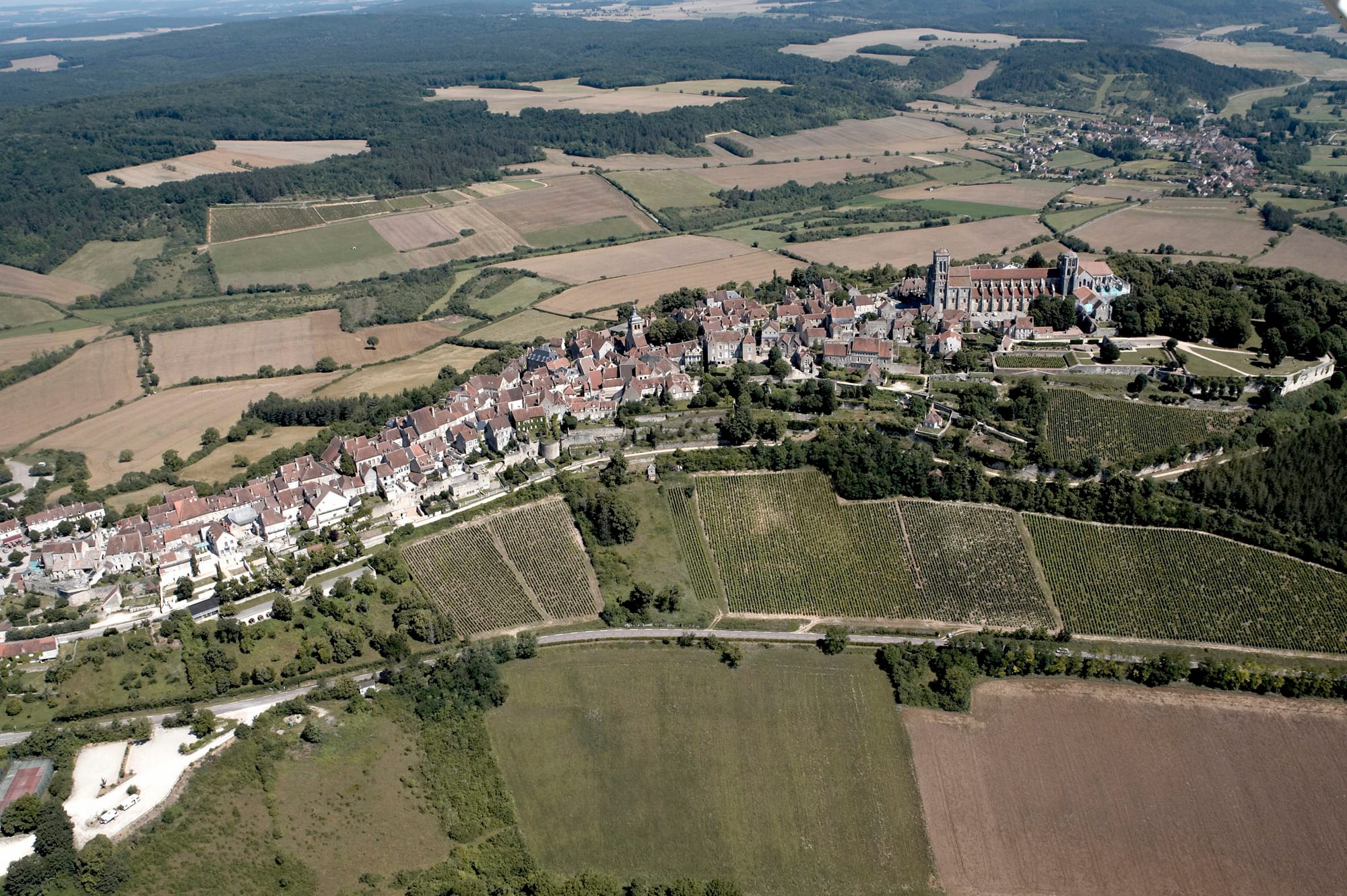
Aerial view of a long village of stone houses climbing a ridge to a large church, with vineyards and fields below

Burgundy & Franche-Comté, France

Vézelay

Vézelay seen from the air, its main street rising along the hill to the basilica of Sainte-Marie-Madeleine. (Conseil Général de l'Yonne / Wikimedia Commons · CC BY-SA 4.0)

A small walled village on a hill above the Cure valley in the Yonne, in northern Burgundy, crowned by the Romanesque basilica of Sainte-Marie-Madeleine. Relics of Mary Magdalene made it one of medieval Europe's great pilgrimage centres and a starting point for the road to Santiago de Compostela. Today the hill and basilica are a UNESCO World Heritage Site, surrounded by vineyards and farmland.

Neighbourhoods

  • The hilltop village
    • First-time visitors
    • Historic district

    The old town inside its 12th-century walls, strung along the steep main street that climbs the ridge to the basilica. Shops, galleries, restaurants and pilgrims' lodgings line the way, and the gardens behind the basilica look out over the valley.

    Open in Maps
  • The foot of the hill
    • Quiet and residential
    • Vineyards

    The vineyards that run down to the edge of the village and the scattered hamlets on the plain below, part of the same commune. Paths lead down to the chapel of La Cordelle and on to the neighbouring villages of Asquins and Saint-Père.

    Open in Maps

Things to do

The basilica and the hill

  • Basilica of Sainte-Marie-Madeleinelandmark

    The church of the former Benedictine abbey, consecrated in 1104 and restored by Viollet-le-Duc from 1840 to 1859, famous for its Romanesque sculpture and listed with the hill as a UNESCO World Heritage Site.

    Open in Maps
  • Basilica gardensviewpoint

    The park behind the basilica, with wide views over the valley and the surrounding countryside.

    Open in Maps
  • The rampartslandmark

    The village was fortified in 1150 with about 2,000 metres of curtain wall and a gate, and walks around the walls give views on every side.

    Open in Maps
  • La Cordellelandmark

    A small chapel on the hillside, built as a memorial where Saint Bernard preached the Second Crusade in 1146, now at the heart of the oldest Franciscan foundation in France, reached by a footpath from the basilica.

    Open in Maps
  • Maison Zervosmuseum

    The villa of the art publisher Christian Zervos and his wife Yvonne, designed by Jean Badovici and Eileen Gray, now a foundation showing contemporary art and architecture on a terrace above the village.

    Open in Maps

Walks and short trips

  • Way of St James from Vézelaytrail

    Vézelay is the starting point of the Via Lemovicensis, one of the main pilgrim routes to Santiago de Compostela, waymarked as a long-distance footpath.

    Open in Maps
  • Saint-Pèreattraction

    The village at the foot of the hill on the Cure, where the first community that became Vézelay's abbey was founded in the 9th century.

    Open in Maps
  • Avallonattraction

    The nearest town, a base for exploring the surrounding area.

    Open in Maps

Eat and drink

Long-standing places and food districts in Vézelay. Hours, ratings and directions come from your maps app, always current.

Vézelay classics

  • Vézelay wineneighborhood

    The vineyards on the slopes produce light reds and whites; the whites, from Chardonnay, have had their own appellation, Vézelay, since 2017.

    Open in Maps
  • Regional produce shopsneighborhood

    Shops on the main street selling local wine, cheese and jams.

    Open in Maps
  • Restaurants on the main streetneighborhood

    Many restaurants line the climb to the basilica, serving the large numbers of visitors.

    Open in Maps

Experience Vézelay

History

People lived near the salt springs below the hill as early as 2300 BC. The Romans planted vines on the hill. In the 9th century Girart de Roussillon founded a convent of nuns at what is now Saint-Père; after the Normans drove them out in the 870s, the community was refounded on the hill with Benedictine monks. Around the turn of the millennium, according to legend, relics of Mary Magdalene were brought here from Saint-Maximin-la-Sainte-Baume, and in 1058 the pope confirmed their authenticity.

Pilgrims poured in. Between 1050 and 1250 Vézelay was the largest sanctuary of the Magdalene in Western Europe and a starting point for the road to Santiago de Compostela. The abbey church was consecrated in 1104, and the village grew into a small town whose people fought the abbots for their rights. In 1146 Bernard of Clairvaux preached the Second Crusade here before King Louis VII, and in 1190 Philip Augustus and Richard the Lionheart met here to set out on the Third. The town was walled in 1150.

Decline set in when the pope recognised the body found at Saint-Maximin as Mary Magdalene's in 1279, and the pilgrims turned away. In 1790 the revolutionary authorities ended the religious community at the abbey. From 1840 to 1859 the architect Eugène Viollet-le-Duc restored the decaying church. In the 20th century writers including Romain Rolland, Georges Bataille and Jules Roy settled on the "inspired hill", Franciscans returned to La Cordelle in 1949, and a monastic community came back to the basilica in 1993.

Culture & Customs

Vézelay's identity is bound up with pilgrimage. The basilica remains a living church, and walkers still set out from here on the Via Lemovicensis, one of the main French routes to Santiago de Compostela. The Fraternités monastiques de Jérusalem keep the daily round of prayer in the basilica, and three Franciscan brothers lived at the hermitage of La Cordelle in 2025.

The village has also drawn artists and writers. It is known as the "colline inspirée", the inspired hill, and among those who lived here were the novelist Romain Rolland, the writer Georges Bataille and the author Jules Roy. The art publisher Christian Zervos and his wife Yvonne had a house here, designed by Jean Badovici and Eileen Gray, which is now a foundation for contemporary art and architecture.

Wine is the other local tradition. In January 2019 Vézelay hosted the 75th Saint-Vincent Tournante, the travelling wine festival of Burgundy overseen by the Confrérie des Chevaliers du Tastevin. The pace of the place is slow, and visitors are expected to respect the quiet of the basilica and its services.

Daily Life

Vézelay is tiny: about 476 people lived in the commune in 2023, though that figure has been rising. Many more visitors than residents climb the hill on a summer day, and the village's shops, galleries, restaurants and guest houses live largely from tourism and pilgrimage, alongside the vineyards and farms on the plain below.

Daily life follows the seasons. In summer the main street is busy from morning to evening with walkers, pilgrims and day trippers; in winter the village returns to its few hundred residents, the monastic community of the basilica and the farmers and winegrowers around it. The commune includes several hamlets scattered across the plain, and Avallon, about 15 km away, is the nearest town.

The landscape around it, at the northern edge of the Morvan hills and above the Cure valley, which long served as the main waterway of the area and the border between the Nivernais and Burgundy, is rural and thinly populated, and life for most residents depends on the car.

Food

The food of Vézelay is that of Burgundy. Restaurants on the main street serve the regional classics: bœuf bourguignon, beef braised in red wine; œufs en meurette, eggs in a red-wine sauce; escargots, snails baked in their shells with parsley butter; and gougères, savoury choux pastries made with cheese. Époisses, a pungent washed-rind cow's-milk cheese, and crème de cassis, the blackcurrant liqueur used in kir, are found throughout the area.

The local wine has its own name. The vineyards on the slopes around the village produce light reds and whites; the whites, made from Chardonnay, were recognised as Bourgogne Vézelay in 1996 and became an appellation of their own, Vézelay, in 2017. Shops along the main street sell local wine, cheese and jams.

The Romans first planted vines here, and a temple to Bacchus was found in the foundations of an old church in 1689. Centuries later the parish was described as rough, dry and stony country producing only mediocre wine and little wheat.

Planning tools

Budget

Vézelay itself has few rooms and many day visitors, so prices for a night on the hill are higher than in the surrounding villages and Avallon. Food and wine in the shops and cellars are fairly priced, and the basilica, the gardens and the walks are free.

Daily Budget Midrange
USD 140–280 (guest house or chambre d'hôte, restaurant dinners, a wine tasting, a hire car)
Daily Budget Shoestring
USD 65–110 (pilgrim hostel or budget room, picnic and bakery food, regional buses)

A car makes it far easier to combine Vézelay with the Morvan and nearby villages, as buses are infrequent.

Best Time to Visit

May to October, when the walks are pleasant and the views clearest; summer brings the most pilgrims and day visitors, and early mornings and evenings on the hill are quieter. Winter is cold and very quiet.

Suggested Number of Days

The village and basilica can be seen in a day. Two or three days allow time for the surrounding walks, villages and the Morvan hills; pilgrims setting out on foot treat Vézelay as a starting point rather than a stop.

First Visit
1 day
With Surroundings
2–3 days

Transportation

The village is small and walked on foot; cars are best left in the car parks at the foot of the old town. SNCF regional buses link Vézelay with Sermizelles, Clamecy and Corbigny. Elsewhere in the area a car or bike is needed.

The main street is steep and cobbled in places; sensible shoes help.

Airport & Station Connections

There is no railway station in Vézelay. The nearest station is at Sermizelles, where SNCF regional buses connect to the village. Most visitors arrive by car.

Walkability

Excellent but steep: the whole village lies along a single ridge, and the climb from the lower gate to the basilica is the main walk. Footpaths lead down through the vineyards to La Cordelle, Asquins and Saint-Père.

Safety

France is a safe country overall, with violent crime against visitors uncommon. Vézelay is a quiet village; the main risks are slippery paving in wet weather and narrow country roads after wine tastings.

Take care on steep streets in rain or frost, and do not drive after tastings. Check current official travel advice before travelling.

Climate

A degraded oceanic climate, with rain spread through the year. At the nearby weather station of Merry-sur-Yonne the year averages about 11.5°C, with around 780 mm of rain.

Summer
warm; at the weather station near Avallon the record high is 41.3°C, set in July 2019
Winter
cold; at the weather station near Avallon the record low is -16°C, from December 2009

Local Customs

The basilica is an active place of worship, home to the Fraternités monastiques de Jérusalem since 1993, and visitors are expected to keep quiet during services. A 'bonjour' on entering shops is expected, and service is included in restaurant prices, so tipping is limited to small change.

Dress modestly in the basilica and La Cordelle, and avoid photographing services or pilgrims at prayer without asking.

Common Payment Methods

The currency is the euro. Cards are accepted in most shops and restaurants, and some cash is useful in a village this small.