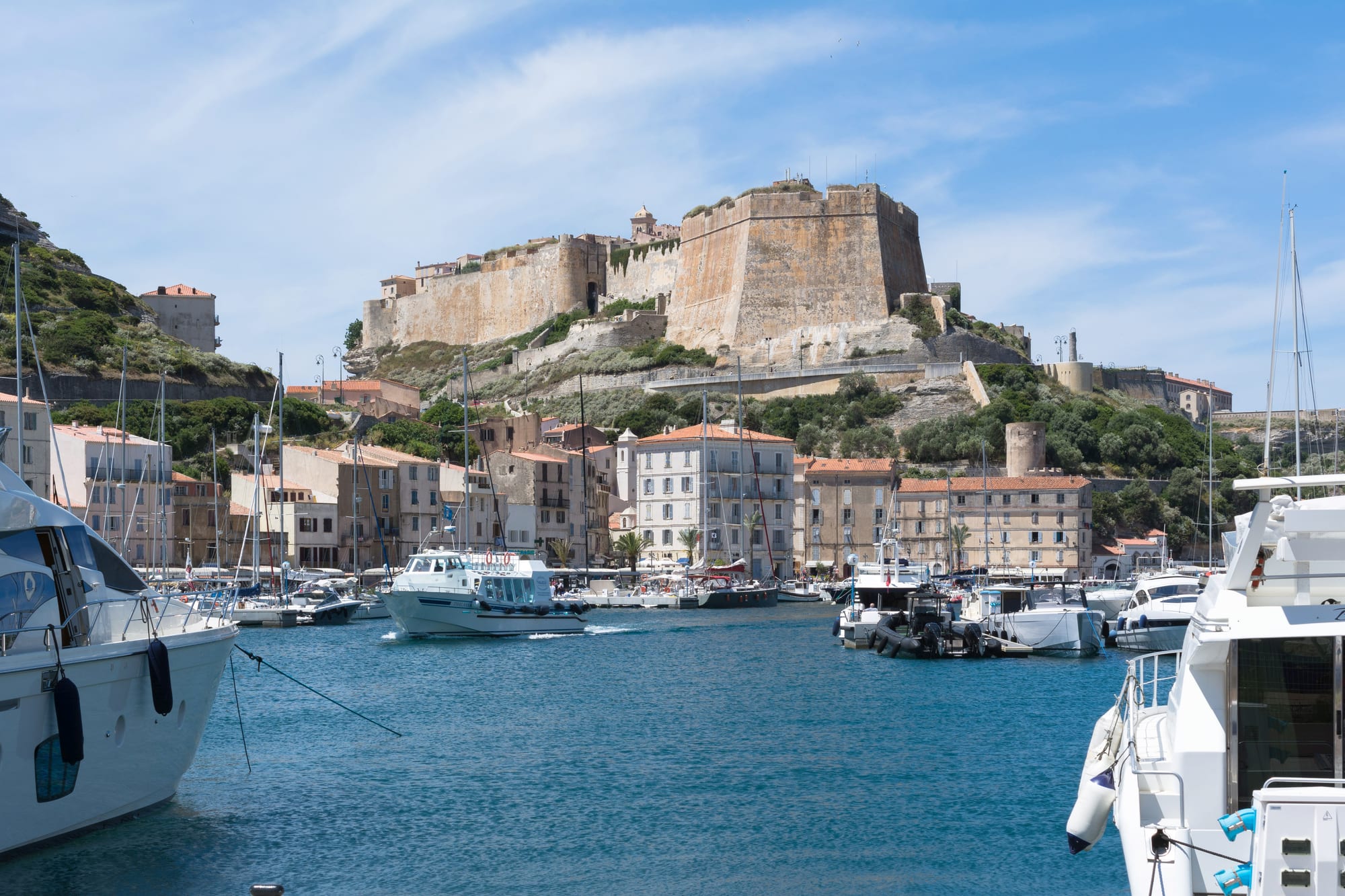
Boats in a narrow blue harbour lined with pale houses, below the massive stone walls and bastion of a hilltop citadel

Corsica, France

Bonifacio

The marina of Bonifacio below the walls of the citadel. (Isiwal / Wikimedia Commons · CC BY-SA 3.0)

France's southernmost commune, at the tip of Corsica facing Sardinia across the Strait of Bonifacio. A fortress founded in 828 and repopulated by Genoa in 1195, its walled upper town stands on white limestone cliffs undercut by the sea, above a fjord-like harbour that now fills with yachts, ferries and boats bound for the Lavezzi islands.

Neighbourhoods

  • The Haute Ville
    • First-time visitors
    • Historic district
    • Views

    The walled upper town on the promontory, entered by the Genoa Gate: a warren of tall houses and alleys with the churches of Sainte-Marie-Majeure and Saint-Dominique, the bastion museum and restaurants, built right to the edge of cliffs about 70 metres above the sea.

    Open in Maps
  • La Marine
    • Harbour life
    • Close to public transport
    • Best for food

    The harbour quarter along the narrow shelf of the inlet below the citadel, with the marina, the ferry terminal, the boat-trip kiosks and waterfront bars and restaurants. It stretches some distance up the valley.

    Open in Maps
  • The southern beaches
    • Beaches
    • Quiet stays

    East and west of the town, the commune's coast of coves and bays runs from La Tonnara to Piantarella near Sperone and the Golfu di Sant'Amanza, facing the islands of the marine reserve.

    Open in Maps

Things to do

The citadel and the cliffs

  • King of Aragon's Staircaselandmark

    A staircase of 189 steps cut at a 45-degree angle down the limestone cliff; legend credits Alfonso V of Aragon's troops in 1420, but it was probably made by Franciscan monks to reach a freshwater well.

    Open in Maps
  • Église Sainte-Marie-Majeurelandmark

    A church built in the 12th–13th centuries, with a loggia at the front above a cistern that collects rainwater from the roofs.

    Open in Maps
  • Église Saint-Dominiquelandmark

    An early 14th-century church within the walls of a former Dominican convent beside the town hall, described as the largest church on the island.

    Open in Maps
  • Bastion de l'Étendardmuseum

    The bastion guarding the Genoa Gate into the upper town, now a museum.

    Open in Maps
  • Col Saint-Roch and the Grain de Sableviewpoint

    The saddle below the citadel with a tiny chapel marking where the town's last plague victim died, and a sweeping view of the straits and the offshore rock called the Grain de Sable.

    Open in Maps

The sea and the coast

  • Lavezzi islandspark

    Small granite islands and reefs in the strait, part of the Strait of Bonifacio marine nature reserve; boat trips leave the marina, and military cemeteries recall the wreck of the frigate Sémillante in 1855.

    Open in Maps
  • Boat trips along the cliffsattraction

    Short and half-day boat trips from the harbour run beneath the overhanging white cliffs and out into the strait that separates Corsica from Sardinia.

    Open in Maps
  • Torra di Sant'Amanzalandmark

    The round base of a Genoese watchtower 125 metres up on a headland on the south-east coast of the commune, built against Barbary pirates.

    Open in Maps

Short trips from the town

  • Santa Teresa Galluraattraction

    The Sardinian town across the strait, reached by frequent car ferries, with a beach, Rena Bianca, just north of its centre.

    Open in Maps

Seasonal events

  • Holy Weekthe week before Easter, March or April

    The town's five religious brotherhoods, still very much alive, lead the services and processions of Holy Week, the most spectacular of their many ceremonies.

Eat and drink

Long-standing places and food districts in Bonifacio. Hours, ratings and directions come from your maps app, always current.

Corsican classics

  • Corsican charcuterie and cheesemarket

    Lonzu, coppa, prisuttu and figatellu, and brocciu, the island's cheese of milk and whey, made across Corsica.

    Open in Maps
  • Fiadonecafe

    The Corsican cheesecake made with brocciu, sugar, eggs and lemon zest.

    Open in Maps

Food districts

  • The harbour quaysneighborhood

    Waterfront bars and restaurants line the marina below the citadel, facing the yachts and the boats to the islands.

    Open in Maps
  • The upper townneighborhood

    Restaurants tucked into the alleys of the walled town, some with terraces near the cliff edge.

    Open in Maps

Experience Bonifacio

History

People were in the area very early: the cave shelter of Araguina-Sennola just north of the town held the burial known as the Lady of Bonifacio, carbon-dated to about 6570 BC. The town that stands today was founded as a fortress in 828 by Boniface II of Tuscany, who had led a naval expedition against the Saracens and gave it his name; Il Torrione, a round tower, survives from the original citadel. Pisa and Genoa fought over this strategic port in the 12th century, and in 1195 Genoa took it for good, expelled all but thirty families and repopulated it with 400 families from Liguria, granting statutes that allowed the town to mint coins and produce salt.

As a Genoese stronghold Bonifacio withstood a five-month siege by Alfonso V of Aragon in 1420. Plague later devastated it, and in 1553, still weakened, it surrendered to the corsair Dragut acting with the French; it was rebuilt and returned to Genoa under the peace of 1559. The Holy Roman Emperor Charles V stayed in the town in 1541, and Napoleon Bonaparte in 1793.

In 1855 the French frigate Sémillante was wrecked on the Lavezzi islands with the loss of hundreds of lives, and military cemeteries on the islands mark the disaster. The citadel served for many years as a base of the French Foreign Legion, which left for Nîmes in 1983. In 1993 France and Italy created the international marine park of the Strait of Bonifacio, which includes the Lavezzi islands.

Culture & Customs

Bonifacio's Genoese repopulation still shows in its speech. The town has its own dialect, Bonifacino, a form of Ligurian rather than Corsican, and the town's name in it is Bunifazziu. The old families' chapels in the marine cemetery of Saint-François and the tall houses of the upper town keep the feel of a Genoese colony on the edge of the sea.

Religious life is organised through five historic brotherhoods — of the Holy Cross, Saint John the Baptist, Saint Bartholomew, Saint Mary Magdalene and Saint Erasmus, the last for fishermen. Now lay associations, they remain very much alive, appearing at funerals and saints' processions, and above all during Holy Week, when they lead the Tenebrae services and processions through the old town. A procession is still held at the chapel of Saint-Roch, built where, by tradition, the last victim of the plague died.

The town has also found its way into literature: Guy de Maupassant set his short story "A Vendetta" in Bonifacio. Since 2025 the town has been twinned with Santa Teresa Gallura, its neighbour across the strait.

Daily Life

The commune had about 3,300 residents in 2023. It covers a much larger area than the town itself, including about 75 km of coastline and the Lavezzi islands, and it is the southernmost commune of metropolitan France — closer to the capitals of 20 other countries in Europe and Africa than to Paris.

Tourism drives the economy: the town is a popular summer destination, mostly for visitors from mainland France, and the port combines a marina, a small fishing port, boat-trip operators and ferry crossings several times a day to Santa Teresa Gallura in Sardinia. Fishing is restricted in the marine reserve around the islands. The hinterland, the Piali, was once important farmland, dotted with dry-stone huts called baracun.

Historically most residents lived in the upper town under the protection of the citadel, while the harbour quarter of La Marine stretches along the inlet and up the valley. Summer brings crowds to both, and in winter the town is quiet and many businesses close.

Food

Bonifacio cooks as the rest of Corsica does, from the island's farms and its sea. Corsican charcuterie comes from pigs that live partly in the wild and feed mainly on chestnuts: lonzu, a peppered, salted and smoked pork fillet; coppa, also called capicollu; prisuttu, ham; and figatellu, a pork-liver sausage. Brocciu, a cheese made from milk and whey, mostly of sheep's milk, is used in cannelloni and ravioli and in fiadone, a cheesecake with lemon zest.

Chestnut flour, once the island's staple, is used in pulenda, a chestnut polenta, in cakes and fritters, and in Pietra, a Corsican beer brewed from malt and chestnut flour. Fish soup, made with sea or river fish, is typical of the island. Canistrelli are biscuits flavoured with white wine or anisette.

The restaurants of the harbour and the upper town serve these island dishes alongside seafood. Corsican wines from grapes such as Nielluccio, Sciaccarellu and Vermentinu, myrtle liqueur and the aperitif Cap Corse Mattei are the island's best-known drinks.

Planning tools

Budget

Bonifacio is among the most expensive places in Corsica, especially in July and August, when rooms, restaurants and hire cars are in high demand. Prices fall considerably outside the peak, though many places close in winter. Walking the upper town and the cliff paths costs nothing; boat trips and the staircase have fees.

Daily Budget Midrange
USD 190–360 (mid-range hotel, restaurant dinners, a boat trip to the islands, a hire car)
Daily Budget Shoestring
USD 80–130 (campsite or budget room, bakery and market food, walking and local buses)

Book summer stays and cars well ahead, and consider a day trip to Sardinia on the car ferry.

Best Time to Visit

May, June and September are the most pleasant months, warm and sunny with fewer visitors. July and August are hot and very crowded, and the upper town's lanes fill with day-trippers. The strait is often windy, which can cancel boat trips. Holy Week brings the brotherhoods' processions, and winter is quiet, with many businesses closed.

Suggested Number of Days

A day or two covers the town, the cliffs and a boat trip. Allow three or four to add the beaches of the south coast and a crossing to Sardinia; a car is needed for most of the surroundings.

First Visit
1–2 days
With Surroundings
3–4 days

Transportation

The town is walked, though the climb to the citadel is steep; a small tourist train runs up from the port in season. The upper town can be reached by car but is congested, with little parking. A minibus connects with the bus to Ajaccio by way of Sartène and Propriano, and other buses run up the east coast to Porto-Vecchio and Bastia. A car is needed for most beaches.

Park below and walk up to the citadel by the stairs rather than driving into the upper town.

Airport & Station Connections

The nearest airport is Figari–Sud Corse, north of the town, reached by car or taxi. Car ferries cross the strait several times a day to Santa Teresa Gallura in Sardinia. By road, the N196 comes down the west coast from Ajaccio and the N198 the east coast from Porto-Vecchio and Bastia.

Walkability

Good but hilly. The port and the upper town are close but separated by a steep climb, by road or by stairs, and the old town's lanes are narrow and cobbled. The beaches and Cap Pertusato need a car, a bicycle or a long walk.

Safety

France is a safe country overall, with violent crime against visitors uncommon. Bonifacio has little crime; the real hazards are natural ones — unfenced cliff edges and crumbling rock, strong winds and rough water in the strait, and wildfire in the dry season.

Keep back from cliff edges, take care on the steep staircase, and check the wind before boat trips or swimming off exposed coves. Check current official travel advice before travelling.

Climate

A Mediterranean climate, with an average annual temperature of about 16.8°C and around 580 mm of rain a year, November being the wettest month. Summers are hot and dry, winters mild, and strong winds are common in the strait.

Summer
warm to hot and dry, with August, the warmest month, averaging about 24.8°C
Winter
mild, with February, the coolest month, averaging about 10.5°C

Local Customs

Greet people with 'bonjour' on entering a shop or café; service is included in bills, so tipping is a modest extra. The town has its own dialect, Bonifacino, a form of Ligurian, alongside Corsican and French. The religious brotherhoods remain an important part of local life, and their processions are acts of worship, not shows.

Dress modestly in the churches, keep back and quiet during processions, and cover up away from the beach.

Common Payment Methods

The currency is the euro. Cards and contactless payment are accepted in most hotels, restaurants and shops, and there are ATMs in the port and upper town. Some buses and small businesses prefer cash, so carry a little.