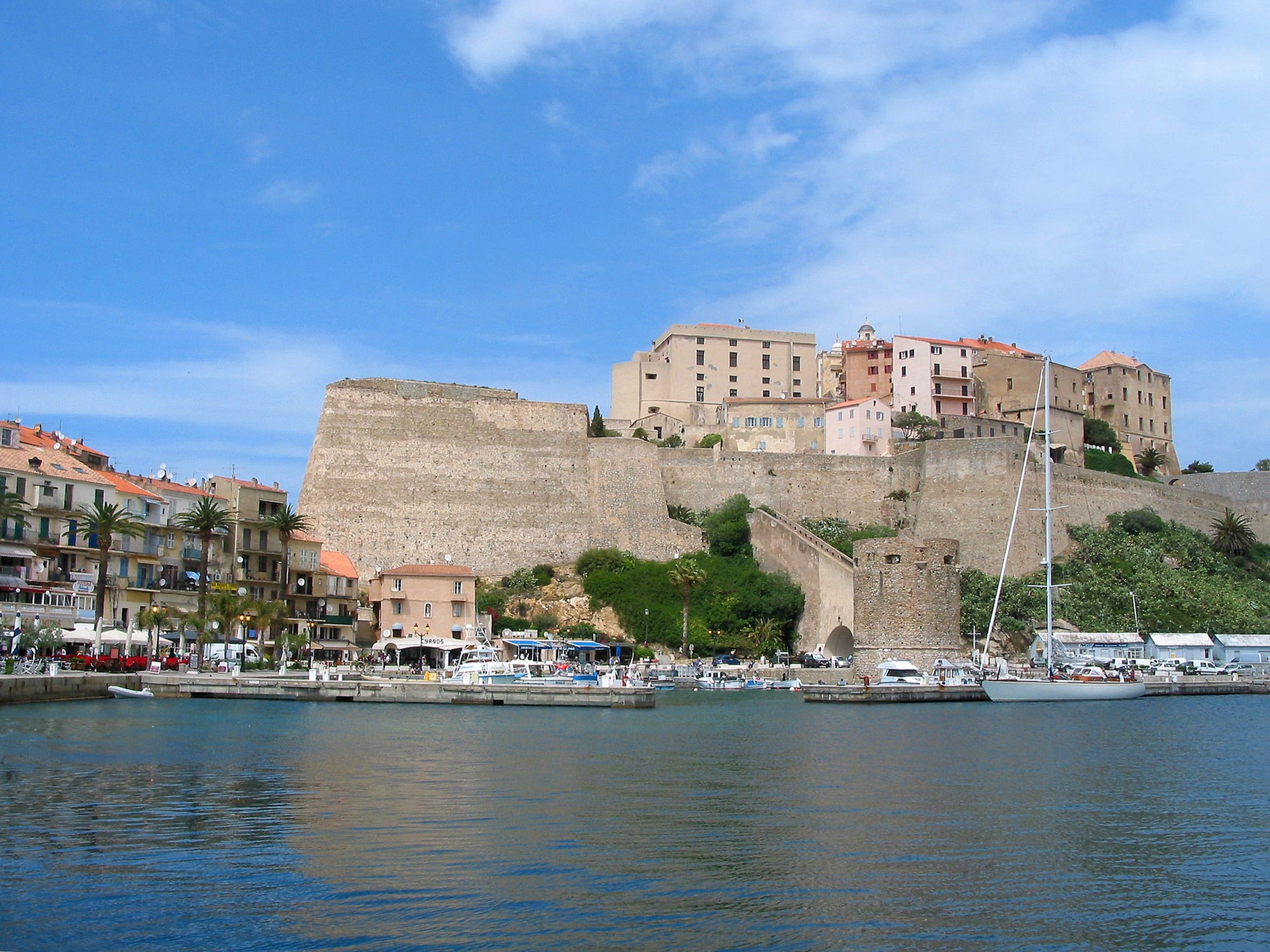
Massive stone ramparts with tall pastel houses above them, rising over a calm harbour with moored boats and palm-lined quays

Corsica, France

Calvi

The citadel of Calvi above the harbour. (Jean-Pol GRANDMONT / Wikimedia Commons · CC BY 3.0)

The main town of the Balagne, on Corsica's north-west coast, where a Genoese citadel stands on a headland above a marina and a long sandy bay backed by mountains. Loyal to Genoa for centuries and besieged by Nelson in 1794, Calvi now lives from summer tourism and from the Foreign Legion parachute regiment based beside it.

Neighbourhoods

  • The citadel
    • First-time visitors
    • Historic district
    • Views

    The walled upper town on the Punta San Francesco, reached up steep cobbled ramps: the pro-cathedral of Saint-Jean-Baptiste, the oratory of the Saint-Antoine brotherhood, the old governors' palace and a house claimed as Columbus's birthplace, with wide views over the gulf, best at sunset.

    Open in Maps
  • The lower town and the marina
    • Best for food
    • Nightlife
    • Close to public transport

    The streets below the citadel, around the baroque church of Sainte-Marie-Majeure and along the Quai Landry, where café and restaurant terraces face the Xavier Colonna marina as far as the Tour du Sel.

    Open in Maps
  • La Pinède and the bay
    • Beaches
    • Families

    East of the town, the long beach of La Pinède curves around the Gulf of Calvi, backed by pine woods, with the mountains of the Balagne behind.

    Open in Maps

Things to do

The citadel and the town

  • Citadel ramparts and Torra di Calvilandmark

    The Genoese fortifications above the harbour, strengthened in the 16th century, whose ramparts and tower are listed historic monuments; walking the walls gives the town's best views.

    Open in Maps
  • Pro-cathedral of Saint-Jean-Baptistelandmark

    The church inside the citadel, residence of the bishops of Sagone from 1625, from which the Good Friday processions set out.

    Open in Maps
  • Oratoire Saint-Antoinelandmark

    The early 15th-century chapel of one of Corsica's most active brotherhoods, with frescoes from 1510 and 1513, still used for its services and for concerts.

    Open in Maps
  • Église Sainte-Marie-Majeurelandmark

    The baroque church of the lower town, where the Granitula procession pauses on Good Friday.

    Open in Maps
  • Tour du Sellandmark

    A massive lookout tower of 1495 at the end of the marina, later used to store salt.

    Open in Maps

The coast

  • La Pinède beachbeach

    The long sandy beach of the Gulf of Calvi, running east from the town below the pines.

    Open in Maps
  • Revellata peninsulaviewpoint

    A wild, protected headland west of the town, with a track to the Revellata lighthouse, and the beach of l'Alga.

    Open in Maps
  • Notre-Dame de la Serraviewpoint

    A pilgrimage chapel and statue of the Virgin on a hill just outside the town on the road to Porto, looking over Calvi and its bay.

    Open in Maps

Short trips from the town

  • Scandola Nature Reservepark

    A nature reserve on the west coast, established in 1975 and part of a UNESCO World Heritage Site, visited on boat trips from the marina.

    Open in Maps
  • Calenzanaattraction

    The village inland from Calvi best known as the starting point of the GR 20 long-distance trail across Corsica.

    Open in Maps
  • L'Île-Rousseattraction

    A port town along the Balagne coast founded by Pasquale Paoli in 1758 as a rival to Genoese Calvi, reached by the coastal train.

    Open in Maps
  • Algajolaattraction

    A small fortified village on the coast between Calvi and L'Île-Rousse, a stop on the beach train.

    Open in Maps

Seasonal events

  • Holy Week and the GranitulaGood Friday, March or April

    Hooded barefoot penitents walk the Way of the Cross from the cathedral down to Sainte-Marie-Majeure with the brotherhoods of Saint-Érasme and Saint-Antoine, through streets lit by thousands of candles in the windows.

  • Saint-Érasmeearly June

    The fishermen's patron saint is carried through the lower town and out to sea in a boat, where a wreath is thrown for sailors lost at sea.

  • Calvi Jazz FestivalJune

    A jazz festival held every June since 1987, with free evening concerts at the marina, concerts in the Oratoire Saint-Antoine and jazz on the ramparts.

  • Calvi on the RocksJuly

    Three nights of electronic music and DJs on the beach, with after-parties in the citadel and on the port.

Eat and drink

Long-standing places and food districts in Calvi. Hours, ratings and directions come from your maps app, always current.

Corsican classics

  • Corsican charcuterie and honeymarket

    Dried meats such as lonzu, coppa and figatellu, honey, olive oil and herbs of the maquis, sold in shops all over the town.

    Open in Maps
  • Chestnut flourmarket

    Farine de châtaigne, once the island's staple, used in cakes, fritters and pulenda, a chestnut polenta.

    Open in Maps

Food districts

  • Quai Landryneighborhood

    The marina-front quay whose café and restaurant terraces spread across the street in summer, facing the yachts.

    Open in Maps
  • Lower-town streetsneighborhood

    The streets running parallel to the marina, around the square of Sainte-Marie-Majeure, where restaurant terraces fill in summer.

    Open in Maps

Experience Calvi

History

The Calvi gulf was known in antiquity: the geographer Ptolemy, in the 2nd century, called it the most famous port of the island, and prehistoric remains have been found on the Revellata peninsula and the Serra plateau. The town itself was founded in the 13th century, and in 1278 it joined itself to the Republic of Genoa; in 1483 Genoa's Office of Saint George decided to build new fortifications, and the Tour du Sel was built as a lookout in 1495.

Calvi's motto, "Civitas Calvi semper fidelis" — Calvi always faithful — recalls its loyalty to Genoa. It was besieged in 1553 and again in 1555 by the French and their Ottoman allies, with Corsicans led by Sampiero Corso, and stayed loyal to Genoa. In 1652 Genoa allowed the motto to be carved over the town gate. When Corsica rose against Genoa in the 18th century, Calvi stayed on the Genoese side; in 1758 Pasquale Paoli founded L'Île-Rousse along the coast to give the Corsicans a port of their own.

In 1794, during the French Revolutionary Wars, British forces under General Charles Stuart and Captain Horatio Nelson, allied with Paoli, besieged and took the town; Nelson was blinded in one eye during the bombardment. The British left Corsica at the end of 1796. Calvi was an important centre of resistance in the Second World War, and its port was used for the Provence landings in August 1944. Tourism began in 1950, and the Foreign Legion's 2nd Foreign Parachute Regiment is based at Camp Raffalli beside the town.

Culture & Customs

Calvi's religious brotherhoods, of Saint-Érasme and Saint-Antoine, shape its calendar. On Good Friday they lead two processions: a cerca in the morning and, at night, the Granitula, in which hooded, barefoot penitents walk the Way of the Cross from the cathedral down to Sainte-Marie-Majeure, where the brotherhoods spiral on the square singing hymns while thousands of candles burn in the windows. In early June the fishermen's saint, Erasmus, is carried to the harbour and out to sea in memory of lost sailors. The Saint-Antoine brotherhood has spent more than twenty years collecting and reviving its chants and liturgy.

The town claims Christopher Columbus as a native son, a legend based on Calvi's Genoese past, and a house in the citadel is shown as his birthplace. Music has a large place in summer: the Calvi Jazz Festival has run every June since 1987, with concerts at the marina, in the Saint-Antoine oratory, including polyphony, and on the ramparts, and Calvi on the Rocks brings electronic music to the beach in July.

The Foreign Legion parachutists are part of the town's identity, and Calvi's own form of Corsican, mixing Tuscan, Genoese and Balagne influences, is still spoken by a few residents.

Daily Life

The commune had about 5,800 residents in 2023, making Calvi the main town of the Balagne. Beyond the old town, newer flats and shops have grown up along the road into town, with villas in districts such as Pietramaggiore and the airport out on the Figarella plain.

The economy rests on summer tourism. The other mainstay is the Foreign Legion's 2nd Foreign Parachute Regiment, whose base at Camp Raffalli and its personnel bring steady business; the military presence has been estimated at between 13 and 20 per cent of the Balagne's economic output. Apart from a spring-water bottling plant at Zilia, the area has almost no industry.

Calvi's commercial port, with a single large quay, has lost most of its traffic, since lorries in the town's only through road caused problems and ferries and cargo ships now use L'Île-Rousse. A market is held at the entrance to the town every other Thursday. In summer the marina terraces and the beach are packed; in winter the town is quiet and many businesses close.

Food

Calvi eats as the rest of Corsica does. The island's charcuterie comes from pigs raised semi-wild in the chestnut and oak woods: lonzu, cured pork fillet; coppa, also called capicollu; prisuttu, a ham; and figatellu, a pork-liver sausage. Brocciu, a fresh cheese made from the whey of sheep's or goat's milk, goes into cannelloni and fiadone, a cheesecake flavoured with citron zest.

Chestnut flour, the island's old staple, is used in pulenda, cakes and fritters, and in Pietra, a chestnut beer. Wild boar has its own recipes, fish soup comes from the coast, and canistrelli are biscuits often flavoured with white wine or aniseed. Shops in the town sell dried meats, honey, olive oil and herbs of the maquis, and restaurants line the marina and the streets parallel to it.

Corsican wines, from areas such as Calvi and Patrimonio, are poured with meals, along with myrtle liqueur and the Cap Corse Mattei aperitif.

Planning tools

Budget

Calvi is one of the priciest places in Corsica in July and August, when rooms, restaurants and hire cars are in high demand. Prices fall well outside the peak, although many businesses close in winter. The citadel, the beach and the coastal walks cost nothing.

Daily Budget Midrange
USD 190–350 (mid-range hotel, restaurant dinners, a boat trip to Scandola, a hire car for the Balagne)
Daily Budget Shoestring
USD 80–130 (campsite or budget room, market and bakery food, the coastal train)

Book July and August months ahead, and use the coastal train to reach beaches along the Balagne instead of driving.

Best Time to Visit

May, June and September are the most pleasant months, warm with fewer people; June brings the jazz festival. July and August are hot and very busy, with festivals on the beach. The west wind can be strong, and boat trips are best when it drops. Holy Week draws visitors for the processions, and winter is quiet.

Suggested Number of Days

A day or two is enough for the town and its beach. Allow three to five to add a boat trip, the hill villages of the Balagne and more of the coast; walkers starting the GR 20 nearby need longer.

First Visit
1–2 days
With Surroundings
3–5 days

Transportation

The town is compact enough to walk. A narrow-gauge railway runs along the coast to L'Île-Rousse and inland to Ponte-Leccia, joining the main Ajaccio–Bastia line, and a beach service stops at several halts along the Pinède shore. A regular bus links Calvi with Calenzana. A car is needed for the hill villages.

Use the coastal train in summer; roads and parking along the Balagne coast are crowded.

Airport & Station Connections

Calvi–Sainte-Catherine Airport is about 6 km south-east of the town, with daily flights to mainland France. Car ferries and cargo ships now use the port of L'Île-Rousse, about 24 km away, rather than Calvi. Trains from Bastia and Ajaccio change at Ponte-Leccia.

Walkability

Very good. The marina, the lower town and the beach are flat and close together, though the climb into the citadel is steep, with many steps and cobbles that are hard work in the midday heat. The Revellata peninsula and Notre-Dame de la Serra make good walks from the town.

Safety

France is a safe country overall, with violent crime against visitors uncommon. Calvi has little crime; the main risks are summer wildfires, strong winds and rough sea off exposed coasts, and the heat on the climb to the citadel.

Carry water in summer, take care swimming off rocky points when the wind is up, and check fire warnings before walking in the maquis. Check current official travel advice before travelling.

Climate

A hot-summer Mediterranean climate with an average annual temperature of about 16.4°C and around 650 mm of rain a year, November being the wettest month. The town and the whole Balagne are exposed to winds off the sea.

Summer
hot and mostly dry, with August, the warmest month, averaging about 24.7°C
Winter
mild, with February, the coolest month, averaging about 9.4°C

Local Customs

Greet people with 'bonjour' on entering a shop or café; service is included in bills, so tipping is a modest extra. The brotherhoods' processions at Easter and for Saint Erasmus are religious acts, and the Foreign Legion's presence is part of the town's life. A local form of Corsican is still spoken by some older residents.

Keep quiet and respectful during processions, dress modestly in the churches, and cover up away from the beach.

Common Payment Methods

The currency is the euro. Cards and contactless payment are accepted in most hotels, restaurants and shops, and ATMs are found in the lower town. Carry a little cash for markets and smaller businesses.