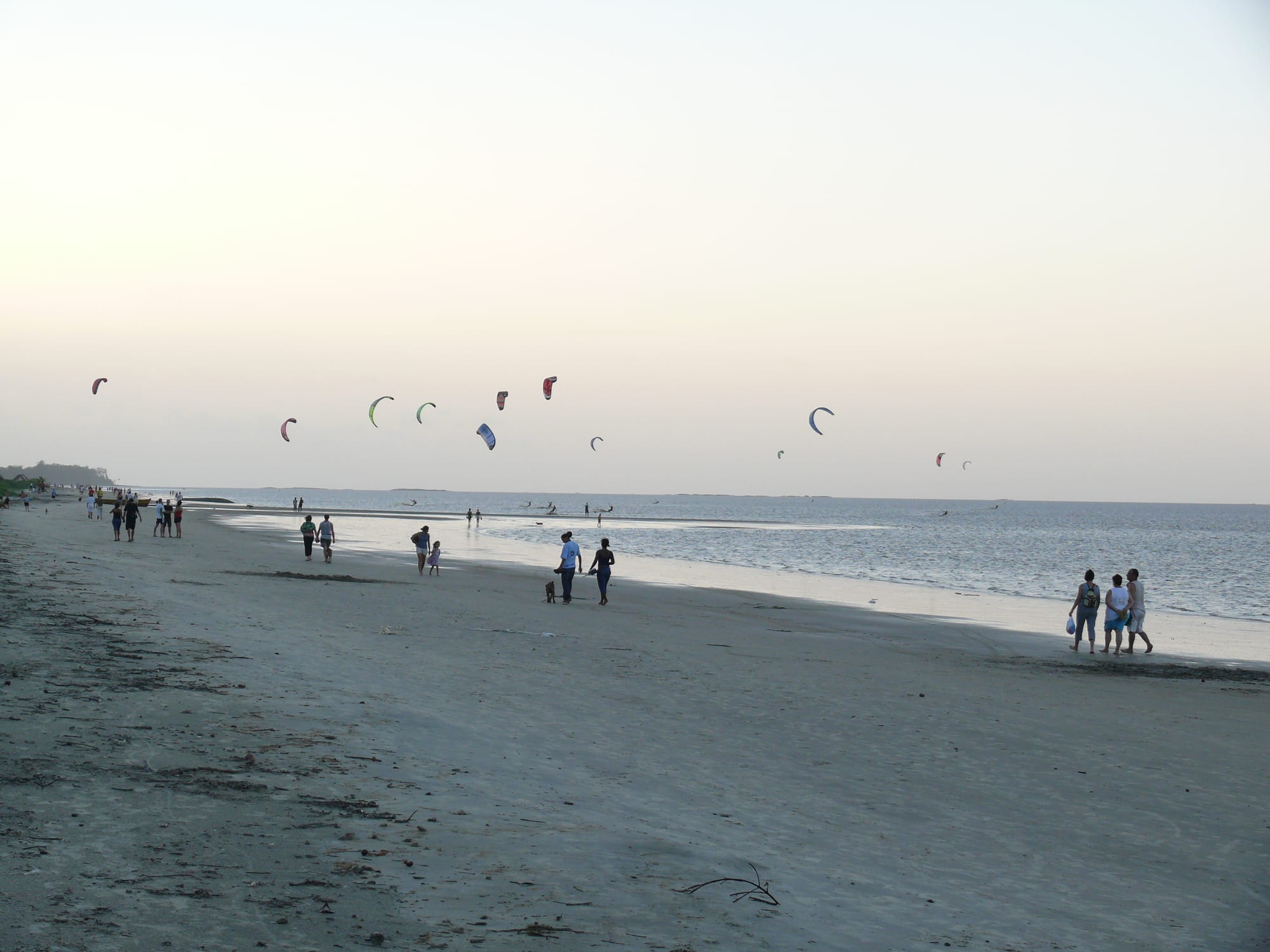
A wide sandy beach at dusk with people strolling at the water's edge and kitesurf kites in the pale sky

French Guiana

Kourou

Kourou's beach on a Sunday evening. (Arria Belli / Wikimedia Commons · CC BY-SA 3.0)

A coastal town at the mouth of the Kourou River, about 60 km north-west of Cayenne. Once a small village remembered for a disastrous colonising expedition and a penal camp, it grew rapidly after France chose it for its spaceport in the 1960s. Today it lives around the Guiana Space Centre and is the departure point for boats to the Îles du Salut.

Neighbourhoods

  • The Vieux Bourg
    • Historic district
    • Bars
    • Markets

    The old town by the river port near the mouth of the Kourou, laid out in the 1760s around the Church of Saint Catherine. Before the space centre it was the heart of the community, and it still has the fish hall, a Saturday vegetable market and several bars.

    Open in Maps
  • Pointe des Roches
    • History
    • Sea views

    The rocky point where the river meets the ocean, once the site of the Kourou prison. Most of the prison buildings were demolished after it closed, but the Dreyfus Tower still stands here, looking out towards the Îles du Salut.

    Open in Maps
  • The space-age town
    • Quiet and residential
    • Beaches

    The districts of apartment blocks and houses built from the late 1960s near the beach for space centre staff and residents, such as Simarouba, with the town hospital nearby since 1965, close to the long sandy beach.

    Open in Maps
  • Quartier Saramaka
    • Local life

    A district along the river where most of Kourou's Saramaka Maroon community settled, one of the several communities — Kalina, Creole, Maroon, metropolitan French and newer arrivals — that make up the town.

    Open in Maps

Things to do

The spaceport

  • Guiana Space Centreattraction

    Europe's spaceport, in operation since 1968 just outside the town, from which Ariane 6 and Vega C rockets are launched; guided tours of the area can be taken, and launches watched with an invitation applied for online or from a beach nearby.

    Open in Maps
  • Musée de l'Espacemuseum

    The space centre's museum, devoted to space and space exploration and visited by tens of thousands of people each year.

    Open in Maps

The town and its beaches

  • Dreyfus Towerlandmark

    A small telegraph tower on the Pointe des Roches, used before radio to signal by semaphore to the prison islands, one of the few remains of the penal era on the mainland.

    Open in Maps
  • Kourou's beachesbeach

    Long white-sand beaches with rocky outcrops line the ocean side of the town; the sea is brown with Amazonian silt, but the water and sand are clean.

    Open in Maps
  • Lac Bois Diablepark

    One of three lakes within the town, where jet-skiing and other water sports can be learned.

    Open in Maps
  • Kourou Riverpark

    The brown, 144 km river whose estuary serves as a pleasure port; at weekends many people travel up it by canoe or small boat to camp in hammocks in the forest.

    Open in Maps

Walks and rock art

  • Les Roches Gravéesattraction

    Indigenous rock carvings near the small industrial zone of Pariacabo, a reminder of the Kalina who lived here before the French arrived.

    Open in Maps
  • Montagne des Singestrail

    The hill behind the town carrying the best-known of Kourou's marked rainforest footpaths.

    Open in Maps

The Îles du Salut

  • Îles du Salutattraction

    Three small volcanic islands about 14 km north of Kourou, part of the penal colony from 1852 to 1953; catamarans from Kourou land at Île Royale, a smaller boat crosses to Île Saint-Joseph, and the islands are protected areas.

    Open in Maps
  • Devil's Islandattraction

    The northernmost island, where political prisoners were held, among them Alfred Dreyfus from 1895 to 1899; it is closed to the public and seen across the channel from Île Royale.

    Open in Maps

Seasonal events

  • CarnivalJanuary to February or March

    Kourou's share of the long French Guianese carnival, with street parades every Sunday and livelier nights out.

  • Open-air cinema on the beachJuly and August

    Free films screened outdoors on the beach in the evenings.

Eat and drink

Long-standing places and food districts in Kourou. Hours, ratings and directions come from your maps app, always current.

Markets

  • Place de la République marketmarket

    One of the town's food markets, held in the mornings.

    Open in Maps
  • Fish hall in the Vieux Bourgmarket

    The fish hall in the old town, selling fresh fish, with a vegetable market beside it on Avenue du Général-de-Gaulle.

    Open in Maps

Bars and restaurants

  • Bars of the Vieux Bourgneighborhood

    The old part of town has several bars, and some bars in town are popular with legionnaires.

    Open in Maps
  • Restaurants of the town centreneighborhood

    Creole, Brazilian and Chinese cooking, from pizza and ice cream to local dishes, reflecting the town's mixed population.

    Open in Maps

Experience Kourou

History

Before the French arrived late in the 17th century, the Kalina, also called Galibi, lived along this coast, and their rock carvings survive at Les Roches Gravées near the town. In 1710 Jesuit missionaries settled converts to farm at Guatémala, across the river, and in 1744 the scientist La Condamine passed by on his way back from measuring the meridian arc near the equator, giving his name to one of the mountains behind the town.

In 1763, having lost New France, the French government sent a great expedition to colonise Guiana. Ten to twelve thousand settlers, mostly French and lured by tales of an El Dorado, landed at Kourou, where engineers had laid out a town around the Church of Saint Catherine. Around 6,000 died within the year of fevers and other illnesses; survivors fled to the windswept offshore islands to recover, which is why they became the Îles du Salut, the Salvation Islands. The disaster gave the colony the nickname "Green Hell".

From the 19th century Kourou had a prison devoted mostly to agriculture, part of the penal system centred on the islands, which became prisons in 1852; the Kourou prison closed in 1946. In 1964 France chose Guiana for its spaceport, and the Guiana Space Centre was founded behind the village in 1965. The European Space Agency has used it since 1975, and the village of a few hundred people became a modern town, with new districts for staff, the Foreign Legion's 3rd Foreign Infantry Regiment from 1973 and a town hall completed around 1979.

Culture & Customs

Kourou is a meeting of very different communities. The Kalina, Creoles and Maroons — Boni and Saramaka — form one group, metropolitan French families linked to the space centre another, and Brazilians, Surinamese, Hmong, Haitians and Guyanese a third, each roughly equal in size. The Saramaka have their own district by the river, and many residents head upriver at weekends to camp in hammocks in the forest.

The space centre shapes the town's identity, and its launches can be watched from official viewpoints by invitation or from a nearby beach. The Foreign Legion has been part of town life since 1973, though not always smoothly, with clashes between legionnaires and residents in 1985 and 2006.

Before the space centre, the bourg was the heart of the community, where people gathered for church, market and festivals such as Carnival, and Carnival is still celebrated, with street parades every Sunday of the season. In summer free films are shown on the beach. The memory of the penal colony is everywhere offshore, in the ruins of the Îles du Salut, which feature in Henri Charrière's memoir Papillon.

Daily Life

Kourou had 24,824 inhabitants in 2023, making it the fifth most populous commune in French Guiana. About half of those counted in 2015 had been born in French Guiana, with many of the rest from metropolitan France, Suriname, Haiti and Brazil. The change has been rapid: before the space centre, the bourg had about 200 people, and children from the surrounding savannah walked two hours each way to school there.

The economy is dominated by the space centre, where Ariane 6, first flown in July 2024, and Vega C are launched; Soyuz rockets also flew from here from 2011 until Roscosmos suspended operations in February 2022. The Legion's base and the hospital, open since 1965, are other fixtures of the town, and a solar power plant was built on the Aubanèle savannah in 2010.

Markets are held in the morning, and at weekends many people go up the river to camp. On launch days parts of the town and the islands are closed. Crime is a recurring concern, and the town held a march against insecurity in 2006.

Food

Kourou eats the Creole food of French Guiana, with Brazilian, Chinese and Maroon influences brought by its communities. Bouillon d'awara, the stew of awara palm pulp, smoked meat and seafood, is the dish of Easter; colombo, fricassée and blaff — fish poached with lime, chilli and herbs — are everyday fare, alongside couac and cassave, both made from cassava.

Fish matters here more than most things. The Kourou River holds a great many species used in the local diet, and the fish hall in the old town sells fresh fish, with a vegetable market alongside and another market on Place de la République. Restaurants in town serve Creole, Brazilian and Chinese food, and pizza and ice cream are as easy to find as local dishes.

Ti-punch — white rhum agricole, cane syrup and lime — is the aperitif, and punches and juices such as maracuja and comou are the other drinks.

Planning tools

Budget

Kourou is expensive, with French prices and much imported, and good rooms can be relatively costly. The markets and snack food keep daily costs down; the island boat trip, car hire and restaurant dinners add up.

Daily Budget Midrange
USD 140–300 (hotel, restaurant meals, car hire, the boat to the Îles du Salut)
Daily Budget Shoestring
USD 60–100 (guesthouse or a hammock on the islands, market food, the bus from Cayenne)

Book the island catamaran ahead, especially at weekends and holidays, and check the launch calendar both to see a launch and because the islands close during them.

Best Time to Visit

The short dry season, from August to October, is the most comfortable time. The rest of the year is wet, with rain on most days. Launches take place throughout the year, and Carnival brings weekend parades early in the year.

Suggested Number of Days

Most visits last about two days, including the boat trip offshore. Three or four allow for a night on the islands, time on the river or a rocket launch, whose date can shift, so spare time helps.

First Visit
2 days
With Surroundings
3–4 days

Transportation

Kourou lies on the coastal road between Cayenne and the Surinamese border. There is no public transport within the town itself, but it is only about 2 km across. Buses and shared taxis link it to Cayenne and Saint-Laurent- du-Maroni, and a hire car is the easiest way to reach the space centre and outlying sights.

Parts of the town and the islands are closed during rocket launches, so check the calendar before planning a visit.

Airport & Station Connections

International flights land at Cayenne – Félix Éboué Airport, near the capital, which lies about 60 km to the south-east. From Cayenne a bus takes a little over an hour, and taxis and hire cars are the other options; shared taxis run from Saint-Laurent-du-Maroni. Kourou Airport, 2 km west of the town, is a small general aviation airfield.

Walkability

The town is compact, about 2 km across, and most of it can be covered on foot, from the old town by the river to the beaches. Heat and heavy rain are the main obstacles. The space centre and the trails behind the town are too far to walk to.

Safety

French Guiana has higher crime than mainland France, with a notably high homicide rate concentrated in Cayenne and around Saint-Laurent-du-Maroni, much of it linked to gold-mining and trafficking; muggings and burglaries affect visitors occasionally. Kourou has had its own problems with crime, and residents marched against insecurity in 2006. Social protests can block roads, as in the general strike of March 2017.

Keep valuables out of sight, avoid quiet areas at night, respect closures during launches, and follow the boat crew's instructions on the island crossing. Check current official travel advice before travelling.

Climate

A tropical monsoon climate, hot and humid all year. A short dry season runs from August to October; from November to July rain falls on most days under heavy cloud, adding up to about 2,400 mm. On Île Royale offshore the average temperature is about 27.6°C, varying little through the year.

Summer
dry season, August–October — October is the warmest month, averaging about 28.7°C on Île Royale
Winter
wet season, November–July — rain on most days, January averages about 26.9°C on Île Royale

Local Customs

French is the official language and Creole the everyday one, alongside Kalina, Maroon languages, Portuguese and others. The town is home to a regiment of the French Foreign Legion, and some bars are popular with legionnaires. The Îles du Salut are a former prison and protected area, and their ruins are treated as heritage.

Dress modestly in churches, stay on paths and leave the ruins on the islands as they are, and ask before photographing people. Check what may be photographed on space centre tours.

Common Payment Methods

The currency is the euro. Cards are widely accepted in Kourou, but cash is useful at the markets and small shops, and for any trip upriver or to outlying settlements.