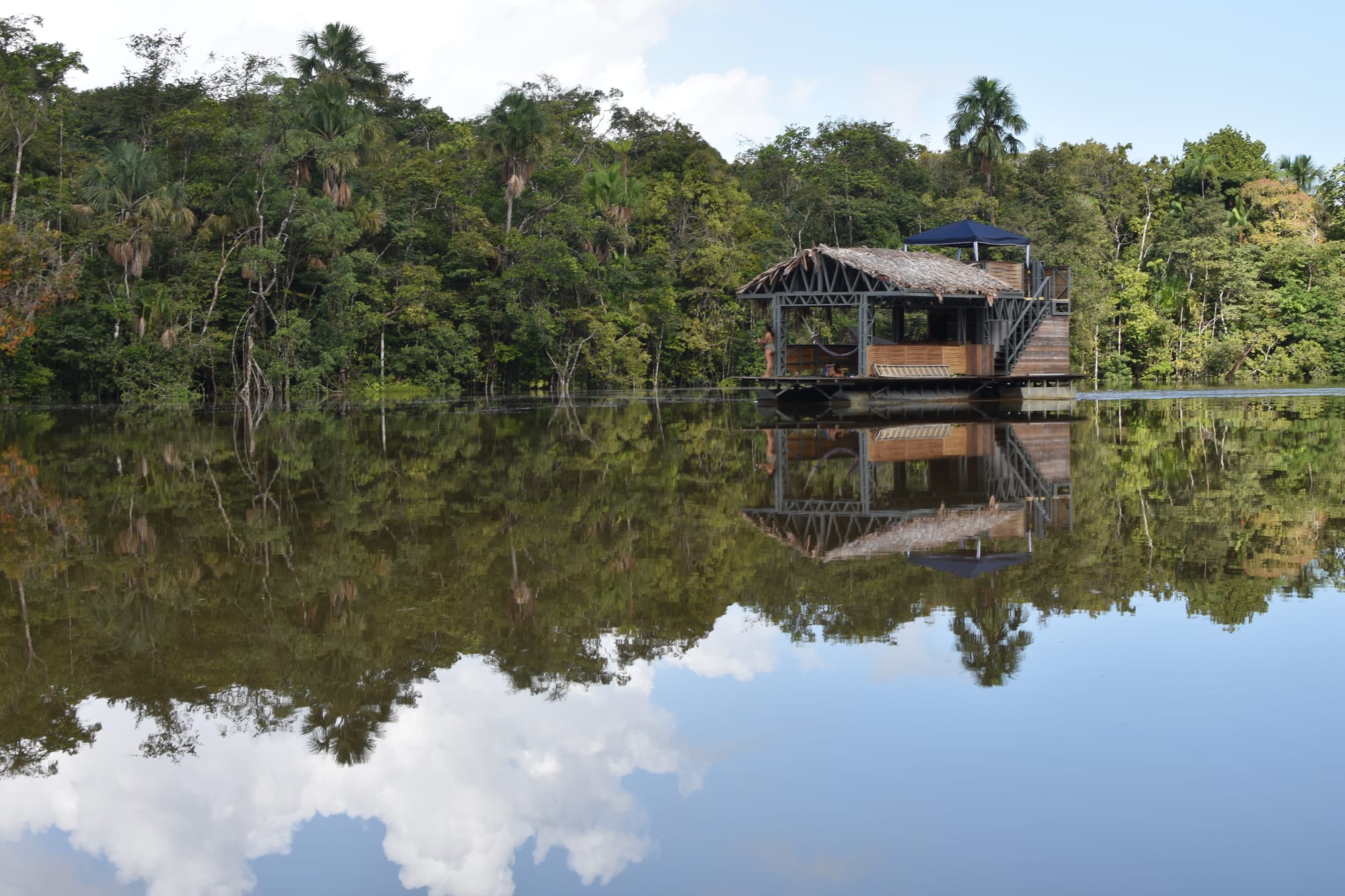
A thatched floating wooden shelter moored against a wall of rainforest and palms, perfectly mirrored with the clouds in still dark river water

French Guiana

A floating carbet on the Comté river, with the rainforest and sky reflected in the still water. (Lechatsylvestre / Wikimedia Commons · CC BY-SA 4.0)

An overseas department of France on the northeast shoulder of South America — part of the French Republic and the European Union, almost entirely Amazon rainforest, and home to Europe's spaceport at Kourou and a notorious former penal colony.

Explore French Guiana

History

The Guiana coast was home to Arawak, Carib, and other Indigenous peoples, and several early French attempts to settle it failed disastrously — an expedition to Kourou in the 1760s lost thousands to disease. From the plantation era, French Guiana was worked by enslaved Africans; many escaped into the forest and formed Maroon (Bushinengue) communities along the Maroni River, whose descendants remain a major part of the population.

France abolished slavery in its colonies in 1848, and from 1852 turned French Guiana into a penal colony, the bagne. Over the next century tens of thousands of convicts and political prisoners were transported here — including Alfred Dreyfus, held on Devil's Island, and Henri "Papillon" Charrière, whose escape memoir made the place famous. Conditions were lethal, and the bagne was finally closed in 1953.

In 1946 French Guiana became an overseas department, fully part of France, with the same laws, currency, and, later, European Union membership; it is an outermost region of the EU, uses the euro, and lies outside the Schengen Area. In 1964 France chose Kourou for its spaceport, and the Guiana Space Centre has been in operation since 1968, exploiting the near-equatorial location; it is now the European Space Agency's main launch site. Russian Soyuz rockets flew from it until Roscosmos suspended operations there in February 2022, and the new Ariane 6, first flown in July 2024, now launches alongside the smaller Vega C — an operation that underpins a large share of the local economy. Persistent grievances over crime, cost of living, unemployment, and under-investment have produced major general strikes, notably the one that brought the department to a halt in March 2017.

Culture & Customs

French Guiana is one of the most ethnically varied societies in the Americas: French Guianese Creoles (of mixed African and European descent), Maroons, Amerindians (Kalina, Wayana, Palikur, Teko, Wayampi), metropolitan French, Haitians, Brazilians, Chinese, Lebanese, and Hmong refugees resettled from Laos in the 1970s, who now grow much of the country's fruit and vegetables and run the markets in villages such as Cacao.

French institutions — the language, schools, the euro, the administrative calendar — sit alongside strong local traditions. Carnival is the biggest, a months-long season culminating in the Touloulou balls, where masked women choose their dance partners and cannot be refused. Maroon communities maintain distinct governance, woodcarving, and textile art with deep West and Central African roots, and Amerindian communities keep their own languages and customs, especially in the interior.

Family, community festivals, food, and — for many — the Catholic or Evangelical church organise social life, against a backdrop of debate about French Guiana's place within the Republic.

  • French Guiana: The Touloulou Chooses — A French department on the edge of the Amazon, where a masked woman leads the dance, carved patterns carry messages of love, and a visitor to a forest village waits to be offered a seat

Daily Life

About 300,000 people live in French Guiana, overwhelmingly along the coastal strip between Saint-Laurent-du-Maroni and the Brazilian border, with Cayenne the capital and largest town and Kourou the space city. Its population density is among the lowest in South America, under four people per square kilometre, since about 99 per cent of the land is forest.

The economy is dominated by the public sector, the Space Centre and its contractors, construction, and gold — both licensed operations and a large illegal trade by garimpeiros crossing from Brazil, which drives crime and mercury pollution. Unemployment is high, the cost of living is a constant grievance, and the population is young and growing fast, swelled by migration from Haiti, Brazil, and Suriname.

Daily life is French in its framework and Creole, Maroon, and Amazonian in its texture, lived between the coastal towns and the great forest at their back.

Food

The food is Creole with strong Amazonian, Chinese, and Brazilian threads. Bouillon d'awara is the signature dish — a rich, dark stew of awara palm pulp cooked for a day or more with smoked and salted meats, fish, prawns, greens, and crab, traditionally eaten at Easter. Colombo (a Caribbean curry), fricassée, and grilled or fried river and sea fish are everyday fare.

Blaff (fish poached with lime, chilli, and herbs), pimentade, cassava bread (couac and cassave) from the Amerindian and Maroon kitchens, and Chinese noodle and rice dishes all feature, and the Hmong markets supply fresh produce and their own dishes.

Ti-punch — white rhum agricole, cane syrup, and lime — is the aperitif, and locally distilled rum, fresh tropical juices (maracuja, comou, cachiman), and strong coffee are the other drinks.

  • French Guiana: Food and the National Dish — A rich Amazonian palm-fruit stew cooked for Easter and Pentecost, and a food culture where Creole, Amerindian, Hmong and French tables all sit within the same territory

Attractions & Natural Wonders

The Îles du Salut, three small islands off Kourou, are the top sight: Île Royale, once the reception centre for the colony's general population, with its surviving prison buildings; Île Saint-Joseph, where men were punished by solitary confinement in silence and darkness, its cells now ruined under the palms; and Île du Diable (Devil's Island), where Dreyfus was held, visible across a rough channel. Day boats run from Kourou.

The Guiana Space Centre can be visited on a guided tour of the launch complexes, and launches can be watched from viewpoints with a prior reservation — a genuinely rare spectacle. Cayenne itself has brightly painted Creole houses, the ruined Fort Cépérou, a lively market, and the Rémire-Montjoly beaches nearby.

The natural attractions are Amazonian: the Kaw marshes east of Cayenne, alive with caiman and birds at night; the Trésor and Kaw-Roura reserves; and the deep interior, including the Guiana Amazonian Park, the largest national park in the European Union, reached via the forest outpost of Saül for multi-day hikes. On the west coast, Awala-Yalimapo has one of the world's most important nesting beaches for leatherback turtles.

Planning basics

Budget

Prices are high — French department costs in a South American setting, with much imported. Cayenne and Kourou have hotels and gîtes; the interior is reached by expensive pirogue trips or light aircraft. A Space Centre tour or a place at a launch viewpoint has to be arranged in advance.

Daily Budget Midrange
EUR 120–260 (hotel, restaurants, car hire, a pirogue trip or interior excursion)
Daily Budget Shoestring
EUR 50–85 (guesthouse or gîte, market and Creole snack-bar food, shared taxis and buses)

Hire a car for the coastal road, and book any interior trip (Maroni or Approuague rivers, Saül) through a local operator well ahead.

Visa Requirements

French Guiana is part of France but not part of the Schengen Area, so a Schengen visa is not automatically valid. Citizens of the EU, UK, US, Canada, Australia, and many others enter visa-free with a passport; those who need a visa require a French visa endorsed for the overseas departments. A yellow-fever vaccination certificate is required for entry, for travellers aged one year and over.

Typical Stay
90 days visa-free for most Western passports; separate from Schengen

Carry a valid yellow-fever certificate — you can be refused entry without one — and, if you need a visa, ensure it is valid for the French overseas departments.

Safety

French Guiana has higher crime than mainland France, with a notably high homicide rate concentrated in Cayenne and around Saint-Laurent-du-Maroni, much of it linked to gold-mining and trafficking; muggings and burglaries affect visitors occasionally. Illegal gold-mining zones in the interior are dangerous and off-limits. Social protests can block roads and the airport, as in the general strike of March 2017.

Health
Yellow fever vaccination is required for entry; malaria and dengue are present, mainly in the interior and near the borders — take precautions; tap water is safe in Cayenne and Kourou

Avoid Cayenne's rougher districts and quiet areas at night, do not approach illegal mining sites, keep a yellow-fever certificate, take anti-malarials for interior trips, and monitor for road-blocking protests.

Climate

Equatorial: hot and humid year-round, around 28–32°C. A long rainy season runs from about December to July, and there is a pronounced dry season from August to November. Rain can fall heavily at any time, and the interior is always humid.

Dry Season
August–November
Long Rains
December–July

Transportation

Cayenne – Félix Éboué Airport, 13 km southwest of the capital at Matoury, is the territory's main international airport and the long-haul link to mainland France. The coastal highway (the RN1 and RN2) links Saint-Laurent -du-Maroni, Kourou, Cayenne, and the Brazilian border at Saint-Georges; the interior has almost no roads and is reached by pirogue or small plane. Shared taxis and buses serve the coast.

Hire a car for the coastal strip; for the forest interior, join an organised pirogue expedition rather than travelling independently.

Best Time to Visit

August to November, the dry season, is best for river travel, hiking, and the Îles du Salut. Leatherback and green turtles nest on the western beaches between roughly March and July. Rocket launches happen year-round; check the schedule if you want to see one.

Events
Carnival — a long, elaborate season from Epiphany to Ash Wednesday, with the Touloulou masked balls; the Space Centre's launch calendar

Currency

The currency is the euro. Cards are widely accepted in Cayenne and Kourou; carry cash for the interior, markets, and river villages, where card acceptance is minimal.

Symbol
€
Currency Code
EUR — euro

Language

French is the official language and the language of administration and schooling. French Guianese Creole is the everyday lingua franca for much of the population, and Maroon languages (Aluku, Ndyuka, Saramaka), Amerindian languages, Hmong, Portuguese, and Haitian Creole are all widely spoken.

Lingua Franca
French Guianese Creole
Official Language
French