History · French Guiana
Why does Europe launch its rockets from the jungle of South America?
Kourou sits just north of the equator, faces open ocean, escapes cyclones and earthquakes, and is legally part of France. Losing Algeria did the rest.
By Globeway Editorial · 2 November 2026
The short answer
Europe launches from Kourou, in French Guiana, because it is one of the best places on Earth to send a rocket into space that Europe can call its own. Kourou lies about 500 kilometres (310 miles) north of the equator, where the planet's spin gives an eastbound rocket the biggest free push, and where satellites can reach the equatorial orbits used by communications satellites without wasting fuel on changing course. The coast faces open ocean to the north and east, so spent stages and debris fall into the sea; few people live nearby; and the region suffers neither earthquakes nor cyclones.
Above all, French Guiana is not a foreign country. It has been fully part of the French Republic since 1946 and is part of the European Union, with the euro as its currency. When France lost its Saharan launch site after Algeria became independent, it chose Kourou in 1964 for a new base, and Europe followed. Today the European Space Agency (ESA) pays about two-thirds of the spaceport's annual budget.
Why the equator matters
The Earth turns from west to east, and at the equator its surface moves at about 465 metres per second. A rocket launched eastward from there starts with that speed already in hand, so it needs less fuel to reach orbit. The farther from the equator, the smaller the boost.
The bigger advantage concerns geostationary orbit, a circle about 35,786 kilometres (22,236 miles) above the equator where a satellite takes exactly one day to go round and so appears to hang still in the sky. Many communications and weather satellites live there. A rocket can be launched into an orbit tilted no less than the latitude of its launch site, so a satellite launched from Cape Canaveral, at 28.5 degrees north, must later burn a large amount of fuel to swing its orbit level with the equator. From Kourou, orbits tilted as little as 6 degrees are possible. The French space agency calculated that the correcting manoeuvres from Florida can cost 15 per cent of the mass put into orbit.
The difference shows in the numbers. When Russian Soyuz rockets flew from Kourou, a Soyuz that could lift 1.7 tonnes towards geostationary orbit from Baikonur, in Kazakhstan, could carry 2.8 tonnes from French Guiana.
Driven out of the Sahara
France's first launch site was not in South America but in the Algerian desert. From 1947 to 1967 its rockets flew from the Interarmy Special Vehicles Test Centre near Hammaguir, south-west of Béchar, and on 26 November 1965 a Diamant rocket launched from there put Astérix, France's first satellite, into orbit, a feat seen as making France the world's third space power. But the 1962 Évian Accords, which ended the Algerian War of Independence, required France to withdraw from its military bases in Algeria. The site was handed back to Algeria in July 1967.
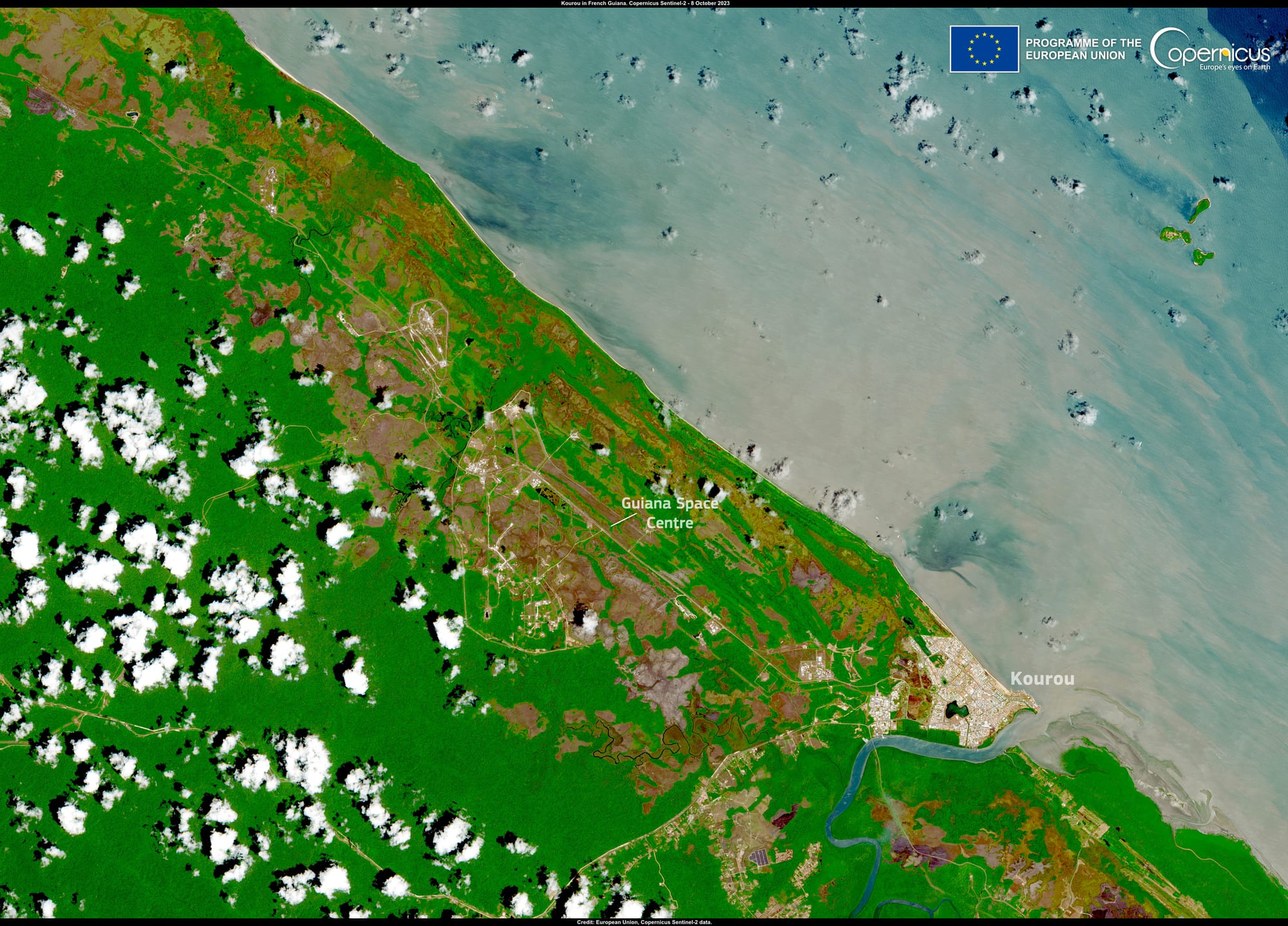
France needed a new base, and the French space agency CNES studied fourteen sites, in its overseas departments and in foreign countries such as Brazil and Australia. All were close to the equator. The other tests were practical: room for safe launches, a deep-water port, an airfield able to take long-haul aircraft, the shortest possible distance from Europe, and political stability. Five sites qualified, but the report came down heavily in favour of French Guiana. On 14 April 1964 the government of Prime Minister Georges Pompidou established the Guiana Space Centre at Kourou, on land of the village of Malmanoury, which was expropriated.
Building a spaceport in the forest
French Guiana is one-seventh the size of European France and about 98.9 per cent of it is covered by forest, much of it primeval rainforest. In 1964 the whole territory had only about 40,000 inhabitants, and Kourou, at the mouth of the Kourou River some 60 kilometres north-west of the capital Cayenne, was a village of 660 people. Work began in September 1965 and employed more than 2,500 people of eleven nationalities. A jetty was built on the river to land rocket parts shipped from Europe, the runway at Cayenne was lengthened to 3,200 metres for long-haul jets, a bridge replaced the ferry over the Kourou River, and a new town grew up where the village had stood.
The first rocket, a Véronique sounding rocket, a research rocket that flies up and falls back rather than reaching orbit, flew in April 1968. On 10 March 1970 a Diamant-B made the first satellite launch from Kourou.
- 1947–1967
France launches its rockets from Hammaguir in the Algerian Sahara.
- 14 April 1964
The French government establishes the Guiana Space Centre at Kourou.
- April 1968
The first rocket, a Véronique sounding rocket, is launched.
- 10 March 1970
A Diamant-B makes Kourou's first satellite launch.
- 1975
France offers to share Kourou with the new European Space Agency.
- 24 December 1979
The first Ariane rocket flies from Kourou.
- 25 December 2021
An Ariane 5 launches the James Webb Space Telescope.
- 9 July 2024
Ariane 6 makes its first flight.
How France's base became Europe's
Europe's own rocket programme moved to Kourou too. In July 1966 ELDO, an early European launcher organisation, chose the site for its Europa rocket, but the single Europa-II launched from there in 1971 failed and the programme was cancelled. At France's request, Europe then backed a new launcher family named Ariane. In 1975 France offered to share Kourou with ESA, and on 24 December 1979 the first Ariane lifted off, with French President Valéry Giscard d'Estaing pressing the firing button himself.
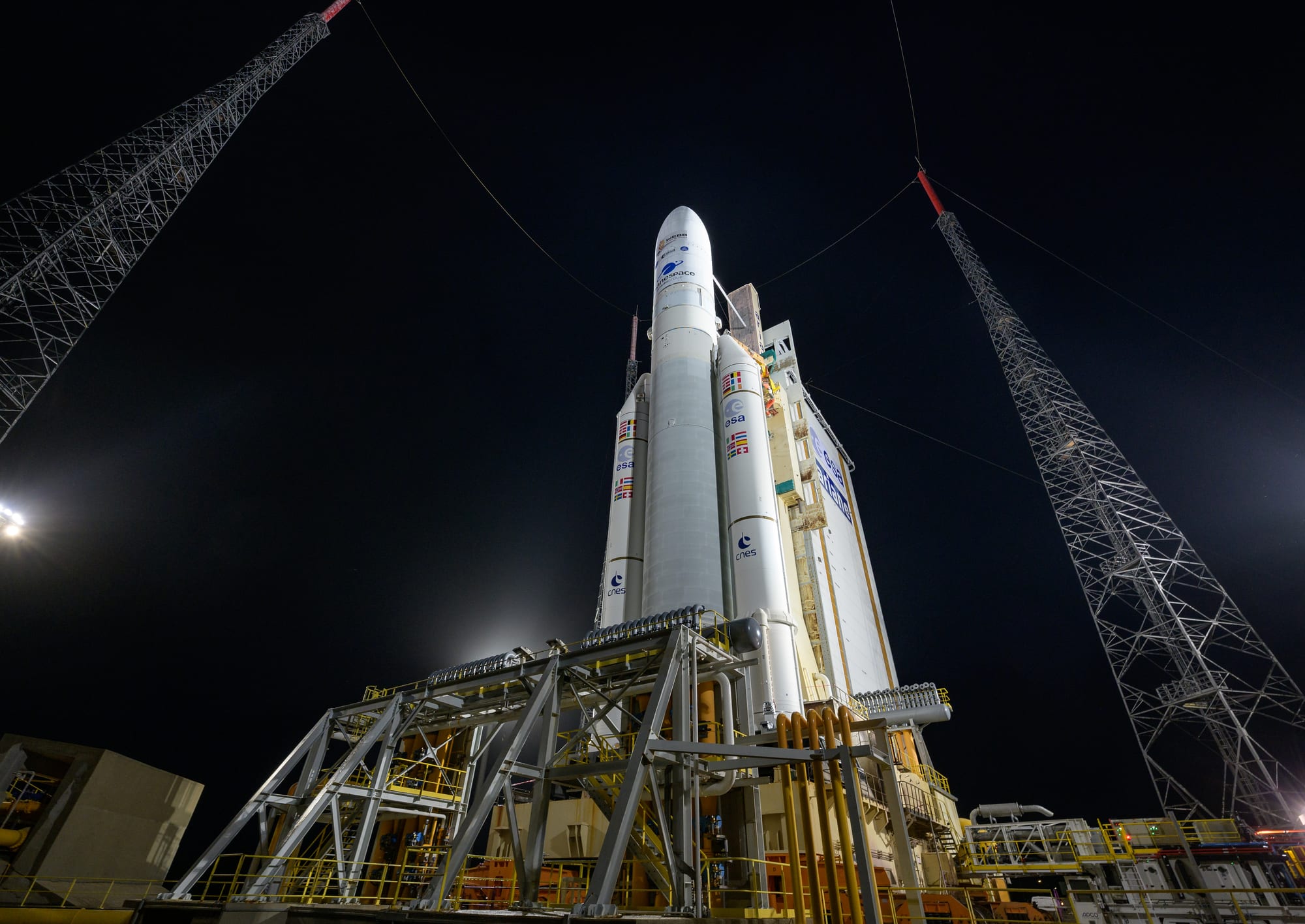
Ariane became a great commercial success, carrying satellites for customers far beyond Europe. Ariane 5, which flew from 1996 to 2023, had a run of 82 consecutive successful launches between 2003 and 2017 and, on Christmas Day 2021, sent the James Webb Space Telescope on its way. As of 2026 two rockets fly from Kourou: Ariane 6, which first flew on 9 July 2024, and the smaller Vega C. A pad built for Russian Soyuz rockets fell silent in 2022, when Russia suspended operations in response to sanctions over its war in Ukraine.
A spaceport in an unequal place
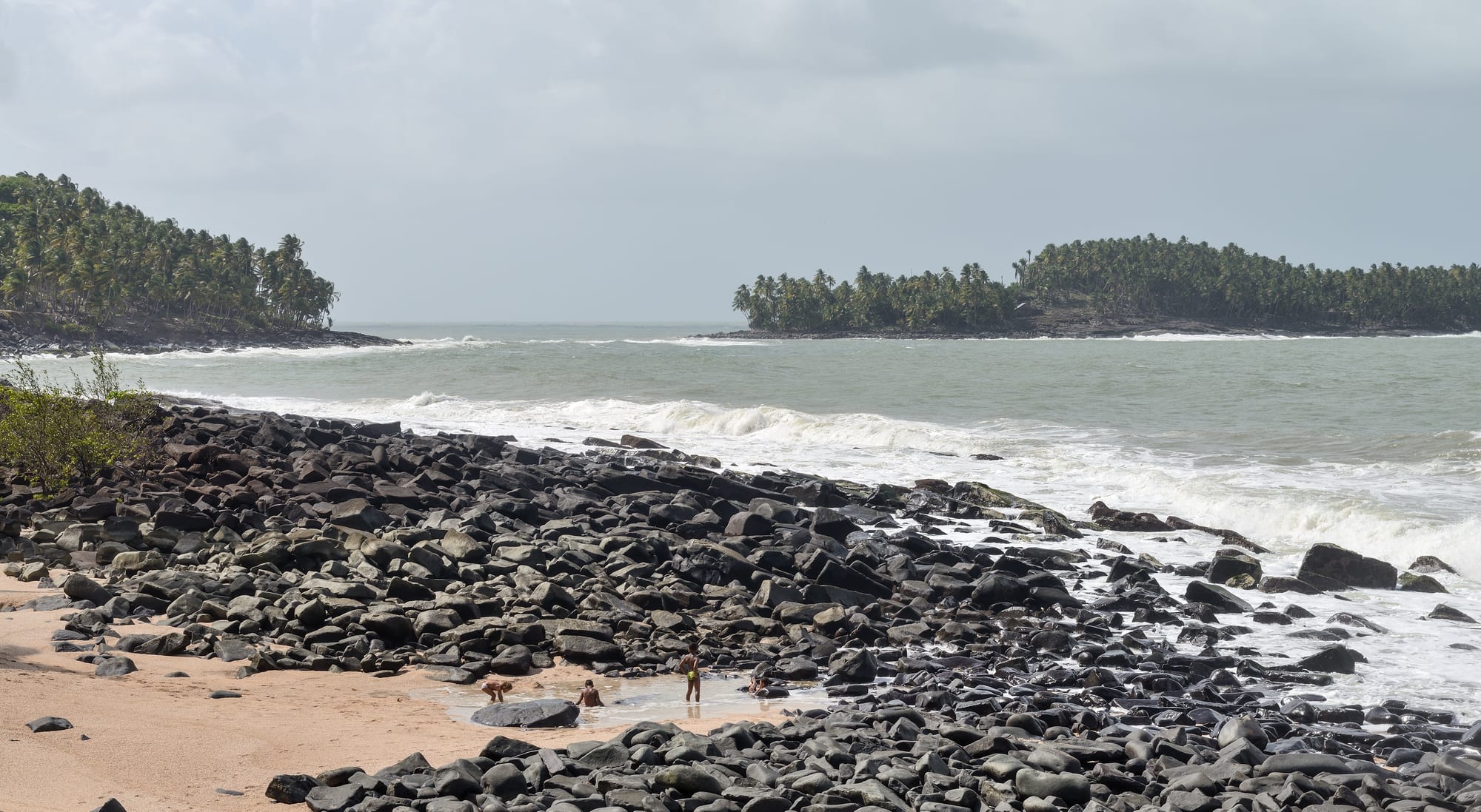
The space centre dominates the local economy. In 2014 the space sector accounted for about 15 per cent of French Guiana's GDP, and in 2020 it employed 4,620 people directly, just under a tenth of salaried jobs. The 3rd Foreign Infantry Regiment of the French Foreign Legion guards the base, and the Salvation Islands offshore, home to the former penal colony of Devil's Island, lie under the launch path and are evacuated during launches.
The contrast with life outside the fence has caused friction. Unemployment in French Guiana has run above 20 per cent and living costs are high, and local and Indigenous groups argue that mainland France cares about the territory mainly for its spaceport. In March and April 2017, protests over insecurity and neglect spread across the territory; protesters and striking workers blockaded the centre, delaying an Ariane 5 launch, and the French government authorised an emergency relief plan of up to 2.1 billion euros.