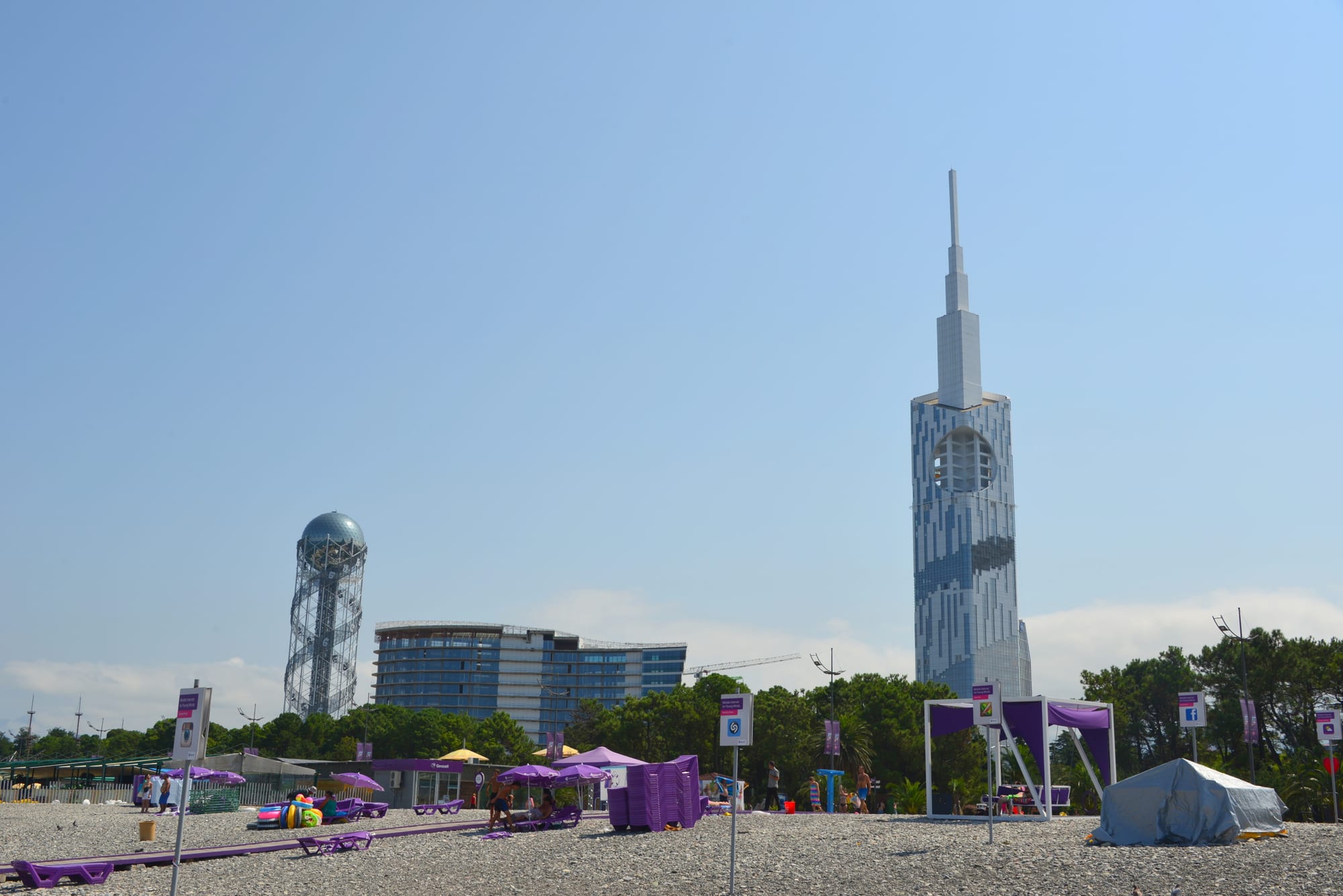
A grey pebble beach with parasols and sun loungers, backed by pines and two tall modern towers under a clear summer sky

Kutaisi, Batumi & Western Georgia, Georgia

Batumi

The pebble beach and the seafront towers along Batumi Boulevard. (Андрей Бобровский / Wikimedia Commons · CC BY 3.0)

Georgia's Black Sea resort city and the capital of the autonomous republic of Adjara, on a bay near the Turkish border. An oil port under the Russian Empire, it kept a compact nineteenth-century centre of stuccoed streets and gained a long seafront boulevard, pebble beaches and a skyline of tall towers in the 2000s. Subtropical rain keeps the hills behind it green.

Neighbourhoods

  • The old town
    • First-time visitors
    • Historic district
    • Best for food

    The compact grid of nineteenth-century streets behind the port, with stuccoed facades, balconies, small squares and the Italianate arcades of the Piazza. Restaurants, bars and many of the city's hotels are here, and the seafront is a few minutes' walk away.

    Open in Maps
  • Batumi Boulevard and the seafront
    • Beaches
    • Evening walks
    • Families

    The long strip between the city and the sea, with the pebble beach on one side and gardens, fountains, cafés, a ferris wheel and the tall towers on the other. It runs for several kilometres north from the port and is where the city spends its summer evenings.

    Open in Maps
  • New Boulevard and the northern beaches
    • Beaches
    • Modern hotels
    • Quiet and residential

    The newer seafront district north of the centre, with wide lawns, cycle paths, apartment blocks and hotels facing a quieter stretch of beach. It is more spread out than the old town and closer to the airport road.

    Open in Maps
  • Khimshiashvili and the inland districts
    • Local life
    • Everyday shopping

    The residential city behind the seafront, with apartment blocks, markets, schools and workshops. Prices are lower, buses run frequently to the centre, and this is where most of the permanent population lives.

    Open in Maps
  • Green Cape and the northern coast road
    • Gardens
    • Sea views
    • Quiet and residential

    The wooded headland about 9 kilometres north of the centre, where the botanical garden covers the slopes above the sea. Small hotels, guesthouses and beaches line the coast road between the city and Chakvi.

    Open in Maps

Things to do

The seafront

  • Batumi Boulevardpark

    The seafront park and promenade first laid out in the 1880s, running for kilometres between the beach and the city, with sculptures, fountains, cafés and cycle hire.

    Open in Maps
  • Alphabetic Towerlandmark

    A 130-metre tower on the seafront whose two helix bands carry the 33 letters of the Georgian alphabet, with an observation deck near the top.

    Open in Maps
  • Ali and Ninolandmark

    A kinetic sculpture by Tamara Kvesitadze, installed on the shore in 2010, of a man and a woman who slowly move through each other; it takes its name from the novel of a Muslim Azerbaijani and a Christian Georgian in love.

    Open in Maps
  • Batumi beachbeach

    The city's long grey-pebble beach, shelving quickly into the Black Sea, with sun loungers, bars and swimming supervised in the summer season.

    Open in Maps

The old town and landmarks

  • Batumi Cathedral of the Mother of Godlandmark

    A Gothic Revival church built between 1898 and 1903 for the city's Catholic community, designed by Aleksander Rogojski and transferred to the Georgian Orthodox Church in 1989.

    Open in Maps
  • Orta Mosquelandmark

    The city's historic mosque in the old town, serving the Muslim community that makes up about a quarter of Batumi's population.

    Open in Maps
  • Batumi Piazzalandmark

    An enclosed square in the old town built in the 2000s in Italianate style, with mosaics, arcades, a clock tower, restaurants and frequent live music.

    Open in Maps
  • Batumi Seaporttransit hub

    The working harbour that made the city, handling oil, cargo and ferries at the southern end of the bay.

    Open in Maps

Museums and gardens

  • Batumi Botanical Gardenpark

    A garden of 108 hectares begun by the botanist Andrey Krasnov and opened in 1912 on the Green Cape 9 kilometres north of the city, its slopes divided into sections of subtropical plants from several continents.

    Open in Maps
  • Batumi Archaeological Museummuseum

    One of the oldest museums in Georgia, holding finds from Adjara and the ancient Colchian coast.

    Open in Maps
  • State Art Museum of Adjaramuseum

    The region's state art museum, in the centre of the city, showing painting and graphic art.

    Open in Maps
  • 6 May Parkpark

    A city park around a small lake near the seafront, with shaded walks and boating, popular with families in the evening.

    Open in Maps

Short trips from the city

  • Gonio fortresslandmark

    A Roman fort about 15 kilometres south at the mouth of the Chorokhi, known in antiquity as Apsaros, rectangular in plan with 18 of its 22 wall towers still standing and excavations continuing inside.

    Open in Maps
  • Mtirala National Parkpark

    A protected area of relict Colchic rainforest in the hills east of the city, listed by UNESCO in 2021 as part of the Colchic Rainforests and Wetlands, with about 4,500 millimetres of rain a year, waterfalls, trails and a lake.

    Open in Maps
  • Kobuletiattraction

    A quieter beach resort about 28 kilometres north along the coast, with a long pebble shore and the Ispani marsh and Kobuleti reserve nearby.

    Open in Maps
  • Makhuntseti waterfall and bridgeattraction

    A waterfall in the Adjaran hills inland from the city, in the valley of Keda, near one of the narrow medieval stone arch bridges found across the province.

    Open in Maps

Seasonal events

  • Black Sea Jazz FestivalJuly

    An international jazz festival founded in 2007 and held each July in the city and nearby places on the coast, with concerts on open-air and indoor stages.

Eat and drink

Long-standing places and food districts in Batumi. Hours, ratings and directions come from your maps app, always current.

Batumi classics

  • Adjaruli khachapurirestaurant

    The boat-shaped Adjaran cheese bread with an egg and butter stirred into the centre is the local dish, and it is served in restaurants across the old town and along the seafront.

    Open in Maps
  • Batumi fish marketmarket

    A market near the seafront where the day's Black Sea catch is sold and where neighbouring kitchens will fry or grill a chosen fish to order.

    Open in Maps

Food districts and markets

  • The old town streetsneighborhood

    The blocks around the Piazza and the parallel streets hold most of the city's restaurants and bars, Georgian and Turkish, with tables outside through the summer.

    Open in Maps
  • Batumi central marketmarket

    The main produce market, strongest for Adjaran cheese, greens and herbs, honey, walnuts, citrus and tea grown in the hills behind the coast.

    Open in Maps
  • Batumi Boulevard cafésneighborhood

    Cafés, ice cream stands and beach bars strung along the promenade, busiest at dusk when the whole city walks by the sea.

    Open in Maps

Experience Batumi

History

The bay has been used since antiquity: Greek writers record a Colchian harbour here, and the Romans built the fort of Apsaros at Gonio, a little to the south, to guard the coast. The settlement that became Batumi remained small through the medieval period, when Adjara belonged to the Georgian kingdoms, and from the sixteenth century it fell under Ottoman rule, which lasted for three centuries and left a lasting Muslim Georgian population in the province.

Russia annexed Batumi from the Ottomans in 1878, under the Treaty of San Stefano, and the town was transformed within a generation. The Batumi–Tiflis–Baku railway was completed in 1883 and a pipeline from Baku followed in 1907, making Batumi the Black Sea outlet for Caspian oil; the Rothschilds and Nobel interests built refineries and storage, and the port filled with tankers. The population grew quickly with Georgian, Armenian, Greek, Russian and Turkish arrivals, the stuccoed streets of the present old town were laid out, the seaside boulevard was planted in the 1880s, and a young Joseph Stalin lived here in 1901 organising strikes. British forces held the town from December 1918 until July 1920, when it passed to the Democratic Republic of Georgia.

In 1921 Adjara became an autonomous republic within Soviet Georgia, with Batumi as its capital, and the city lived on the port, tea, citrus and Soviet seaside holidays. After independence it was run for more than a decade by Aslan Abashidze, whose authoritarian local rule ended in 2004; the government that followed remade the seafront, inviting international architects and building the towers, plazas and hotels that now define the skyline, alongside casinos that draw visitors from across the region.

Culture & Customs

Batumi is Georgia's most obviously mixed city. Adjara's Muslim Georgians, a legacy of Ottoman rule, live alongside an Orthodox majority, and Armenian, Greek and Russian communities have left churches and buildings in the centre; Turkish is widely heard and Turkish traders and holidaymakers are a constant presence. The result is a city that feels less conservative and more Mediterranean in its habits than inland Georgia.

Summer sets the tone. Evening on the boulevard is a social institution: whole families walk from dusk until late, children ride bicycles, and street musicians play along the promenade. The Black Sea Jazz Festival, founded in 2007, brings international acts to the city each July. Casinos, nightclubs and a large summer bar scene give Batumi a reputation within Georgia as a place of easy pleasure.

Adjaran folk culture survives strongly in the hills behind the coast, with its own dances such as gandagana, the accordion-driven music of the mountain villages, and traditions of hospitality centred on the table. Visitors find the same rules as elsewhere in Georgia: toasts have an order and a purpose, guests are pressed to eat, and refusing food or wine outright is taken as coldness rather than restraint.

Daily Life

About 150,000 people live in Batumi, Georgia's second-largest city and the capital of the Autonomous Republic of Adjara, with its own regional government and parliament. The population swells greatly in July and August, when domestic and foreign visitors fill the seafront and short-let flats, and thins again in winter when much of the seasonal workforce leaves.

The economy rests on four things: the port and oil terminal, tourism, construction, and gambling, which is legal in Georgia and draws visitors from Turkey and beyond. Tea and citrus grown in the Adjaran lowlands, fishing and trade through the nearby Sarpi border crossing add to this. Construction has been the most visible force of the past two decades, filling the seafront with towers, much of it bought as investment property, and the pace of building has raised concerns about infrastructure and the loss of older houses.

Life divides sharply between the seafront and the inland districts where most residents actually live, in Soviet-era blocks and newer estates. Wages are modest and many jobs are seasonal. Rain is a constant of daily life, umbrellas are carried through much of the year, and the city's rhythm follows the tourist calendar — frantic in August, slow and quiet by December.

Food

Adjara's contribution to Georgian cooking is famous well beyond the country: Adjaruli khachapuri, a boat of bread filled with melted cheese into which a raw egg yolk and a knob of butter are stirred at the table, then eaten by tearing off the crust and dipping. It is served everywhere in the city, sometimes in sizes intended to be shared. Other regional breads and cheeses come from the hills, including sulguni, the stretchy brined cheese used throughout western Georgia.

The wider western Georgian table is built on maize rather than wheat: mchadi, flat cornbread, and ghomi, a stiff cornmeal porridge, are served with cheese and stews, and elarji folds sulguni into the cornmeal until it pulls into threads. Sauces lean on walnuts, coriander, blue fenugreek and adjika, the hot red pepper paste. Being a port and a border city, Batumi also has Turkish grills, kebabs and baklava, and coffee is drunk in the Turkish style as often as not.

Fish is the local luxury. Black Sea species are landed daily and sold at the fish market, where a whole fish can be taken to a neighbouring kitchen to be grilled or fried; mussels and small fried fish appear on seafront menus in summer. Adjara grows tea and citrus, so mandarins fill the markets in autumn and Georgian tea is sold in the bazaars. Wine comes from Imereti and Kakheti rather than the coast, and chacha, the grape spirit, is made locally.

Planning tools

Budget

Batumi is one of the more expensive places in Georgia in July and August, when seafront hotel rates and restaurant prices rise for the beach season, but it is inexpensive by Black Sea standards and much cheaper out of season. Beds inland from the boulevard cost a fraction of sea-view rooms, and the beach, the boulevard and the botanical garden grounds are cheap or free.

Daily Budget Midrange
USD 60–120 (sea-view hotel or good guesthouse, restaurant meals, a driver for Gonio and the Adjaran hills)
Daily Budget Shoestring
USD 25–45 (hostel or guesthouse, khachapuri and market food, city buses)

Rooms a few streets back from the sea cost far less in high summer, and prices fall sharply from October to May.

Best Time to Visit

Late June to early September for swimming and the festival season, when the city is at its busiest and hottest. May, June and September are warm, greener and quieter, and better for the botanical garden and the hills. Winter is mild but very wet, with many seafront businesses closed, though the casinos, restaurants and museums stay open.

Suggested Number of Days

Two or three days suit the city itself and its seafront. Four or five allow the coast, the botanical garden and the Adjaran hills as well. Beach holidays here often run to a week or more, and the number depends on the weather as much as on anything else.

First Visit
2–3 days
With Surroundings
4–5 days

Transportation

The centre is easily walked, and city buses and minibuses cover the outlying districts, the botanical garden and the coast road; taxis and ride-hailing apps are cheap and widely used. A cable car climbs from near the port to a hill above the city, bicycles can be hired along the boulevard, and marshrutkas from the main station serve Kobuleti, Gonio and the inland valleys.

Use a ride-hailing app or agree the fare before getting into a taxi, and expect heavy traffic on the seafront roads in August.

Airport & Station Connections

Batumi International Airport lies a short drive south of the centre, with flights to Turkey, Europe and Tbilisi, and Turkey's Trabzon and Rize airports are reachable by road. Trains from Tbilisi take around five to six hours to Batumi, marshrutkas rather longer, and the Sarpi border crossing with Turkey is about 20 kilometres down the coast.

Walkability

One of the easiest Georgian cities to walk: the old town is flat and compact, the boulevard runs for several kilometres beside the beach, and pavements and crossings are in better condition than in most of the country. Distances to the botanical garden and the airport need transport. Heavy rain, common through much of the year, is the main obstacle, and summer traffic near the seafront is dense.

Safety

Batumi is generally safe, with the usual resort risks: pickpocketing and bag theft on the crowded seafront and in nightlife areas in summer, and occasional trouble around the casinos late at night. The sea is the more serious hazard — the beach shelves steeply and rip currents and rough water cause drownings every season. Traffic is fast and pedestrian crossings are not always respected.

Swim only where lifeguards are on duty and heed warning flags, keep valuables out of sight on the beach and at night, and take care crossing the seafront roads. Check current official travel advice before travelling.

Climate

Humid subtropical and very wet: Batumi is the wettest city in Georgia and in the Caucasus, with rain through the year and most of it in autumn, which is why the hills behind it are covered in dense green forest. Snow is rare and frost unusual on the coast.

Summer
hot and humid — August averages about 22°C across the day and afternoons reach the high 20s, with warm sea temperatures and heavy downpours
Winter
mild and wet — January averages about 5°C, with frequent rain and only occasional brief frost

Local Customs

Adjara has both Orthodox Christian and Muslim Georgian communities, and churches and a mosque stand within a few streets of one another in the old town; modest dress is expected in all of them. Beachwear belongs on the beach rather than in the streets. Georgian hospitality and the supra, with toasts led by a tamada, are as strong here as elsewhere, and gambling is legal and visible, drawing many visitors from Turkey.

Cover shoulders and knees in churches and the mosque, remove shoes at the mosque, ask before photographing people, and tip about 10 per cent where service is not already added.

Common Payment Methods

The currency is the Georgian lari. Cards and contactless payment work in hotels, restaurants and shops across the city, and ATMs are plentiful along the seafront and in the old town. Small guesthouses, market stalls, buses and some taxis prefer cash, and Turkish lira are sometimes accepted near the border but at poor rates.