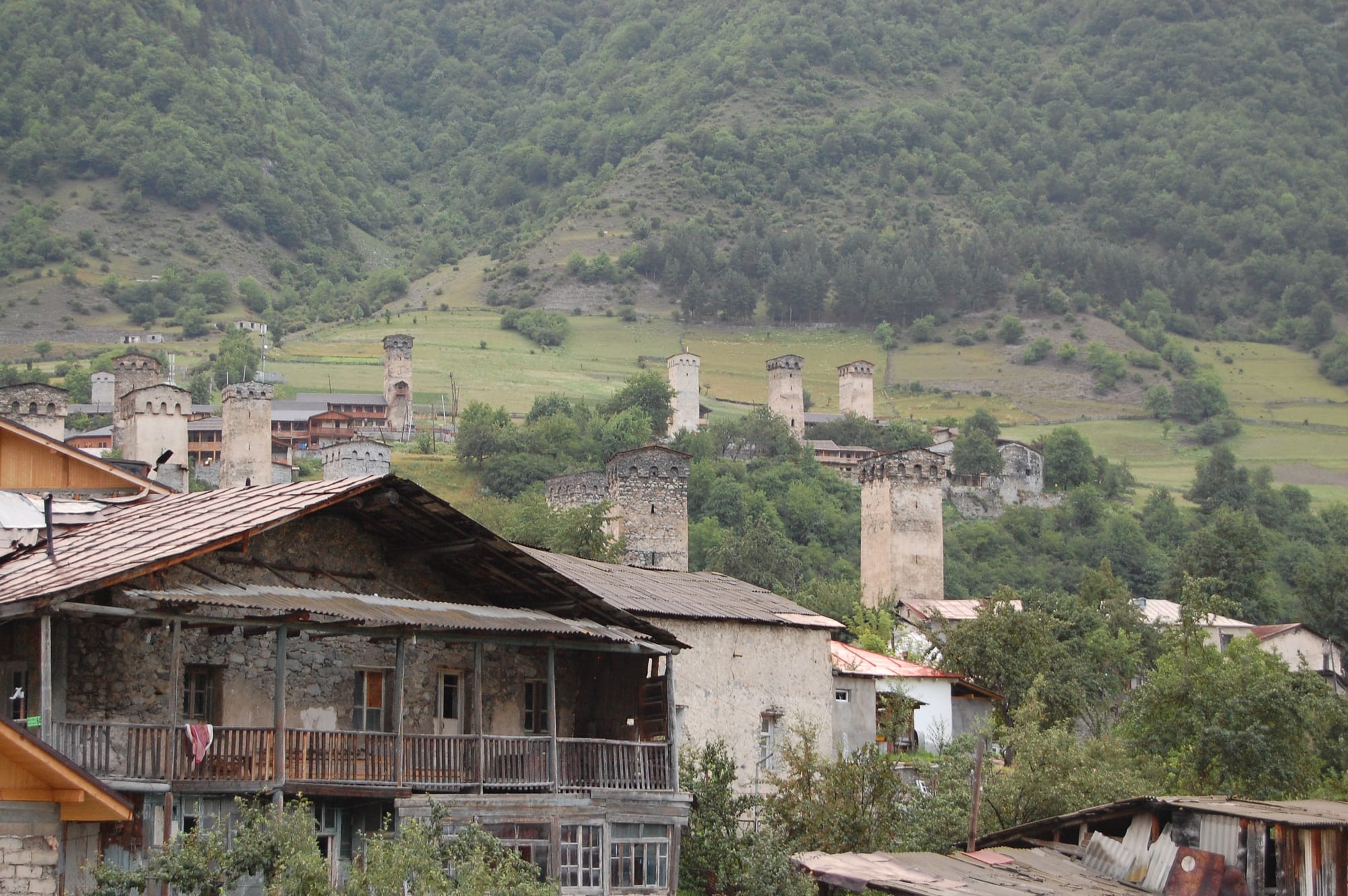
Stone defensive towers rising among slate-roofed houses in Mestia, with green forested mountain slopes behind

Kutaisi, Batumi & Western Georgia, Georgia

Mestia

Svan defensive towers among the houses of Mestia in Upper Svaneti. (Andrzej Wójtowicz from Poznań, Poland / Wikimedia Commons · CC BY-SA 2.0)

The main settlement of Upper Svaneti, high in the Caucasus of north-western Georgia at about 1,500 metres, where stone defensive towers stand among slate-roofed houses below glaciated peaks. Long one of the most isolated corners of the country, it was rebuilt as a tourism centre in the 2010s with an airport and ski lifts, and is now the base for Svaneti's museums and long walking routes.

Neighbourhoods

  • Seti
    • First-time visitors
    • Central
    • Best for food

    The central quarter, with the main square, the municipal buildings, the bank and cash machines, and most of the village's cafés, bars and shops. Minibuses and shared cars leave from here, and the Mestia Historical-Ethnographic Museum, which keeps Svaneti's icons and manuscripts, stands on the slope just above.

    Open in Maps
  • Lagami
    • Historic district
    • Towers
    • Quiet

    The oldest quarter, spread along the western side of the village, where clusters of towers and old Svan houses stand close together among hayfields. It is a short walk from the centre and keeps a farming feel, with cattle on the lanes in summer.

    Open in Maps
  • Lanchvali
    • Quiet and residential
    • Guesthouses

    The eastern quarter, on the road out towards Ushguli, with guesthouses, family compounds and its own towers. It is a little further from the square but has open views up the valley.

    Open in Maps
  • The Hatsvali road
    • Skiing
    • Mountain views

    The slopes south of the village, climbing towards the Hatsvali ski area on the forested ridge. Hotels and guesthouses here look across to the Caucasus wall, and the road is the winter link to the nearest lifts.

    Open in Maps

Things to do

Towers and village landmarks

  • Svan towerslandmark

    The medieval defensive towers that give the village its outline — tall, tapering stone structures built beside family houses as refuges from raids, feuds and avalanches.

    Open in Maps
  • Queen Tamar Airporttransit hub

    The small airport at the edge of the village, reopened in 2010, whose terminal by the German architect Jurgen Mayer is a modern take on the Svan towers.

    Open in Maps

Museums

  • Mikheil Khergiani House Museummuseum

    A museum in his home village to the Svan climber Mikheil Khergiani, a seven-time national champion nicknamed the Tiger of the Rocks, who was killed by rockfall on Monte Civetta in the Italian Alps in 1969 and is buried in Mestia.

    Open in Maps

Mountains, walks and viewpoints

  • Ushbaviewpoint

    The twin-headed peak north-west of the village, among the hardest climbs in the Caucasus and the mountain that dominates views from the ridges above Mestia.

    Open in Maps
  • Tetnuldiviewpoint

    A glaciated peak east of the village, reckoned the tenth-highest in the Caucasus, with a ski resort that opened on its lower slopes in the 2015-16 winter season.

    Open in Maps

Short trips from the village

  • Ushguliattraction

    A cluster of tower villages at the head of the Enguri valley, part of the Upper Svaneti UNESCO World Heritage Site, reached by a rough mountain road or a multi-day walk.

    Open in Maps
  • Shkharaviewpoint

    Georgia's highest mountain and the third-highest in the Caucasus, on the main watershed at the head of the Enguri valley beyond Ushguli.

    Open in Maps

Seasonal events

  • Lamprobaearly February

    An early-spring festival kept alive in Svaneti, in which torches made from dried birch or oak branches are lit, traditionally one for each member of a household.

  • Kvirikoba28 July

    An all-Svan pilgrimage and feast day at Lagurka, the church of Saints Cyricus and Julitta at Kala east of Mestia, regarded as the principal shrine of Upper Svaneti.

Eat and drink

Long-standing places and food districts in Mestia. Hours, ratings and directions come from your maps app, always current.

Where to eat in the village

  • Seti Square cafés and restaurantsneighborhood

    Most of the village's eating places sit around the central square and the street leading off it, serving Svan dishes such as kubdari and chvishtari alongside standard Georgian khachapuri and khinkali.

    Open in Maps
  • Guesthouse tablesneighborhood

    Family guesthouses throughout Lagami and Lanchvali cook home meals for their guests, and these are often the best place to try mountain cooking, home-made cheese and chacha.

    Open in Maps
  • Village market stallsmarket

    Small stalls near the centre sell Svan salt, a herb-and-garlic seasoning mix, along with mountain honey, cheese and dried meat.

    Open in Maps

Experience Mestia

History

Svaneti has been settled since antiquity — the Greek geographer Strabo describes the Soanes of these mountains, placing them roughly where the Svans live now — and Mestia grew as one of the main communities of Upper Svaneti, the valley of the upper Enguri. Its towers, most of them raised between roughly the ninth and twelfth centuries, belong to a building tradition found across the region: a tall stone shaft attached to a family house, used as a refuge against raiders, snow and the feuds that clan society produced.

The high valleys were hard to reach and harder to hold. Svaneti kept a large degree of independence through the medieval centuries, and its churches became a strongroom for Georgian religious art, receiving icons, crosses and manuscripts sent up from the lowlands when invasion threatened. Much of what survives is now gathered in the museum at Mestia. The princes of Upper Svaneti signed a treaty of protectorate with the Russian Empire in 1833; Russia abolished the principality's autonomy in 1857 and tightened its taxes in 1875, and an unsuccessful anti-Soviet uprising followed in 1921.

Soviet rule brought a road, a school, electricity and a district administration to Mestia, and avalanches in 1987 destroyed homes across the region and killed at least eighty people, many of them schoolchildren. After independence the region became poor and remote again. From about 2010 the Georgian government rebuilt the centre, restored towers, opened the airport and developed the ski areas at Hatsvali and Tetnuldi, and Mestia turned into the base for walking and skiing in the Caucasus that it is today.

Culture & Customs

Svaneti has its own language, Svan, a Kartvelian language distinct from Georgian that has kept features the other Kartvelian languages lost; Georgian serves as its written and literary language, UNESCO classes Svan as definitely endangered, and it is spoken at home in Mestia alongside Georgian. With it comes a distinct musical tradition, including what is often called the most archaic of Georgia's polyphonic singing, sung by men in tight harmonies at feasts, funerals and church festivals. Round felt hats, hand-woven cloth and carved wooden furniture belong to the same inheritance.

Religion here mixes Orthodox Christianity with much older practice. Villages keep their own chapels and their own feast days, families guard icons that have been in the community for generations, and and ceremonies such as Lamproba, when torches of birch or oak are lit in early February, carry older agricultural meaning beneath a Christian feast day. Kvirikoba on 28 July draws Svans from across the valleys to the church of Lagurka at Kala.

Svan society was organised around clans, with a long history of blood feud that the towers were built to survive, and reputations for independence and for hospitality that are both taken seriously. Mountaineering is a source of local pride — the climber Mikheil Khergiani, born here, was a seven-time Soviet national champion known as the Tiger of the Rocks, and Svan guides have long worked on Caucasus expeditions. Visitors are received warmly, but Svans dislike being treated as a spectacle.

Daily Life

About 2,000 people live in Mestia itself, with roughly 9,000 in the surrounding municipality, which covers a large area of high valleys and dozens of small villages. The population fell sharply in the late twentieth century as families moved to the lowlands, and many houses in outlying hamlets are used only in summer.

Tourism is now the main employer in the village: guesthouses, small hotels, restaurants, drivers, guides, ski staff and shops all depend on it, and a considerable share of households take in visitors. Around that sits the older economy of livestock, hay, potatoes and home cheese-making, with animals driven up to summer pastures and back down in autumn. Public sector jobs in the municipality, the school and the hospital matter too.

The year splits in two. In the walking and climbing months from June to October the square is busy with minibuses and rucksacks, and in the ski season from January the hotels fill again; the shoulder months are quiet, wet and slow. Winter can close the road down the gorge for a time, so households lay in supplies, and heating is mostly by wood. Continuing concerns are the state of the roads, the reliability of electricity and water, avalanche risk in the side valleys, and whether young people will stay rather than move to Tbilisi.

Food

Svan cooking is mountain food: filling, cheese-heavy and built on what grows or grazes above 1,000 metres. The signature dish is kubdari, a leavened bread stuffed with chunks of lamb, kid or pork, onions and Georgian spices, and listed as part of Georgia's intangible cultural heritage in 2015. Chvishtari is a cornmeal flatbread with cheese worked through the dough and fried; petvraali is a bread filled with cheese and millet. Sulguni and fresh mountain cheeses turn up at almost every meal.

Svan salt, svanuri marili, is the region's best-known export: coarse salt ground with coriander, dill, blue fenugreek, marigold, garlic, cumin and red pepper, used on soups, salads, meat, potatoes and fish, and sold in bags at village stalls. Mountain honey, smoked and dried meats, matsoni yoghurt and pickled vegetables round out the winter store cupboard.

The national Georgian dishes are all here as well — khachapuri, khinkali, grilled meats, walnut sauces and aubergine rolls — usually in an Imeretian version brought up from the lowlands. Vines do not grow at this altitude, so tables lean on wine carried up from Imereti and Kakheti, on local spirits made from fruit such as elderberry and from honey, and on chacha, the clear pomace brandy, which in Svaneti is often home-distilled and served in small glasses with a toast.

Planning tools

Budget

Mestia is inexpensive for food and beds but costs more to reach than lowland Georgia, because the journey involves a long drive or a small plane and because getting to the trailheads and to Ushguli usually means hiring a vehicle with a driver. Guesthouse rates very often include dinner and breakfast, which keeps daily spending low.

Daily Budget Midrange
USD 60–120 (comfortable guesthouse or small hotel, restaurant meals, a shared 4x4 for a day trip)
Daily Budget Shoestring
USD 25–45 (simple guesthouse room or hostel bed, home-cooked meals, shared minibus seats)

Bring enough cash for the whole stay in case a machine is empty, and share the cost of a vehicle to Ushguli or the Chalaadi valley with other travellers.

Best Time to Visit

June to early October for walking, when the passes and high trails are clear of snow and the alpine meadows are open; late September brings settled air and autumn colour. January to March is the ski season at Hatsvali and Tetnuldi. April, May and November are the quietest months, with mud, closed lifts and unreliable high routes.

Suggested Number of Days

Two to three days suit the village and one walk from it. Four to six allow the higher valleys and the rougher mountain roads, and the classic long-distance walking route across the region takes about four days on its own. Weather can close roads, so a spare day is worth having.

First Visit
2–3 days
With Surroundings
4–6 days

Transportation

The village itself is covered on foot. Everything beyond it is reached by shared minibus, by hired 4x4 with a driver, or on foot: the roads up the side valleys and towards Ushguli are unsurfaced, steep and slow, and are often impassable in winter and after heavy rain. Ski shuttles run to Hatsvali and Tetnuldi in season. Horses can be hired for some routes.

Agree the price and the route with a driver before setting off, and treat road times rather than distances as the measure of a day.

Airport & Station Connections

Most visitors come by road from Zugdidi, roughly three hours up the Enguri gorge, with marshrutkas and shared cars connecting to trains and buses from Tbilisi, Kutaisi and Batumi. Journeys from Kutaisi or Batumi take the best part of a day. Queen Tamar Airport at the edge of the village receives small propeller aircraft from Natakhtari near Tbilisi and from Kutaisi when weather allows, and flights are cancelled readily when cloud sits in the valley.

Walkability

The built-up area is small and walkable, and the quarters of Seti, Lagami and Lanchvali are within twenty minutes of each other, though lanes are unpaved, muddy after rain and snowbound in winter. The ground rises steeply as soon as the village ends, so walks out of it climb quickly, and street lighting is limited after dark.

Safety

Serious crime is rare and the village feels safe, but the risks here are of the mountain kind: sudden weather, river crossings, rockfall, avalanche danger in winter and spring, and long distances from medical help. Livestock guardian dogs around summer pastures can be aggressive. Mountain roads are narrow and unfenced.

Check the forecast and local conditions before any high route, carry warm and waterproof layers even in summer, leave word at the guesthouse before setting out, and do not attempt glacier ground without a guide. Check current official travel advice before travelling.

Climate

A high mountain climate, far colder and snowier than the Georgian lowlands and much wetter than the eastern Caucasus. Snow lies for months and can block roads; summer days are mild with frequent afternoon cloud and thunderstorms, and nights stay cool all year.

Summer
mild rather than hot — daytime temperatures commonly around 20–25°C, with cool nights and regular rain
Winter
cold and snowy — January daytime temperatures around -3 to 2°C, frequent frost and deep snow in the village and on the passes

Local Customs

Svan hospitality is formal and generous: a guest at a table may be toasted repeatedly by a tamada, the toastmaster, and refusing all food is taken poorly. Churches and tower chapels are working religious places, some of them holding icons that villages have guarded for centuries; dress modestly, remove hats, and ask before entering or photographing inside. Many villagers speak Svan among themselves as well as Georgian.

Ask permission before photographing people, their houses or their towers, take off shoes when invited into a home, and do not enter a private tower without the family's agreement.

Common Payment Methods

The currency is the Georgian lari. Hotels, larger restaurants and shops in Seti take cards, and there are cash machines in the centre, but guesthouses, drivers, horse hire and the higher villages often work in cash only, and machines can run out during busy weekends.