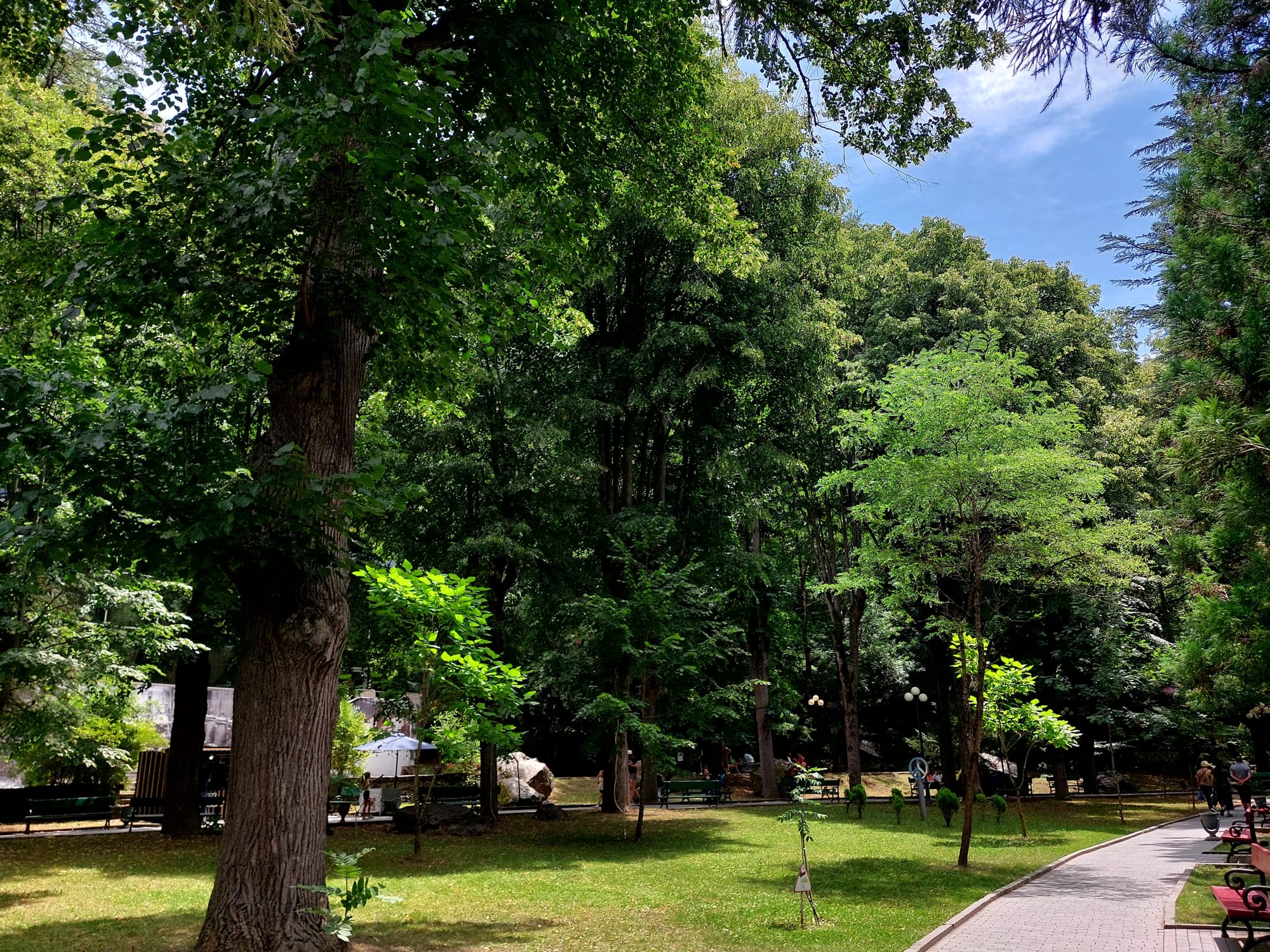
Tall shade trees, mown grass and a paved path with benches in a wooded town park on a bright summer day

Gori, Borjomi & Vardzia, Georgia

Borjomi

Borjomi Central Park, the wooded park laid out around the town's mineral springs. (Kober / Wikimedia Commons · CC0)

A small spa town in a forested gorge of the Mtkvari river in south-central Georgia, famous throughout the former Soviet Union for the salty mineral water bottled under its name. Russian imperial patronage in the nineteenth century gave it a park around the springs, sanatoriums and a summer palace, and it remains a place of walks, warm baths and mountain air.

Neighbourhoods

  • The town centre and the park entrance
    • First-time visitors
    • Close to public transport
    • Cafés

    The narrow core along the Mtkvari, where Rustaveli Street and 9 April Street run towards the gates of the central park. Most hotels, guesthouses, cafés and souvenir stalls are here, along with the railway station and the marshrutka stands, and the mineral water is sold on every corner.

    Open in Maps
  • Likani
    • Quiet and residential
    • Spa hotels
    • Riverside walks

    A leafy suburb a few kilometres west along the gorge, built around the Romanov summer palace and the sanatoriums that followed it. It is quieter than the centre, shaded by conifers and close to the river, and it has its own mineral springs.

    Open in Maps
  • The hillside neighbourhoods
    • Local life
    • Views

    Streets of low houses climbing the slopes on both sides of the valley above the centre, reached by steep lanes and, on one side, by the cable car. They are residential rather than touristic, and they give the wide views down the wooded gorge.

    Open in Maps

Things to do

The springs and the park

  • Borjomi Central Parkpark

    The nineteenth-century park along the stream above the town centre, where warm mineral water can be drunk straight from the spring pavilion, with shaded paths, a small funfair and a warm open-air pool at its far end.

    Open in Maps
  • Borjomi cable carviewpoint

    A short cableway that lifts passengers from the edge of the park to a wooded plateau above the town, with wide views along the gorge.

    Open in Maps

Walks and the forests

  • Borjomi-Kharagauli National Parkpark

    One of the largest national parks in Georgia, covering about 85,000 hectares of forested mountains north-west of the town, with marked long-distance trails, huts and an information centre in Borjomi.

    Open in Maps
  • Likani Palacelandmark

    The summer residence built in the 1890s for Grand Duke Nikolay Mikhailovich of Russia to a design by Leon Benois, standing in gardens beside the Mtkvari in Likani; it is now a presidential summer residence and has held a museum since 2016.

    Open in Maps

Short trips from the town

  • Bakurianiattraction

    A ski and summer resort on the wooded plateau about 30 kilometres above Borjomi, with pistes on Didveli and Kokhta and pine forest walks in warmer months.

    Open in Maps
  • Borjomi–Bakuriani railwaytransit hub

    A narrow-gauge mountain line, first run in 1902 and electrified in 1966, that climbs 37 kilometres from Borjomi to Bakuriani past bridges and forest.

    Open in Maps
  • Timotesubanilandmark

    A monastery church of pink stone, built in the early thirteenth century under Queen Tamar, in a side valley near Borjomi and known for its frescoes.

    Open in Maps

Eat and drink

Long-standing places and food districts in Borjomi. Hours, ratings and directions come from your maps app, always current.

Food streets and markets

  • Rustaveli Streetneighborhood

    The main street through the centre, lined with family-run restaurants and bakeries serving khinkali, khachapuri and grilled meat, and busiest on summer evenings.

    Open in Maps
  • 9 April Street and the park gatesneighborhood

    The short approach to the park, with cafés, bakeries and stalls selling mineral water, dried fruit, tklapi fruit leather and churchkhela.

    Open in Maps
  • Borjomi marketmarket

    The small town market near the centre, selling cheese, honey, forest mushrooms and berries, walnuts and the fruit of the Mtkvari valley.

    Open in Maps

Experience Borjomi

History

The mineral springs in the gorge were known to local people for a thousand years or more before they reached wider recognition, in an area that the Middle Ages knew as the province of Tori, guarded by forts that still overlook the town. Their modern history began in the 1820s and 1830s, after Russia took control of the area, when soldiers of an imperial regiment garrisoned in the valley rediscovered the warm, salty water and found it eased their ailments. Doctors were sent to analyse it, the first bathhouse was built, and a small resort began to form in what had been a thinly settled, heavily forested gorge.

Imperial patronage made the town. The viceroy of the Caucasus, Mikhail Vorontsov, promoted the waters in the 1840s, and later the Romanov family took the valley as a summer estate, building the palace at Likani in the 1890s. Parks were laid out around the springs, villas and hotels went up along the river, and bottling began in the nineteenth century, carrying the name Borjomi across the Russian Empire. A narrow-gauge railway was built up to the plateau at Bakuriani, and a branch line linked the town to the main Transcaucasian route. By 1901 Russian residents outnumbered Georgians in the growing town.

Under Soviet rule Borjomi became a mass health resort, with sanatoriums, rest homes and a bottling plant that supplied the whole union; the Likani palace served as a state dacha. The collapse of the Soviet Union cut both the visitors and the export market, and the 1990s were hard. Bottling and the resort trade recovered in the 2000s, and a fire that burned more than three square kilometres of the national park above the gorge in August 2008 underlined how much the town depends on the woods around it.

Culture & Customs

Borjomi's identity is bound up with water. Taking the cure — drinking a measured glass of warm mineral water each morning, walking in the park, bathing in the baths — is a habit passed down from imperial and Soviet times, and Georgian families still come for a fortnight of it in summer. The rhythm of the spa town, with its promenades, kiosks and benches under the trees, is quite different from the working towns of the Kartli plain below.

The architecture reflects that history: timber balconies and carved eaves on nineteenth-century villas, the domed glass pavilion over the spring, Soviet sanatorium blocks along the gorge, and the eclectic palace at Likani. The town sits on an old frontier between Kartli and Meskheti, and Meskhetian traditions of dried fruit, cheese-making and mountain hospitality mix here with the eastern Georgian supra, the long feast run by a tamada.

Everyday manners are those of small-town Georgia: quick invitations to eat, generous toasts, and a strong attachment to the Orthodox church, whose feast days empty the streets and fill the monasteries of the gorge. The forests matter culturally as well as economically, and mushroom and berry gathering in autumn is a family activity. Bakuriani, the resort on the plateau above, has been a winter sports centre since Soviet times and gives the area a second, colder season of its own.

Daily Life

About 11,000 people live in Borjomi, which makes it a town rather than a city, strung along a few kilometres of the Mtkvari gorge and rarely more than a few streets wide. It is the administrative centre of the surrounding municipality, whose villages and the resort of Bakuriani depend on it for schools, the hospital and the market. The population has fallen since Soviet times, as it has in much of rural Georgia, with younger people leaving for Tbilisi or abroad.

Two things support the local economy: the bottling of mineral water, which is one of Georgia's best-known exports, and tourism, which brings Georgian and regional visitors to hotels, guesthouses and sanatoriums through the summer and sends others on to the ski slopes above in winter. Forestry, small-scale farming and work in the national park add to this, and many households keep fruit trees, bees or a few animals.

The daily rhythm is quiet and seasonal. Mornings begin with walkers heading for the spring, the market fills early with cheese, honey and vegetables, and the park is busiest in the evening, when families walk, children ride the roundabouts and the cafés at the gates fill up. Out of season the town empties and many businesses close. Its persistent concerns are the same as those of other Georgian mountain towns: depopulation, ageing sanatorium buildings, and protecting the forests and the aquifer that give the place its living.

Food

Borjomi's most famous product is not a dish but a drink: naturally carbonated, mineral-rich and distinctly salty water that rises warm from volcanic rock and has been bottled since the nineteenth century. In the central park it is drunk straight from the spring, noticeably warmer and stronger than the bottled version, and Georgians treat a glass of it as medicine as much as refreshment. Other springs rise elsewhere in the gorge, including at Likani.

The cooking is eastern Georgian with a mountain accent. Khinkali, the pleated dumplings filled with spiced meat and broth, are eaten by hand and with plenty of black pepper; mtsvadi, meat grilled over vine cuttings, appears at every celebration; and khachapuri, cheese-filled bread, comes in the round Imeretian and other forms. Soups such as chikhirtma, thickened with egg, and kharcho, made with walnuts, suit the cool evenings, as do beans in a clay pot, lobio, served with mchadi cornbread and pickles.

The forests and orchards supply the rest. Market stalls sell chiri, sun-dried plums and other dried fruit typical of the Meskheti side of the region, tklapi, sheets of fruit leather, churchkhela, walnuts dipped in thickened grape juice, and jars of honey, wild berries and pickled mushrooms. Cheese from the plateau villages, walnut sauces and tarragon feature strongly, and meals end with Georgian wine or a small glass of chacha, the local grape spirit.

Planning tools

Budget

Borjomi is inexpensive by European standards but is one of the pricier stops in central Georgia, because it is a resort: guesthouses in the centre are cheap, while the spa hotels along the gorge and in Likani are priced for Georgian and regional holidaymakers. Summer and the Bakuriani ski season push room rates up, and treatments, baths and the cable car add small extra costs.

Daily Budget Midrange
USD 60–120 (spa or mid-range hotel, restaurant meals, a hired driver for the gorge or Bakuriani)
Daily Budget Shoestring
USD 25–45 (guesthouse room, bakeries and simple restaurants, marshrutkas and the local train)

The central park, the springs and the forest trails cost little or nothing; book rooms ahead for July, August and the ski season.

Best Time to Visit

May to October, when the forests are green, the park is open and the national park trails are walkable; September is settled and quieter than high summer. July and August are the busiest weeks, when Georgian families escape the heat of the lowlands. Winter is cold and snowy but is the season for the slopes above at Bakuriani.

Suggested Number of Days

A day or two covers the town itself. Add another two or three for the national park, the plateau and the monasteries of the gorge; walkers who want a multi-day trail need longer, and winter visitors often base here for several days of skiing above the town.

First Visit
1–2 days
With Surroundings
3–4 days

Transportation

The town is small enough to cross on foot, and marshrutkas run along the gorge road between the centre, Likani and the surrounding villages. Trains and marshrutkas connect Borjomi with Tbilisi and Khashuri, the narrow-gauge railway and shared cars climb to Bakuriani, and taxis are easy to arrange for the monasteries and trailheads.

Hire a driver or take a taxi for Timotesubani, the Green Monastery and the national park entrances, as public transport to them is thin.

Airport & Station Connections

Borjomi lies about 165 kilometres west of Tbilisi, roughly two and a half to three hours by marshrutka or car on the main east–west highway and then up the gorge; trains from Tbilisi also serve the town, more slowly. Kutaisi and Tbilisi airports are the nearest air gateways, and most visitors arrive by road from Tbilisi, Gori or Akhaltsikhe.

Walkability

The centre is compact and walkable, laid out along the river between the station and the park gates, with most of it flat. Distances beyond the core are longer: Likani is a few kilometres west along the gorge, and the hillside streets are steep. Pavements are uneven in places, and snow and ice make the slopes slippery in winter.

Safety

Borjomi is a quiet town with low crime, and the main risks are practical rather than criminal: slippery paths, cold water, and mountain weather that changes quickly on the trails of the national park and the plateau. Forest tracks are poorly signposted away from the marked routes, and winter driving through the gorge and up to Bakuriani can be icy.

Carry warm and waterproof clothing for the forests even in summer, register at a national park office before a long walk, and drive carefully on the gorge and plateau roads in winter. Check current official travel advice before travelling.

Climate

A mountain climate softened by the forested gorge, milder in summer than the plains to the east and cooler and snowier in winter. The air is damp and fresh, rain falls through much of the year, and the plateau above the town is colder still.

Summer
warm rather than hot — daytime temperatures usually in the low to mid 20s °C, with cool evenings and thunderstorms
Winter
cold and snowy — midwinter days usually around 0–5°C and nights below freezing, with deep snow on the plateau above the town

Local Customs

Georgian hospitality is strong in a small town: guesthouse hosts often offer food, wine or chacha, and refusing outright can seem rude, though a small amount is enough. Church visits call for covered shoulders and knees and a headscarf for women in monasteries, and photography inside churches is often restricted. Toasting at a table follows the tamada, the appointed toastmaster.

Tipping is not obligatory but around 10 per cent is welcome in restaurants, and it is polite to ask before photographing people or monastery interiors.

Common Payment Methods

The currency is the Georgian lari. Cards are accepted in hotels, larger restaurants and supermarkets, but guesthouses, market stalls, marshrutkas and taxis often want cash. ATMs are available in the centre; carry lari before heading into the villages and the national park.