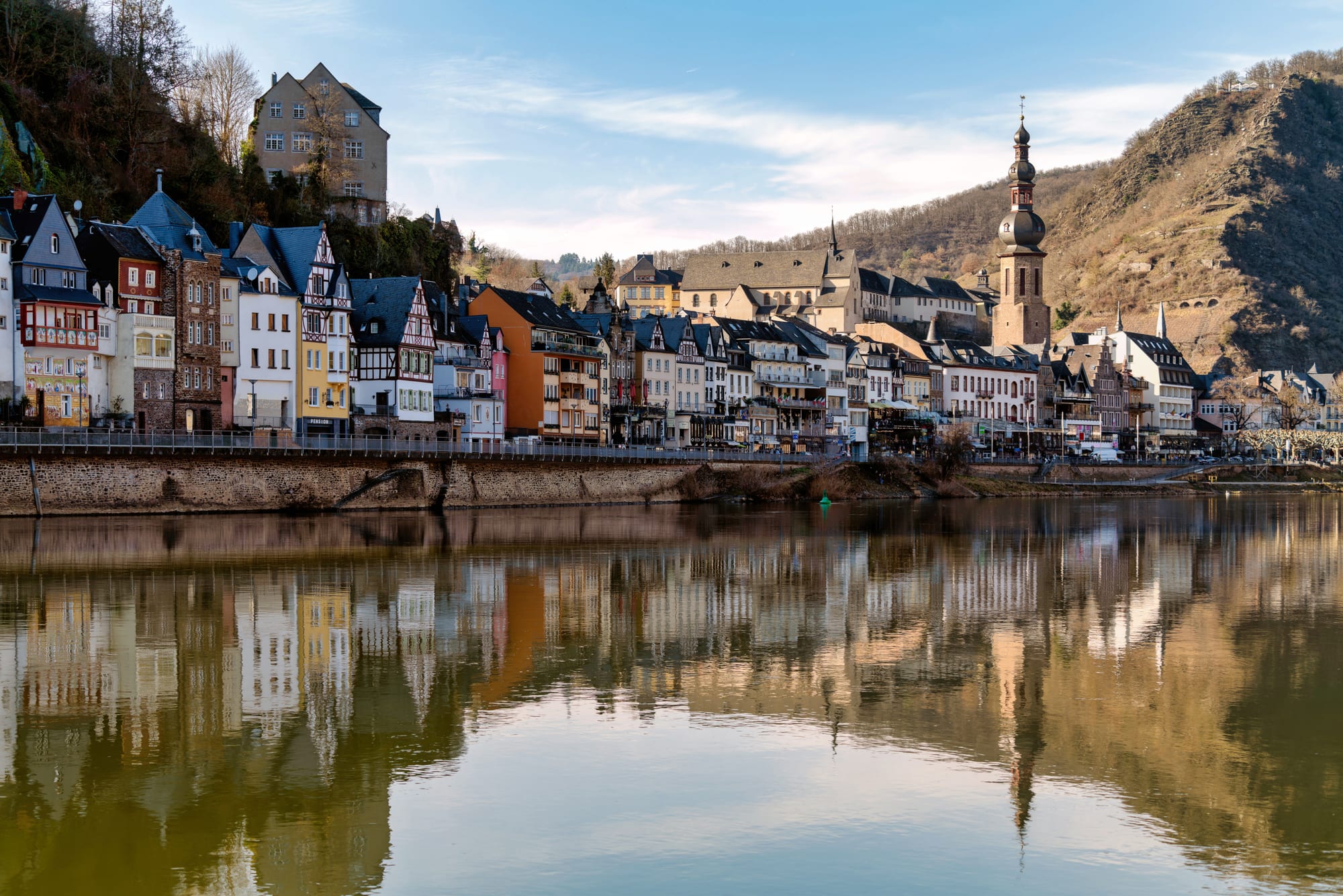
A row of colourful gabled houses and a church tower along the Moselle at Cochem, reflected in the still river

Hesse, Rhineland-Palatinate & Saarland, Germany

Cochem

Cochem's old town and Moselle promenade, seen across the river. (Rolf Kranz / Wikimedia Commons · CC BY-SA 4.0)

A small wine town on the Moselle between the Eifel and the Hunsrück, the seat of the Cochem-Zell district and one of Germany's smallest district towns. It grew as a trading and wine centre of the Electorate of Trier, was ruined by French troops in 1689, and is now a busy river resort below the rebuilt Reichsburg castle.

Neighbourhoods

  • Old town and the promenade
    • First-time visitors
    • Historic district
    • Close to public transport

    The centre on the left bank, from the station past the market square, with its town hall and 18th-century fountain, to the castle hill. Half-timbered houses line the lanes, and a broad riverside promenade holds the boat landings, terraces and wine bars.

    Open in Maps
  • Cond
    • Views of the old town
    • Families
    • Riverside

    The former fishing village across the river on the right bank, joined to Cochem in 1932 after the first bridge opened. Its afternoon terraces look straight across at the old town and the castle, and it has the indoor pool and leisure centre, the youth hostel and the Cold War Bundesbank bunker.

    Open in Maps
  • Sehl
    • Quiet and residential
    • Walking

    A second former fishing village a short walk upstream along the promenade, with its own village festival, the Quetschefest, two weeks after the town's wine festival.

    Open in Maps

Things to do

Castles and the old town

  • Reichsburg Cochemlandmark

    The hilltop imperial castle, first recorded in 1130, destroyed by the French in 1689 and rebuilt in Gothic Revival style after a Berlin businessman bought the ruin in the 1860s; owned by the town since 1978 and open for guided tours.

    Open in Maps
  • Market squarelandmark

    The square at the heart of the old town, with a town hall rebuilt after 1689 and completed in 1739 and a basalt fountain of 1767, ringed by half-timbered houses.

    Open in Maps
  • Capuchin monasterylandmark

    A monastery founded in 1623 by Elector Lothar von Metternich, with a church of 1625–28 and Baroque decoration.

    Open in Maps
  • Winneburglandmark

    The ruin of a castle near the town, burnt down and blown up by French troops in 1689 and never rebuilt.

    Open in Maps

Views and curiosities

  • Pinnerkreuz chairliftviewpoint

    A chairlift up to the Pinnerkreuz lookout, with views over the town and the castle.

    Open in Maps
  • Bundesbank bunkermuseum

    A secret Cold War vault built 30 metres underground in Cond between 1962 and 1964, where the Bundesbank stored up to 15 billion marks of emergency currency until 1988; it is now a museum.

    Open in Maps
  • Historic mustard millattraction

    The Senfmühle, a mustard mill established around 1810 that still grinds mustard by traditional methods.

    Open in Maps

Short trips from the town

  • Eltz Castlelandmark

    A medieval castle on a rock spur in the forested Elzbach valley above the Moselle, still owned by a branch of the family who have lived there since the 12th century.

    Open in Maps
  • Beilsteinattraction

    A small wine village upriver, in the same collective municipality as Cochem, once the seat of the lordship of Winneburg and Beilstein.

    Open in Maps
  • Bremmer Calmontviewpoint

    At Bremm, upriver, the steepest recorded vineyard in the world, with a slope of 65 degrees.

    Open in Maps

Seasonal events

  • Easter marketweekends before Easter

    An Easter market held on Saturdays and Sundays, usually before Easter.

  • Heimat- und Weinfestlast weekend of August

    Cochem's town and wine festival, the main event of the wine year.

  • Sehler Quetschefesttwo weeks after the wine festival

    A village festival in Sehl.

  • Advent marketAdvent

    The Adventszauber and Christmas market in the old town.

Eat and drink

Long-standing places and food districts in Cochem. Hours, ratings and directions come from your maps app, always current.

Cochem classics

  • Moselle wine tastingsrestaurant

    Tastings are offered almost everywhere in and around the town, and many of the places that hold them also serve food.

    Open in Maps
  • Cochem mustardmarket

    Mustards made at the town's historic mill, which has been grinding since around 1810.

    Open in Maps

Food streets

  • The Moselle promenadeneighborhood

    The riverside boulevard of restaurants, bars and terraces facing the water and the boat landings.

    Open in Maps
  • Cond's riverside terracesneighborhood

    Afternoon-sun terraces on the far bank with views back across the river to the old town and the castle.

    Open in Maps

Experience Cochem

History

Cochem was settled in Celtic and Roman times and first recorded in 866 as Villa cuchema. Its castle is first mentioned in 1130, and in 1151 King Konrad III occupied it and declared it an imperial castle. In 1294 King Adolf of Nassau pledged the town to the archbishops of Trier, and it stayed in the Electorate of Trier until 1794. Cochem received town rights in 1332, and the walls built soon afterwards still stand. Plague struck in 1423–25, and in 1623 Elector Lothar von Metternich founded the Capuchin monastery above the town. Cochem was besieged in the Thirty Years' War but not taken.

The great disaster came in 1689, in the Nine Years' War, when Louis XIV's troops burnt the Winneburg, took the town and destroyed its castle; rebuilding was slow, and the town hall was finished only in 1739. French rule followed from 1794 and Prussian from 1815. In the 1860s a Berlin businessman, Louis Ravené, bought the castle ruin and rebuilt it in Gothic Revival style. The first bridge across the Moselle opened in 1927, and in 1932 the fishing villages of Cond and Sehl joined the town.

Much of the old town was destroyed in the Second World War, and the operations staff of Zeisig, an underground subcamp of the Natzweiler concentration camp between Bruttig and Treis where prisoners were forced to work for Bosch, were based here. After 1946 Cochem became part of Rhineland-Palatinate, and from 1964 to 1988 the Bundesbank kept a secret emergency currency reserve under Cond.

Culture & Customs

Cochem was one of the first places on the Moselle to attract visitors: the first modern tourists came early in the 19th century, and in the 1930s it became the river's first tourist centre. Its image — half-timbered houses below a turreted castle, steep vineyards behind — draws visitors through the season, and river tours leave its promenade at frequent intervals. The town is the seat of the district and, since 2009, of the collective municipality of Cochem.

The calendar follows the wine year and the church. The season opens with an Easter market, the town and wine festival fills the last weekend of August, Sehl holds its own festival two weeks later, and Advent ends the year with a Christmas market. The town's coat of arms carries the red cross of Trier and the keys of Saint Peter, a reminder of five centuries under the archbishops.

Cochem is Catholic in tradition, with the Capuchin monastery and its Baroque-decorated church and the parish church of St. Remaclus, designed by Emil Steffann as a counterpoint to the castle across the river. Cochem is twinned with Avallon in Burgundy, Malmedy in Belgium and Moritzburg in Saxony; outside the season, local life is that of a small district town.

Daily Life

Just under 5,000 people live in Cochem, which makes it the smallest district town in Germany and the largest place in the Cochem-Zell district. The old town and Sehl lie on the left bank of the Moselle and Cond on the right, while Brauheck, about 2 km from the centre on the Eifel heights, has the commercial area, an air force barracks and newer housing.

Cochem is an important centre for tourism in the Moselle wine region, and wine production still plays a significant part, though the economic weight of both has waned over recent decades. Small family wineries sell from cellars and courtyards in the lanes, and the district offices, schools and a hospital provide much of the year-round work.

The day follows the visitors in season — boats arriving at the promenade, coaches and trains bringing day-trippers — and the town grows quiet after about six in the evening, when most of them leave. In winter and spring it sometimes floods the riverside; the last major floods were in 1993, 1995 and 2003.

Food

Cochem eats and drinks like the rest of the Moselle wine country, at tables in wine taverns and family wineries many of which also serve food. Tastings are offered almost everywhere in and around the town, and local wine and liqueurs are sold in its shops.

The wines are the Moselle's own. The region is mainly famous for Riesling, with Elbling and Müller-Thurgau also grown, and its northerly position tends to give light, crisp, low-alcohol wines with high acidity and flowery aromas, often from vineyards on slate soils. The slopes are famously steep — at Bremm, a short way upriver, the Calmont is the steepest recorded vineyard in the world, at a 65-degree incline — and in recent years winemakers have worked to win acceptance for fully dry, or trocken, Rieslings.

Cochem's own speciality is mustard, ground at a historic mill established around 1810 and sold in many flavours. The riverside restaurants on the promenade serve their meals with the river and its boats for a view.

Planning tools

Budget

Cochem is a busy resort with a wide range of places to stay, from a youth hostel to hotels, and prices stay moderate outside peak weekends. Riverside restaurants cost more than the wine taverns in the lanes behind, and castle tours, the chairlift and boat trips are the main extras.

Daily Budget Midrange
USD 150–250 (mid-range hotel or winery rooms, restaurant dinners, castle tour and a river cruise)
Daily Budget Shoestring
USD 70–110 (youth hostel or campsite, bakery and wine-tavern meals, regional trains and buses)

The town goes quiet in the evening once day-trippers leave, so a stay overnight is the calmer way to see it.

Best Time to Visit

Easter to October, when the chairlift and river boats run and the vineyard paths are at their best. Late August brings the town's wine festival, and September and October the grape harvest. Winter is quiet, with high water on some days in winter and spring, and Advent brings a Christmas market to the old town.

Suggested Number of Days

One or two days cover the town and the castle. Three or four allow boat or rail trips to other Moselle wine villages and the castles and walks in the hills on both sides of the valley; without a car, bus and boat timetables add a little time.

First Visit
1–2 days
With Surroundings
3–4 days

Transportation

The old town, Cond and Sehl are all within easy walking distance, linked by two bridges, though the climb to the castle and the upper town is steep. Buses and, less often, boats link Cochem with Moselle villages that have no railway, and bike paths run along the river in both directions; bicycles can be hired in town.

Cars can follow the scenic B49 along the river or the faster A48 motorway with a descent on the B259.

Airport & Station Connections

Cochem station, close to the centre, is on the Moselle railway between Koblenz and Trier, with direct trains to both and on to Luxembourg, Bonn and Cologne. Just beyond the station trains enter the Kaiser Wilhelm Tunnel, Germany's longest railway tunnel from 1877 until 1985. Frankfurt-Hahn, Cologne Bonn and Frankfurt are the nearest airports, and cruise boats call from Trier, Bernkastel-Kues and Koblenz.

Walkability

Excellent in the valley: the centre, the promenade and the two former villages across and up the river take only minutes to walk between. The lanes up to the castle and the Capuchin monastery are steep and cobbled, and the chairlift saves the climb to the Pinnerkreuz.

Safety

Germany is a safe country with low levels of violent crime. Cochem's risks are small: crowds on the promenade and at festivals, steep and slippery paths in the vineyards and up to the castle, and Moselle floods, which reach the riverside on some days in winter and spring.

Watch for flood warnings when parking by the river in winter and spring, wear sturdy shoes for the castle climb, and stay out of marked cycle lanes on foot. Check current official travel advice before travelling.

Climate

Summers in the valley are warm and winters cool. In nearby Koblenz the average annual temperature is 10.8°C.

Summer
warm — in nearby Koblenz July averages 19.5°C, with occasional heatwaves
Winter
cool — in nearby Koblenz January averages 2.7°C

Local Customs

Tipping is usual in restaurants, bars and taxis but rarely more than 10 per cent; most people round the bill up and say the total when paying. Wine tastings are part of almost every visit. The town is Catholic in tradition, and its churches are working places of worship.

Keep to marked paths through working vineyards, especially around the harvest.

Common Payment Methods

The currency is the euro. Hotels and larger restaurants take cards, but Germany remains fond of cash, and some wine taverns, bakeries and small wineries take only cash. ATMs are found in the centre.