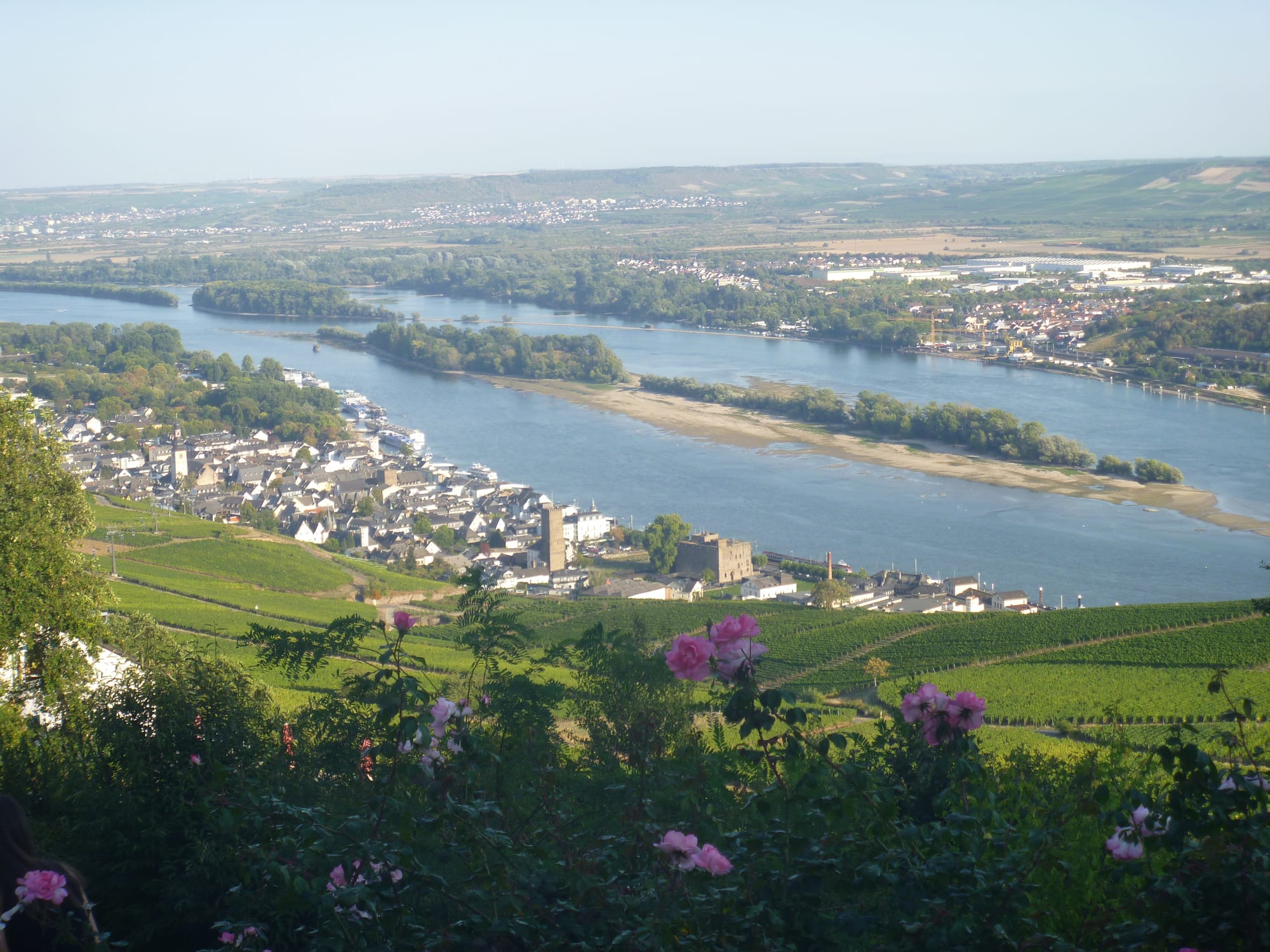
The rooftops of Rüdesheim beside the wide Rhine with wooded islands, seen from vineyards on the hill above

Hesse, Rhineland-Palatinate & Saarland, Germany

Rüdesheim am Rhein

Rüdesheim am Rhein and the Rhine, seen from the vineyards below the Niederwald. (Anna Diderot / Wikimedia Commons · CC BY-SA 4.0)

A winemaking town on the right bank of the Rhine in Hesse, facing Bingen at the southern gate of the UNESCO-listed Rhine Gorge. Vineyards and river trade built it; since the Niederwald monument rose above it in 1883, tourism has largely replaced shipping. Its wine-tavern lanes, castles, cable car and boat landings make it a major tourist attraction.

Neighbourhoods

  • Old town and the Drosselgasse
    • First-time visitors
    • Wine taverns
    • Close to public transport

    The compact old centre between the river and the vineyards, built on the plan of a Frankish 'clump village'. Wine taverns, music and souvenir shops crowd the Drosselgasse and its side lanes, aristocratic courtyards line Oberstraße, and the station, boat landings and the cable car to the Niederwald are all at hand.

    Open in Maps
  • Eibingen
    • Quiet and residential
    • Pilgrimage

    The former village just east of the old town, joined to Rüdesheim in 1939 and now grown together with it. Its parish church holds the shrine of Hildegard of Bingen, and the Benedictine abbey of St. Hildegard stands in the vineyards above.

    Open in Maps
  • Assmannshausen
    • Red wine
    • Quieter stays
    • Walking

    A wine village round a bend of the Rhine downstream, part of the town since 1977, famous for its red wine from Pinot noir, called Spätburgunder in German. It has a lithium spring and a spa house, and a chairlift climbs from it to the Niederwald.

    Open in Maps

Things to do

Old town landmarks

  • Drosselgasselandmark

    A 144-metre cobbled lane of wine taverns, first recorded in the 15th century, known for the live music in its taverns.

    Open in Maps
  • Brömserburgmuseum

    The oldest castle in the Rhine Gorge World Heritage Site, held by the archbishops of Mainz and now home to the Rheingau wine museum.

    Open in Maps
  • Boosenburglandmark

    A castle probably built in the 12th century, whose 38-metre tower survives beside a Gothic Revival villa of 1872.

    Open in Maps
  • Adlerturmlandmark

    A 15th-century tower of the town wall, a former powder tower on the Rhine bank and the only one of its towers to survive; Goethe lived here when he visited the town.

    Open in Maps
  • Siegfried's Mechanical Music Cabinetmuseum

    A museum of self-playing musical instruments in the Brömserhof, a nobleman's house of 1542 on Oberstraße.

    Open in Maps

The Niederwald and the vineyards

  • Niederwald monumentlandmark

    The colossal Germania statue raised between 1871 and 1883 to mark the unification of Germany, looking over the Rhine to Bingen; a cable car rises to it over the vineyards.

    Open in Maps
  • Niederwald Templeviewpoint

    A lookout temple built by the Count of Ostein in 1788 in the Niederwald landscape park, destroyed in 1944 and rebuilt in 2006.

    Open in Maps
  • Ehrenfels Castlelandmark

    A ruined castle on the steep vineyard slopes above the gorge, which gave its name to the Ehrenfelser grape.

    Open in Maps
  • Eibingen Abbeylandmark

    The Benedictine abbey of St. Hildegard in the vineyards above Eibingen, the successor of the convent Hildegard of Bingen founded in 1165.

    Open in Maps
  • Rheinsteigtrail

    The long-distance trail from Wiesbaden to Bonn, which passes the abbey and the Niederwald monument on its way through the town's vineyards.

    Open in Maps

Short trips from the town

  • Bingen am Rheinattraction

    The town directly across the river, reached by passenger and car ferries.

    Open in Maps
  • Mouse Towerlandmark

    The Binger Mäuseturm, a tower on an island in the Rhine off Bingen.

    Open in Maps
  • Rheinstein Castlelandmark

    A Rhine castle that round-trip tickets combine with Rüdesheim's cable car and boats.

    Open in Maps
  • Eberbach Abbeylandmark

    The former Cistercian abbey of Kloster Eberbach, in the hills of the Rheingau.

    Open in Maps

Seasonal events

  • Rhein in Flammenfirst Saturday in July

    A fireworks display over the Rhine in the Rüdesheim and Bingen area, watched from the banks and from boats.

  • Rheingau Musik Festivalsummer

    A classical music festival whose concerts are held in Eibingen Abbey, the parish church of St. Jakobus and other venues around the Rheingau.

  • Rüdesheim Wine Festivalthird weekend of August

    The town's wine festival, at which Rüdesheim's wine queen and her princesses are crowned.

  • Tage des Federweißenlate October to early November

    The last wine festival of the year, celebrating the new season's young wine.

  • Christmas Market of the Nationslate November to Christmas

    A Christmas market in the old town through Advent.

Eat and drink

Long-standing places and food districts in Rüdesheim am Rhein. Hours, ratings and directions come from your maps app, always current.

Rüdesheim classics

  • Rüdesheimer Kaffeecafe

    Coffee invented here in 1957: Asbach brandy and sugar flambéed in a special cup, then topped with strong coffee, sweetened whipped cream and chocolate flakes.

    Open in Maps
  • Asbach Visitor Centrerestaurant

    The visitor centre and shop of Asbach, the brandy maker founded in Rüdesheim in 1892, whose Asbach Uralt goes into the town's famous coffee.

    Open in Maps

Wine streets

  • Drosselgasse wine tavernsneighborhood

    Wine taverns along the town's famous lane, many with live music.

    Open in Maps
  • Assmannshausen red wineneighborhood

    The village downstream known for Assmannshäuser, a red wine made from Spätburgunder, the German name for Pinot noir.

    Open in Maps

Experience Rüdesheim am Rhein

History

Celts, then the Ubii and the Mattiaci lived here before the Romans pushed into the Taunus in the 1st century; while they built a fort at Bingen across the river, a bridgehead on the road to the Limes lay near today's Rüdesheim. Alamanni and Franks followed, and finds of glass suggest wine was already grown in the Frankish period. The layout of a Frankish 'clump village' still shows in the old town's streets. Rüdesheim was first named in a document in 1074, when Archbishop Siegfried I of Mainz released the wooded hills of 'Rudensheim and Ibingen' to be cleared for vineyards.

The archbishops of Mainz held the Brömserburg, the oldest castle in what is now the Rhine Gorge World Heritage Site, and the town lived from wine and shipping, especially timber rafting. The land road ended here at the steep riverbank, so traffic heading downstream had to change to boats. French troops damaged the Brömserburg in 1640 during the Thirty Years' War. Rüdesheim received town rights on 1 January 1818, and after Prussia annexed Nassau in 1867 it became a district seat, a role it kept until 1977.

The foundation stone of the Niederwald monument was laid in 1877, and its completion in 1883 drew crowds, first on donkeys, then from 1885 on a cog railway and since 1954 by cable car. Tourism steadily replaced shipping. In 1939 the Nazis absorbed neighbouring Eibingen against its residents' wishes, new housing for refugees followed after the war, and Assmannshausen, Aulhausen and Presberg joined the town in 1977.

Culture & Customs

Rüdesheim is a showcase of Rhine Romanticism, the 19th-century taste for castles, vineyards and river views that drew painters and writers to the gorge; Goethe lodged in the Adlerturm, and Beethoven, Goethe and Brentano visited the Niederwald temple. The town remains a major attraction, especially for foreign visitors, and the Drosselgasse, with live music in its taverns, is its best-known image.

Wine shapes local identity. The town elects a wine queen and princesses each year, crowned at the August wine festival, who represent Rüdesheim in other wine regions, and the season runs from the Rhine in Flames fireworks in July to the Tage des Federweißen in late autumn. The Rheingau Musik Festival brings classical concerts to Eibingen Abbey and the parish church of St. Jakobus, and a Harley-Davidson rally, Magic Bike, fills the streets around Corpus Christi.

Religious life centres on Hildegard of Bingen, the medieval abbess who founded a convent at Eibingen in 1165. Her shrine is in Eibingen's parish church, the abbey above still bears her name, and pilgrims come on her feast day. Rüdesheim is twinned with Meursault in Burgundy and Swanage in Dorset, and the villages of Juliénas and Oingt in Beaujolais are partnered with Assmannshausen and Presberg.

Daily Life

Rüdesheim is a small town of five quarters — the old centre, Eibingen, Assmannshausen, Aulhausen and Presberg — spread from the riverbank up into the Taunus forest. The centre and Eibingen have grown together since the war, with housing estates built for refugees in 1953 and 1970 and a newer eastern district from 1977, while Aulhausen and Presberg are quiet villages in the hills.

Wine, the Niederwald monument and tourism together shape the town's life and economy, above all in the centre and Assmannshausen. Restaurants and hotels cluster around the Drosselgasse, river boats unload day visitors through the season, and the vineyards on the south-facing slopes are mostly planted with Riesling. Asbach, founded here in 1892, has a visitor centre in the town, though most of the company's operations have moved away. The town belongs to the Rhine-Main transport association's fare zone.

The rhythm is seasonal: crowded lanes, boats and festivals from spring to autumn, then a quieter winter broken by the Christmas market. The terraces between Assmannshausen and Ehrenfels Castle show the pressure on hillside farming — winegrowing there has been almost entirely abandoned because the plots could be reached only on foot.

Food

Rüdesheim's food is the tavern cooking of the Rheingau, eaten alongside a glass of the local wine. The town's best-known contribution is a drink: Rüdesheimer Kaffee, created in 1957 by the television chef Hans Karl Adam. Asbach Uralt brandy and sugar cubes go into a specially designed cup, the brandy is flambéed and stirred until the sugar dissolves, strong coffee is added, and the cup is crowned with whipped cream sweetened with vanilla sugar and scattered with chocolate flakes.

Asbach itself began here in 1892, when Hugo Asbach founded a company selling 'Rüdesheim Cognac'; after the First World War the word cognac could no longer be used, and Asbach Uralt became one of Germany's best-known brandies. The company also makes chocolate.

Wine is the heart of it. Rüdesheim lies in the north-western corner of the Rheingau, where Riesling is the main grape and the wines are mainly high-quality whites, and vineyards on its slopes are recorded as early as 1399. Assmannshausen is the exception, known for Assmannshäuser, a red made from Spätburgunder, the German Pinot noir. The Drosselgasse taverns, the village wine bars and the festivals from summer to the Federweißer days of late autumn are where it is drunk.

Planning tools

Budget

Rüdesheim is a busy tourist town, and food and drink in the Drosselgasse cost more than in the quieter villages around it. Accommodation prices climb on festival weekends, especially for the July fireworks and the August wine festival, and many visitors come only for the day from Frankfurt, Wiesbaden or Mainz. Cable car, chairlift and boat tickets can be combined.

Daily Budget Midrange
USD 150–250 (mid-range hotel, tavern dinners, cable car and boat trips)
Daily Budget Shoestring
USD 70–110 (simple guesthouse, bakery and wine-tavern meals, regional trains)

Rüdesheim lies inside the Frankfurt region's RMV fare zone, so trains from Frankfurt, Wiesbaden and Mainz are cheap.

Best Time to Visit

Late March to early November, when the cable car and the Rhine boats run and the summer brings music in the Drosselgasse, the July fireworks and the August wine festival. Autumn adds the grape harvest and the last wine festival of the year; in Advent the Christmas Market of the Nations fills the old town, while much else is quiet in winter.

Suggested Number of Days

The town itself fills one full day, or two at a slower pace with time for the walks above it. Three or four days allow boat trips down the gorge and visits to Bingen and the Rheingau's other wine villages. Fewer boats and lifts run in winter, which shortens the list.

First Visit
1–2 days
With Surroundings
3–4 days

Transportation

The town is small enough to walk. Assmannshausen is reached by train, by bus or on foot along the Rhine, and a cable car runs over the vineyards to the Niederwald, with a chairlift down to Assmannshausen. Passenger and car ferries cross to Bingen, since there are no bridges over the Rhine between Wiesbaden and Koblenz, and KD and other river boats call at the landing stages in season.

Drivers on the B42 meet a railway level crossing just west of the town that causes long queues on fine weekends; arriving by train avoids it.

Airport & Station Connections

Rüdesheim (Rhein) station is on the East Rhine Railway, with trains around once an hour to Wiesbaden and Frankfurt in one direction and Koblenz in the other. Frankfurt Airport is the nearest major airport, reached by train via Frankfurt or Wiesbaden. Drivers come on the A66 from Frankfurt via Wiesbaden or along the B42 riverside road, and KD and other Rhine cruise boats stop at the town.

Walkability

The old town is compact and flat between the river and the first vineyard terraces, and the station, landing stages, Drosselgasse and castles are close together. The walk up through the vineyards to the Niederwald is steep, and Assmannshausen is a longer walk along the river. The lanes become very crowded on summer weekends.

Safety

Germany is a safe country with low levels of violent crime. In Rüdesheim the risks are pickpockets in the summer crowds of the old town and on Rhine boats, drink at the wine festivals, and the steep paths through the vineyards. The Rhine occasionally floods riverside roads.

Keep bags close in the Drosselgasse and at festivals, wear sturdy shoes on vineyard paths, and stay out of marked cycle lanes on foot. Check current official travel advice before travelling.

Climate

The Rhine and Main valleys are among the warmest parts of Germany, with mild winters and warm summers that suit the vine, and the town's south-facing slopes catch the sun. In nearby Wiesbaden the average annual temperature is 9.8°C.

Summer
warm — in nearby Wiesbaden July averages 18.9°C, and 38.9°C was recorded in July 2019
Winter
cool and grey — in nearby Wiesbaden January averages 1.2°C

Local Customs

Tipping is usual in restaurants, bars and taxis but rarely more than 10 per cent; most people round the bill up and say the total when paying. The wine year sets the calendar, and Eibingen's parish church and abbey are places of pilgrimage to Hildegard of Bingen.

Dress modestly and keep quiet in the abbey and churches, and keep to marked paths through working vineyards.

Common Payment Methods

The currency is the euro. Cards are accepted in hotels, larger restaurants and shops, but Germany remains fond of cash, and some wine taverns, bakeries and small shops take only cash. ATMs are found in the old town.