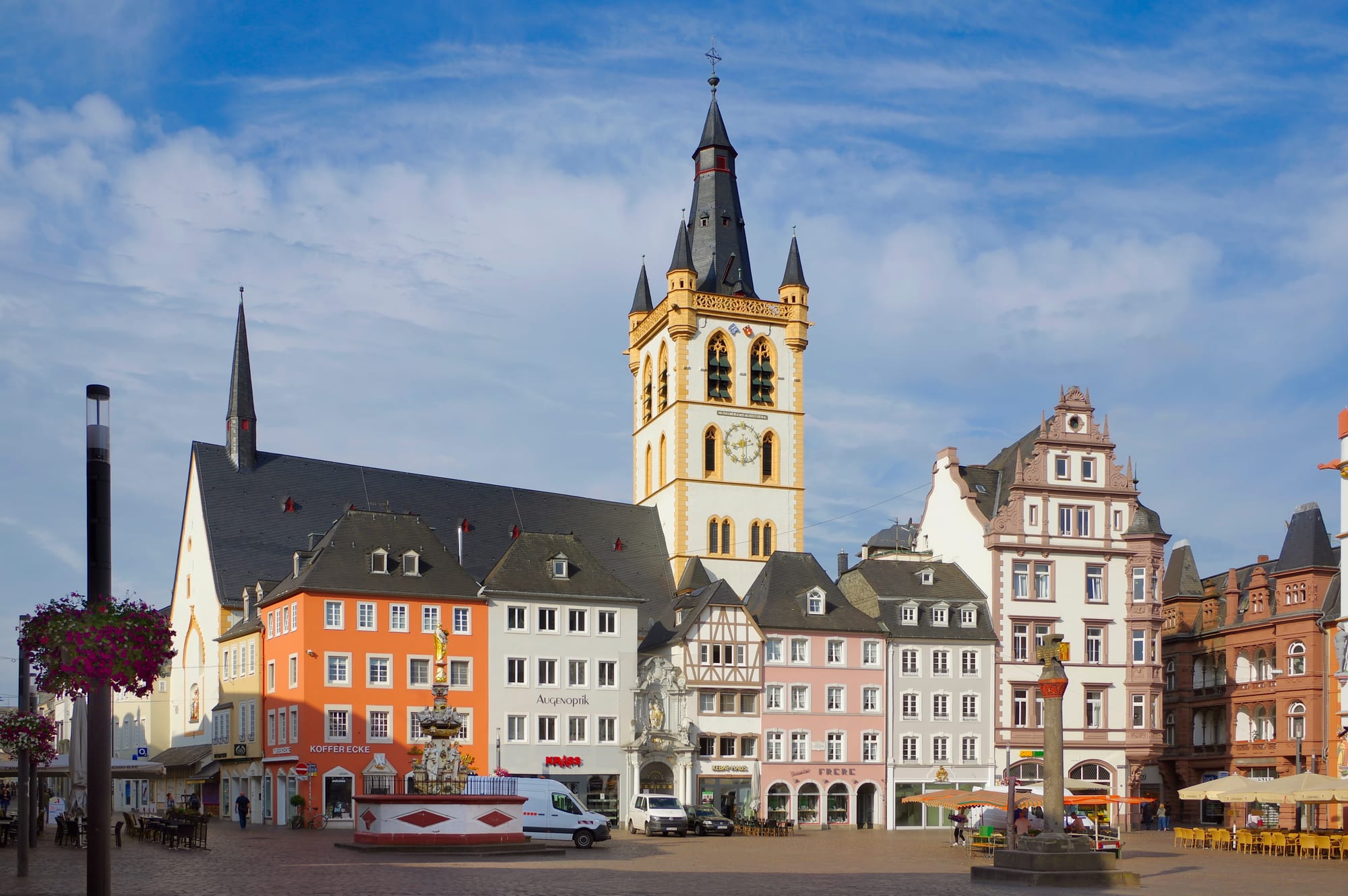
Trier's Hauptmarkt with a fountain, a market cross and colourful gabled houses below the tower of St. Gangolf

Hesse, Rhineland-Palatinate & Saarland, Germany

Trier

The Hauptmarkt, Trier's main market square, with the tower of St. Gangolf behind. (Berthold Werner / Wikimedia Commons · CC BY-SA 4.0)

A university city on the Moselle near the Luxembourg border, founded by the Romans as Augusta Treverorum and counted as Germany's oldest city. It was an imperial residence in the late Roman Empire and later the seat of powerful archbishop-electors. Today its Roman gate, baths and basilica stand among medieval squares, wine villages and vineyard slopes.

Neighbourhoods

  • Altstadt
    • First-time visitors
    • Historic district
    • Close to public transport

    The old centre inside the ring of avenues, running from the Porta Nigra past the Hauptmarkt to the cathedral, the Aula Palatina and the Imperial Baths. Most of the Roman and medieval sights, the shopping streets and the wine bars are here, and the main station is a short walk east.

    Open in Maps
  • Zurlauben and the Moselle bank
    • Riverside
    • Best for food
    • Summer evenings

    A former fishing village, now a stretch of riverside street on the east bank north of the centre. Restaurants and terraces face the Moselle, and the bank holds the Zurlaubener Heimatfest each summer.

    Open in Maps
  • Olewig
    • Wine taverns
    • Quiet and residential

    A wine-growing district in a side valley east of the amphitheatre, absorbed by the city in 1930. Vineyards climb the slopes above it, and the Olewiger Weinfest crowns Trier's wine queen each year.

    Open in Maps
  • Trier-West and Pallien
    • Viewpoints
    • Local life

    The districts on the west bank, across the Roman Bridge from the centre, beneath red sandstone hills. The 19th-century Mariensäule column stands on the Pulsberg above, the classic lookout over the city and the river.

    Open in Maps

Things to do

Roman Trier

  • Porta Nigralandmark

    The 'Black Gate', a large Roman city gate and the city's emblem, at the northern end of the old town.

    Open in Maps
  • Aula Palatinalandmark

    Constantine's 67-metre palace hall, also called the Basilica of Constantine, built in the early 4th century and now used as a Protestant church.

    Open in Maps
  • Imperial Bathslandmark

    The ruins of a vast Roman bath complex, with the staff's underground passageways and the remains of the sewers still to be seen.

    Open in Maps
  • Barbara Bathslandmark

    Remains of Roman baths built in the second half of the 2nd century AD.

    Open in Maps
  • Roman amphitheatrelandmark

    An arena dug into the side of a hill, which could hold about 20,000 spectators.

    Open in Maps
  • Roman Bridgelandmark

    The bridge across the Moselle whose piers date from the 2nd century AD — the oldest bridge north of the Alps still crossed by traffic.

    Open in Maps

Churches and palaces

  • Trier Cathedrallandmark

    Germany's oldest cathedral, built on Roman foundations, with a Romanesque west front and the Holy Tunic among its relics.

    Open in Maps
  • Liebfrauenkirchelandmark

    The Church of Our Lady beside the cathedral, one of the most important early Gothic churches in Germany.

    Open in Maps
  • Electoral Palacelandmark

    The palace of the archbishop-electors beside the Aula Palatina, with a Renaissance residence and a Rococo south wing, and Baroque gardens beside it.

    Open in Maps
  • St. Matthias' Abbeylandmark

    A working Benedictine monastery whose Romanesque church holds what is held to be the only tomb of an apostle north of the Alps.

    Open in Maps
  • St. Paulinus' Churchlandmark

    A Baroque church built between 1734 and 1753, with an interior designed by Balthasar Neumann, on a site that has held churches since the 4th century.

    Open in Maps

Museums

  • Rheinisches Landesmuseummuseum

    An archaeological museum whose research covers Trier and its surroundings, with a replica of the Igel Column among its exhibits.

    Open in Maps
  • Karl Marx Housemuseum

    The house on Brückenstraße where Karl Marx was born in 1818, now a museum of his life, his writings and the history of communism.

    Open in Maps
  • Stadtmuseum Simeonstiftmuseum

    The city history museum beside the Porta Nigra, known for its scale model of medieval Trier.

    Open in Maps
  • Museum am Dommuseum

    The diocesan museum near the cathedral, devoted to the religious and cultural history of the diocese and the late Roman buildings beneath the cathedral.

    Open in Maps

The river and viewpoints

  • Old Cranelandmark

    A Gothic treadwheel harbour crane of 1413 on the Moselle bank, one of two historic cranes in the city.

    Open in Maps
  • Mariensäuleviewpoint

    A 19th-century column of the Virgin on the Pulsberg, on the west bank, with a panoramic view over the city and the valley.

    Open in Maps
  • Weinkulturpfadtrail

    A signposted walk from beside the amphitheatre up through the vineyards, with views over the Olewig valley.

    Open in Maps

Short trips from the city

  • Igel Columnlandmark

    In Igel, just upriver, a 23-metre Roman funerary monument of about 250 AD carved with scenes from a cloth merchant family's business, part of the UNESCO listing for Roman Trier.

    Open in Maps
  • Saarburgattraction

    A small Riesling town on the Saar a few kilometres upstream from its meeting with the Moselle, where a stream drops through the town centre in a waterfall.

    Open in Maps
  • Luxembourg Cityattraction

    The capital of the Grand Duchy, about 40 km to the south-west.

    Open in Maps

Seasonal events

  • Altstadtfestlast weekend of June

    The old-town festival, held in the centre of Trier since 1980.

  • Zurlaubener HeimatfestJuly

    A festival on the Moselle bank at Zurlauben, two weeks after the Altstadtfest, with an electronic music festival as part of it since 2011.

  • Olewiger Weinfestusually August

    The local winemakers' festival in Olewig, held over several days from the first weekend of August, with fireworks, at which the Trier wine queen is crowned.

  • Trier Christmas MarketAdvent, late November to December

    Stalls on the Hauptmarkt and on the Domfreihof square in front of the cathedral.

Eat and drink

Long-standing places and food districts in Trier. Hours, ratings and directions come from your maps app, always current.

Trier classics

  • Viezrestaurant

    The region's tart cider, also called Apfelwein elsewhere in Germany, traditionally drunk from a white porcelain vessel called a Viezporz; it is often drunk mixed with lemonade or sparkling water.

    Open in Maps
  • Teerdischrestaurant

    A Trier dish of mashed potatoes and sauerkraut, served with sausage or other meat — eaten alongside Flieten, the local name for fried chicken wings.

    Open in Maps

Food districts and markets

  • Hauptmarktmarket

    The main square, which has a market every working day and is ringed by cafés and the Steipe, the rebuilt medieval banqueting house.

    Open in Maps
  • Judengasseneighborhood

    A former Jewish lane just off the Hauptmarkt, now lined with bars.

    Open in Maps
  • Zurlaubener Uferneighborhood

    The riverside street of the old fishing village, with restaurants and terraces looking over the Moselle.

    Open in Maps

Wine

  • Weinstube Kesselstattrestaurant

    A wine bar opposite the cathedral, in an old building with a leafy courtyard, pouring local Moselle wines.

    Open in Maps
  • Olewig's wine tavernsneighborhood

    The wine-growing district east of the centre, where winemakers pour Riesling below their own slopes.

    Open in Maps

Experience Trier

History

Celtic Treveri lived in this stretch of the Moselle valley before the Romans subdued them in the 1st century BC and founded Augusta Treverorum around 16 BC, a name that set it apart from the empire's many other towns honouring Augustus. It became the capital of the province of Belgic Gaul and, after Diocletian's reforms, the seat of the prefecture of the Gauls. From 293 to 395 it was one of the residences of the Western Roman emperor, and in the 4th century perhaps 75,000 or more people lived here — Saint Ambrose was born in the city. The Porta Nigra, the baths and Constantine's throne hall date from these centuries.

The Franks took Trier in 459. Pilgrims came to the relics of Saint Matthias, and the archbishops grew into prince-electors, among the seven who chose the Holy Roman Emperor, ruling lands from the French border to the Rhine. A university was founded in 1473. Between 1581 and 1593 the Trier witch trials killed about 368 people in the city alone, one of the largest witch persecutions in Europe. Spain and France fought over Trier in the Thirty Years' War, and French troops occupied it repeatedly before revolutionary France annexed it in 1794.

Prussia took over in 1815, and Karl Marx was born here three years later. The synagogue was looted in 1938 and destroyed in 1944, the year Allied bombing hit the city hard. Trier joined Rhineland-Palatinate after the war, its university was refounded in the 1970s, and it celebrated its 2,000th anniversary in 1984.

Culture & Customs

The city's identity rests on its Roman past: the Roman monuments, the cathedral and the Church of Our Lady form a UNESCO World Heritage Site, and Trier is generally counted as Germany's oldest city. It is also the oldest bishop's seat north of the Alps, and Catholic tradition runs deep, from pilgrimages to St. Matthias' Abbey to the Holy Tunic kept in the cathedral. Karl Marx, born in Brückenstraße in 1818, was an awkward son for a long time; today the city actively presents his birthplace to visitors.

Theater Trier stages musical theatre, plays and dance, and the summer calendar fills with street festivals — the Altstadtfest in the centre, the Zurlaubener Heimatfest on the river, and wine festivals in Olewig and other districts. Until 2014 Trier staged Germany's largest Roman festival, Brot und Spiele. The Gladiators Trier basketball team and the football club Eintracht Trier have loyal followings.

The local dialect is Moselle Franconian, and the border is only about 15 km away; Trier works with Luxembourg, Metz and Saarbrücken in the QuattroPole network of cities. Wine culture sets much of the social life, in wine bars in the centre and in the taverns of the wine-growing districts.

Daily Life

Trier had 105,054 residents at the end of 2025, making it the fourth-largest city in Rhineland-Palatinate after Mainz, Ludwigshafen and Koblenz. The city is divided into 19 districts, each with its own local council, from the old centre in the valley to the wine villages in the side valleys and the newer housing and university campuses on the Petrisberg above.

The University of Trier and the Trier University of Applied Sciences give the city a large student population, and the Academy of European Law, founded in 1992, trains lawyers from across Europe. Trier is the administrative seat of the surrounding Trier-Saarburg district and of a state supervisory authority, and tourism and the Moselle wine trade matter a great deal. Commuters also cross the border daily to work in Luxembourg.

Everyday life is centred on the pedestrian streets, the daily market on the Hauptmarkt and the riverbanks, which fill with walkers, cyclists and terrace drinkers in summer. The Moselle can be a threat as well as a pleasure: in July 2021 floods badly damaged the district of Ehrang.

Food

Trier eats the plain, filling food of the Moselle country. Teerdisch is a dish of mashed potatoes mixed with sauerkraut, served with sausage or other meat; Flieten is the local name for fried chicken wings; and other potato dishes belong to the same tradition. Bakeries and kebab shops supply the quick meals of a student city.

The drink that marks Trier out is Viez, the local cider — the name, like the Frankfurt Apfelwein, covers a tart drink made from sour apples. It is traditionally drunk from a white porcelain vessel, the Viezporz, and many people cut its sourness with orange lemonade or sparkling water; in October freshly pressed sweet Viez appears. Beer comes from regional brewers such as Bitburger, and a tavern in Olewig brews its own.

Wine is the bigger story. Trier lies at the heart of the Moselle wine region, and vineyards climb the slopes around the city; Riesling is the traditional white, and red Spätburgunder has gained ground since the mid-1990s. Wine bars around the cathedral and the taverns of the wine districts pour local bottles, and the August wine festival in Olewig is the city's great wine gathering.

Planning tools

Budget

Trier is one of the better-value cities of western Germany, cheaper than Frankfurt or nearby Luxembourg. Roman sites charge modest entry fees and many of the sights — the Porta Nigra seen from outside, the cathedral, the market square and the riverside — cost nothing. Rooms fill up around the summer festivals and the Advent Christmas market.

Daily Budget Midrange
USD 150–250 (mid-range hotel, wine-bar dinners, Roman site and museum tickets)
Daily Budget Shoestring
USD 70–110 (youth hostel on the Moselle, bakery and kebab meals, walking everywhere)

Carry some cash for bakeries, market stalls and small wine bars, which may not take cards.

Best Time to Visit

May to October, when the Roman sites are best seen in long daylight, the riverside terraces are open and the summer festivals and the Olewig wine festival fall. Late summer and autumn bring the grape harvest on the slopes around the city. Winter is quieter and grey, brightened in Advent by the Christmas market on the Hauptmarkt and in front of the cathedral.

Suggested Number of Days

Two days cover the Roman monuments, churches and main museums at an easy pace. Allow three or four to add the wine villages, the Saar valley and a trip over the border to Luxembourg; a car or regional trains make the surroundings easier.

First Visit
2 days
With Surroundings
3–4 days

Transportation

The centre is compact enough to walk, and city buses run out to the districts on the hills and across the river; the city belongs to the regional transport association, the Verkehrsverbund Region Trier. The Moselle is a busy waterway, with river cruises in season. The A1, A48 and A64 motorways link Trier with Koblenz, Saarbrücken and Luxembourg.

The hill above the stadium gives a view over the whole city and is easiest reached by bus or car.

Airport & Station Connections

Trier Hauptbahnhof is a through station about 500 metres east of the inner city and the Porta Nigra, with direct trains to Cologne, Koblenz, Saarbrücken and Luxembourg. The nearest airports are Luxembourg Airport, about 40 minutes by car, Frankfurt-Hahn, about an hour, and Frankfurt Airport, about two hours. Some Moselle cruise boats come up the river from Koblenz.

Walkability

Very good. The old town is flat and largely pedestrianised, and the Porta Nigra, the Hauptmarkt, the cathedral, the Aula Palatina and the Imperial Baths form a walkable chain through it. The amphitheatre and the wine paths above it involve a climb, and the Mariensäule lookout on the west bank is a steep walk up from the river.

Safety

Germany is a safe country with low levels of violent crime. Trier is a relatively safe city, and the usual precautions against pickpockets apply in crowds at festivals and the Christmas market. The area around the railway station can feel intimidating late at night, and parts of the riverside districts flood when the Moselle runs high — Ehrang was badly hit in July 2021.

Keep bags close in festival crowds, take a taxi or bus from the station late at night, and stay out of marked cycle lanes on foot. Check current official travel advice before travelling.

Climate

An oceanic climate, but with greater extremes than northern Germany's coast. Summers are warm apart from occasional heatwaves, and winters are cold but not harsh; rain is spread through the year. The average annual temperature for 1991–2020 was 10.3°C.

Summer
warm, with occasional heatwaves — 40.6°C was recorded in July 2019, a record broken again in June 2026
Winter
cold but not harsh, with grey spells; the lowest temperature on record is −19.3°C, in February 1956

Local Customs

Tipping is usual in restaurants, bars and taxis but rarely more than 10 per cent; most people round the bill up and say the total when paying. The city has embraced Karl Marx as a visitor draw after decades of unease, and visitors of every political view come to his birthplace. Churches are working places of worship.

Dress modestly and keep quiet in the cathedral and churches during services, and keep out of marked cycle lanes when walking.

Common Payment Methods

The currency is the euro. Cards are widely accepted in shops, hotels and larger restaurants, but Germany remains fond of cash, and some bakeries, bars, wine taverns and market stalls take only cash. ATMs are easy to find in the centre and at the station.