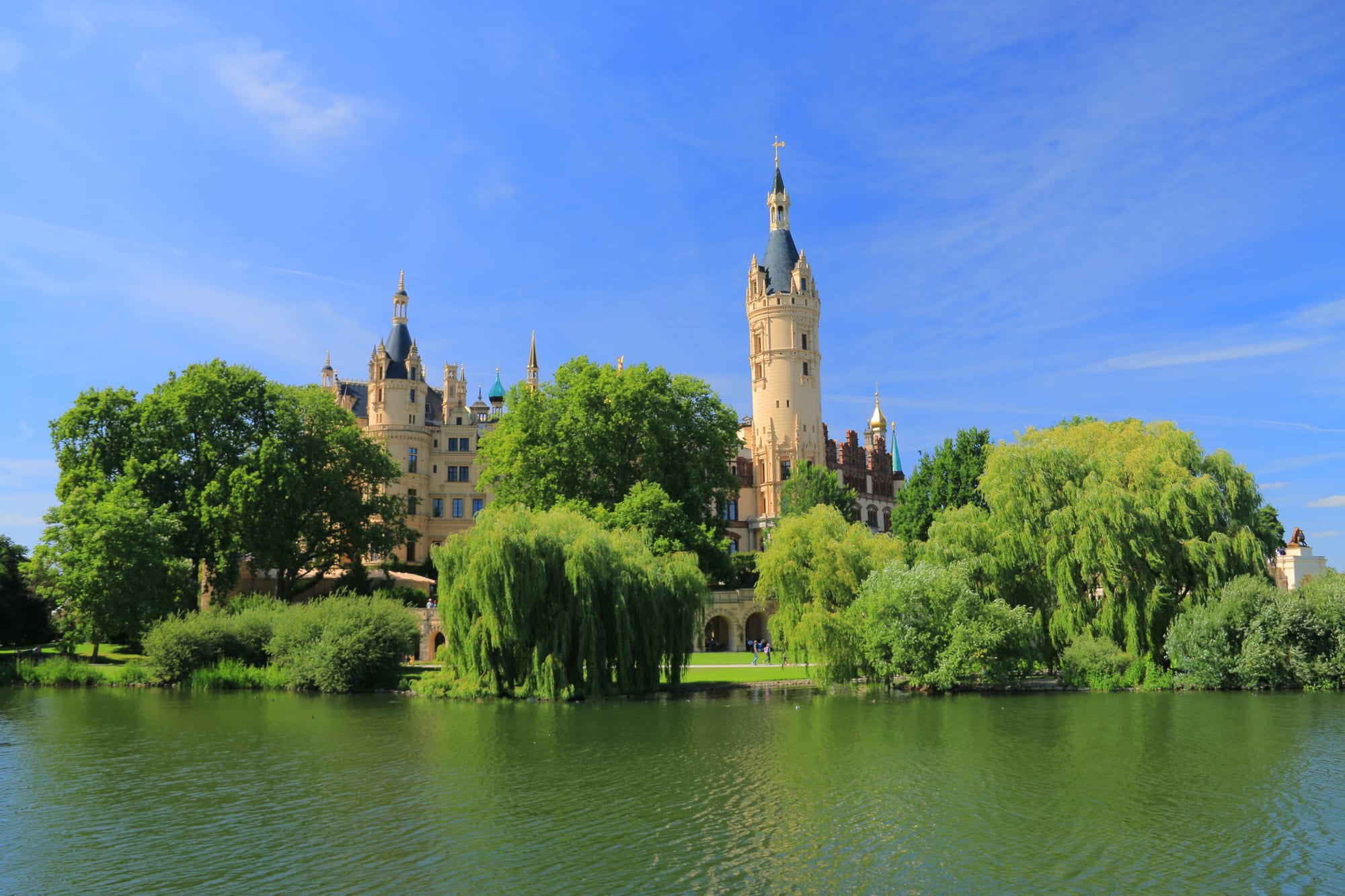
A pale palace with slender towers and domes rising above weeping willows and trees on the shore of a calm green lake

Mecklenburg-Vorpommern & the Baltic Coast, Germany

Schwerin

Schwerin Castle on its island, seen across the water from the lake side. (Benjamin Smith / Wikimedia Commons · CC BY-SA 4.0)

The capital of Mecklenburg-Vorpommern and the smallest state capital in Germany, set among a dozen lakes on the south-western shore of Lake Schwerin. For centuries the seat of the dukes of Mecklenburg, it is crowned by a many-towered 19th-century palace on its own island, now a World Heritage Site, and kept a largely intact old town through the war.

Neighbourhoods

  • Altstadt (Old Town)
    • First-time visitors
    • Historic district
    • Best for food

    The medieval core between the Pfaffenteich and the castle, little damaged in the war, with the Markt and town hall, the Brick Gothic cathedral and the shopping streets. The Alter Garten square, the theatre and the state gallery lie at its edge, facing the castle island.

    Open in Maps
  • Schelfstadt
    • Historic district
    • Quiet and residential

    The quarter north of the old town, built up on the duke's orders from 1705 around the Baroque Schelf Church. Its streets of old houses were saved from demolition in the late 1980s by a citizens' initiative and restored after 1991.

    Open in Maps
  • Paulsstadt and Feldstadt
    • Local life
    • Close to public transport

    The 19th-century extensions west and south of the centre, streets of tenement houses brought into the city's renewal programmes — the Feldstadt from 1991, the Paulsstadt from 2004.

    Open in Maps
  • Zippendorf
    • Lakeside
    • Families

    The old spa quarter on the lake south-east of the centre, with the zoo, which grew from a pet park opened in 1956, and lakeside walks. Steamers have sailed from here to the island of Kaninchenwerder since 1852.

    Open in Maps
  • Großer Dreesch
    • Local life

    The prefabricated housing district begun in 1971 in the south of the city, which became Schwerin's most populous quarter; its surroundings have been improved since 1993, though it lost many residents after reunification.

    Open in Maps

Things to do

Famous landmarks

  • Schwerin Castlelandmark

    The historicist palace built largely in 1845–57 on an island between Lake Schwerin and the Burgsee, seat of the state parliament since 1990, with a palace museum and a UNESCO World Heritage listing since 2024.

    Open in Maps
  • Castle gardenpark

    The formal gardens beside and behind the castle, part of the residence ensemble that surrounds the palace.

    Open in Maps
  • Schwerin Cathedrallandmark

    One of the earliest large Brick Gothic churches, consecrated in 1248, whose tower of 1889–93, 117.5 metres high, is the tallest church spire in the state.

    Open in Maps
  • Schelf Churchlandmark

    The Baroque church of St Nicholas in the Schelfstadt, rebuilt in 1713 after a storm destroyed its predecessor, and the burial place of the House of Mecklenburg-Schwerin.

    Open in Maps
  • Alter Gartenlandmark

    The square between the old town and the castle, framed by the 18th-century Altes Palais, the state gallery and the theatre of 1886, and the stage for open-air opera each summer.

    Open in Maps

Museums

  • Staatliches Museum Schwerinmuseum

    The state gallery opened in 1882 beside the theatre, known for its 17th-century Dutch paintings, the animal paintings of Jean-Baptiste Oudry and sculptures by Houdon.

    Open in Maps
  • Mecklenburg State Theatrelandmark

    The city's principal theatre, built in 1883–86 after its predecessor burned down, staging plays, opera, ballet and concerts by the Mecklenburgische Staatskapelle, as well as Low German drama.

    Open in Maps
  • Freilichtmuseum Schwerin-Mueßmuseum

    An open-air museum in the lakeside village of Mueß showing how the rural people of Mecklenburg lived from the 17th century onwards.

    Open in Maps

Lakes and parks

  • Pfaffenteichpark

    The lake in the city centre, first laid out as a mill pond in the Middle Ages, with the Arsenal on its shore and a small ferry, nicknamed the Pfaffenteichkreuzer, crossing it.

    Open in Maps
  • Lake Schwerinpark

    A lake of about 62 square kilometres and up to 52 metres deep, the second largest of the Mecklenburg lakes, crossed by the passenger boats of the Weiße Flotte.

    Open in Maps
  • Zoo Schwerinattraction

    The city zoo in Zippendorf, opened as a pet park in 1956 and a zoological garden since 1974.

    Open in Maps

Short trips from the city

  • Ludwigslust Palacelandmark

    The ducal residence south of Schwerin that served as the seat of government of Mecklenburg-Schwerin from 1765 to 1837, now also run by the state museum.

    Open in Maps
  • Wismarattraction

    The Hanseatic port north of Schwerin, whose old town shares a World Heritage listing with Stralsund's.

    Open in Maps

Seasonal events

  • Filmkunstfest Mecklenburg-VorpommernMay

    The state's film festival, held in the city since 1991.

  • Weiße Flotte fleet paradeMay

    A parade of the passenger boats of the Weiße Flotte on the lake.

  • SchlossfestspieleJune and July

    Open-air opera staged by the State Theatre on the Alter Garten, in front of the castle — the theatre's annual highlight.

  • Der Stern im NordenDecember

    The Christmas market that closes the city's year of events.

Eat and drink

Long-standing places and food districts in Schwerin. Hours, ratings and directions come from your maps app, always current.

Food districts

  • Old town and the Marktneighborhood

    Restaurants and cafés in the streets around the Markt and the cathedral, the busiest place to eat in the city.

    Open in Maps
  • Schelfstadtneighborhood

    Smaller cafés and restaurants among the restored houses of the Baroque quarter north of the old town.

    Open in Maps
  • Pfaffenteichneighborhood

    Cafés and restaurants around the city-centre lake, with views of the water.

    Open in Maps

Experience Schwerin

History

A Slavic Obotrite settlement stood among the lakes here by the 11th century, and the place was first recorded in 1018 as Zuarina. Henry the Lion defeated the Obotrites and captured it in 1160, granting town rights that make Schwerin the oldest city in Mecklenburg-Vorpommern, and the bishopric he founded built a cathedral consecrated in 1248. A castle on the island grew into a ducal palace; from 1358 Schwerin belonged to the Duchy of Mecklenburg, and after the division of 1621 it was the capital of Mecklenburg-Schwerin, apart from the years 1765–1837 when the court sat at Ludwigslust.

The grand dukes rebuilt the castle in 1845–57 in the Romantic historicist style, with the architects Gottfried Semper, Friedrich August Stüler, Georg Adolf Demmler and Ernst Friedrich Zwirner, and the state gallery (1882) and the theatre (1886) followed on the Alter Garten. Many people emigrated in the mid-19th century, a large number to Milwaukee, now a sister city. The grand duke abdicated in 1918, and from 1919 to 1933 the theatre served as the first parliament of the Free State of Mecklenburg-Schwerin.

Bombs destroyed only about three per cent of the city in the Second World War; the worst raid, on 7 April 1945, killed 224 people. American troops took Schwerin on 2 May 1945, then handed it to the British and on 1 July to the Soviets. In East Germany it was a district capital, and industry and the Großer Dreesch estate from the 1970s took its population past 100,000. After reunification it was chosen over Rostock as the capital of the restored state, and in 2024 the castle and its residence ensemble were added to the World Heritage List.

Culture & Customs

Schwerin's culture is a court culture that outlived its court. The Mecklenburg State Theatre, built in 1883–86, stages plays, opera, operetta, ballet and Low German drama, with concerts by its orchestra, the Mecklenburgische Staatskapelle. Its annual high point is the Schlossfestspiele, open-air opera on the Alter Garten in June and July with the castle as a backdrop. The state gallery's Dutch paintings, its collection of Oudry's animal pictures and the castle's museum rooms reflect the tastes of the grand dukes.

The calendar fills up from May, with the Filmkunstfest Mecklenburg-Vorpommern, held since 1991, the parade of the lake's passenger fleet and a night run, followed by a potters' market, a dragon-boat festival and an old-town festival; the Christmas market, Der Stern im Norden, ends the year. The castle has its own legend: it is said to be haunted by Petermännchen, a small, impious ghost.

Residents like to call Schwerin the city of seven lakes and forests. In sport it is known as a boxing town, thanks to the trainer Fritz Sdunek, and above all for the women's volleyball team of Schweriner SC, many times German champions. Like most of eastern Germany, the city is largely secular, though the cathedral and the Schelf Church are still in use.

Daily Life

The 2022 census counted about 96,000 people, making Schwerin the smallest state capital in Germany; by the end of 2025 the city reported just under 100,000 and growing. It had passed 100,000 in 1972 but lost some 34,000 residents by 2005 through unemployment, falling birth rates and moves to the surrounding villages, where new housing added about 20,000 people. The prefabricated estates of the Großer Dreesch, Neu Zippendorf and Mueßer Holz lost the most.

As the state capital, Schwerin lives largely on government: ministries, courts and the parliament in the castle. Healthcare is a major employer, with the Helios hospitals employing more than 2,000 people, alongside machine building, high technology, railway supply, consumer goods and tourism. Higher education is represented by two colleges of applied sciences.

Life moves at a measured pace. The trams, running since 1908, carry people from the southern estates to the centre, and the city sits on the eastern edge of the Hamburg metropolitan region, an hour from Hamburg by train. Sebastian Ehlers of the CDU, elected in April 2026, took office as mayor in July 2026.

Food

Schwerin eats the food of Mecklenburg, a cuisine long considered down-to-earth and hearty, shaped by farming, a long coastline, many lakes and large forests full of game. Potatoes, called Tüften locally, are the staple, along with kale, Grünkohl, and a sweet-and-sour streak that comes from cooking with dried fruit. The signature dish is Mecklenburger Rippenbraten, roast ribs; Tüffel un Plum is a potato soup with plums and bacon, and Kloppschinken and Topfleberwurst are other farmhouse classics.

The lakes and the coast supply fish: smoked eel, fried or baked, and fried Maischolle, plaice. Desserts include Rote Grütze, a red-berry pudding, Schwarzbrotpudding made with black bread, Mecklenburgische Götterspeise and Sanddorntorte, a cake made with sea buckthorn.

To drink there is grog in winter, sea buckthorn juice, wine and spirits, and the beers of Mecklenburg's breweries, such as Lübzer from the Mecklenburgische Brauerei Lübz and Darguner from the Darguner brewery. The best places to eat in Schwerin are the streets of the old town around the Markt and cathedral, the Schelfstadt and the shores of the Pfaffenteich.

Planning tools

Budget

Schwerin is cheaper than Hamburg or the Baltic resorts, and rooms are easier to find than on the coast in summer. Prices rise around the Schlossfestspiele and Advent. Museum and castle tickets are the main sightseeing costs; the lakeside walks and gardens are free.

Daily Budget Midrange
USD 130–230 (mid-range hotel, restaurant dinners, castle and gallery tickets, a lake boat trip)
Daily Budget Shoestring
USD 60–100 (hostel or budget hotel, bakery and Imbiss food, trams and buses)

Schwerin is an easy day trip from Hamburg, about an hour away by train.

Best Time to Visit

May to September, when the lake boats run, the gardens are at their best and the open-air opera plays in June and July. May brings the film festival and the boat parade. December has the Christmas market; the rest of the winter is quiet, cold and grey.

Suggested Number of Days

One or two days are enough for the city itself. Allow three or four to add the lake by boat and the other ducal residences and Hanseatic towns within reach; the train makes day trips easy without a car.

First Visit
1–2 days
With Surroundings
3–4 days

Transportation

Nahverkehr Schwerin runs four tram lines, in service since 1908, and 14 city bus lines, plus the little ferry across the Pfaffenteich. Trams reach Zippendorf, the zoo and the southern districts. Passenger boats of the Weiße Flotte cross Lake Schwerin in season.

Buy and validate tickets before riding: in Schwerin, travelling without a ticket is counted as a crime in the city's statistics.

Airport & Station Connections

Schwerin Hauptbahnhof has rail links to Hamburg, about an hour away, Berlin and Rostock. The nearest major airport is Hamburg, 116 kilometres to the west; a small regional airport at Parchim lies south-east of the city.

Walkability

The centre is compact and pleasant on foot: the station, the Pfaffenteich, the old town, the Alter Garten and the castle island lie in a line within easy walking distance, and paths run along the lakeshores. Zippendorf, the zoo and the open-air museum are better reached by tram or bus.

Safety

Germany is a safe country with low levels of violent crime. Schwerin once topped national crime-rate tables, but largely because fare dodging on buses and trams and benefit fraud were counted there; for visitors the city is quiet, and ordinary care with bags in crowds at festivals is enough.

Keep bags secure in crowds, validate transit tickets, and stay out of marked cycle lanes on foot. Check current official travel advice before travelling.

Climate

An oceanic climate moderated by the nearby Baltic, though the city has recorded 38.4°C in July 2022 and, long ago, -27°C in 1912. Rain falls through the year.

Summer
mild — summer averages around 18°C
Winter
cold and grey — winter averages around 1°C

Local Customs

Tips are usual in restaurants, bars and taxis but rarely exceed 10 per cent; many people round up, stating the total when paying. Most shops close on Sundays. Bottles and cans carry a deposit (Pfand). The churches remain places of worship.

Keep out of cycle lanes on foot, dress respectfully and keep quiet in churches during services.

Common Payment Methods

The currency is the euro. Cards are accepted in hotels, larger shops and many restaurants, but Germany is still fond of cash, and some bakeries, bars and small shops may refuse cards, so carry some euros. ATMs are easy to find in the centre and at the station.