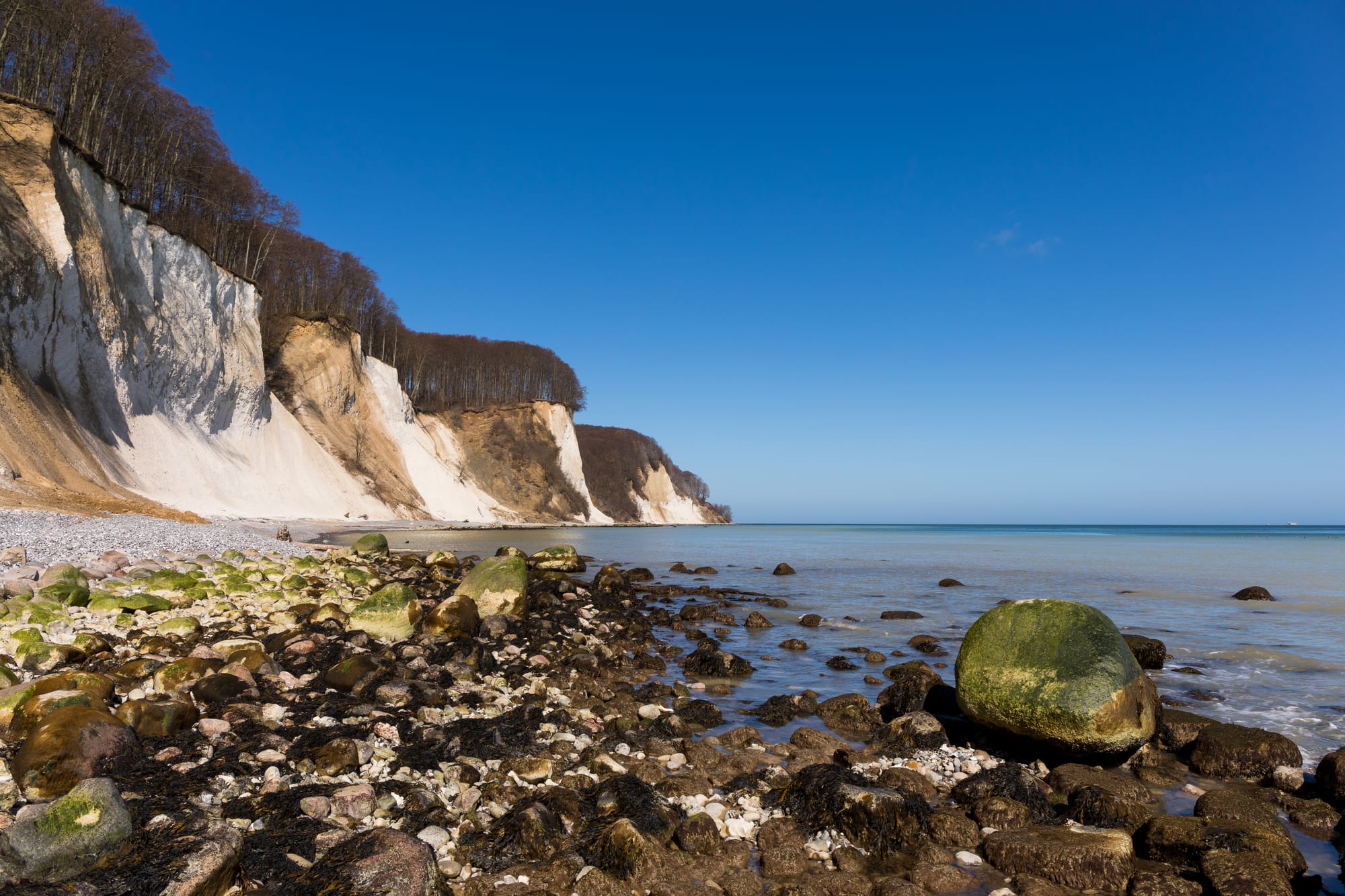
White chalk cliffs topped with bare beech forest above a stony beach with mossy boulders and a calm blue sea

Germany

Mecklenburg-Vorpommern & the Baltic Coast

The chalk cliffs of Jasmund National Park on the east coast of Rügen, Germany's largest island. (Ansgar Koreng / Wikimedia Commons · CC BY-SA 4.0)

Germany's north-eastern corner and its most thinly settled state, with nearly 2,000 kilometres of Baltic shore counting its lagoons and islands — the Hanseatic brick towns of Wismar, Rostock and Stralsund, the chalk cliffs of Rügen and the white resort villas of Usedom on the coast, and behind them a quiet country of manor houses, rapeseed fields and more than a thousand lakes.

Explore Mecklenburg-Vorpommern & the Baltic Coast

History

Slavs settled this coast after the Germanic tribes moved away: the Obotrites in the west, the Lutici further east and the Rani on Rügen, whose temple at Cape Arkona fell to the Danes in 1168. Henry the Lion's Saxons killed the Obotrite prince Niklot in 1160, but his son Pribislav took the land back as a fief in 1167, and the dynasty he founded ruled Mecklenburg until 1918. German settlers, monks and merchants followed; Wismar, Rostock, Stralsund and Greifswald joined the Hanseatic League, which dictated the Peace of Stralsund to Denmark in 1370, and Rostock's university, founded in 1419, is the oldest on the Baltic.

The Thirty Years' War ended that prosperity. Wallenstein failed to take Stralsund in 1628, Gustavus Adolphus landed on Usedom in 1630, and from 1648 Sweden held Wismar, Stralsund, Greifswald and Rügen — western Pomerania until 1815, Wismar formally until 1903. Mecklenburg, split in 1701 into the duchies of Schwerin and Strelitz, remained a land of great estates where serfdom lasted until 1820 and a constitution of 1755 stayed in force until 1918, and many of its people were driven to emigrate. The coast found a new trade when the duke founded Germany's first seaside resort at Heiligendamm in 1793.

The Nazis built the 4.5-kilometre holiday block of Prora on Rügen and the rocket station at Peenemünde, where the V-2 first flew in October 1942. In 1945 the Soviets joined Mecklenburg to the strip of Pomerania left west of the new Polish border. East Germany dissolved the state in 1952, collectivised the estates, built Rostock into its ocean port and made the coast the trade unions' holiday shore. The state was restored in 1990; racist riots at Rostock-Lichtenhagen in 1992 shocked the country, and the Nord Stream gas pipelines, landed at Lubmin, were blown up in 2022.

Culture & Customs

Mecklenburgers have a national reputation for being slow to speak and slower to change, and the dry understatement is cultivated with some pride. Low German, Plattdeutsch, is still heard in the villages and was made a literary language by Fritz Reuter, born at Stavenhagen in 1810. Pomeranians east of the Recknitz and Trebel rivers keep a separate identity, with a griffin on their arms. The great brick churches have been Lutheran since the Reformation, but four decades of East German rule left about four in five people with no religion at all.

Seaside culture is the region's own invention. Heiligendamm set the fashion, the resorts that followed built the white, veranda-fronted villas of Bäderarchitektur and the long piers of Sellin, Ahlbeck and Heringsdorf, and a Rostock basket-maker, Wilhelm Bartelmann, wove the first Strandkorb, the hooded wicker beach chair, in 1882. Nude bathing, FKK, was a small freedom under East Germany and keeps its marked stretches of beach. Inland, the landscape is one of manor houses — some two thousand survive, many now hotels — and on the Darß of thatched fishing villages with carved and painted front doors.

Painters found the coast early: Caspar David Friedrich, born in Greifswald in 1774, painted Rügen's chalk cliffs and the ruins of Eldena, the sculptor Ernst Barlach worked in Güstrow from 1910, and artists' colonies grew up at Ahrenshoop and on Hiddensee, where Gerhart Hauptmann spent his summers. The calendar runs from the Hanse Sail, which brings some 250 traditional ships to Rostock each August, to the Störtebeker pirate plays at Ralswiek on Rügen, the concerts of the Festspiele Mecklenburg-Vorpommern in barns and manor houses, and the Tonnenabschlagen of the Darß villages, in which riders club a hanging barrel to pieces. Football loyalty belongs to Hansa Rostock, East Germany's last champion.

Daily Life

About 1.6 million people live here, at some 70 to the square kilometre the lowest density of any German state. Rostock, with around 210,000, is the only large city; Schwerin, the capital, has just under 100,000 and is the smallest state capital in Germany; Neubrandenburg, Stralsund and Greifswald each have about 60,000 and Wismar some 43,000. The population has fallen since 1990 as the young went west for work, leaving Vorpommern's villages among the oldest and poorest in the country, though Rostock, Greifswald and the coast are growing again.

Tourism is a mainstay: the state is Germany's top destination for domestic holidays, with some 28 million overnight stays a year, most of them by Germans. Farming is done on a vast scale, the East German collectives having passed to companies that grow rapeseed, wheat and sugar beet across fields of a hundred hectares. The shipyards of Wismar, Rostock and Stralsund went through their latest insolvency in 2022. Rostock's port handles ferries to Denmark and Sweden and the cruise ships at Warnemünde, the universities of Rostock and Greifswald keep both towns young, and Greifswald's Wendelstein 7-X fusion experiment is the region's scientific flagship.

The year has two speeds. From May to September the coast works seven days a week; in winter many island cafés and guesthouses close, and whole streets of holiday flats stand dark. That is the sharpest local grievance: second homes have pushed prices in Binz, Ahrenshoop and Heringsdorf beyond local wages, which are among the lowest in Germany. A liquefied-gas terminal at Mukran on Rügen was built against strong local protest, and the far-right AfD has become one of the strongest parties in the state.

Food

The coast eats fish, and eats it simply. Harbour kiosks and moored cutters sell Fischbrötchen — rolls of Matjes, fried herring or smoked fish — and the smokehouses of the fishing harbours hang eel, sprats, flounder and halibut over beech and alder. Bismarck herring, pickled in vinegar with onion and mustard seed, is said to have been named, with the chancellor's permission, by a Stralsund fishmonger in 1871. Spring brings the herring weeks and, in May, Hornfisch, the green-boned garfish fried in butter; the lakes supply zander, pike, eel and the small, delicate Maräne, a whitefish of the larger lakes.

Inland cooking is farmhouse food with a sweet-and-sour streak. Mecklenburger Rippenbraten is a pork rib roast stuffed with apples and prunes; Tüften un Plum is a soup of potatoes — Tüften in Low German — and dried plums with smoked bacon; Kloppschinken is pounded ham, breaded and fried; and Wruken, swedes, are stewed with goose giblets. Pomerania contributes its famous geese, and autumn brings venison and wild boar from the big forests, goose at Martinmas and carp at New Year.

The coast's own flavour is Sanddorn, sea buckthorn, whose sharp orange berries from the dunes of Rügen and Hiddensee are made into juice, jam, liqueur and ice cream. Rote Grütze, a red-berry pudding with vanilla sauce, is the usual dessert, and the Rügener Badejunge is a small camembert made on the island. Beer is pale and northern — Rostocker, Lübzer and the many styles of Stralsund's Störtebeker brewery — and the spirits are Korn and caraway Kümmel, with a hot grog or a Sanddorn punch when the winter wind is off the sea.

Attractions & Natural Wonders

Rügen, Germany's largest island, is the headline. In Jasmund National Park the chalk cliffs run for kilometres north of Sassnitz, followed by a clifftop path through UNESCO-listed beech forest to the Königsstuhl, 118 metres above the sea, where a suspended walkway opened in 2023. Cape Arkona has two lighthouses and the ramparts of the Slavic temple fort; Binz and Sellin have the white villas and the pier; the Rasender Roland steam train links the resorts to Putbus; and Prora's Nazi-era block stretches behind its beach. Car-free Hiddensee lies to the west. Stralsund, the gateway, keeps a UNESCO-listed old town of brick Gothic around its town hall and the Nikolaikirche, with the Ozeaneum aquarium on the harbour.

East of Stralsund lie Greifswald, with the ruined abbey of Eldena, and Usedom, where the imperial spas of Ahlbeck, Heringsdorf and Bansin share a promenade that continues into Poland and the Peenemünde museum occupies the rocket station's power plant. To the west, the Fischland-Darß-Zingst peninsula forms the Western Pomerania Lagoon Area National Park, with the wild Weststrand and tens of thousands of cranes each autumn. Rostock has the astronomical clock of 1472 in the Marienkirche; its seaside quarter of Warnemünde has fishing boats along the Alter Strom, a lighthouse of 1897 and a very broad beach. Beyond are Bad Doberan's Cistercian minster, the Molli steam train to Heiligendamm, and Wismar, whose market square shares Stralsund's World Heritage listing.

Inland, Schwerin castle stands on an island between lake and gardens, rebuilt in 1845–57 on the model of the Loire châteaux, now the seat of the state parliament and the centre of a World Heritage Site listed in 2024. The Mecklenburg lakes fill the country to the east: more than a thousand, linked by rivers and canals navigable by canoe or licence-free houseboat, around the Müritz, at 117 square kilometres the largest lake wholly inside Germany. Müritz National Park, entered from Waren, shelters ospreys, white-tailed eagles and cranes, and Neubrandenburg keeps its ring of medieval walls and four brick gates.

Cities in Mecklenburg-Vorpommern & the Baltic Coast

Planning basics

Budget

There are two price zones. The coast in July and August — Binz and Sellin on Rügen, Heringsdorf on Usedom, Kühlungsborn, Warnemünde — is as dear as anywhere in Germany, often with minimum stays of several nights and a daily spa tax (Kurtaxe) of a few euros on top. Inland Mecklenburg, the lake district and the Hanseatic towns are cheaper than western Germany, and from October to April coastal room prices fall steeply.

Daily Budget Midrange
USD 140–260 (guesthouse or resort hotel, fish restaurants, museum and national-park tickets, a hire car or boat for a day)
Daily Budget Shoestring
USD 65–100 (hostel or campsite, fish rolls and bakery food, regional trains and a hired bicycle)

Book summer beds on Rügen and Usedom months ahead, or stay in Stralsund, Greifswald or Rostock and reach the beaches by train.

Safety

One of the safest corners of Germany, with little crime even in Rostock. The hazards are natural. The Baltic has almost no tide, but offshore winds carry air mattresses out to sea and currents run hard beside groynes and piers, so the lifeguards' flags matter. Rügen's chalk cliffs break away without warning, mostly after rain and frost, and people have died beneath them. On Usedom's northern beaches lumps of wartime phosphorus wash up looking like amber and can ignite as they dry. Ticks are common in the woods, and in hot summers blue-green algae close some lake and lagoon beaches to bathers.

Keep back from cliff edges and do not linger beneath the cliffs, carry beach finds in a tin rather than a pocket, swim at guarded beaches and check for ticks after forest walks. Check current official travel advice before travelling.

Climate

A Baltic climate: cooler summers and later springs than inland Germany, a steady wind, and less rain than the North Sea coast, and Usedom is regularly the sunniest place in the country. The sea reaches 17–20°C in July and August; in a hard winter the shallow lagoons and the lakes freeze over, and an easterly wind makes a few degrees of frost feel much colder.

Summer
mild and bright, 18–25°C, with a sea breeze, long evenings and the occasional hot spell near 30°C
Winter
cold, grey and raw, -2 to 4°C, with some snow, sea fog and ice on the lagoons and lakes in hard years

Transportation

The region has no airport of any size, so most visitors arrive by train or car from Berlin or Hamburg: Schwerin is about an hour from Hamburg, Rostock about two hours from Berlin and Stralsund about three, and long-distance trains run through to Binz on Rügen. The A20 motorway follows the coast and the A19 links Rostock to Berlin. Rügen is joined to Stralsund by a bridge and a causeway, and Usedom by bridges and its own railway, which continues to Świnoujście in Poland; car-free Hiddensee is reached only by boat. Ferries leave Rostock for Gedser in Denmark and Trelleborg in Sweden. The lake district is best covered by bicycle, canoe or hired houseboat.

Avoid driving onto Rügen or Usedom on a summer Saturday, the weekly changeover day, when the approach roads jam for hours; the steam trains Rasender Roland on Rügen and Molli at Bad Doberan run daily and double as local transport.

Best Time to Visit

May to September. May turns the fields yellow with rapeseed, June has daylight until ten and the emptiest beaches, and July and August are the school-holiday peak, when the resorts are full and the Störtebeker open-air theatre plays on Rügen; the Hanse Sail fills Rostock's harbour on the second weekend of August. Mid-September to late October is the crane season on the Darß-Zingst lagoons and the Müritz. From November to March many island businesses close, though the spa hotels and the Advent markets of Rostock, Schwerin and Stralsund stay busy.