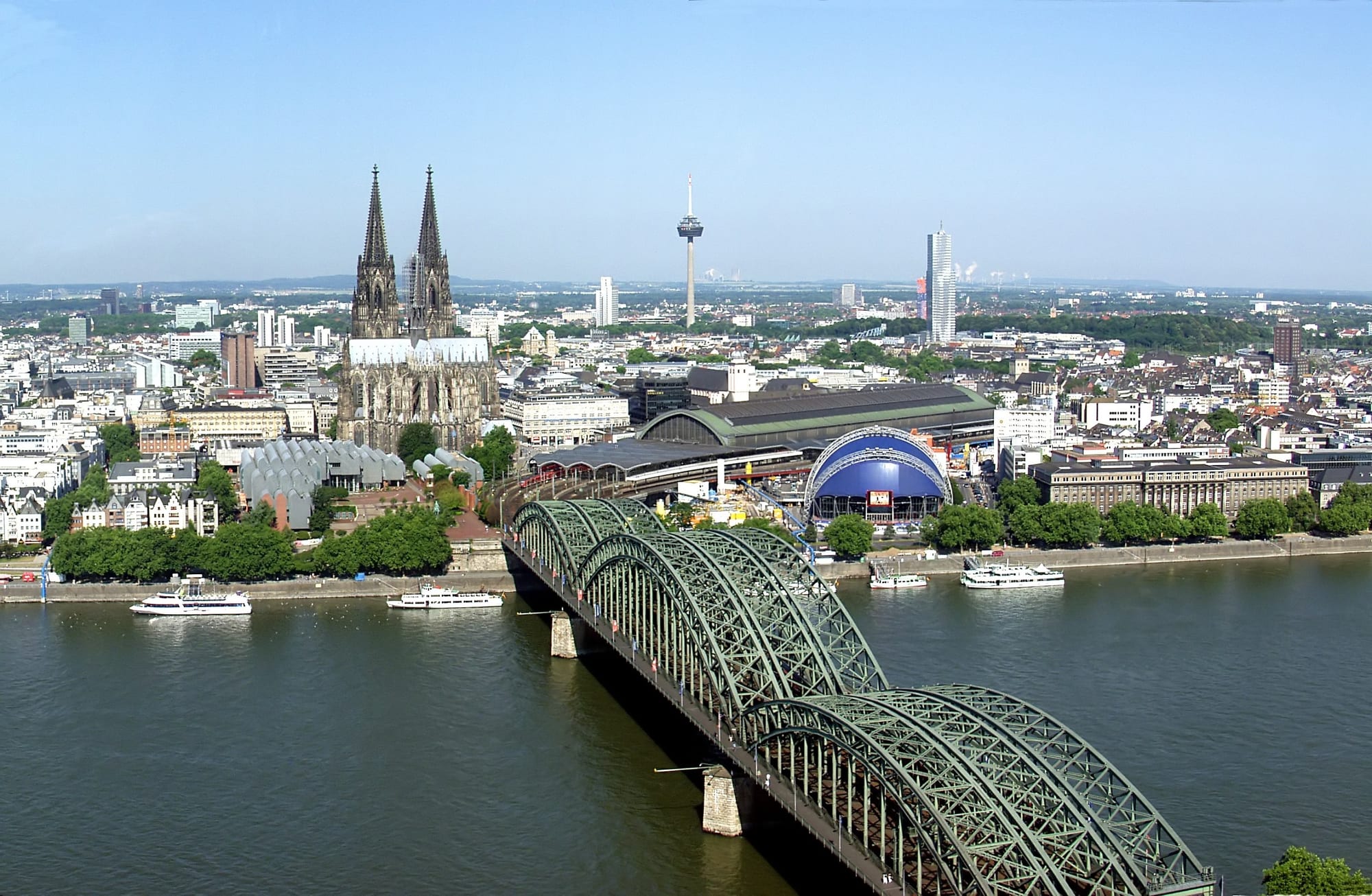
The green steel arches of a railway bridge crossing a wide river towards a twin-spired Gothic cathedral and a city skyline

Germany

North Rhine-Westphalia

Cologne from across the Rhine, with the Hohenzollern Bridge leading to the cathedral and the main station. (Raimond Spekking / Wikimedia Commons · CC BY-SA 4.0)

Germany's most populous state, with some 18 million people between the Dutch and Belgian borders and the River Weser — the Rhine cities of Cologne, Düsseldorf and Bonn, the former coal-and-steel conurbation of the Ruhr, Charlemagne's Aachen and the cathedral city of Münster, framed by the flat Münsterland and the wooded hills of the Eifel, the Sauerland and the Teutoburg Forest.

Explore North Rhine-Westphalia

History

The Rhine was Rome's frontier, and the region's oldest cities began as its garrisons: Cologne, raised to a colony in AD 50 and capital of Lower Germany, Bonn, Neuss and Xanten. Around 800 Charlemagne made Aachen the chief residence of his empire; he was buried in his palace chapel in 814, and German kings were crowned there from 936 to 1531. Medieval Cologne, one of the largest cities north of the Alps, grew rich on Rhine trade and on pilgrims to the relics of the Three Kings, began its cathedral in 1248 and defeated its archbishop at Worringen in 1288; he and his successors ruled from Bonn and Brühl instead. Westphalia was a country of prince-bishops and Hanseatic towns — Dortmund, Soest, Münster — where Anabaptists proclaimed a short-lived kingdom in 1534 and where the peace that ended the Thirty Years' War was negotiated in 1648.

French armies held the left bank from 1794 to 1814, and the Congress of Vienna then gave the Catholic Rhineland and Westphalia to Protestant Prussia, an uneasy match. Deep-shaft mining in the 19th century turned the farm villages between the Ruhr and the Lippe into Europe's largest industrial district — Krupp in Essen, Thyssen in Duisburg — its population swollen by hundreds of thousands of Polish-speaking migrants from Prussia's east. The French and Belgians occupied the Ruhr in 1923, and as Hitler's armoury it was bombed relentlessly; the first thousand-bomber raid hit Cologne in May 1942, and Aachen, in October 1944, was the first German city to fall.

The British created the state in 1946 by joining the northern Rhineland to Westphalia, adding Lippe in 1947, with Düsseldorf as capital. Bonn was West Germany's seat of government from 1949 until the move to Berlin in 1999. Ruhr coal and steel powered the economic miracle and drew "guest workers" from Italy and Turkey, but pits began closing in 1958; the last, Prosper-Haniel in Bottrop, shut in December 2018. The region has spent sixty years reinventing itself through universities, services and its own industrial heritage.

Culture & Customs

North Rhine-Westphalia is a marriage of convenience, and its halves still tease each other. Rhinelanders are held to be sociable, talkative, Catholic and relaxed about rules — Cologne sums up its outlook in dialect mottoes such as "Et kütt wie et kütt", it comes as it comes — while Westphalians are cast as reserved, stubborn and loyal. The Ruhr belongs to both and neither. Its identity was made underground: the word for a mate is Kumpel, a miner; the greeting "Glück auf" has outlived the pits; speech is blunt, the corner kiosk or Trinkhalle is the neighbourhood's living room, racing pigeons were the miner's racehorses, and football is a creed. The Revierderby between Borussia Dortmund and Schalke 04 of Gelsenkirchen is Germany's fiercest, and Dortmund's south stand holds 25,000 standing fans.

Carnival is the Rhineland's "fifth season". It opens on 11 November at 11.11 and peaks in the week before Lent, from Weiberfastnacht, the Thursday when women cut off men's ties, to the Rose Monday parades of Cologne and Düsseldorf, where floats lampoon politicians and tonnes of sweets are thrown to crowds in costume. The two cities, forty kilometres apart, cultivate a rivalry that extends to the carnival cry — "Alaaf" in Cologne, "Helau" in Düsseldorf — and the beer. Westphalia largely ignores carnival and holds Schützenfeste, marksmen's fairs with parades and brass bands, in summer; on 11 November children across the state walk with lanterns behind a mounted St Martin.

Düsseldorf's art academy trained Joseph Beuys, Gerhard Richter and the photographers around Bernd and Hilla Becher, and the city gave pop music Kraftwerk; Cologne had Stockhausen's electronic studio and the novelist Heinrich Böll, Bonn Beethoven, Wuppertal Pina Bausch's dance theatre. Düsseldorf has Germany's only Japantown, Cologne one of Europe's biggest Pride parades and a central mosque inaugurated in 2018, and a large share of the state's people have a migrant background.

Daily Life

About 18 million people live here — roughly as many as in the neighbouring Netherlands, on less land — most of them in the Rhine-Ruhr belt, a chain of cities that run into one another for a hundred kilometres. Cologne has just over a million people, Düsseldorf about 630,000, Dortmund and Essen nearly 600,000 each, Duisburg 500,000, and Bochum, Wuppertal, Bielefeld, Bonn and Münster more than 300,000 each. The Ruhr alone counts five million people with no single centre. Outside the belt, the Münsterland, the Lower Rhine, the Sauerland, the Eifel and East Westphalia are farm and forest country with small, prosperous industrial towns.

The state produces about a fifth of Germany's output, and its company names are household ones: Bayer in Leverkusen, Henkel and Rheinmetall in Düsseldorf, Thyssenkrupp, RWE and E.ON in Essen, Deutsche Telekom and DHL in Bonn, Ford in Cologne, Bertelsmann and Miele in Gütersloh, Dr. Oetker in Bielefeld. Cologne is Germany's television capital, Düsseldorf a city of fashion, advertising and trade fairs, and Duisburg, the largest inland port in Europe, is a hub for rail freight. With some 770,000 students — at Aachen's technical university, Cologne, Münster, Bonn, Bochum and dozens more — it is one of Europe's densest university regions.

Life in the cities turns on the neighbourhood: the kiosk, the corner pub where a Cologne waiter, the Köbes, replaces each empty glass unasked until a beer mat is laid on top, football on Saturday, the allotment and a Sunday cycle ride along a canal or a converted colliery railway. The contrasts are sharp. Düsseldorf, Münster and Bonn are prosperous, while Gelsenkirchen, with high unemployment, is often called Germany's poorest city, and the A40 motorway through the Ruhr is nicknamed its social equator. Steel and car jobs are still being cut, lignite mining west of Cologne is due to end in 2030, and worn-out bridges and late trains are an everyday complaint.

Food

Rhenish cooking likes sweet with sour. Rheinischer Sauerbraten is beef — once horse — marinated for days in vinegar and spices and served in a raisin-sweetened gravy with potato dumplings and apple sauce; Himmel un Ääd, "heaven and earth", pairs mashed potato and apple with fried black pudding; and Reibekuchen, potato fritters, are eaten at markets with apple sauce or on black bread with sugar-beet syrup. Cologne's brewhouse menu has its own jokes: a Halver Hahn is not half a chicken but a rye roll with aged Gouda and mustard, and Kölscher Kaviar is black pudding with onions. Mussels cooked Rhenish style, with white wine and vegetables, are a Rhenish speciality, and Aachen's Printen are hard gingerbread sweetened with beet syrup.

Westphalia's staples are darker and heavier: bone-in Westphalian ham, dry-cured and smoked over beech; Pumpernickel, rye bread steamed for up to twenty-four hours until almost black; Pfefferpotthast, a peppery beef-and-onion stew from Dortmund; Töttchen, a Münsterland veal ragout; and Pickert, Lippe's potato-and-raisin pancake. The Bergisches Land lays a coffee table of waffles with hot cherries, rice pudding, raisin bread and quark around a pewter urn. The Ruhr's dish is Currywurst with chips "rot-weiss", under ketchup and mayonnaise, from the Pommesbude, with the Turkish grills of Duisburg-Marxloh and Cologne's Keupstraße close behind.

Beer divides the state. Kölsch — pale, top-fermented and legally brewed only in and around Cologne — comes in 0.2-litre glasses called Stangen, carried in a circular tray; Düsseldorf's Altbier is copper-brown, also top-fermented and drawn from wooden casks in the Altstadt brewpubs of Uerige, Füchschen, Schumacher and Schlüssel. Dortmund has more than five centuries of brewing behind it, and the Sauerland and Siegerland supply the national pilsners Warsteiner, Veltins and Krombacher. Juniper Steinhäger and Düsseldorf's herbal Killepitsch are the local spirits, the state's vineyards cling to the Siebengebirge near Bonn, and Haribo's gummy bears were invented in Bonn in 1922.

Attractions & Natural Wonders

Cologne Cathedral, begun in 1248 and completed only in 1880, raises twin spires 157 metres above the station; inside are the golden Shrine of the Three Kings and a stained-glass window of 2007 by Gerhard Richter, and 533 steps climb the south tower. The city also has twelve Romanesque churches, the modern art of Museum Ludwig, the Hohenzollern Bridge and the brewhouses of the old town. South of it lie the rococo palaces of Augustusburg and Falkenlust at Brühl and then Bonn, with Beethoven's birthplace, the Haus der Geschichte on post-war Germany and, across the river, the rack railway up the Drachenfels in the Siebengebirge. Düsseldorf, downstream, offers the Altstadt and Rhine promenade, the K20 and K21 art collections, the Königsallee and Frank Gehry's buildings in the MedienHafen.

Aachen Cathedral, Germany's first World Heritage Site, encloses Charlemagne's octagonal chapel of about 800, his throne and his golden shrine; the Eifel National Park and the slate-roofed town of Monschau lie to the south. The industrial heritage of the Ruhr is linked by a signposted route: the Zollverein colliery in Essen, a UNESCO site with the Ruhr Museum in its coal washery; the Landschaftspark Duisburg-Nord, an ironworks turned public park and lit in colour at night; the Gasometer at Oberhausen, now an exhibition hall 117 metres high; the German Mining Museum in Bochum; and the Krupp family's Villa Hügel. Wuppertal's suspension railway has hung above the River Wupper since 1901.

Münster's Prinzipalmarkt, a curve of arcaded gabled houses rebuilt after 1945, leads to the town hall's Hall of Peace and to St Lambert's church, where the cages that displayed the Anabaptist leaders' bodies still hang; the moated castles of the Münsterland, among them Nordkirchen and Vischering, lie on a cycling route around it. Further afield are Roman Xanten with its archaeological park, the Hermann Monument and the Externsteine rocks in the Teutoburg Forest, the Carolingian abbey of Corvey on the Weser, and the Sauerland's lakes, caves and ski slopes around Winterberg.

Cities in North Rhine-Westphalia

Planning basics

Budget

Prices sit around the German average, with wide swings. Düsseldorf and Cologne are the dearest cities, and their hotel rates multiply during the big trade fairs and at carnival; the Ruhr cities are markedly cheaper and many of their industrial monuments, including the Landschaftspark in Duisburg and the Zollverein grounds, are free to enter. Münster and Bonn fall in between, and the Sauerland, the Eifel and the Lower Rhine are inexpensive country.

Daily Budget Midrange
USD 140–260 (mid-range hotel, brewhouse and restaurant dinners, museum tickets, an occasional ICE journey)
Daily Budget Shoestring
USD 65–110 (hostel or budget hotel, Imbiss and brewhouse snacks, regional trains on a day or monthly ticket)

Check the Düsseldorf and Cologne trade-fair calendars before booking; during a major fair, a room in Duisburg, Essen or Bonn, 15 to 30 minutes away by train, can cost half as much.

Safety

The state is safe, with the usual big-city cautions: pickpockets work the crowds around Cologne Cathedral and the main stations, Düsseldorf's Altstadt is rowdy on weekend nights, and the areas around Cologne's Neumarkt and Dortmund's Nordstadt have open drug scenes. Carnival brings dense crowds, heavy drinking, glass bans in the party districts and more theft. Derby matches fill trains with rival football supporters under police escort. The Rhine is the underestimated danger: its currents and the wash of barges drown swimmers every summer.

Keep phones and wallets in front pockets at carnival and in station crowds, avoid trains full of away fans on derby days, and never swim in the Rhine. Check current official travel advice before travelling.

Climate

Atlantic air makes the Rhine lowlands around Cologne and Düsseldorf one of the mildest parts of Germany in winter, when snow seldom lies, and often sultry in summer. Rain falls all year, most heavily on the west-facing slopes of the Bergisches Land and the Sauerland, and the high Sauerland around Winterberg and the Eifel plateau are several degrees cooler, with snow in most winters.

Summer
warm and often humid, 20–27°C in the Rhine cities with hot spells above 33°C; cooler in the hills
Winter
mild, grey and damp, 1–6°C in the lowlands with little snow; -3 to 2°C with snow cover in the high Sauerland and Eifel

Transportation

Düsseldorf and Cologne Bonn are the main airports, with smaller ones at Dortmund, Münster/Osnabrück and Weeze, and Frankfurt Airport is about an hour from Cologne by high-speed train. Cologne is also a hub for trains to Brussels, Paris and Amsterdam. Within the state the regional expresses and S-Bahn work like a metro: Cologne to Düsseldorf or Bonn takes 25 to 30 minutes, Düsseldorf to Essen and Essen to Dortmund about the same, and Münster is a short ride beyond Dortmund. The network is dense and delays are common. Motorways are dense and congested, and most city centres are low-emission zones requiring a windscreen sticker.

Treat the Rhine-Ruhr as one large city, stay in one base and make day trips by train; leave the car outside Cologne and Düsseldorf, and allow slack for late trains.

Best Time to Visit

May to September for the cities, the Rhine terraces, cycling in the Münsterland and the open-air industrial sites; Bonn's old town is roofed with cherry blossom in April, and the fairs on the Rhine meadows at Düsseldorf in July and at Crange in Herne in August draw millions. Carnival, from the Thursday before Rose Monday in February or early March, is either the reason to come or a week to avoid: Cologne and Düsseldorf fill up, prices rise and many shops and museums close. The Christmas markets of Cologne, Aachen, Dortmund and Münster run from late November to 23 December, and Winterberg's ski season is January and February.