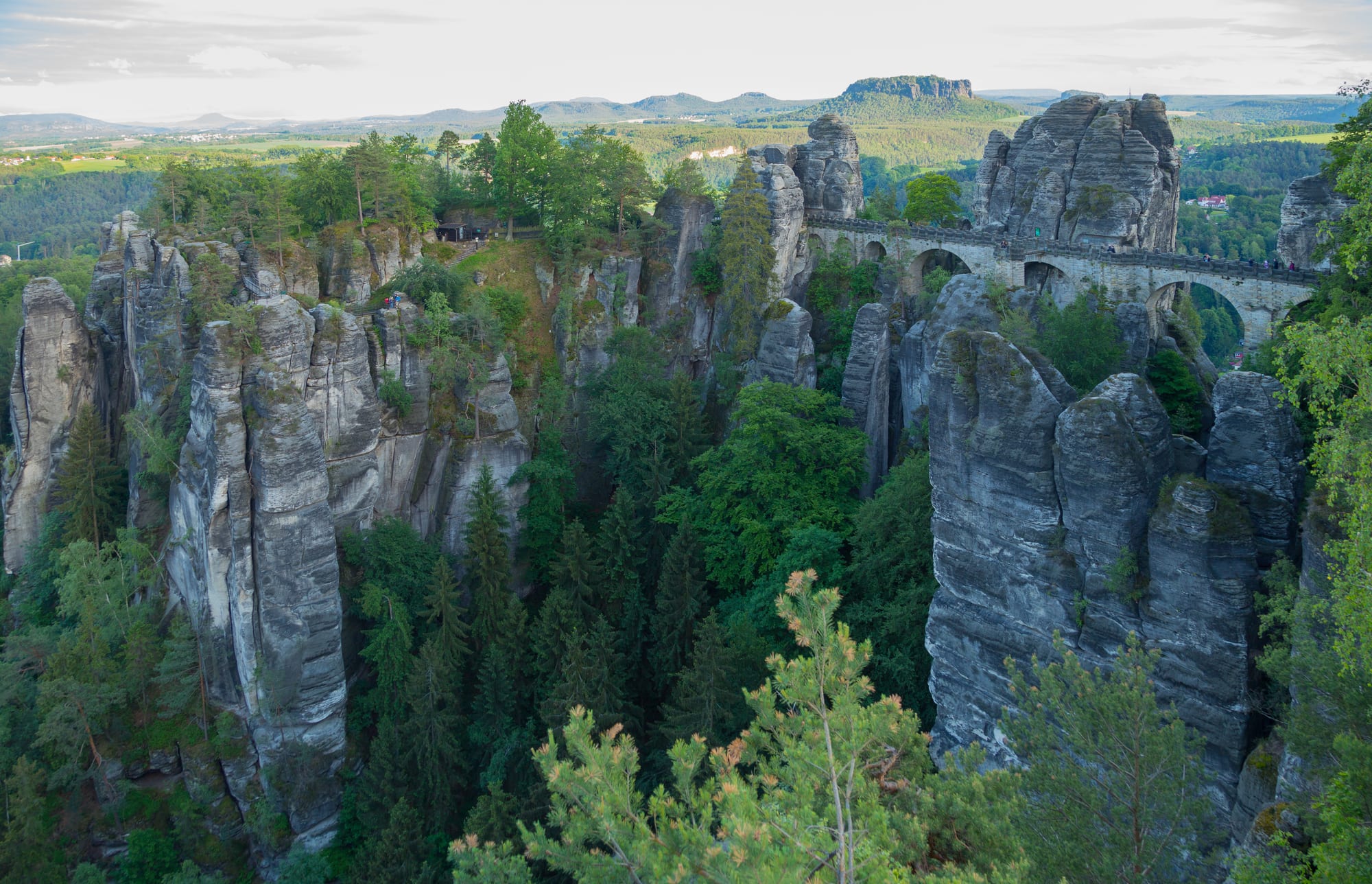
A stone arched bridge linking tall grey sandstone pillars above a forested gorge, with table mountains on the horizon

Germany

Saxony, Thuringia & Saxony-Anhalt

The Bastei bridge among the sandstone pillars of Saxon Switzerland National Park, south-east of Dresden. (J.-H. Janßen / Wikimedia Commons · CC BY-SA 4.0)

The three southern states of the former East Germany, from the Harz and the Elbe plains to the Thuringian Forest and the Ore Mountains on the Czech border — the country of Luther's Reformation, Bach's music and Goethe's Weimar, with baroque Dresden, mercantile Leipzig, the sandstone towers of Saxon Switzerland and a dense scatter of castles, cathedrals and half-timbered towns.

Explore Saxony, Thuringia & Saxony-Anhalt

History

The Saale and the Elbe were long the frontier between Germans and Slavs, and the first German kings made the land below the Harz their base: Henry I, founder of Meissen castle in 929, was buried at Quedlinburg in 936, and Otto the Great made Magdeburg an archbishopric. The Wettin family held the March of Meissen from 1089 until 1918, enriched by the silver of Freiberg and the fairs of Leipzig. In 1485 the dynasty split into an Ernestine line, with the electoral title, Wittenberg and most of Thuringia, and an Albertine line in Dresden, which took the title in 1547 while the Ernestine lands splintered into a dozen small duchies.

An Ernestine elector protected Martin Luther, who published his 95 theses at Wittenberg in 1517 and translated the New Testament at the Wartburg in 1521–22. The wars that followed ran through the region, from the sack of Magdeburg in 1631 to the death of Gustavus Adolphus at Lützen in 1632. Augustus the Strong, elector from 1694 and King of Poland, built baroque Dresden and founded Europe's first porcelain works at Meissen in 1710, Bach served Leipzig's Thomaskirche from 1723, and Goethe's arrival in 1775 made tiny Weimar the capital of German letters. Napoleon won at Jena in 1806 and lost at Leipzig in 1813, and Saxony, his ally, forfeited its northern half to Prussia, whose new Province of Saxony was the forerunner of today's Saxony-Anhalt.

Saxony industrialised early — Germany's first long-distance railway ran from Leipzig to Dresden in 1839 — and the labour movement was founded in Leipzig, Eisenach and Gotha. The national assembly of 1919 met in Weimar, where the Bauhaus opened that year before moving to Dessau in 1925. The Nazis built Buchenwald above Weimar in 1937, and Allied bombs destroyed central Dresden in February 1945, killing up to 25,000. East Germany mined lignite and uranium here, and it was in Leipzig, on 9 October 1989, that 70,000 marchers faced down the state. The three states were re-founded in 1990.

Culture & Customs

The three states share a history more than an identity. Saxons are proud of a kingdom that lasted until 1918, Thuringians of a land of small courts that each kept a theatre and an orchestra; Saxony-Anhalt, assembled in 1947 from Prussian and Anhalt lands, is still finding a common story. Saxon dialect is much mocked in Germany, although the language of the Saxon chancery, used by Luther for his Bible, became the basis of standard German. Around Bautzen the Slavic Sorbs keep their language and the Easter processions of riders. The cradle of the Reformation is now among the least religious places on earth: some three-quarters of people belong to no church, and the secular Jugendweihe coming-of-age ceremony has outlived East Germany.

Music is the great inheritance. Bach was born in Eisenach and worked in Arnstadt, Weimar, Köthen and Leipzig; Handel was born in Halle, Schumann in Zwickau and Wagner in Leipzig; Mendelssohn led the Gewandhaus Orchestra. The Thomanerchor, founded in 1212, still sings in Bach's church every week, Dresden has the Kreuzchor and the Semperoper, and the calendar includes Leipzig's Bachfest in June, Halle's Handel Festival and Rudolstadt's folk festival in July. Leipzig also hosts the Wave-Gotik-Treffen, which fills the city with some 20,000 black-clad visitors each Whitsun.

Craft traditions are tied to the mountains. When the Ore Mountain silver gave out, miners turned to carving, and the villages around Seiffen still produce the nutcrackers, smoking men, candle arches and rotating pyramids of the German Christmas; miners' parades march through Advent, and Dresden's Striezelmarkt, held since 1434, is the country's oldest Christmas market. Meissen marks its porcelain with crossed swords, Glashütte makes watches, and Lauscha in the Thuringian Forest blew the first glass tree baubles. On 30 April the Harz celebrates Walpurgis Night with bonfires and costumed witches. Dresden and Leipzig — court city and merchant city — keep up a cordial rivalry, as do Halle and Magdeburg.

Daily Life

About 8.3 million people live in the three states — 4 million in Saxony and 2.1 million each in Thuringia and Saxony-Anhalt — far fewer than in 1990. Leipzig, with about 620,000 residents, and Dresden, with 565,000, have grown strongly since 2010; Chemnitz has about 250,000, Magdeburg some 245,000, Halle 226,000, Erfurt 215,000 and Jena 110,000. Beyond them lies a country of small towns that have lost their young.

East Germany's big state combines collapsed after 1990, and what replaced them is patchy but real. Dresden is the centre of "Silicon Saxony", Europe's largest chip-making cluster, with plants of Infineon, GlobalFoundries and Bosch. Leipzig assembles BMWs and Porsches and handles DHL's European air freight; Volkswagen builds electric cars in Zwickau, where the Trabant was made; Jena lives on optics, the legacy of Carl Zeiss; and the chemical works at Leuna, Schkopau and Bitterfeld survive in slimmer form. Lignite is still dug south of Leipzig and in Lusatia, with an end date of 2038, while exhausted pits have been flooded to make Leipzig's Neuseenland. The black earth of the Magdeburg Börde is some of the best farmland in Europe.

Working days start early — schools and factories at seven or half past — and often end in the allotment garden: the Schrebergarten movement began in Leipzig in 1864. East German habits persist in the high share of working mothers and full-day nurseries. Wages remain below western levels, and skilled workers are scarce because the generation that left after 1990 was never replaced. Politics is the sharpest subject: the far-right AfD came first in Thuringia's state election of 2024 and a close second in Saxony's, Dresden saw the anti-Islam Pegida marches for a decade from 2014, and Leipzig's Connewitz district is a stronghold of the radical left.

Food

Thuringia's emblem is the Rostbratwurst, a long, thin pork sausage seasoned with marjoram and caraway, documented since 1404, grilled over charcoal and eaten in a roll with mustard; beside it on the grill lies Rostbrätel, a pork neck steak marinated in beer and onions. Sunday lunch means Thüringer Klöße, dumplings of raw and cooked potato with a crouton at the centre, served with a roast, gravy and red cabbage. Sheet cakes, Blechkuchen, of plum, poppy seed or quark come in tray-sized squares, and the black beer of Bad Köstritz has been brewed since 1543.

Saxony is Germany's coffee-and-cake country: its people were nicknamed Kaffeesachsen, and Melitta Bentz invented the paper coffee filter in Dresden in 1908. The cakes are Dresdner Eierschecke, a three-layered slice of yeast dough, quark and egg custard, the Leipziger Lerche, a marzipan tart devised after lark-hunting was banned in 1876, Quarkkeulchen, fried quark-and-potato cakes with apple sauce, and at Christmas the Dresdner Christstollen, a protected name. Savoury dishes include Sauerbraten with dumplings, potato soup with sausage and Leipziger Allerlei, young vegetables with morels and crayfish. Radeberger, brewed near Dresden since 1872, is the best-known beer, and Leipzig has revived Gose, a sour wheat beer with salt and coriander.

Saxony-Anhalt adds Salzwedel's Baumkuchen, a cake baked in rings on a spit, Halle's Halloren-Kugeln from Germany's oldest chocolate factory, pungent Harzer cheese and Magdeburg's Bötel, as pork knuckle is called there. Two of Germany's smallest and most northerly wine regions lie here: Saale-Unstrut, on terraces around Freyburg and Naumburg, where Rotkäppchen has made sparkling wine since 1856, and the Elbe valley between Meissen, Radebeul and Pillnitz. Both grow mainly dry whites — Müller-Thurgau, Weissburgunder and Riesling — and Saxony has a rarity of its own, Goldriesling.

Attractions & Natural Wonders

Dresden's baroque skyline lines a bend in the Elbe: the Frauenkirche, a ruin until its rebuilding in 1994–2005, the Zwinger with Raphael's Sistine Madonna, the Semperoper and the Green Vault treasury in the palace. Paddle steamers run upstream to Pillnitz and down to Meissen's cathedral, castle and porcelain works. Saxon Switzerland National Park begins half an hour south-east: sandstone towers and table mountains above the Elbe gorge, the Bastei bridge of 1851, the fortress of Königstein and the Malerweg walking trail. Leipzig offers Bach's grave in the Thomaskirche, the Nikolaikirche of 1989, the 91-metre Monument to the Battle of the Nations and the Stasi museum in the Runde Ecke. Görlitz, undamaged by the war, sits on the Polish border, and the Ore Mountains, a UNESCO mining landscape, run along the Czech one from Freiberg to the Fichtelberg.

In Thuringia, Weimar packs Goethe's and Schiller's houses, the Duchess Anna Amalia Library and the Bauhaus Museum into a town of 65,000, with the Buchenwald memorial on the hill above. Erfurt, the capital, has the Krämerbrücke, a bridge of 1325 lined with inhabited houses, the cathedral and St Severus on their hill, Luther's Augustinian monastery and a synagogue of about 1100, UNESCO-listed in 2023. The Wartburg above Eisenach, Bach's birthplace, shows the room where Luther worked. The Rennsteig ridge path runs 170 kilometres along the Thuringian Forest, and Hainich National Park protects old beech woods.

Saxony-Anhalt holds Quedlinburg, well over a thousand half-timbered houses beneath the church where Henry I lies, and Wernigerode, where steam trains climb the Brocken, at 1,141 metres the summit of the Harz. Luther's Wittenberg keeps the Castle Church, his house — now the largest Reformation museum — and the Cranach altarpiece in the town church. Nearby are the Bauhaus building at Dessau and the 18th-century Garden Realm of Wörlitz; further south, Naumburg Cathedral with its donor statues and, in Halle, the Nebra Sky Disc, some 3,600 years old. Magdeburg has Germany's first Gothic cathedral and the tomb of Otto the Great.

Cities in Saxony, Thuringia & Saxony-Anhalt

Planning basics

Budget

This is one of the cheaper parts of Germany. Hotel rooms, restaurant meals and beer cost noticeably less in Dresden, Leipzig and Erfurt than in Munich, Hamburg or Frankfurt, and small towns such as Görlitz, Naumburg and Eisenach are cheaper again. The exceptions are Leipzig during its trade fairs and at Whitsun, and Dresden, Quedlinburg and the Ore Mountains on Advent weekends, when beds are scarce and prices rise.

Daily Budget Midrange
USD 130–230 (mid-range hotel, restaurant dinners, museum and castle tickets, a steam-train or paddle-steamer trip)
Daily Budget Shoestring
USD 55–100 (hostel or simple guesthouse, bratwurst stands and bakery food, regional trains)

Dresden's state museums and Weimar's houses each sell combined passes; the Harz steam railway and the Elbe paddle steamers are priced separately from ordinary public transport.

Safety

The region is safe, with ordinary pickpocketing around the main stations of Leipzig and Dresden and more car theft than average near the Polish and Czech borders. Political demonstrations are frequent in Dresden, Leipzig and Chemnitz and are best avoided; the far right is stronger here than elsewhere in Germany, and visitors of colour report more hostile remarks in some small towns than in the cities, though serious incidents involving tourists are rare. The physical risks are in the hills: unfenced cliff edges and forest-fire bans in Saxon Switzerland, fast weather changes on the Brocken, ticks carrying encephalitis in parts of Saxony and Thuringia, and occasional Elbe floods.

Stay on marked paths in Saxon Switzerland, where open fires are banned, carry warm layers up the Brocken even in summer, and do not leave valuables in cars near the borders. Check current official travel advice before travelling.

Climate

More continental than western Germany, with warmer summers and colder winters. The Leipzig lowlands, the Thuringian Basin and the country around Halle and Magdeburg lie in the rain shadow of the Harz and the Thuringian Forest and are among the driest parts of the country, while the Elbe valley at Dresden is mild enough for vineyards. The uplands are another matter: the Ore Mountains, the Thuringian Forest and the Harz are cool, wet and snowy, and the summit of the Brocken is in fog on most days of the year.

Summer
warm, 22–28°C in the lowlands with hot spells above 33°C; five or six degrees cooler in the hills
Winter
cold, -3 to 3°C, with grey spells in the basins and lying snow above about 600 metres from December to March

Transportation

Leipzig/Halle and Dresden airports have few international flights, and most visitors arrive by train: Berlin is about 75 minutes from Leipzig and two hours from Dresden and Erfurt, and the high-speed line opened in 2017 puts Erfurt about two and a half hours from Munich. Regional trains link Weimar, Erfurt, Eisenach, Halle, Magdeburg and the Harz towns; the S-Bahn from Dresden follows the Elbe to Bad Schandau in Saxon Switzerland, and EuroCity trains continue to Prague. Narrow-gauge steam railways climb the Brocken from Wernigerode. The Ore Mountains, the Thuringian Forest and the Saale-Unstrut vineyards are easier with a car, and the Elbe Cycle Route links Dresden, Meissen, Wittenberg, Dessau and Magdeburg.

Base a Thuringian visit in Erfurt or Weimar, fifteen minutes apart by train, and reach the Bastei by S-Bahn to Kurort Rathen and the small river ferry rather than the crowded car park.

Best Time to Visit

May, June, September and early October suit both the cities and the walking country; Leipzig's Bachfest falls in June and the wine festivals of Freyburg and the Elbe valley in September. Saxon Switzerland is crowded at the Bastei on summer weekends and at its best in spring and in October colour. Advent is a season in its own right, with Dresden's Striezelmarkt, the markets and miners' parades of the Ore Mountains and the market on Erfurt's cathedral square. January to March brings cross-country skiing on the Rennsteig and downhill runs at Oberwiesenthal, and 30 April is Walpurgis Night in the Harz.