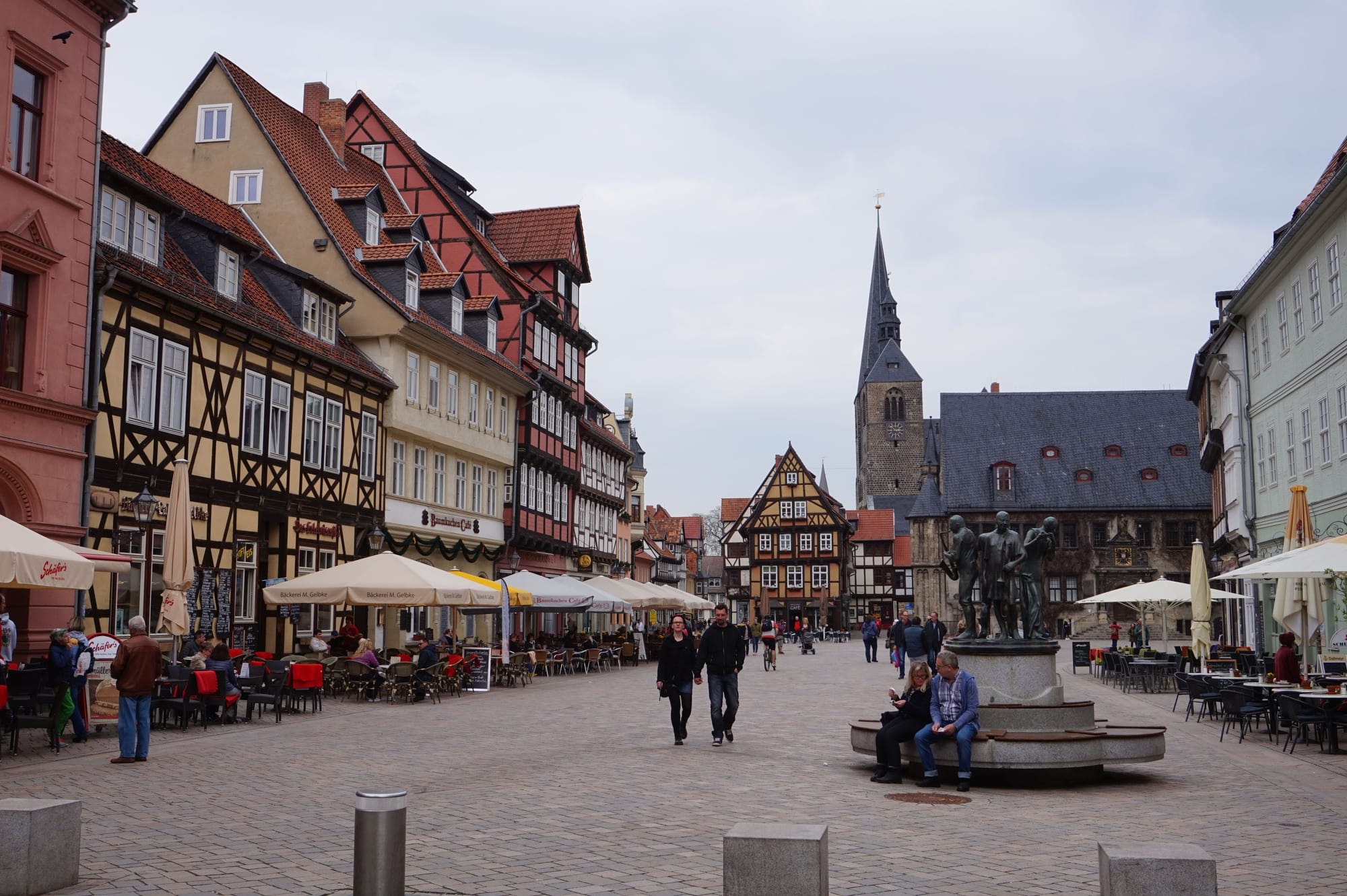
Half-timbered houses and café umbrellas around a cobbled market square, with a bronze fountain group and a church spire behind

Saxony, Thuringia & Saxony-Anhalt, Germany

Quedlinburg

The Markt in Quedlinburg, with the town hall and the spire of the market church behind. (Tobias Paul / Wikimedia Commons · CC BY-SA 4.0)

A small town on the Bode just north of the Harz in Saxony-Anhalt, where Henry the Fowler was buried and the Ottonian kings kept a palace and a powerful abbey of noblewomen. Its castle hill, Romanesque collegiate church and old town of some 2,000 half-timbered houses have been a UNESCO World Heritage Site since 1994, and tourism now drives the town.

Neighbourhoods

  • Altstadt and the Markt
    • First-time visitors
    • Historic district
    • Best for food

    The old town around the market square, with the Renaissance town hall and its Roland statue, the market church of St Benedikt and lanes of half-timbered houses from several centuries. Most cafés, restaurants and shops are here.

    Open in Maps
  • Schlossberg and Westendorf
    • Historic sites
    • Viewpoints

    The castle hill south of the Markt, crowned by the collegiate church of St Servatius and the abbey buildings, with the little Finkenherd square, the Klopstock house and the Feininger museum at its foot in the old royal quarter of Westendorf.

    Open in Maps
  • Münzenberg
    • Quiet lanes
    • Viewpoints

    A hill west of the castle where poor settlers, musicians among them, built tiny houses into the ruins of a medieval convent from the 1550s. Its crooked lanes look across to the Schlossberg, and a small museum tells its story.

    Open in Maps
  • Neustadt
    • Quiet and residential
    • Historic district

    The medieval new town east of the Altstadt, joined to it around 1330, built around the early Gothic church of St Nikolai with its 72-metre towers and the Mathildenbrunnen fountain.

    Open in Maps
  • Gernrode
    • Romanesque church
    • Steam railway
    • Harz walks

    A small town at the edge of the Harz, part of Quedlinburg since 2014, known for its Ottonian collegiate church of St Cyriakus and as a station on the narrow-gauge Selke Valley Railway.

    Open in Maps

Things to do

Castle hill and old town

  • Quedlinburg Abbey and St Servatiuslandmark

    The abbey for noblewomen founded in 936 by Henry the Fowler's widow Matilda as his memorial; its Romanesque church on the castle hill holds the tomb of Henry I and a treasury returned in 1993 after its theft by an American soldier in 1945.

    Open in Maps
  • Fachwerkmuseum Ständerbaumuseum

    A museum of half-timbered building in one of the oldest timber-framed houses in Quedlinburg and in Germany, dating from the 14th century.

    Open in Maps
  • Klopstockhausmuseum

    The house of 1570 where the poet Friedrich Gottlieb Klopstock was born in 1724, now one of the town's museums.

    Open in Maps
  • Museum Lyonel Feiningermuseum

    A gallery opened in 1986 showing works by the Bauhaus artist Lyonel Feininger, saved from destruction by the Nazis by Hermann Klumpp, a Bauhaus student from Quedlinburg.

    Open in Maps
  • Münzenbergviewpoint

    The hill of tiny houses built into a ruined convent, with views across to the castle hill and a museum of the convent and the quarter.

    Open in Maps

Romanesque churches

  • St Cyriakus, Gernrodelandmark

    One of the few surviving examples of Ottonian architecture, built from 959/960 to 965 by Margrave Gero and a stop on the Romanesque Road.

    Open in Maps

Short trips into the Harz

  • Selke Valley Railwaytransit hub

    The metre-gauge steam railway of the Harz Narrow Gauge Railways, extended to Quedlinburg station in 2006, running through Gernrode and the Selke valley to Alexisbad and the high Harz.

    Open in Maps
  • Bode Gorgetrail

    A ravine some 10 kilometres long and up to 280 metres deep where the Bode breaks out of the Harz granite at Thale, a nature reserve since 1937 with a riverside walk.

    Open in Maps
  • Hexentanzplatzviewpoint

    The 'witches' dance floor', a plateau at 454 metres high above the Bode Gorge, opposite the Rosstrappe crag, home to the open-air Bergtheater Thale.

    Open in Maps

Seasonal events

  • KaiserfrühlingEaster and Whitsun

    A medieval spectacle in the historic old town that opens the town's season of events.

  • Quedlinburger MusiksommerJune to September

    A weekly series of concerts in the collegiate church of St Servatius, founded in 1981.

  • Advent in den Höfenthe first three weekends of Advent

    Courtyards that are otherwise closed open for gift stalls, food and mulled wine, the town's biggest event.

Eat and drink

Long-standing places and food districts in Quedlinburg. Hours, ratings and directions come from your maps app, always current.

Quedlinburg classics

  • Brauhaus Lüdderestaurant

    A combined brewhouse, restaurant and bar, home of the only beer still brewed in Quedlinburg, Pubarschknall.

    Open in Maps
  • Cafés and restaurants on the Marktneighborhood

    Terraces in front of the half-timbered houses and town hall on the market square, the busiest place to eat in the old town.

    Open in Maps
  • Restaurants around Finkenherd and the Schlossbergneighborhood

    Small cafés and restaurants with outdoor tables on the cobbled squares below the castle hill.

    Open in Maps

Experience Quedlinburg

History

A settlement existed by the River Bode by the early 9th century, and Quedlinburg is first recorded as a town in 922, in a donation by King Henry the Fowler. Legend holds that Henry was offered the German crown here in 919, which earned the town the name "cradle of the German Reich". He was buried on the castle hill in 936, and his widow, Saint Matilda, founded a community of noblewomen there to pray for his memory; their granddaughter, another Matilda, became the first abbess. The Ottonian rulers kept a palace in the valley below the hill and held court here at Easter; in 973 Otto the Great received dukes from Poland and Bohemia and envoys from as far as Byzantium. In 994 Otto III granted market, toll and coinage rights.

The abbesses ruled Quedlinburg for more than eight centuries without taking the veil, and they were free to marry. The town joined the Hanseatic League in 1426, but in 1477 Abbess Hedwig, with the help of her Saxon brothers, crushed its bid for independence and forced it out of the league. Town and abbey became Lutheran in 1539, Saxony sold its rights to Brandenburg in 1697, and in 1802 the abbey was dissolved and Quedlinburg passed to Prussia.

In the 19th century the town grew rich on plant breeding and seed growing: before the First World War some 60 per cent of the world's flower seed came from its firms, and it was known as the flower town. The Nazis turned Henry I into a cult figure, and in 1945 an American soldier stole the church treasury, which only came back in 1993. Under East Germany much of the old town decayed, but it survived; the town lost a fifth of its population after 1990, and in 1994 the castle, church and old town became a World Heritage Site.

Culture & Customs

Quedlinburg's identity is its age. Since 2006 the town has called itself the "cradle of Germany", and the Romanesque churches of St Servatius, St Wiperti and St Mary on the Münzenberg are its stations on the Romanesque Road, a tourist route through Saxony-Anhalt. Beneath the castle hill the half-timbered houses span at least five centuries, from one of the oldest in Germany in the 14th century to Jugendstil villas built on seed-trade money around the edges of the old town.

The town has produced more than its share of notable people: the poet Friedrich Gottlieb Klopstock, born here in 1724; Dorothea Erxleben, the first woman doctor of medicine in Germany; and Johann Christoph Friedrich GutsMuths, known as the father of German gymnastics. Lyonel Feininger's works are kept here thanks to Hermann Klumpp, a local Bauhaus student who saved them from the Nazis. Theodor Fontane set part of his novel Cécile in Quedlinburg and Thale.

The calendar is built around visitors and the church year: the Kaiserfrühling medieval spectacle at Easter and Whitsun, weekly summer concerts in the collegiate church, a heritage day when more than 70 normally closed monuments open and a flower fair is held in the Neustadt, and above all Advent in den Höfen, when private courtyards open across the old town. The Nordharzer Städtebundtheater plays in Quedlinburg and Halberstadt.

Daily Life

More than 24,000 people live in Quedlinburg, including Gernrode and Bad Suderode, which were incorporated in 2014. The population peaked at about 35,500 in 1950; after 1990 high unemployment and moving away cost the town a fifth of its residents, and by the end of 2024 almost a third of its people were over 65.

The seed firms, nationalised after 1945 and run by the state in East Germany, when Quedlinburg was called the seed capital of the Eastern bloc, were privatised or closed after 1990, but seed growing remains the town's agricultural speciality. Industry centres on construction firms that specialise in restoring old buildings, along with woodworking, metalworking, pharmaceuticals and printing, and services are dominated by tourism, with overnight stays peaking at Easter, from May to July, in September and October and in Advent.

The town was the seat of its own district until 2007. In autumn 1989 few towns of its size saw such large demonstrations, and after xenophobic attacks in the Neustadt in 1992 residents set up a prevention project, the Altstadtprojekt, that is still active.

Food

Quedlinburg eats the cooking of the Harz and Saxony-Anhalt, served in the restaurants and cafés of half-timbered houses around the Markt, the Finkenherd and the lanes in between. Menus range from traditional German cooking to international cuisine. Local producers are known for pure rapeseed honey and other bee products, mustards and fine brandies distilled from regional fruit.

The mountains behind the town give their name to Harzer, a sour-milk cheese made from low-fat curd that originated in the Harz region. It is small and round or shaped into cylinders, usually flavoured with caraway, with white-mould and red-mould varieties, and has a distinctive strong smell and flavour; it is low in fat and rich in protein, and is usually eaten with bread.

The only beer still brewed in the town is Pubarschknall, from the Lüdde brewery, whose brewhouse also serves as a restaurant and bar. During Advent the courtyards open for food stalls and mulled wine.

Planning tools

Budget

Quedlinburg is inexpensive by German standards for meals and guesthouses, but this small town fills up around Easter, from May to July, in September and October and above all on Advent weekends, when rooms are scarce and prices rise. Walking the old town costs nothing; the castle hill church, the museums and the steam railway are paid separately.

Daily Budget Midrange
USD 130–220 (mid-range guesthouse in a half-timbered house, restaurant dinners, museum tickets, a steam-train trip)
Daily Budget Shoestring
USD 55–95 (hostel or simple guesthouse, bakery and Imbiss food, regional trains)

Book well ahead for the Advent weekends; the Harz steam railway fare is separate from ordinary train tickets.

Best Time to Visit

Late spring to early autumn suits the old town and walks in the Harz, with the Kaiserfrühling at Easter and Whitsun and concerts in the collegiate church from June to September. Advent brings the courtyard markets, the town's busiest time. Winter outside Advent is cold and very quiet.

Suggested Number of Days

One or two days are enough for the old town and the castle hill. Three or four allow time for the steam railway and walks in the Harz nearby.

First Visit
1–2 days
With Surroundings
3–4 days

Transportation

Regional trains on the line from Magdeburg and Halberstadt to Thale stop at Quedlinburg station, which is also the terminus of the narrow-gauge Selke Valley Railway, with steam trains running via Gernrode into the Harz. Local buses serve the town and the surrounding villages. In season a small tourist road train runs through the old and new towns from the Markt.

Walk in the old town, where the lanes are narrow and cobbled, and use the regional train to Thale for the Bode Gorge.

Airport & Station Connections

Most visitors arrive by regional train, changing from the long-distance network in Magdeburg or Halberstadt, or by car. The nearest large airports are Leipzig/Halle, about 90 km to the south-east, and Hannover, about 120 km to the north-west; Magdeburg-Cochstedt is closer but has few airlines.

Walkability

The old town is compact and entirely walkable, with the station, the Markt and the castle hill a short walk apart. Cobbles and the steep climbs to the Schlossberg and the Münzenberg make sturdy shoes a good idea.

Safety

Germany is a safe country with low levels of violent crime. Quedlinburg is a quiet small town. Most visitors to Germany never meet open racism, though non-white visitors may occasionally get a wary look in rural areas.

Watch footing on the cobbles and steep lanes, keep valuables out of sight in parked cars, and stay on marked paths in the Bode Gorge. Check current official travel advice before travelling.

Climate

An oceanic climate just north of the Harz, with cold winters and mild summers.

Summer
mild to warm — July and August average about 17–18°C
Winter
cold — January and February average about 0.5–1.5°C

Local Customs

Service is included in restaurant prices, and rounding up the bill is the usual way to tip. Many residents of the old town live in the listed half-timbered houses, so courtyards and doorways are private unless open for an event. Shops close on Sundays. Most people belong to no church, but the collegiate church is still a place of worship.

Respect private courtyards and houses, keep quiet during services and concerts, and wait for the green signal at crossings.

Common Payment Methods

The currency is the euro. Cards are accepted in most hotels, shops and restaurants, but small cafés, market and Advent stalls often prefer cash, so carrying some is useful. There are cash machines in the old town.