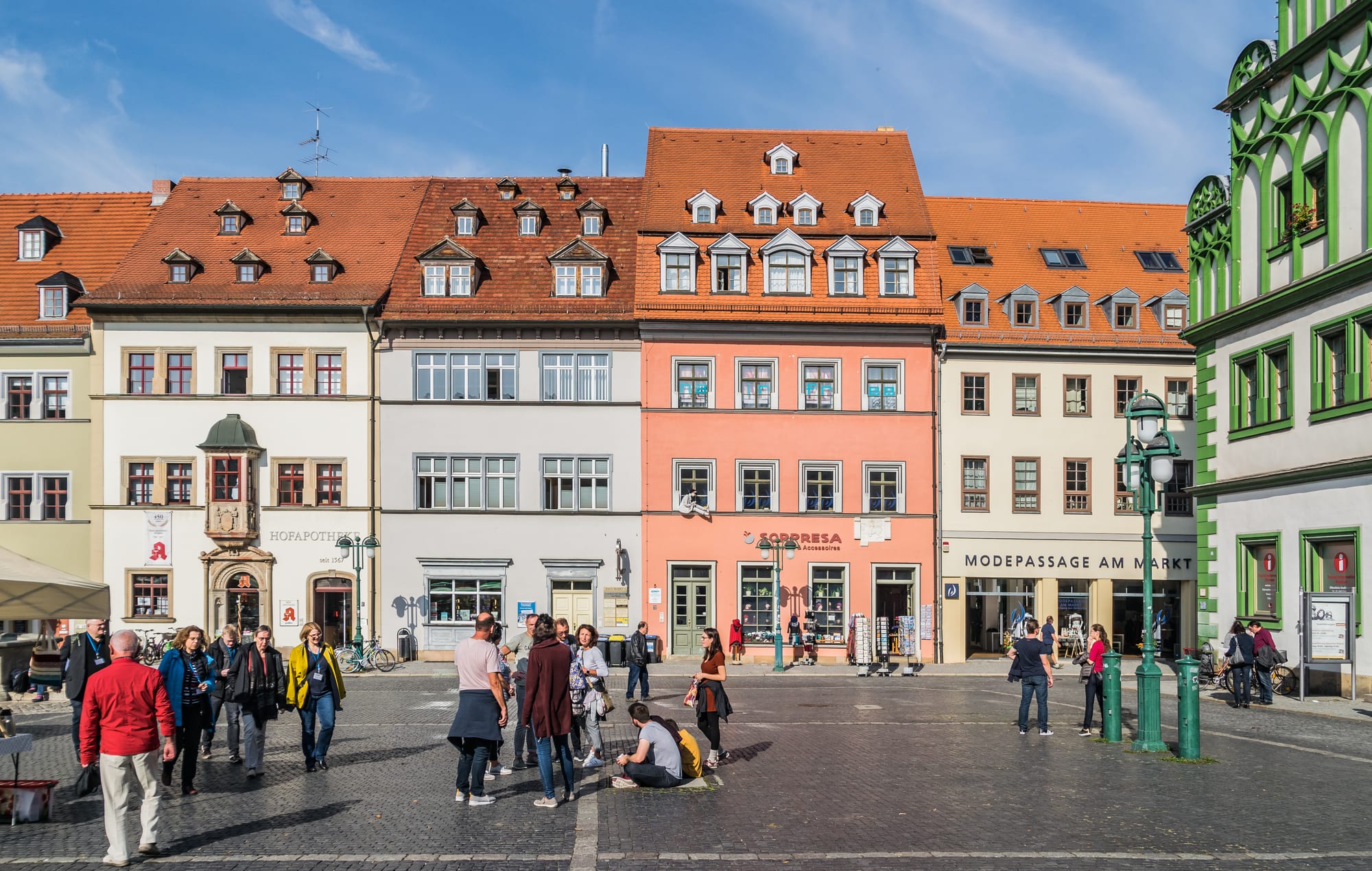
A row of pastel-painted town houses with steep red-tiled roofs and dormer windows along a cobbled market square

Saxony, Thuringia & Saxony-Anhalt, Germany

Weimar

Town houses on the Marktplatz in the centre of Weimar. (Krzysztof Golik / Wikimedia Commons · CC BY-SA 4.0)

A small city in the Ilm valley of Thuringia, between Erfurt and Jena, that rose from a ducal residence to the capital of German letters in the age of Goethe and Schiller, then became the birthplace of the Bauhaus and of Germany's first democratic constitution. Today heritage, two universities and the memorial at Buchenwald on the hill above shape it.

Neighbourhoods

  • The Altstadt
    • First-time visitors
    • Historic district
    • Museums

    The historic centre between the Ilm and Goetheplatz, built around two squares — the Marktplatz with its Neo-Gothic town hall and the Herderplatz with the town church. Goethe's house on the Frauenplan, Schiller's house, the Duchess Anna Amalia Library and the National Theatre are all a few minutes apart.

    Open in Maps
  • Park an der Ilm and the palace
    • Parks
    • Quiet walks
    • World Heritage

    The landscape park along the river from the ducal palace south towards Oberweimar, with Goethe's garden house and the Roman House. The streets on either side of the park are among the most sought-after places to live.

    Open in Maps
  • Around the Bauhaus University
    • Architecture
    • Students
    • Arts and culture

    The area south and west of the old town around the university's two main buildings on Marienstraße, icons of early modern architecture, with the Liszt House nearby and the Historic Cemetery a short walk away.

    Open in Maps
  • Weimarplatz and the station quarter
    • Close to public transport
    • 20th-century history

    The area between the old town and the station, about a kilometre north, dominated by the Gauforum, the Nazi government district, and by the new Bauhaus Museum near the Weimarhallenpark.

    Open in Maps
  • Tiefurt and Belvedere
    • Palaces and gardens
    • Quiet and residential

    Outlying districts with ducal summer residences: Tiefurt on the Ilm about four kilometres east of the centre, and Belvedere with its baroque palace and orangery on the south-eastern outskirts.

    Open in Maps

Things to do

Classical Weimar

  • Goethe's Housemuseum

    The house on the Frauenplan where Goethe lived from 1782 to 1832, with rooms he redesigned himself and a garden; it is the main site of the Goethe National Museum.

    Open in Maps
  • Duchess Anna Amalia Librarymuseum

    A library first opened to the public in 1691 and now a research library for literature and art history; a fire in 2004 destroyed the main wing and much of the collection, and restoration of salvaged volumes lasted until 2015.

    Open in Maps
  • Schloss Weimarlandmark

    The ducal and grand-ducal residence at the north end of the park, rebuilt in Neoclassical style after a fire in 1774, with rooms dedicated to the poets who worked in Weimar.

    Open in Maps
  • St Peter and Paul (Herderkirche)landmark

    The town church on the Herderplatz, rebuilt in late Gothic style around 1500 and named after Johann Gottfried Herder, its dean from 1766 to 1803.

    Open in Maps
  • German National Theatrelandmark

    The theatre on Theaterplatz, where the National Assembly drafted the Weimar Constitution in 1919; Rietschel's Goethe–Schiller Monument stands outside.

    Open in Maps

Bauhaus and the modern city

  • Bauhaus Museum Weimarmuseum

    The Weimar collections of the State Bauhaus, founded here in 1919, shown since April 2019 in a new building near the Weimarhallenpark.

    Open in Maps
  • Haus am Hornmuseum

    Georg Muche's house for the Bauhaus exhibition of 1923, the first building based on Bauhaus design principles and part of a UNESCO World Heritage Site.

    Open in Maps
  • Bauhaus Universitylandmark

    The art school founded in 1860 that Walter Gropius renamed the Bauhaus in 1919; its two main buildings on Marienstraße are icons of early modern architecture.

    Open in Maps
  • Nietzsche Archivemuseum

    The Villa Silberblick, home of the archive of Nietzsche's work founded and long run by his sister, now a museum; Nietzsche spent his last years in Weimar from 1897.

    Open in Maps

Parks and palaces

  • Park an der Ilmpark

    An English landscape garden laid out between 1778 and 1833 under Goethe's influence and little changed since, with his garden house and the Roman House.

    Open in Maps
  • Schloss Belvederelandmark

    A baroque pleasure palace of 1724–1732 on the outskirts of the city, with an orangery, landscape gardens and collections of porcelain, faience and furniture.

    Open in Maps
  • Tiefurt Houselandmark

    The small summer residence of Duchess Anna Amalia in a wide park on the Ilm, about four kilometres east of the centre.

    Open in Maps

Memorials and short trips

  • Buchenwaldmuseum

    The memorial and museum on the Ettersberg, about 8 kilometres from the centre, at the site of the Nazi concentration camp established in 1937, where an estimated 56,000 people died, later used as a Soviet special camp.

    Open in Maps
  • Erfurtattraction

    The Thuringian capital, about 20 kilometres west, with its cathedral hill, the house-lined Krämerbrücke and a medieval synagogue.

    Open in Maps

Seasonal events

  • Weimar Onion MarketOctober

    Thuringia's largest festival, held since 1653, with stalls of onion plaits, crafts and onion cakes, soups and breads filling the old town for a weekend.

Eat and drink

Long-standing places and food districts in Weimar. Hours, ratings and directions come from your maps app, always current.

Weimar classics

  • Bratwurst stands on the Marktplatzmarket

    Grills on the market square sell the Thüringer Rostbratwurst, a thin, spiced sausage from Thuringia, through the day.

    Open in Maps
  • Restaurants around the Marktplatzneighborhood

    Thuringian, Italian and international restaurants and cafés in the historic houses of the compact old town, many with tables on the squares.

    Open in Maps

Experience Weimar

History

Weimar is recorded in 899 and was the seat of a powerful county in the early Middle Ages, but it stayed a small town of under 5,000 people for centuries, rebuilt again and again after fires. Its fortunes turned in 1547, when the Ernestine branch of the Saxon dukes lost the Schmalkaldic War and their capital, Wittenberg, and needed a new residence; from 1572 Weimar was the capital of Saxe-Weimar.

The regency of Duchess Anna Amalia from 1758 and the reign of her son Carl August began the classical or "golden" age, which lasted until Goethe's death in 1832. Goethe arrived in 1775 and took on civic duties at court, followed by Herder, Wieland and Schiller, and a town of about 7,000 people became the centre of German literature. A "silver age" followed: Liszt came as court conductor in 1842 and staged the premiere of Wagner's Lohengrin in 1850, an art school was founded in 1860, Nietzsche spent his last years here from 1897, and Henry van de Velde set up a school of applied arts in 1902.

In 1919 the National Assembly met in the theatre to draft the constitution of the Weimar Republic, away from street fighting in Berlin, and Walter Gropius merged the two art schools into the Bauhaus, which moved to Dessau in 1925 under pressure from a right-wing state government. The Nazis built a government district by the station and in 1937 opened Buchenwald concentration camp on the Ettersberg, 8 kilometres away, where an estimated 56,545 people died; after liberation the Soviets used it as a special camp until 1950. Weimar was Thuringia's capital until 1948. The Bauhaus sites were listed by UNESCO in 1996 and Classical Weimar in 1998, and in 2004 a fire badly damaged the Duchess Anna Amalia Library.

Culture & Customs

Weimar has been a place of pilgrimage for German readers since Goethe moved here, and its identity rests on that inheritance. Goethe and Schiller lie in the ducal crypt of the Historic Cemetery, Rietschel's statue of the two poets stands before the National Theatre, and their papers are kept in the Goethe and Schiller Archive, part of UNESCO's Memory of the World. The Klassik Stiftung Weimar, one of the largest cultural institutions in Germany, looks after more than twenty museums, palaces, houses and parks, covering not only the classical age but also Liszt, Nietzsche, van de Velde and the Bauhaus.

Music runs through the city's life. The Liszt School of Music, founded in 1872, trains some 850 students, a boarding school for young musicians occupies Schloss Belvedere, and the National Theatre and the Staatskapelle play on six stages across the city. The Bauhaus University, with more than 4,000 students in architecture, design and media, keeps an experimental, student edge in a city otherwise devoted to its past, and celebrated the Bauhaus centenary with partners worldwide in 2019.

The city also lives with the darker side of its history. Weimar's residents were ordered to walk through Buchenwald after liberation, and the memorial on the Ettersberg is part of how the town understands itself. The great popular festival is the Onion Market each October, held since 1653, when the old town fills with onion plaits and onion food.

Daily Life

About 66,000 people lived in Weimar in 2024, much the same as the 65,000 of 1940; together with Erfurt and Jena it forms the central metropolitan area of Thuringia, with around 500,000 people. As elsewhere in eastern Germany, the foreign-born population is small and most residents are non-religious.

Heritage tourism is one of the leading parts of the economy, alongside the universities, the cultural foundation, the theatre and public institutions, including Thuringia's supreme administrative court and constitutional court and the main state archive. Students give the old town much of its life during term.

The most desirable homes are on either side of the Park an der Ilm in the south-east, while the western and northern districts are more modest and mixed with industry at their edges. Trams ran in the city from 1899 to 1937; today buses meeting at Goetheplatz carry residents around a town small enough to cross on foot or by bicycle, and regional trains link it with Erfurt and Jena.

Food

Weimar shares the cooking of Thuringia. The Thüringer Rostbratwurst, a thin, spiced sausage of 15 to 20 centimetres, is sold from grills on the Marktplatz, and potatoes from the farmland north of the city go into Thuringian dumplings, made from a mixture of raw and boiled potatoes. In 2016 a kosher version of the Thuringian bratwurst, of veal and chicken, was first sold at the Onion Market.

Onions are the city's own emblem. At the Onion Market in October the stalls sell braided onion plaits and onion cakes, onion soups and onion breads, using onions grown in farming villages to the north. Saale-Unstrut wine from Bad Sulza, about 25 kilometres to the north-east, is the local wine.

Eating out centres on the old town, where restaurants and cafés in historic houses around the Marktplatz, the Herderplatz and Theaterplatz serve Thuringian home cooking and international food to visitors and students alike.

Planning tools

Budget

Weimar is inexpensive by German standards for food and drink, but rooms in the small old town fill quickly in summer, during the Onion Market in October and in Advent. The Klassik Stiftung, which runs more than twenty museums, palaces, houses and parks, is the main cost; the parks, the squares and the outside of the Bauhaus buildings are free.

Daily Budget Midrange
USD 130–220 (mid-range hotel, restaurant dinners, museum and palace tickets, a theatre evening)
Daily Budget Shoestring
USD 55–95 (hostel or guesthouse, bratwurst and bakery food, walking and buses)

The Klassik Stiftung sells combined tickets for its museums and houses, which pay off for anyone seeing several.

Best Time to Visit

May to September suits the parks, the palaces and outdoor tables on the squares; October brings the Onion Market. Winter is cold and quiet, a good time for the museums, the theatre and the library without crowds.

Suggested Number of Days

Two days cover the compact old town and its main museums at an easy pace. Three or four allow time for the outlying palaces, the memorial on the hill and nearby Thuringian cities by train.

First Visit
2 days
With Surroundings
3–4 days

Transportation

The city has no trams; buses meet at Goetheplatz in the centre, many also serving the main station, and an hourly bus runs to the Buchenwald memorial. Cycle routes follow the Ilm valley and the Thuringian cities trail along the old Via Regia, and themed routes are named after Goethe and Feininger. A car is unnecessary in the centre.

Take the hourly bus to the Buchenwald memorial and allow plenty of time there; walk or cycle everywhere in the centre.

Airport & Station Connections

Weimar station, about a kilometre from the centre, has long-distance trains to Frankfurt and Dresden, and regional trains reach Erfurt in under 20 minutes. Erfurt–Weimar Airport, west of Erfurt, has mainly seasonal charter flights, so most visitors fly into Frankfurt or Leipzig/Halle and continue by train.

Walkability

One of the most walkable cities in Germany: the old town is small and largely pedestrian, and Goethe's house, the theatre, the library, the palace and the park are within ten minutes of each other. The station is a walk of about a kilometre; Belvedere, Tiefurt and Buchenwald are better reached by bus or bicycle.

Safety

Germany is a safe country with low levels of violent crime. Weimar is a university and museum town, and it is sensible to watch belongings at busy events such as the Onion Market.

Keep bags closed in festival crowds, treat the Buchenwald memorial with quiet respect, and stay out of marked cycle lanes on foot. Check current official travel advice before travelling.

Climate

The city lies in the Ilm valley on the southern edge of the Thuringian Basin. Its basin position can bring winter temperature inversions with very cold nights.

Summer
warm and sometimes humid — average highs around 23°C, lows around 12°C
Winter
relatively cold — average highs around 2°C, lows around -3°C

Local Customs

Service is included in restaurant prices, and rounding up the bill is the usual way to tip. Most residents belong to no church. The Buchenwald memorial is a cemetery as well as a museum, and visitors keep their voices down and dress and behave with respect there. Shops close on Sundays.

Behave quietly at Buchenwald and photograph with restraint, and wait for the green signal at pedestrian crossings.

Common Payment Methods

The currency is the euro. Cards and contactless payment are widely accepted in museums, shops and most restaurants, but bratwurst stands, market stalls and some small cafés prefer cash, so carrying some is useful. Cash machines are easy to find in the old town.