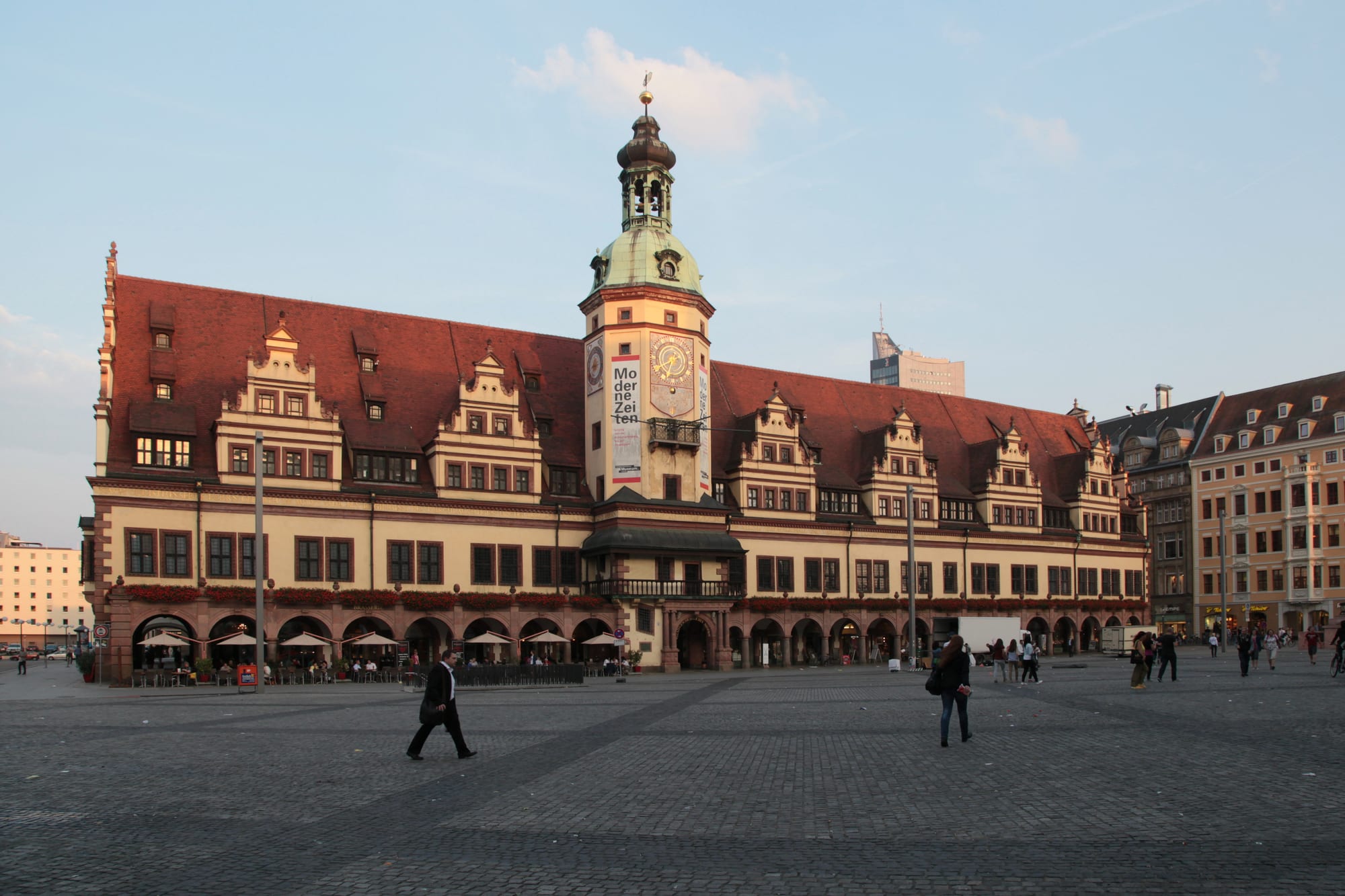
The long Renaissance Old Town Hall with red roofs, stepped gables and a green-domed clock tower across a cobbled square

Saxony, Thuringia & Saxony-Anhalt, Germany

Leipzig

The Old Town Hall on Leipzig's Markt. (Frank Vincentz / Wikimedia Commons · CC BY-SA 3.0)

Saxony's largest city, on the Pleiße and White Elster in the lowlands of eastern Germany — a medieval trade-fair and book town where Bach served the Thomaskirche and where the Monday demonstrations of 1989 helped bring down East Germany. After some 100,000 people left in the decade after reunification it has grown fast again, with artists in old cotton mills and lakes in former mines.

Neighbourhoods

  • Zentrum (the old town inside the Ring)
    • First-time visitors
    • Historic district
    • Close to public transport

    The compact centre inside the ring road, between the Hauptbahnhof and the Thomaskirche. The Markt and Old Town Hall, the Nikolaikirche, Augustusplatz with the opera and the Gewandhaus, and a web of old trade-fair courtyards and glass-roofed arcades such as the Mädler Passage are all a few minutes apart.

    Open in Maps
  • Plagwitz and Lindenau
    • Arts and culture
    • Best for food
    • Nightlife

    The former industrial west, once the densest inner-city factory district in Europe, now a residential and creative quarter. Karl-Heine-Straße crosses the Karl Heine Canal, and the galleries and studios of the old Baumwollspinnerei cotton mill sit on the Lindenau side.

    Open in Maps
  • Südvorstadt
    • Bars and cafés
    • Students
    • Close to public transport

    Gründerzeit blocks south of the centre along Karl-Liebknecht-Straße, the 'Karli', lined with bars, cafés, small restaurants and clubs. It is popular with young people and students and lies close to the green spaces of the riverside forest.

    Open in Maps
  • Connewitz
    • Alternative scene
    • Nightlife
    • Parks

    The southern continuation beyond the Karli, a district known for its left-wing and alternative scene and for Conne Island, the club where the first Wave-Gotik-Treffen was held. The wildlife park and the woods of the riverside forest are close by.

    Open in Maps
  • Waldstraßenviertel
    • Quiet and residential
    • Architecture

    A neighbourhood north-west of the centre counted among the largest complete Gründerzeit districts in Europe, with many listed buildings. It lies between the old town and the Rosental park, a short walk from the zoo.

    Open in Maps
  • Gohlis
    • Quiet and residential
    • Historic sites

    A former village to the north, built up in the late 19th century with tall apartment blocks. Schiller wrote the first version of his Ode to Joy here in 1785, and the small Rococo Gohlis Palace stands in the district.

    Open in Maps

Things to do

Famous landmarks

  • St. Thomas Churchlandmark

    The late-Gothic hall church where Bach was Thomaskantor from 1723 until his death in 1750 and where he is buried; the Thomanerchor boys' choir still sings here.

    Open in Maps
  • St. Nicholas Churchlandmark

    Begun in 1165 and given a Neoclassical interior in the late 18th century, the church whose Monday prayers for peace became the starting point of the 1989 demonstrations.

    Open in Maps
  • Old Town Halllandmark

    The long Renaissance town hall on the east side of the Markt, regarded as one of Germany's most important secular Renaissance buildings, with the Naschmarkt behind it.

    Open in Maps
  • Mädler Passagelandmark

    The last fully preserved historic shopping arcade with an end-to-end glass roof in the centre, home to the entrance to Auerbachs Keller.

    Open in Maps
  • Leipzig Hauptbahnhoftransit hub

    Completed in 1915 and Europe's largest railway station by floor area, with six iron train sheds, a towering stone-arched concourse and a shopping centre inside.

    Open in Maps
  • Monument to the Battle of the Nationslandmark

    A 91-metre granite-faced monument completed in 1913 for the centenary of Napoleon's defeat at Leipzig, with over 500 steps to a viewing platform at the top.

    Open in Maps

Museums and galleries

  • Museum der bildenden Künstemuseum

    The city's museum of fine arts, covering painting and sculpture from the late Middle Ages to the modern era.

    Open in Maps
  • Grassi Museummuseum

    A building complex housing three museums — ethnography, applied arts and musical instruments.

    Open in Maps
  • Bach Museummuseum

    The museum of the Bach Archive in the Bosehaus on the square beside the Thomaskirche, devoted to the composer's life and work.

    Open in Maps
  • Mendelssohn Housemuseum

    The flat where Felix Mendelssohn lived from 1845 until his death in 1847, now a museum of his life and work.

    Open in Maps
  • Spinnereiattraction

    Founded in 1884 and once the largest cotton mill in continental Europe, the ten-hectare site now holds around ten galleries, the Halle 14 arts centre and around 100 artists, including painters of the New Leipzig School.

    Open in Maps

Parks, waterways and lakes

  • Leipzig Zoopark

    Opened in 1878, with about 850 species, the great-ape house Pongoland and Gondwanaland, one of the world's largest indoor rainforest halls.

    Open in Maps
  • Clara-Zetkin-Parkpark

    A large park about two kilometres south-west of the centre, divided by the Elster flood channel and linking the northern and southern parts of the riverside forest.

    Open in Maps
  • Karl Heine Canaltrail

    A protected canal of about 3.3 kilometres through the west of the city, crossed by 15 bridges and navigable by small boats.

    Open in Maps
  • Cospudener Seebeach

    A lake on the city's southern edge on the site of a former open-cast mine, with long sandy beaches, a marina and a lakeside sauna — the first of the Neuseenland mining lakes to be opened for leisure.

    Open in Maps

Music and nights out

  • Gewandhausattraction

    The concert hall on Augustusplatz, third to bear the name and noted for its acoustics, home to the Gewandhaus Orchestra, founded in 1743.

    Open in Maps
  • Leipzig Operaattraction

    The opera house facing the Gewandhaus across Augustusplatz; the company traces its history to 1693.

    Open in Maps
  • Augustusplatzlandmark

    The city's largest square, framed by the opera, the Gewandhaus and the university's main campus, and the central hub of the tram network.

    Open in Maps

Seasonal events

  • Leipzig Book FairMarch

    Germany's second-largest book fair, held over four days at the trade fairground, with readings in bookshops, cafés and the Old Town Hall in the evenings.

  • Wave-Gotik-TreffenWhitsun, May or June

    One of the world's largest festivals of gothic and 'dark' music and culture, with more than 150 bands at venues across the city over four days.

  • Bachfest LeipzigJune

    Around 100 events in Bach's city each year, opening with a concert conducted by the Thomaskantor and traditionally closing with the Mass in B minor in the Thomaskirche.

  • Leipzig Christmas Marketlate November to 23 December

    One of Germany's oldest and largest Christmas markets, with around 300 stalls on the Markt and the surrounding streets.

Eat and drink

Long-standing places and food districts in Leipzig. Hours, ratings and directions come from your maps app, always current.

Leipzig classics

  • Auerbachs Kellerrestaurant

    The city's second-oldest restaurant, a cellar wine bar by the 16th century that Goethe frequented as a student and made famous as the first stop of Faust and Mephistopheles.

    Open in Maps
  • Zum Arabischen Coffe Baumcafe

    A coffeehouse where coffee has been served since 1711, one of Europe's oldest, where Robert Schumann's circle met; it reopened in 2025 after a long renovation, with a coffee museum upstairs.

    Open in Maps
  • Bayerischer Bahnhof Gasthaus and Gosebrauereirestaurant

    A Gose brewery and restaurant in the old Bavarian railway station, Germany's oldest preserved railway station.

    Open in Maps

Food streets

  • Karl-Liebknecht-Straße (the Karli)neighborhood

    The long street through Südvorstadt lined with pubs, cafés, pizzerias, small international restaurants and late bars.

    Open in Maps
  • Barfußgäßchenneighborhood

    A short lane off the Markt packed with restaurants and outdoor tables.

    Open in Maps

Experience Leipzig

History

Leipzig grew where two great medieval trade routes, the Via Regia and the Via Imperii, crossed the plain between the Pleiße and the White Elster. It is first recorded in 1015 as urbs Libzi in the chronicle of Bishop Thietmar of Merseburg, and in 1165 Otto the Rich granted it town and market rights. Its fairs date back to 1190 and became the oldest surviving trade fair in the world. The university, founded in 1409, made it a centre of law and publishing, later home to the Imperial Court of Justice and the German National Library.

The city's place in the world rested on commerce, music and the railway. Bach served as Thomaskantor from 1723 to 1750, Wagner was born here in 1813, and Mendelssohn founded Germany's first conservatory in 1843. In October 1813 the coalition armies defeated Napoleon outside the walls in the Battle of the Nations. Leipzig was a terminus of Germany's first long-distance railway in 1839, and Ferdinand Lassalle founded the first German workers' party here in 1863. Industry spread west into Plagwitz, where the Spinnerei became the largest cotton mill on the continent, and the population passed 700,000 around 1930.

Under the Nazis the Jewish community was deported and murdered, and Allied raids from December 1943 destroyed much of the centre. In East Germany the fair kept the city in contact with the Eastern bloc while its population fell; in 1968 the regime demolished the university church. In 1989 Monday demonstrations grew out of the peace prayers at the Nikolaikirche, and the city became known as the Heldenstadt, the hero city. After reunification some 100,000 people left within a decade, but urban renewal from 2000 reversed the decline, and Leipzig has since been one of Germany's fastest-growing cities.

Culture & Customs

Music is the centre of Leipzig's identity. The Thomanerchor, founded in 1212, still sings in Bach's church, the Gewandhaus Orchestra, founded in 1743, is among the oldest symphony orchestras in the world, and the opera traces its history to 1693. The Bach Archive runs the museum, an international competition and the Bachfest each June; Mendelssohn's and the Schumanns' homes are museums. The city has an equally strong place in the alternative scene: the Wave-Gotik-Treffen, first held in a Connewitz club, now brings around 20,000 people in black to the city every Whitsun.

Books and art are the other inheritance. The book fair each March is the second largest in Germany, the German Museum of Books and Writing, founded in 1884, is the oldest of its kind, and painters of the New Leipzig School such as Neo Rauch work in the studios of the Spinnerei. Goethe studied here and set a scene of Faust in Auerbachs Keller, and a line from the play gave the city its nickname of Little Paris.

Pride in 1989 runs deep, and Leipzig, the merchant city, keeps up a long rivalry with Dresden. The German Football Association was founded here in 1900. Football is divided between RB Leipzig, winner of the German cup in 2022 and 2023, and the older loyalties of Chemie Leipzig in Leutzsch, and Connewitz is known as a stronghold of the left-wing and alternative scene.

Daily Life

About 634,000 people lived in Leipzig at the end of 2025, making it the largest city in Saxony. The population fell from around 600,000 in 1950 to 437,000 in 1998 before growing again strongly; the share of residents with an immigrant background is low compared with other German cities, though it has grown. Around 30,000 students attend Leipzig University, joined by those of the music and art schools, the university of applied sciences and a branch of Lancaster University opened in 2020.

The economy has been rebuilt around logistics, car-making and services. DHL moved the bulk of its European air operations to Leipzig/Halle Airport in 2011–12, BMW and Porsche assemble cars on the edge of the city, and the trade fair, the university, hospitals, media and the creative industries employ many more. Gründerzeit tenement districts such as the Waldstraßenviertel have been renovated since reunification.

Days start early and evenings move outdoors in summer, to the beer gardens, the Karl Heine Canal and the beaches of the flooded mining lakes south of the city. Allotment gardens are part of life, as the Schrebergarten movement began in Leipzig in 1864.

Food

Leipzig's best-known dish is Leipziger Allerlei, a mixture of young vegetables such as peas, carrots, green beans and asparagus heads with morels, which in its classic form also includes crayfish tails, a sauce of crayfish butter and semolina dumplings. Its pastry is the Leipziger Lerche, the "Leipzig lark": until 1876 larks were roasted with herbs and eggs and baked in pastry, and when the Saxon king banned songbird hunting, bakers replaced them with a shortcrust tart filled with crushed almonds and nuts around a cherry that stands for the bird's heart, topped with a lattice of two dough strips.

The local beer is Gose, a top-fermented wheat beer brewed with coriander and salt and soured in taste by lactic acid, which came from Goslar and was hugely popular in Leipzig for centuries. It disappeared for a time after 1945 and has since been revived; Leipzig celebrates a Gose day each November. Saxony's coffee-and-cake habit is strong here, and Zum Arabischen Coffe Baum has served coffee since 1711.

Eating out ranges from historic cellars in the old town's arcades to the pubs and international restaurants of Karl-Liebknecht-Straße and the cafés of Plagwitz. At the Christmas market, stalls serve potato pancakes and mulled wine.

Planning tools

Budget

Leipzig is one of the more affordable large cities in Germany: rooms, restaurant meals and beer cost noticeably less than in Munich, Hamburg or Frankfurt. Prices rise and beds run short during the big trade fairs, the book fair and the Wave-Gotik-Treffen at Whitsun. Many churches and the Spinnerei grounds are free to visit; concerts at the Gewandhaus and the opera are the main cultural expense.

Daily Budget Midrange
USD 130–220 (mid-range hotel, restaurant dinners, museum tickets, a concert)
Daily Budget Shoestring
USD 55–95 (hostel bed, bakery breakfasts and Imbiss lunches, a day ticket for trams)

Check the trade-fair calendar before booking and book well ahead for Whitsun, when the gothic festival fills the city.

Best Time to Visit

May to September is the best time, with long evenings, beer gardens and swimming in the lakes to the south; Bachfest falls in June and the Wave-Gotik-Treffen at Whitsun. September and early October are quieter and still mild. Winters are cold and grey, but Advent brings the large Christmas market to the Markt, and the concert and opera season runs through the cooler months.

Suggested Number of Days

Two or three days suit a first visit to the city. Four or five allow time for the lake district to the south and for nearby Halle or Dresden by train. A concert, an exhibition or a festival weekend can add a day.

First Visit
2–3 days
With Surroundings
4–5 days

Transportation

Trams are the backbone of public transport, with Augustusplatz as the central hub, and the S-Bahn runs under the centre through the City Tunnel with stations at the Hauptbahnhof, Markt, Wilhelm-Leuschner-Platz and Bayerischer Bahnhof before fanning out to Halle, the airport and the suburbs. Cycling is common and the city is flat. A car is of little use in the centre.

Buy and validate tram tickets before travelling; the S-Bahn through the City Tunnel is the quickest way between the station and the south of the city.

Airport & Station Connections

Most visitors arrive by train at the Hauptbahnhof: Berlin is about 75 minutes away, and Berlin Brandenburg Airport about an hour and a half. Leipzig/Halle Airport, at Schkeuditz between the two cities, has a long-distance railway station and S-Bahn trains to the centre, with flights to German hubs, European cities and holiday destinations, especially around the Mediterranean. Long-distance coaches use a terminal beside the Hauptbahnhof.

Walkability

The old town inside the Ring is small and largely pedestrianised, and almost everything there is a few minutes' walk from the Hauptbahnhof. The Waldstraßenviertel, the zoo and the Clara-Zetkin-Park are within walking distance of the centre; Plagwitz, Connewitz and the Battle of the Nations monument are better reached by tram or bicycle.

Safety

Germany is a safe country with low levels of violent crime. In Leipzig, as in any large city, it is sensible to watch belongings in busy places such as the station and the Christmas market.

Keep bags closed in crowds, including at the Christmas market, and stay out of marked cycle lanes on foot. Check current official travel advice before travelling.

Climate

An oceanic climate with significant continental influences, with warm summers, cold winters and about half as much precipitation in winter as in summer.

Summer
warm — summer averages about 19°C, with daytime temperatures around 24°C
Winter
cold — winter averages around 1°C

Local Customs

Service is included in restaurant prices, and rounding up the bill is the usual way to tip. Shops are closed on Sundays. Services and concerts in the Thomaskirche and Nikolaikirche call for quiet and modest behaviour. People are direct and value punctuality.

Wait for the green signal at pedestrian crossings, stay off cycle paths on foot, and ask before photographing people in the alternative scene of Connewitz.

Common Payment Methods

The currency is the euro. Cards and contactless payment are widely accepted in shops, hotels and most restaurants, but some pubs, bakeries, Imbiss stands and market stalls still prefer cash, so carrying some is useful. Cash machines are easy to find in the centre and at the station.