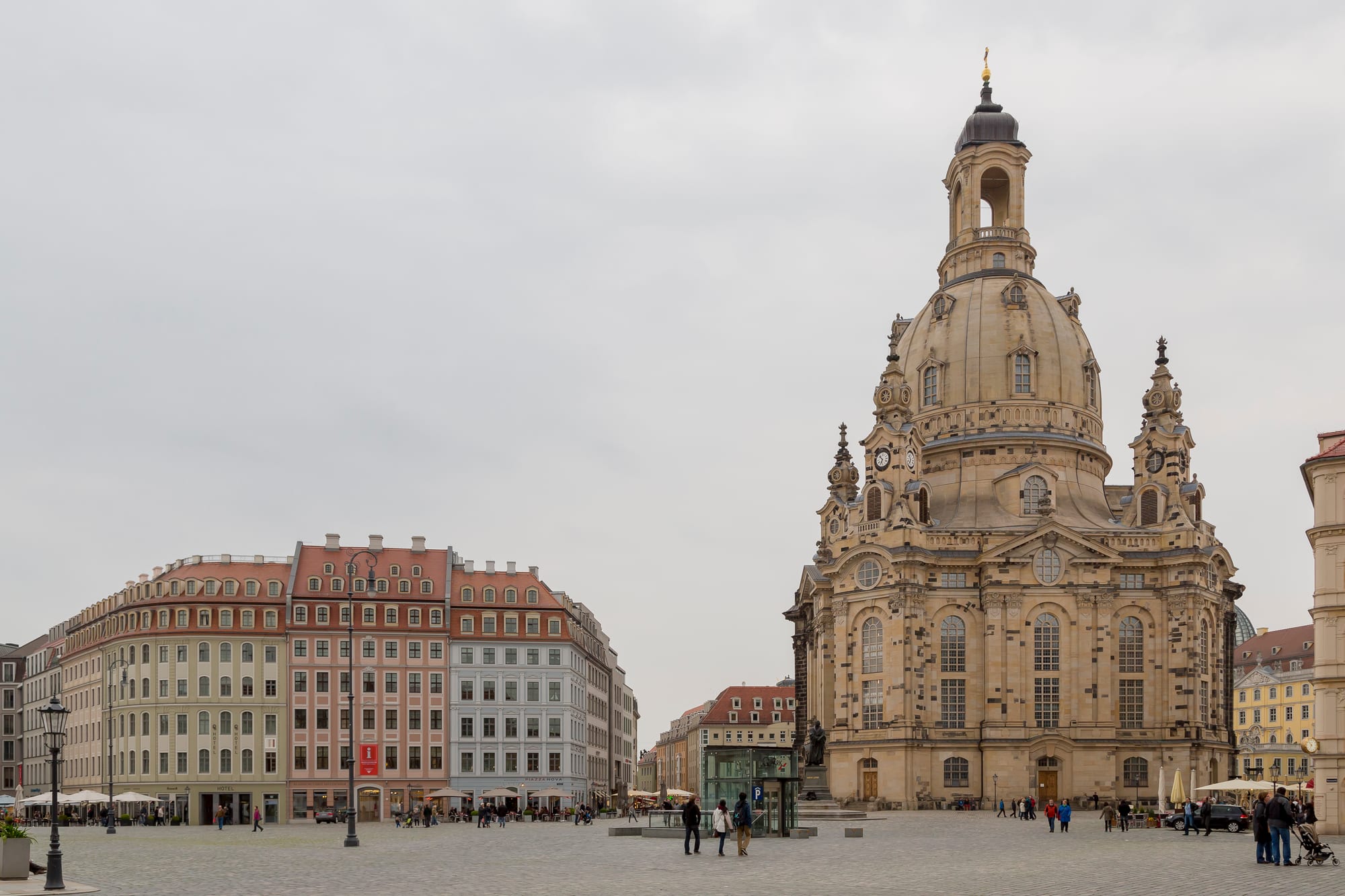
A domed sandstone Baroque church on a wide paved square, with rows of rebuilt pastel town houses on the left

Saxony, Thuringia & Saxony-Anhalt, Germany

Dresden

The Frauenkirche on the Neumarkt in Dresden, rebuilt between 1994 and 2005. (CEphoto, Uwe Aranas / Wikimedia Commons · CC BY-SA 3.0)

The capital of Saxony, on both banks of the Elbe, for centuries the residence of the Saxon electors and kings, who filled it with Baroque palaces, churches and art collections. Its centre was destroyed by Allied bombing in February 1945; much of it has since been rebuilt, the Frauenkirche from its own rubble, and the city is now a centre of chip-making and research.

Neighbourhoods

  • Altstadt (Old Town)
    • First-time visitors
    • Museums
    • Historic district

    The historic centre on the south bank, where the castle, the Zwinger, the Semperoper, the cathedral and the Frauenkirche stand within a few minutes' walk of one another. The Neumarkt has been rebuilt around the Frauenkirche, while the Altmarkt keeps its post-war buildings and the Kulturpalast.

    Open in Maps
  • Innere Neustadt
    • Architecture
    • Quiet and residential

    The Baroque 'new town' across the Augustus Bridge, entered past the gilded equestrian statue of Augustus the Strong on the Neustädter Markt, with the Hauptstraße and the Japanese Palace.

    Open in Maps
  • Äußere Neustadt
    • Nightlife
    • Best for food
    • Students

    The district beyond the old walls of the Neustadt, also called Antonstadt, preserved through the war and now known for its bars, clubs and cafés. Each June it hosts the street festival of the Bunte Republik Neustadt.

    Open in Maps
  • Blasewitz and Striesen
    • Quiet and residential
    • Villas

    Villa districts east of the centre that largely survived the war, linked to Loschwitz by the Blue Wonder bridge; from the late 19th century they drew wealthy residents.

    Open in Maps
  • Loschwitz and Weißer Hirsch
    • Viewpoints
    • Historic villas

    Hillside quarters on the north bank, reached across the Blue Wonder bridge, where a funicular railway has climbed to Weißer Hirsch since 1895 and old villas look down over the river.

    Open in Maps
  • Hellerau
    • Architecture
    • Quiet and residential

    Germany's first garden city, founded in 1909 on the northern edge of Dresden, with Heinrich Tessenow's Festspielhaus; the whole garden city has been a protected monument since 1993.

    Open in Maps

Things to do

Famous landmarks

  • Frauenkirchelandmark

    The Lutheran church of the 18th century on the Neumarkt, destroyed in 1945, left as a ruin for fifty years and rebuilt in 1994–2005 with privately raised funds; its gold cross was made in London.

    Open in Maps
  • Zwingerlandmark

    Pöppelmann's Baroque palace complex of pavilions and galleries, begun in 1709 as an orangery and festival ground for Augustus the Strong, now home to the Old Masters Gallery and still a venue for music and theatre.

    Open in Maps
  • Semperoperlandmark

    The opera house of the Saxon State Opera, destroyed in 1945 and reopened exactly forty years later, on 13 February 1985.

    Open in Maps
  • Dresden Castlelandmark

    The seat of the Saxon rulers from 1485, known for its mix of architectural styles from Baroque to Neo-Renaissance, which now holds the Green Vault and the armoury with its Turkish Chamber.

    Open in Maps
  • Dresden Cathedrallandmark

    The Catholic court church of the Saxon rulers, built in a Protestant city, a cathedral since 1980, with the crypt of the Wettin dynasty.

    Open in Maps
  • Brühl's Terraceviewpoint

    A raised promenade of buildings and gardens above the Elbe, once a gift to Count von Brühl, looking over the river to the Neustadt.

    Open in Maps
  • Kreuzkirchelandmark

    The largest church in Saxony and seat of the Lutheran regional bishop, rebuilt after the war by 1955 and home of the Kreuzchor boys' choir.

    Open in Maps

Museums

  • Green Vaultmuseum

    The largest treasure collection in Europe, founded by Augustus the Strong in 1723 and shown in the historic treasure chamber of 1733 and a modern exhibition in the castle.

    Open in Maps
  • Bundeswehr Military History Museummuseum

    The armed forces' museum in a former arsenal in the Albertstadt, cut through by a wedge-shaped extension designed by Daniel Libeskind.

    Open in Maps
  • German Hygiene Museummuseum

    A museum of health, human biology and medicine in a monumental modernist building of 1928–30.

    Open in Maps
  • Yenidzelandmark

    A former cigarette factory built in 1907–09 in the style of a mosque, one of the city's most unusual buildings.

    Open in Maps

Parks and the river

  • Großer Gartenpark

    A large Baroque park in the centre of the city that contains the zoo and the botanical garden.

    Open in Maps
  • Dresden Zooattraction

    Germany's fourth-oldest zoo, opened in 1861 on the southern edge of the Großer Garten and known especially for its Asian animals.

    Open in Maps
  • Blue Wonderlandmark

    A cantilever truss bridge of 1893 between Blasewitz and Loschwitz, built without river piers and saved in 1945 when two people cut the detonator wires laid by the SS.

    Open in Maps
  • Dresden Funicular Railwayviewpoint

    A funicular that has carried passengers between Loschwitz and Weißer Hirsch since 1895, with views over the Elbe valley.

    Open in Maps
  • Pillnitz Palacelandmark

    The Baroque summer residence of the Saxon electors and kings at the eastern end of the city, with Chinese-style touches, a Baroque garden, a large park and a museum of decorative arts.

    Open in Maps
  • Paddle steamerstransit hub

    The oldest and largest fleet of paddle steamers in the world, running along the Elbe from Dresden towards Meissen and Saxon Switzerland past castles, vineyards and villa quarters.

    Open in Maps

Short trips from the city

  • Meissenattraction

    The cathedral and castle town downriver, home of Meissen porcelain.

    Open in Maps
  • Moritzburg Castlelandmark

    A Baroque palace with four round towers on an artificial island, about 13 kilometres north-west of the city, in the former hunting grounds of the Saxon rulers.

    Open in Maps
  • Basteiviewpoint

    Sandstone towers above the Elbe gorge in Saxon Switzerland National Park, crossed by a stone bridge of 1851.

    Open in Maps

Seasonal events

  • Commemoration of the bombing13 February

    Thousands of residents gather each year on the anniversary of the 1945 raid to remember the city's destruction.

  • Dresden Music FestivalMay and June

    A classical music festival with a theme that changes each year, using venues from the Semperoper to the Frauenkirche and the Großer Garten.

  • Bunte Republik NeustadtJune

    A three-day culture festival in the Äußere Neustadt, with free live music in the streets.

  • StriezelmarktAdvent, until Christmas Eve

    One of the oldest Christmas markets in the world, founded as a one-day market in 1434, with some 240 stands and the Stollen for which the city is famous.

Eat and drink

Long-standing places and food districts in Dresden. Hours, ratings and directions come from your maps app, always current.

Dresden classics

  • Striezelmarktmarket

    The Advent market on the Altmarkt, where Dresdner Stollen is sold.

    Open in Maps
  • Cafés and cakecafe

    Saxony has a strong coffee-house tradition, and Dresden's cafés serve Eierschecke and other Saxon cakes with coffee.

    Open in Maps

Food districts

  • Äußere Neustadtneighborhood

    The district best known for its bars and clubs, with restaurants and cafés among them.

    Open in Maps
  • Neumarkt and the Altstadtneighborhood

    Restaurants and cafés in the rebuilt houses around the Frauenkirche and on the streets towards the castle.

    Open in Maps

Experience Dresden

History

Dresden grew up as a German trading settlement on the south bank of the Elbe, first recorded in 1206, opposite a Sorbian village whose name it took. After the Wettin lands were divided in 1485 Dresden became the capital of the Albertine duchy, and in 1547 of the Electorate of Saxony. Elector Frederick Augustus I, who became King Augustus II the Strong of Poland in 1697, and his son drew musicians, architects and painters from all over Europe and built most of the Baroque city — the Zwinger, the Japanese Palace, Pillnitz, the Catholic court church and the Lutheran Frauenkirche — along with the Green Vault and other collections.

The Seven Years' War brought heavy damage, and Napoleon won the Battle of Dresden here in August 1813. The 19th century brought the Technical School of 1828, forerunner of TU Dresden, the railway to Leipzig, the May Uprising of 1849 and rapid industrial growth; Dresden was famous for cameras and cigarettes, and until 1933 a centre of modern art. Under the Nazis its Jewish community of more than 6,000 was reduced to 41 people.

Between 13 and 15 February 1945 British and American bombers destroyed the inner city, killing between 22,500 and 25,000 people. East Germany cleared many ruins, rebuilt the Zwinger, the cathedral and the Semperoper, and left the Frauenkirche as a memorial. Since reunification the Frauenkirche and the Neumarkt have been rebuilt; the 2002 flood damaged many landmarks; the Elbe valley, listed by UNESCO in 2004, lost its status in 2009 over the Waldschlösschen Bridge; and in September 2024 a section of the Carola Bridge collapsed into the river.

Culture & Customs

Few cities of its size carry such a musical weight. The Sächsische Staatskapelle, founded in 1548, plays at the Semperoper, where works by Wagner and Richard Strauss were first performed, and the Kreuzchor, a boys' choir founded in the 13th century, is based at the Kreuzkirche. The Dresden Philharmonic, the State Operetta and the Herkuleskeule political cabaret add to a calendar that runs from the Dresden Music Festival in May and June to music in the Zwinger and the Striezelmarkt in Advent, held since 1434.

The visual arts have equally deep roots. The Dresden State Art Collections, begun by the electors in the 16th century, run a dozen or more museums, and the Academy of Fine Arts, founded in 1764, counts Otto Dix and Oskar Kokoschka among its former professors; Ernst Ludwig Kirchner also worked here. Hellerau's festival theatre and the Palucca dance school continue a modernist tradition.

Memory is a large part of local identity. Each year on 13 February thousands of residents gather to remember the bombing, a ceremony that has taken on a pacifist tone since reunification, while the city has also seen large far-right marches, including the Pegida demonstrations from 2014. Football support centres on Dynamo Dresden, eight times East German champions and known for their dedicated fans.

Daily Life

About 571,500 people were registered as living in Dresden at the end of 2025, making it the second city of Saxony after Leipzig; more than 780,000 live in its urban area, which includes Radebeul, Freital, Pirna and Meissen. The population fell in the 1990s but grew by more than 45,000 between 2000 and 2010. With 62 per cent of its area green space and forest, including the 50-square-kilometre Dresden Heath, it is one of the greenest cities in Europe.

The economy has recovered faster than most of eastern Germany. Dresden is the centre of Silicon Saxony, a semiconductor industry begun in 1969, with plants of GlobalFoundries and Infineon; pharmaceuticals and mechanical and electrical engineering are the other traditional pillars. TU Dresden, one of Germany's largest universities, three Max Planck institutes and the world's biggest concentration of Fraunhofer institutes make it a research city, and as state capital it houses the Saxon parliament and ministries. Tourism brings around 4.7 million overnight stays a year.

Most people live in the Elbe valley, in districts that range from the preserved villa quarters of Blasewitz, Striesen and Loschwitz to the large prefabricated estates of Prohlis and Gorbitz. Since September 2024 the city has also had to manage without the Carola Bridge, a road and tram crossing, whose remaining structure was being demolished in 2025.

Food

Saxon cooking is hearty, with a great variety of sauces and dumplings, Klöße, served instead of potatoes; freshwater fish, especially carp and trout, are common. Sächsischer Sauerbraten, marinated pot roast, is the classic Sunday dish, and other regional favourites include Quarkkäulchen, Blinsen pancakes, Klitscher potato pancakes and Saure Flecke.

Dresden's sweetest fame is its cakes. Saxony claims the German custom of coffee and cake, Kaffee und Kuchen, and its people were nicknamed Kaffeesachsen. Eierschecke is a layer cake of a cake base, a quark cheesecake middle and vanilla custard on top. Dresdner Stollen, a moist, heavy bread filled with fruit and originally called Striezel, was first mentioned in 1474; the official version carries a seal showing Augustus the Strong and is baked by around 110 bakeries in the city, and a Stollen festival is held every year. Pulsnitzer Pfefferkuchen, a kind of gingerbread, is another Saxon favourite.

Beer comes from Radeberg, where the Radeberger brewery was founded in 1872, and Freiberger is another Saxon beer. The Elbe valley between Pillnitz and Diesbar-Seußlitz north of Meissen forms the Saxony wine region, one of the northernmost in Europe, and the Äußere Neustadt is the place for bars and late nights.

Planning tools

Budget

Dresden is cheaper than Munich, Hamburg or Frankfurt for rooms, meals and beer, though prices rise on Advent weekends, when the Striezelmarkt draws huge crowds and beds become scarce. Museum tickets are the main sightseeing cost; walks along the Elbe meadows and the Neumarkt are free.

Daily Budget Midrange
USD 130–230 (mid-range hotel, restaurant dinners, state museum tickets, a paddle-steamer trip)
Daily Budget Shoestring
USD 55–100 (hostel or simple guesthouse, bratwurst stands and bakery food, trams)

The State Art Collections sell combined tickets for several museums; the paddle steamers are priced separately from city transport.

Best Time to Visit

May, June, September and early October for warm days on the river; the music festival runs in May and June and the Bunte Republik Neustadt in June. July and August are the warmest and wettest months. Advent is a season of its own, with the Striezelmarkt, but brings the biggest crowds. January and February are cold and quiet.

Suggested Number of Days

Two or three days suit a first visit to the city and its main museums. Allow four to six to add the river, the palaces up- and downstream, the porcelain town and the sandstone country; the depth of the museums is what most often stretches a stay.

First Visit
2–3 days
With Surroundings
4–6 days

Transportation

Dresdner Verkehrsbetriebe runs twelve tram lines on a 200-kilometre network, backed by buses and night buses that meet at Postplatz. Three S-Bahn lines run along the Elbe, including towards Saxon Switzerland. Paddle steamers serve the river in season, and a funicular climbs from Loschwitz to Weißer Hirsch.

Rathen, the main base for visiting the Bastei, can be reached from Dresden by paddle steamer on the Elbe.

Airport & Station Connections

Dresden Airport is in Klotzsche, 9 kilometres north of the centre, with its own S-Bahn station; it has flights to a few European cities and holiday destinations, and a direct IC train links the city with Berlin Brandenburg Airport. Dresden Hauptbahnhof and Dresden-Neustadt have trains to Berlin, Leipzig, Chemnitz and Prague. The A4, A13 and A17 motorways meet at the city.

Walkability

The old town is compact and best seen on foot: the Frauenkirche, castle, Zwinger, Semperoper and Brühl's Terrace are all close together, and the Augustus Bridge leads to the Neustadt. The Elbe meadows make long riverside walks possible. The city is large in area, so trams are needed for the Großer Garten, the villa districts and Pillnitz.

Safety

Germany is a safe country with low levels of violent crime. In Dresden the main issue for visitors is pickpocketing around the main station and in Advent crowds. Political demonstrations are frequent and best avoided; far-right marches here have been among the largest of their kind in post-war Germany. The Elbe can flood after heavy rain, as it did disastrously in 2002.

Keep bags secure in crowds, steer clear of demonstrations, validate transit tickets, and stay out of marked cycle lanes on foot. Check current official travel advice before travelling.

Climate

An oceanic climate with significant continental influence. Summers are warm and winters a little colder than the German average; February to April are the driest months and July and August the wettest. The Elbe valley in the city centre is milder than the higher districts, where the weather station at Klotzsche reads one to three degrees colder.

Summer
warm — July averages about 19°C
Winter
cold — January averages about 0°C

Local Customs

Tips are usual in restaurants, bars and taxis but rarely exceed 10 per cent; many people round up, stating the total when paying. Most shops close on Sundays. Bottles and cans carry a deposit (Pfand). The 13 February commemoration is a sombre occasion. Most people belong to no church, but the Frauenkirche, the cathedral and the Kreuzkirche are active places of worship.

Dress respectfully and keep quiet in churches during services, keep out of cycle lanes on foot, and treat the February commemorations with respect.

Common Payment Methods

The currency is the euro. Cards are accepted in hotels, museums, larger shops and most restaurants, but Germany is still fond of cash, and some bakeries, market stalls and bars may refuse cards, so carry some euros. ATMs are easy to find in the centre and at the main stations.