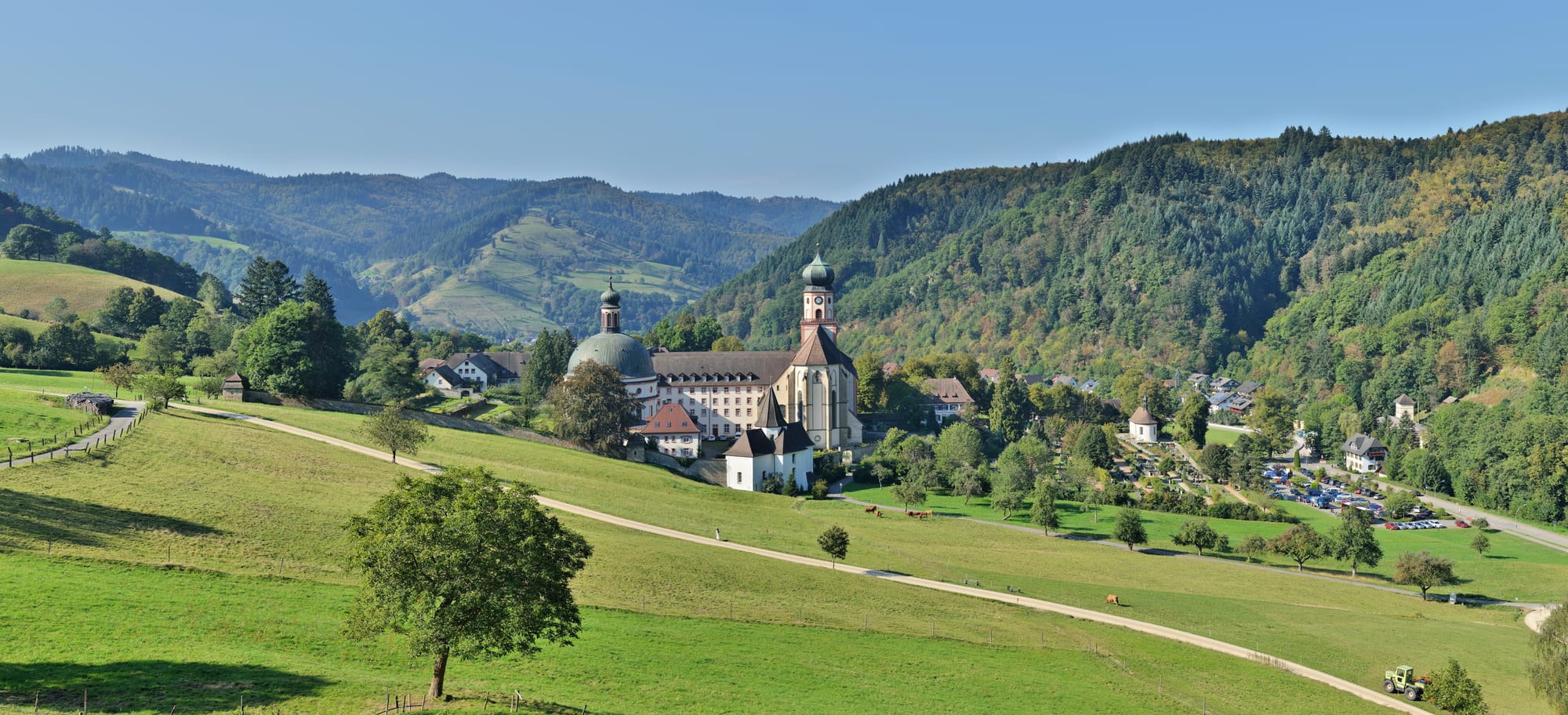
Green meadows and a winding path leading to a white abbey church with an onion-domed tower, set among wooded hills

Germany

Baden-Württemberg

The abbey of St. Trudpert in the Münstertal, a valley of the southern Black Forest. (Taxiarchos228 / Wikimedia Commons · FAL)

Germany's south-western state, bordered by France and Switzerland along the Rhine and reaching Lake Constance in the south. It joins the Swabian heartland around Stuttgart with the old grand duchy of Baden, and runs from the university towns of Heidelberg, Tübingen and Freiburg through the Black Forest to the car factories of the Neckar valley.

Explore Baden-Württemberg

History

Celtic chiefs ruled here long before Rome: the fortified Heuneburg above the Danube and the rich princely grave at Hochdorf date from the 6th century BC. Rome pushed its frontier, the Limes, across the north of the state and ran spa towns such as Aquae, now Baden-Baden, until the Alemanni overran the area in the 3rd century. In the Middle Ages the duchy of Swabia produced the Hohenstaufen emperors, whose ancestral hill lies near Göppingen, and the Hohenzollerns, later kings of Prussia, took their name from a castle near Hechingen.

The land then fragmented into dozens of territories. Württemberg grew around Stuttgart and turned Lutheran; the south, including Freiburg, belonged to the Habsburgs as Further Austria until 1805; and the north-west, including Heidelberg, was part of the Electoral Palatinate, whose castle French troops wrecked in the late 17th century. Heidelberg's university, founded in 1386, is the oldest in today's Germany, and Freiburg and Tübingen followed in the 15th century. Napoleon swept away the small states, creating a Kingdom of Württemberg and a Grand Duchy of Baden in 1806, and Baden became a centre of the 1848–49 revolution, crushed at the fortress of Rastatt.

Industry followed. Carl Benz built his motor car in Mannheim in 1885–86, Gottlieb Daimler worked in Cannstatt, and Robert Bosch opened his Stuttgart workshop in 1886. Allied bombing destroyed much of Stuttgart, Pforzheim and Freiburg, though Heidelberg was largely spared. Baden, Württemberg-Baden and Württemberg-Hohenzollern merged after a referendum to form Baden-Württemberg in 1952, and in 2011 the state elected Germany's first Green-led government.

Culture & Customs

The state joins two peoples who like to tease each other. Swabians, in Württemberg, are caricatured as thrifty, hard-working and house-proud — their motto is "schaffe, schaffe, Häusle baue", work, work, build a little house — while Badeners, on the Rhine side, see themselves as more easy-going and French-influenced. Dialects are Swabian and Alemannic, the latter close to Swiss German; the south and much of Baden are Catholic, and old Württemberg is Protestant with a strong pietist streak.

The great festival is the Swabian-Alemannic Fasnet before Lent, distinct from Rhineland Carnival, with carved wooden masks, bells and whips parading through Rottweil, Villingen and many small towns. Stuttgart's Cannstatter Wasen in autumn is the region's answer to Oktoberfest. In the Black Forest the Bollenhut, a straw hat topped with red wool pompoms for unmarried women, belongs to a few Protestant villages near Gutach but has become the symbol of the whole range, alongside the cuckoo clocks made there since the 18th century.

The region has an outsized share of German letters and ideas: Schiller was born in Marbach, Hölderlin spent his last decades in a tower in Tübingen, and Hegel was born in Stuttgart. Everyday customs include the Swabian Kehrwoche, the rota for sweeping shared stairs and pavements, and the Besenwirtschaft, a winemaker's temporary tavern marked by a broom hung outside.

Daily Life

About 11 million people live in Baden-Württemberg. Stuttgart, with about 630,000 residents, anchors a dense ring of industrial towns along the Neckar; Mannheim and Karlsruhe, each around 300,000, lead the Baden side, followed by Freiburg, Heidelberg, Ulm, Heilbronn and Pforzheim. Tübingen and Konstanz are smaller university towns. Karlsruhe is the seat of Germany's Federal Constitutional Court.

This is one of Europe's richest industrial regions, with low unemployment. Mercedes-Benz and Porsche build cars around Stuttgart, Bosch is the world's largest car-parts supplier, SAP is based at Walldorf and ZF at Friedrichshafen, and hundreds of family-owned engineering firms lead world markets in narrow niches. The shift to electric cars and weak export demand have brought job cuts and anxiety to supplier towns, and housing in Stuttgart, Freiburg and Heidelberg is scarce and dear.

Days start early — many factories begin work before seven — and weekends go to hiking-club outings, the allotment or the family's own vineyard plot. Freiburg is known for its solar power and car-light Vauban district, Stuttgart for traffic and fine-dust smog in its valley basin, and Tübingen and Heidelberg for their large student populations.

Food

Swabian cooking is built on dough. Spätzle, soft egg noodles scraped from a board into boiling water, come with gravy, as Käsespätzle layered with cheese and fried onions, or with lentils and thin Saitenwürstle sausages as Linsen mit Spätzle. Maultaschen are large pasta pockets filled with minced meat and spinach, Schupfnudeln are finger-shaped potato noodles fried with sauerkraut, and Zwiebelrostbraten is a beef steak topped with crisp onions. Flädlesuppe is broth with strips of pancake, and the Swabian Laugenbrezel, the lye pretzel with its thin arms and fat belly, is the breakfast of choice.

Baden's cooking leans towards France: Flammkuchen, a thin tart of cream, onion and bacon, snails, asparagus from the Rhine plain in spring, and game from the forests. The Black Forest supplies Schwarzwälder Schinken, a cold-smoked raw ham with protected status, trout, and Kirschwasser, a clear cherry brandy, which also flavours the Schwarzwälder Kirschtorte, the chocolate, cream and cherry gâteau. Lake Constance fishermen land Felchen, a whitefish usually served fried or grilled.

Baden's wines, from the Kaiserstuhl, the Markgräflerland and the Ortenau, are mostly Pinot varieties — Spätburgunder, Grauburgunder and Weissburgunder — and Gutedel; Württemberg's are light reds such as Trollinger and Lemberger. Farmhouse cider, Most, is common in the Swabian countryside, and Rothaus, brewed by the state in the Black Forest, is a regional favourite.

Attractions & Natural Wonders

Stuttgart has the Mercedes-Benz and Porsche museums, the palaces around the Schlossplatz, the Staatsgalerie and Le Corbusier's houses in the Weissenhof Estate, with the baroque palace of Ludwigsburg just north. Heidelberg's castle ruin, Old Bridge and Philosophers' Walk sit on the Neckar, near the palace gardens of Schwetzingen and the Cistercian monastery of Maulbronn, a UNESCO World Heritage Site. Tübingen offers punting on the Neckar, Hölderlin's tower and the castle of Hohentübingen, with the hilltop Hohenzollern Castle to the south.

The Black Forest runs from Baden-Baden, with its spa baths and casino, along the Black Forest High Road past the Mummelsee and Black Forest National Park, to the Triberg waterfalls, the open-air farmhouse museum at Gutach and the half-timbered towns of Gengenbach and Schiltach. In the south rise the Feldberg, the highest summit, and the Titisee and Schluchsee lakes. Freiburg, at its western edge, has the red sandstone minster, the Bächle and the old market, with the volcanic vineyard hills of the Kaiserstuhl nearby.

Lake Constance has Konstanz, where the church council of 1414–18 met, the monastic island of Reichenau, a UNESCO World Heritage Site, the garden island of Mainau, Meersburg's old castle, prehistoric pile dwellings reconstructed at Unteruhldingen and the Zeppelin Museum in Friedrichshafen. The Swabian Jura has the Blautopf spring at Blaubeuren, caves where Ice Age carvings were found, and Ulm Minster, with one of the world's tallest church steeples.

Cities in Baden-Württemberg

Planning basics

Budget

Baden-Württemberg is one of Germany's wealthier and pricier states. Stuttgart, Heidelberg, Baden-Baden and the Lake Constance shore in summer are expensive, while the Black Forest's family guesthouses, the Swabian Jura and small towns in the Hohenlohe are better value. Many Black Forest communities give overnight guests a card with free local buses and trains.

Daily Budget Midrange
USD 160–280 (mid-range hotel, restaurant dinners, museum and spa tickets, some car hire)
Daily Budget Shoestring
USD 70–110 (hostel or guesthouse, bakery and beer-garden food, regional trains with a guest card)

Ask Black Forest hosts for the local guest card, which usually covers regional trains and buses in the area.

Safety

Baden-Württemberg is one of Germany's safest states. Petty theft around big stations and at Stuttgart's festivals is the usual urban risk. In the Black Forest the hazards are winding roads, winter ice and snow on the passes, thunderstorms on exposed ridges, and ticks in the woods in summer.

Carry winter equipment for mountain roads in the cold months and check for ticks after forest walks. Check current official travel advice before travelling.

Climate

The Upper Rhine plain around Freiburg, the Kaiserstuhl and Heidelberg is among the warmest and sunniest parts of Germany. The Black Forest and the Swabian Jura are much cooler, with reliable winter snow on the higher Black Forest summits, while Lake Constance softens the climate on its shore but is prone to autumn fog.

Summer
warm to hot on the Rhine plain, 25–32°C; pleasant in the Black Forest, 18–25°C, with thunderstorms
Winter
around 0–5°C in the lowlands; snow and sub-zero days in the Black Forest and on the Jura

Transportation

Stuttgart has the main airport, and Karlsruhe, Mannheim and Stuttgart are on the high-speed rail network; the Rhine valley line runs south via Freiburg to Basel. Scenic regional railways cross the Black Forest, and passenger boats and car ferries link the towns of Lake Constance. Stuttgart's long-running rebuilding of its main station continues to disrupt services.

Stuttgart to Heidelberg takes about 40 minutes to an hour by train; a car helps for the higher Black Forest and the Jura.

Best Time to Visit

May to October for walking in the Black Forest, the Neckar valley and around Lake Constance, whose boats and island gardens are at their best in summer. September and October bring the grape harvest, wine taverns and Stuttgart's Cannstatter Wasen fair. January and February suit skiing in the southern Black Forest and the Swabian-Alemannic Fasnet carnival.