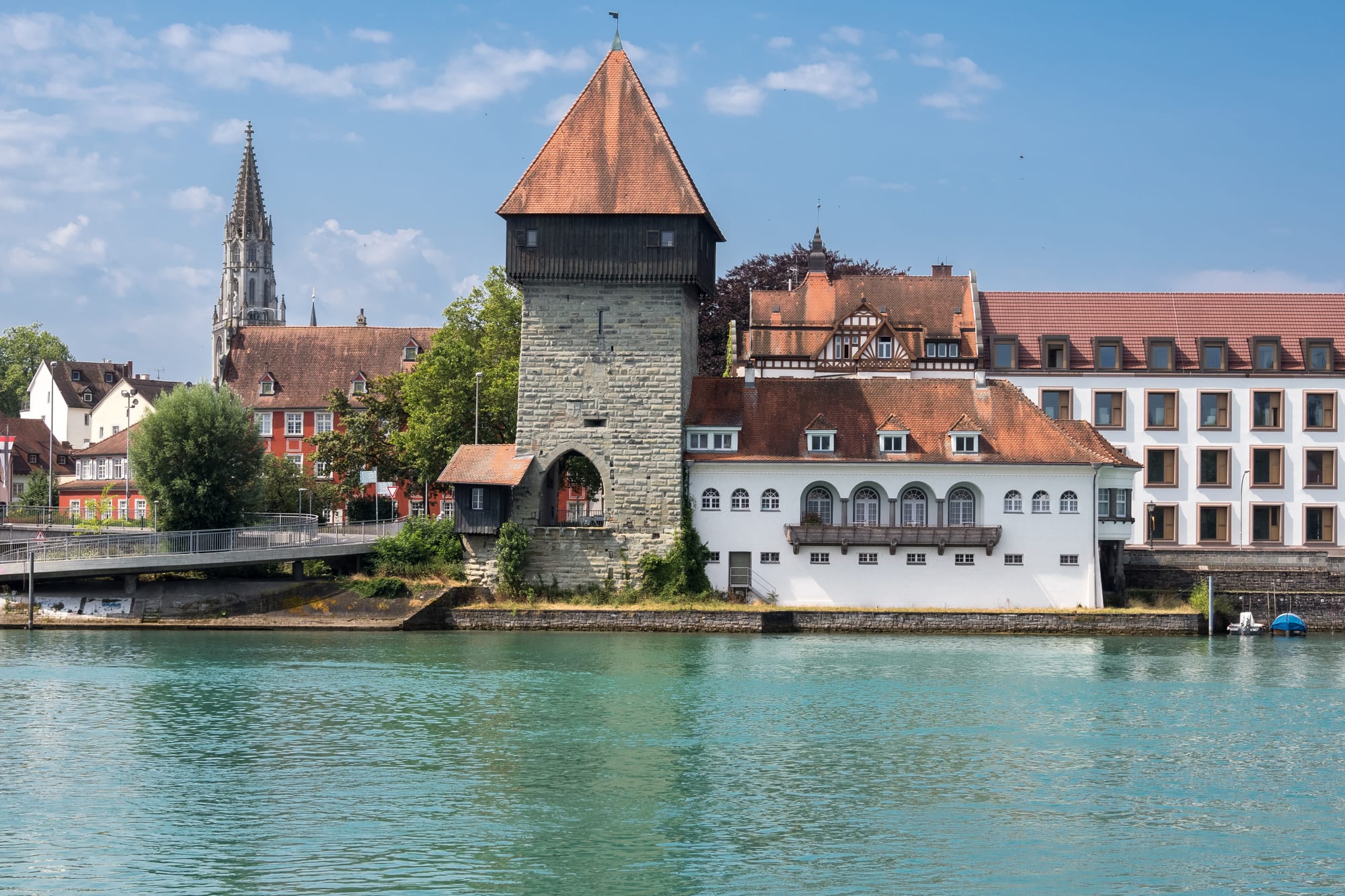
A stone gate tower with a steep red roof on the turquoise Rhine, with old houses behind

Baden-Württemberg, Germany

Konstanz

The Rheintorturm on the Seerhein in Konstanz, a remnant of the medieval Rhine bridge. (JoachimKohler-HB / Wikimedia Commons · CC BY-SA 4.0)

A university city on Lake Constance where the Rhine leaves the lake, its old town pressed against the Swiss border and the town of Kreuzlingen. A Roman fort, then for more than 1,200 years the seat of a bishop, it hosted the Council of Constance in 1414–18, escaped wartime bombing, and is now a lakeside town of students, boats and cross-border shoppers.

Neighbourhoods

  • Altstadt
    • First-time visitors
    • Historic district
    • Close to public transport

    The large old town on the south side of the Rhine, one of only two parts of Germany south of the river, with twisting alleys, the minster, the Marktstätte square, the harbour and the Swiss border at its edge. The Niederburg, the oldest quarter, lies in its north-west corner by the Rhine.

    Open in Maps
  • Paradies
    • Quiet and residential
    • Local life

    A former fishing and farming village west of the old town on the southern shore of the Seerhein, whose vegetable growers long farmed the fields to its west. It is now a residential quarter close to the centre and the border.

    Open in Maps
  • Petershausen
    • Students and nightlife
    • Parks

    The district across the Old Rhine Bridge on the north bank, grown around a Benedictine abbey whose buildings now hold the state archaeology museum. The Herosé park runs along the Seerhein on the site of a former textile factory.

    Open in Maps

Things to do

Famous landmarks

  • Konstanz Minsterlandmark

    The former cathedral of the diocese of Konstanz, dissolved in 1821, whose tower dominates the old town skyline.

    Open in Maps
  • Imperialandmark

    Peter Lenk's 9-metre satirical statue at the harbour entrance, erected without permission in 1993, of a courtesan holding two little figures in papal tiara and imperial crown; it turns once every four minutes.

    Open in Maps
  • Council buildinglandmark

    The Konzilgebäude by the harbour, where the conclave of the Council of Constance elected Pope Martin V — the only papal conclave ever held north of the Alps.

    Open in Maps
  • Rheintorturmlandmark

    A gate tower on the Rhine that marks the site of the medieval bridge and now houses a museum of Konstanz Fasnacht.

    Open in Maps

Museums

  • Rosgartenmuseummuseum

    A museum of the art and history of the city and the lake, founded in 1870 in a guildhall built in 1324.

    Open in Maps
  • Archäologisches Landesmuseummuseum

    The state archaeology museum in the former abbey buildings at Petershausen, showing finds from across Baden-Württemberg.

    Open in Maps
  • Sea Life Centreattraction

    An aquarium on the waterfront near the border, with rays and penguins as well as the fish of the Rhine and Lake Constance.

    Open in Maps

Lake and riverside

  • Hörnlebeach

    The city's lake beach at the eastern tip of Konstanz, reached by bus, with swimming in the lake and a nudist area at its north end.

    Open in Maps
  • Herosé-Parkpark

    A park along the north bank of the Seerhein in Petershausen, laid out on part of the site of the former Herosé textile factory.

    Open in Maps

Short trips from the city

  • Mainaupark

    The garden island in Lake Überlingen, part of the city since 1971 and owned by the Bernadotte foundation, with flowers, a lakeside park and a tropical butterfly house.

    Open in Maps
  • Reichenau Islandlandmark

    An island reached by causeway west of the city, whose abbey was founded in 724; its three churches and abbey are a World Heritage Site.

    Open in Maps
  • Meersburgattraction

    A medieval lakeside town across the water, reached by the car ferry, with a pedestrian lower and upper town joined by stairways.

    Open in Maps
  • Pfahlbaumuseum Unteruhldingenmuseum

    An open-air museum on the lake shore with reconstructed Neolithic and Bronze Age stilt houses.

    Open in Maps
  • Stein am Rheinattraction

    A small Swiss town down the Rhine, reached by boat from Konstanz, with a medieval old town.

    Open in Maps

Seasonal events

  • Konstanz FasnachtJanuary or February

    The carnival season, with masked guilds, the Butzenlauf through the old town and the Hemdglonker parade in nightshirts starting in the Niederburg.

  • Seenachtfestsecond weekend of August

    A lake festival held together with neighbouring Kreuzlingen, with stages, water shows and a market along the shore.

  • Christmas marketlate November to December

    Stalls of mulled wine, food and crafts along the harbour and the Marktstätte.

Eat and drink

Long-standing places and food districts in Konstanz. Hours, ratings and directions come from your maps app, always current.

Konstanz classics

  • Marktstätteneighborhood

    The central square of the old town and the obvious place to start on the city's restaurants, with the old fish-market square, the Fischmarkt, just to the north.

    Open in Maps
  • Felchen from the lakerestaurant

    Felchen, the whitefish that makes up most of the Lake Constance catch, served whole or as a fillet in fish restaurants around the lake.

    Open in Maps

Bars and the riverside

  • Niederburgneighborhood

    The oldest quarter of the old town, whose small shops stay open late with music and art in the streets on the first Friday of each month from May to October.

    Open in Maps
  • Seerhein riversideneighborhood

    The banks of the Rhine between the lake and the Untersee, where people swim near the pedestrian bridge and a beach bar on the south shore sets out deckchairs on the sand.

    Open in Maps

Experience Konstanz

History

Celts lived on the site of today's Niederburg before the Romans arrived around AD 40. The town's name, Constantia, comes either from the emperor Constantius Chlorus, who built a strong fortress here around 300 while fighting the Alemanni, or from his grandson Constantius II; the remains of the late Roman fort were found in 2003. Around 585 a bishop took up residence, beginning more than 1,200 years as a church centre. Konstanz owned the only bridge across the Rhine in the region, grew rich on linen and became an imperial city in 1192.

From 1414 to 1418 the Council of Constance met here. It burned the Czech reformer Jan Hus at the stake on 6 July 1415 and ended the Papal Schism by electing Martin V in the only conclave ever held north of the Alps. When the Swiss took the Thurgau in 1460, Konstanz lost its hinterland, and the Swiss cantons refused it membership. The town turned Protestant in the 1520s, but in 1548 Charles V placed it under the imperial ban and it passed to Habsburg Austria, which brought in the Jesuits; their theatre of 1610 is the oldest in Germany still performing regularly.

Konstanz became part of Baden in 1806, and the diocese was dissolved in 1821. Count Ferdinand von Zeppelin, the airship builder, was born here in 1838. In October 1940 the last Jewish residents were deported to Gurs. Lying almost within Switzerland, the city was not bombed in the Second World War, which is why its large old town survives. The university followed in 1966, and in recent years Swiss cross-border shoppers have reshaped the centre.

Culture & Customs

Konstanz is defined by water and borders. The Rhine leaves the lake through the middle of the city, and summer life moves to the shore, the Rhine banks and the boats; the harbour, with the slowly turning Imperia statue mocking the princes and prelates of the Council, is the city's best-known image. The old town keeps the medieval street plan, three towers of the old city wall and many guild and merchant houses.

Fasnacht is the great festival. In the weeks before Lent masked guilds parade through the old town, the Butzenlauf opens the street carnival, and the Hemdglonker parade of townspeople in nightshirts sets off from the Niederburg; the Rheintorturm holds a Fasnacht museum. In August the Seenachtfest, shared with Kreuzlingen, fills the lakeshore with stages and water shows.

The University of Konstanz, founded in 1966 and counted among Germany's most successful universities in the Excellence Initiative, gives the city a young population, and its library is open around the clock. The city theatre, founded in the Jesuit college, keeps a long stage tradition. Relations with Swiss neighbours are close and sometimes strained: shoppers from Switzerland bring trade, and some residents avoid the centre on Saturdays.

Daily Life

About 83,000 people live in Konstanz, the largest city on Lake Constance. The old town and Paradies lie south of the Rhine; the larger part of the city lies on the Bodanrück peninsula to the north, with districts such as Petershausen, Wollmatingen and Litzelstetten, alongside the university and industrial estates.

The economy rests on the university and other colleges, public administration as the seat of the district, tourism and retail. Cross-border shopping has become a major business since the late 2010s, with large chain stores built near the centre to serve Swiss customers who reclaim German VAT, and customs offices sit beside the shopping centres.

The rhythm of the year follows the lake: swimming in the Rhine and at the Hörnle beach, sailing from the yacht harbour and evenings by the water in summer; fog and quiet in late autumn; Fasnacht in the depths of winter. Crossing between Konstanz and Kreuzlingen is part of ordinary life on both sides of the border.

Food

Konstanz eats from the lake and the surrounding farmland. Felchen, the whitefish that makes up most of the Lake Constance catch, is served whole or as a fillet in fish restaurants around the lake, and the old fish-market square, the Fischmarkt, still recalls the trade. The vegetable growers of Paradies long farmed the fields to its west, and a farmers' market brings regional produce into the old town.

The wider cooking is that of Baden and Swabia. Flammkuchen, a speciality shared with Alsace and Baden, is bread dough rolled very thin and covered with fromage blanc or crème fraîche, sliced onions and lardons, baked in a wood-fired oven; Maultaschen, large pasta pockets filled with minced and smoked meat, spinach and onion, are protected as a Swabian speciality; and Spätzle, an irregular egg pasta, come with many dishes.

The Marktstätte and the streets around it are the centre of the restaurant scene. A wine festival brings local wines and music outdoors, and in summer a beach bar on the Rhine shore sets out deckchairs on the sand.

Planning tools

Budget

Konstanz is moderately expensive, with lakeside hotels the main cost and prices rising in summer. Many Swiss cross the border to shop because basic goods are cheaper in Germany, so supermarkets and shops in the centre are very busy on Saturdays. Boat trips and the island gardens are the main paid extras; swimming in the lake and the Rhine is free.

Daily Budget Midrange
USD 160–280 (mid-range hotel, restaurant dinners with lake fish, Mainau entry and a boat trip)
Daily Budget Shoestring
USD 75–115 (hostel bed, bakery and market food, city buses)

Visitors spending a day in Switzerland should keep in mind that prices across the border in Kreuzlingen are in Swiss francs and noticeably higher.

Best Time to Visit

May to September, when the boats run their full timetables, the lake and the Rhine are warm enough to swim and the gardens of Mainau are in flower; the Seenachtfest falls in August. Autumn and winter often bring days or weeks of fog over the lake, though Fasnacht in January or February and the Christmas market liven up the old town.

Suggested Number of Days

Two days cover the old town, the harbour and the riverside. Four or five allow for the islands, the towns around the lake and a trip down the Rhine into Switzerland, with boats, trains and the car ferry doing much of the travelling.

First Visit
2 days
With Surroundings
4–5 days

Transportation

City buses run by the Stadtwerke cover the districts, and Konstanz has several stations along the line towards Singen. Ferries are part of daily transport: a car ferry crosses to Meersburg, catamarans link the city with Friedrichshafen, and passenger boats run to the lake towns and down the Rhine to Schaffhausen. Cycling is popular along the shores.

Carry a passport or identity card when crossing into Switzerland; Kreuzlingen begins at the southern edge of the old town.

Airport & Station Connections

Konstanz station is the eastern end of the High Rhine Railway from Singen, with connections across Germany and to Schaffhausen and Basel; Swiss trains run from neighbouring Kreuzlingen. Zurich Airport has a direct train once an hour, and Friedrichshafen Airport, mostly for domestic flights, is reached by fast ferry. Drivers from the north often take the car ferry from Meersburg.

Walkability

The old town is compact and level, and the station, harbour, minster and Marktstätte are all a few minutes apart; the border with Kreuzlingen can be crossed on foot. The Old Rhine Bridge and a pedestrian and cycle bridge lead to Petershausen and the riverside park. Mainau and the Hörnle beach are better reached by bus or boat.

Safety

Germany is a safe country with low levels of violent crime. Konstanz is a calm university town; the main risks are crowds at the Seenachtfest and in the shopping streets on Saturdays, and the currents and boat traffic for those swimming in the Rhine.

Swim only at recognised spots, keep clear of boat channels, and keep bags secure in festival crowds. Check current official travel advice before travelling.

Climate

The lake acts as a store of heat, so winters are milder than in most of Germany, with only about 62 frost days a year, but summers can be humid and still. Long spells of fog and low cloud are common from October to February, and the city is among the rainier in Germany.

Summer
warm and sometimes humid — summer days around the lake are typically 26–33°C, and the lake stays around 20°C until October
Winter
short and often foggy — nights around the lake can fall below 0°C from December to February, and snow lies on about 23 days a year, mostly in January and February

Local Customs

Konstanz is Catholic by tradition, the seat of a bishop for more than 1,200 years, and Fasnacht is taken seriously, with masked guilds and the nightshirt parade. Locals speak a city form of Alemannic dialect. The Swiss border runs through daily life, and Swiss shoppers fill the centre on Saturdays. Shops close on Sundays.

Tips are usual in restaurants, bars and taxis but rarely exceed 10 per cent; most people round up, stating the total while paying. Bottles and cans carry a deposit (Pfand) that is refunded at shops.

Common Payment Methods

The currency is the euro; neighbouring Kreuzlingen uses the Swiss franc. Cards are widely accepted, but many places still prefer cash — some bakeries, bars and smaller restaurants do not take cards at all — so it is worth carrying some.