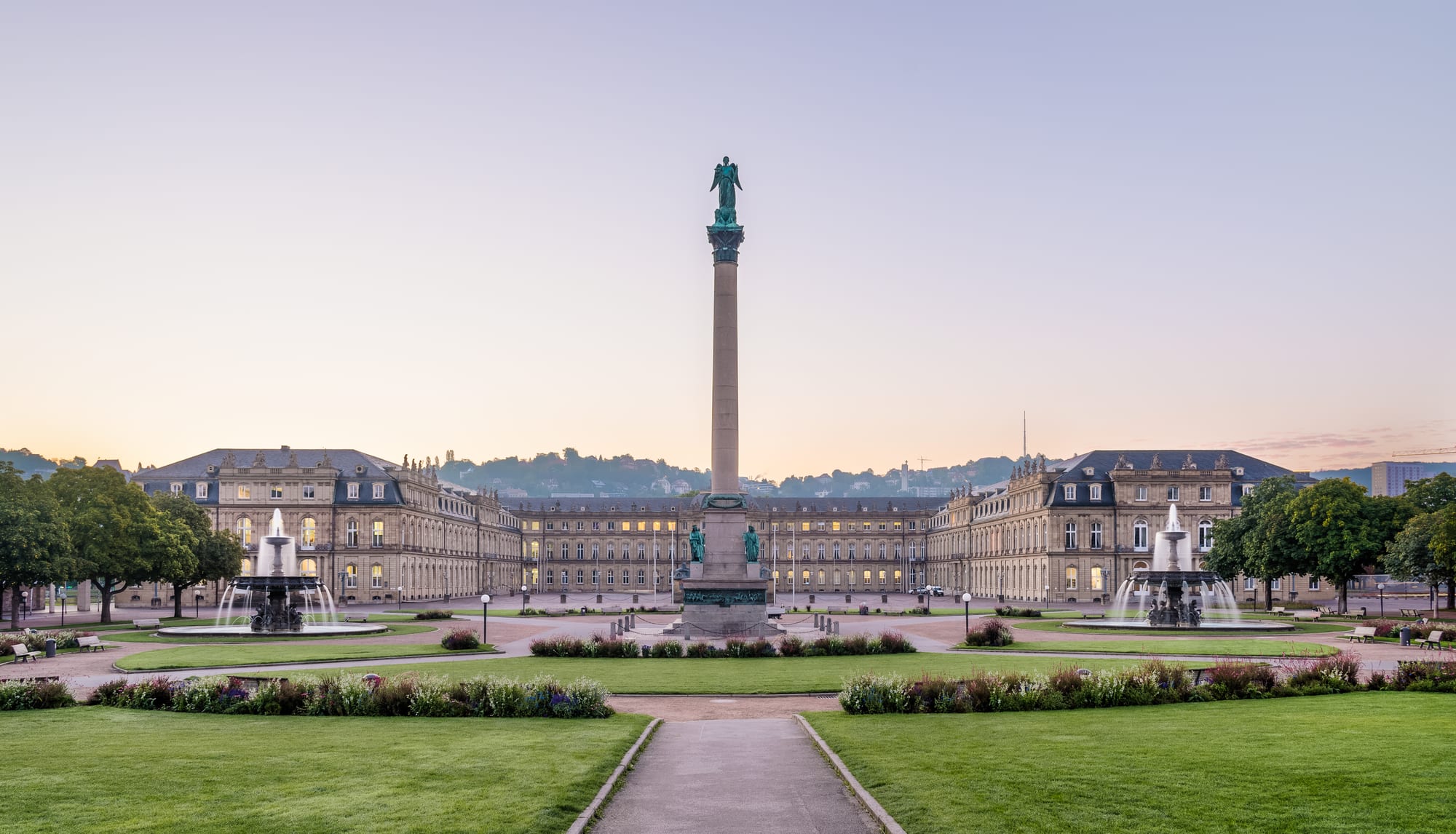
A long three-winged palace behind lawns, two fountains and a tall column topped by a statue, wooded hills under a dawn sky

Baden-Württemberg, Germany

Stuttgart

The Neues Schloss, the Jubilee Column and the fountains of the Schlossplatz in central Stuttgart. (Julian Herzog (Website) / Wikimedia Commons · CC BY 4.0)

The capital and largest city of Baden-Württemberg, spread over the hills, vineyards and forests of a valley basin above the Neckar. A tenth-century stud farm that became the seat of the counts, dukes and kings of Württemberg, it is called the cradle of the automobile and is home to Mercedes-Benz, Porsche and Bosch, mineral springs, a major state theatre and an autumn fair second in size only to Munich's Oktoberfest.

Neighbourhoods

  • Stuttgart-Mitte
    • First-time visitors
    • Museums
    • Close to public transport

    The centre of the valley basin, around the Schlossplatz with its two palaces, the Königstraße pedestrian shopping street, the Schillerplatz and the market hall. The State Theatre, the Staatsgalerie and the Kunstmuseum are here, and the Schlossgarten park runs from the main station towards the Neckar.

    Open in Maps
  • Bohnenviertel
    • Historic district
    • Best for food
    • Small shops

    The only preserved part of the old town, just south-east of the centre, with narrow streets of old houses, craft workshops, small shops and restaurants. It holds its own street festival, the Bohnenviertelfest.

    Open in Maps
  • Bad Cannstatt
    • Mineral springs
    • Festivals
    • Historic district

    The old spa town on the Neckar, older than Stuttgart itself, with a Roman past, mineral springs and an old centre. It is home to the Wasen fairground, the football stadium, the Wilhelma and the site where Gottlieb Daimler built his first motor car.

    Open in Maps
  • Untertürkheim
    • Wine and vineyards
    • Car history

    A district on the right bank of the Neckar in the east of the city, where vineyards climb the slopes and the Mercedes-Benz plant and museum stand by the river. The Württemberg Mausoleum crowns the hill above it.

    Open in Maps
  • Zuffenhausen
    • Car history
    • Close to public transport

    One of the northernmost boroughs, an old township incorporated into the city in 1931, now home to Porsche's headquarters and museum, both reached by S-Bahn.

    Open in Maps
  • Degerloch
    • Quiet and residential
    • Viewpoints

    A residential district on the heights south of the basin, traditionally a wine-growing area, linked to the centre by Germany's only urban rack railway. The television tower stands at its edge.

    Open in Maps

Things to do

Famous landmarks

  • Schlossplatzlandmark

    The city's largest square, between the Königstraße shopping street, the Schlossgarten and the two palaces, with fountains and the Jubilee Column.

    Open in Maps
  • New Palacelandmark

    The Baroque palace of the rulers of Württemberg, built between 1746 and 1807 and rebuilt after the war, now used by state ministries.

    Open in Maps
  • Stiftskirchelandmark

    The city's main Protestant church, Romanesque and Gothic, on the Schillerplatz beside the Old Castle, rebuilt in the 1950s with a modern interior.

    Open in Maps
  • Fernsehturm Stuttgartviewpoint

    The world's first telecommunications tower built of reinforced concrete, controversial at first and now a city landmark with views over the basin from its basket.

    Open in Maps
  • Weissenhof Estatelandmark

    Housing built for the 1927 Werkbund exhibition by seventeen European architects; two buildings by Le Corbusier became part of a World Heritage Site in 2016.

    Open in Maps
  • Württemberg Mausoleumlandmark

    The domed tomb King Wilhelm I built for his wife Catherine Pavlovna of Russia on the vineyard hill of the Württemberg, above Untertürkheim.

    Open in Maps

Museums

  • Mercedes-Benz Museummuseum

    The carmaker's museum, in a building opened in 2006 near the Untertürkheim engine factory, covering the history of the Mercedes-Benz brand.

    Open in Maps
  • Porsche Museummuseum

    The carmaker's museum next to its headquarters in Zuffenhausen, first opened in 1976 and moved into a new building in 2009.

    Open in Maps
  • Staatsgalerie Stuttgartmuseum

    The state gallery, opened in 1843, with James Stirling's New State Gallery of 1984 next door; the collection runs from old German painting to works by Beckmann, Picasso, Klee and Kandinsky.

    Open in Maps
  • Landesmuseum Württembergmuseum

    The state history museum in the Old Castle, founded in 1862, with treasures of the dukes and kings of Württemberg and archaeological finds.

    Open in Maps
  • Kunstmuseum Stuttgartmuseum

    A glass cube on the Schlossplatz, opened in 2005, devoted mainly to modern art, with a large Otto Dix collection.

    Open in Maps
  • Hegel Housemuseum

    The birthplace of the philosopher Georg Wilhelm Friedrich Hegel, with an exhibition on his life and work.

    Open in Maps

Parks, gardens and baths

  • Wilhelmapark

    Europe's only large combined zoo and botanical garden, in the Moorish-style grounds of a former summer residence of the kings of Württemberg, with around 11,500 animals and Europe's biggest magnolia grove.

    Open in Maps
  • Rosenstein Parkpark

    The largest English-style landscape garden in southern Germany, part of the green belt that runs from the city centre to the Neckar, with the natural history museum in Rosenstein Castle.

    Open in Maps
  • Killesbergparkpark

    A hilltop park laid out for a garden show in 1939, with a viewing tower and a miniature railway in summer.

    Open in Maps
  • Leuze Mineralbadattraction

    A mineral spring bath with a sauna, one of several drawing on the springs that give the city one of the largest mineral water deposits in Europe.

    Open in Maps

Sport and nights out

  • MHPArenaattraction

    The stadium in Bad Cannstatt that is home to VfB Stuttgart, five-time German champions, and a venue of the 1974 and 2006 World Cups.

    Open in Maps

Short trips from the city

  • Ludwigsburg Palacelandmark

    The 'Versailles of Swabia', a palace begun in 1704 for Duke Eberhard Louis of Württemberg, with large gardens and an annual festival held since 1947.

    Open in Maps
  • Esslingen am Neckarattraction

    A former free imperial city up the Neckar, which once held Stuttgart itself in the 14th century.

    Open in Maps
  • Tübingenattraction

    A small university town on the Neckar south of the city, with an old town below the castle of Hohentübingen.

    Open in Maps
  • Maulbronn Monasterylandmark

    A Cistercian monastery north-west of the city and a UNESCO World Heritage Site.

    Open in Maps

Seasonal events

  • Stuttgart Spring Festivalmid-April to early May

    The 'small Wasen' on the Cannstatter Wasen fairground, with rides and beer tents, opened by the mayor tapping a barrel.

  • Stuttgarter Weindorflate August to early September

    The wine festival around the Schillerplatz and the Marktplatz, where the wines of Stuttgart and Württemberg are poured.

  • Cannstatter Volksfestlate September to early October

    A fair first held in 1818 after a famine year, now spread over three weekends with beer tents and rides around a column decorated with fruit, second in size only to Munich's Oktoberfest.

  • Stuttgart Christmas Marketlate November to 23 December

    One of the largest and oldest Christmas markets in Europe, with around 200 stalls.

Eat and drink

Long-standing places and food districts in Stuttgart. Hours, ratings and directions come from your maps app, always current.

Stuttgart classics

  • Markthallemarket

    An Art Nouveau market hall of 1910 in the city centre, with food stalls and a restaurant.

    Open in Maps
  • Swabian taverns of the Bohnenviertelneighborhood

    Restaurants in the old streets south-east of the centre serving Maultaschen, Spätzle, Gaisburger Marsch and Stuttgart wine.

    Open in Maps

Wine

  • Vineyard taverns of Untertürkheim and Rotenbergneighborhood

    The wine districts on the slopes above the Neckar, where winemakers open seasonal broom taverns to sell their own wine with simple regional food.

    Open in Maps
  • Bad Cannstattneighborhood

    The old spa town's centre by the Neckar, with its mineral springs and the vineyards around it.

    Open in Maps

Experience Stuttgart

History

The Romans built a fort at Cannstatt around AD 90 to guard the Neckar crossing and the vineyards around it. Stuttgart itself traces its name and roots to a stud farm, the Stutengarten, set up around 950 by Duke Liudolf of Swabia in the Nesenbach valley; vines were documented here by 1108. The town passed to the counts of Württemberg in 1251, received its charter in the 1320s, and became the seat of their county, duchy and, from 1805, kingdom. The court left for nearby Ludwigsburg in the 18th century, but returned to build the New Palace, and Schiller studied at the duke's military academy here and finished his play The Robbers.

Industry arrived in the 19th century. Gottlieb Daimler and Wilhelm Maybach built a petrol-engined car in Cannstatt in 1886, Robert Bosch opened his workshop in the city, and the first prototypes of the Volkswagen Beetle were made here to Ferdinand Porsche's designs. The kings of Württemberg left the throne in 1918. Under the Nazis the synagogue was burned and more than 2,000 Jews from across Württemberg were deported from the North Station. Fifty-three air raids destroyed more than half the city's buildings, and the rubble was piled into the Birkenkopf hill.

After the war the first mayor, Arnulf Klett, rebuilt it as a modern car-oriented city, clearing many ruins and surviving streets alike. Stuttgart became the capital of Württemberg-Baden and, in 1952, of the new state of Baden-Württemberg. Guest workers from Italy, Greece, Turkey and Yugoslavia came in the post-war economic boom. Since 2010 the Stuttgart 21 rebuilding of the main station has brought large protests, rising costs and repeated delays.

Culture & Customs

Stuttgart is known above all for its car culture — it calls itself the cradle of the automobile, and the Mercedes-Benz and Porsche museums are among its best-known sights — but the arts run deep as well. The State Theatre houses an opera company that has repeatedly been named opera of the year and the Stuttgart Ballet, shaped by John Cranko and Marcia Haydée; the Staatsgalerie and the Kunstmuseum hold major collections, and the Weissenhof Estate is a landmark of modern architecture. Hegel was born here, and Schiller and Hölderlin are tied to the city's literary past.

The Cannstatter Volksfest, begun in 1818 by King Wilhelm I and Queen Catherine after a year of famine, is the great popular festival, with a spring version on the same grounds; the Weindorf and the Christmas market fill the old centre. Football is followed closely, with VfB Stuttgart the best-loved club.

Locals call the valley the Kessel, the cauldron, and the city lives between forest and vines, with more than 400 hectares of vineyards inside its boundaries and hundreds of public stairways climbing its slopes. Swabian identity is strong — the dialect, thrift and a love of order and work — even though more than half the population is now not of Swabian background. The city has been mainly Protestant since the Reformation, and the first Waldorf school was founded here in 1919.

Daily Life

About 609,000 people lived in the city at the end of 2025, making it the largest in Baden-Württemberg, and about 2.8 million live in the Stuttgart Region around it. Close to half of the city's residents have a foreign background, with large Turkish, Croatian, Italian and Greek communities, and rents are high.

The economy is built on high technology and engineering. Mercedes-Benz, Porsche, Bosch and Mahle have their headquarters here, along with many medium-sized companies, the second-largest stock exchange in Germany and a dense cluster of universities and research institutes; the region registers more patents than any other in Germany. As capital, the city is also home to the state parliament and ministries, and US military headquarters for Europe and Africa are based in the city.

Daily life follows the hills: commuters ride the Stadtbahn and S-Bahn in from the heights and the Neckar towns, traffic jams are a constant complaint, and air quality in the basin led to a low emission zone in 2008. Weekends go to walks in the forests to the west, the mineral baths, a match at the stadium, or a glass of wine in a vineyard tavern on the slopes.

Food

Stuttgart eats Swabian. Maultaschen, large dumplings of square pasta sheets filled with minced and smoked meat, spinach, breadcrumbs and onion, have protected status in the European Union as a Swabian speciality. Spätzle, an irregular egg pasta with a rough surface, come with almost everything, or as a main dish with cheese and onions. Gaisburger Marsch, named after the Gaisburg district in the east of the city, is beef cooked in strong broth, cut into cubes and served with potatoes and Spätzle, the broth poured over and fried onions on top. Linsen mit Spätzle, lentils cooked in a vinegar broth and served over Spätzle, is another Swabian original.

Wine is the city's own drink. Vines have grown here since at least 1108, and the slopes of Untertürkheim, Rotenberg and Uhlbach lie at the centre of the Württemberg wine region, which is known for its reds. Trollinger, a light-bodied red with fruity strawberry notes, is grown almost only here, and seasonal broom taverns, Besenwirtschaften, run by winemakers sell their own wine with simple cold food. The Weindorf each summer brings the vintages into the city centre.

The city also has a long brewing history, with breweries such as Stuttgarter Hofbräu and Dinkelacker. The Markthalle, an Art Nouveau hall of 1910 in the city centre, is the place for local produce, and pretzels and other lye pastries are sold in every bakery.

Planning tools

Budget

Stuttgart is one of the more expensive German cities, with high rents and business-travel hotel prices that rise further during trade fairs and the two Wasen festivals. Eating out in Swabian taverns and the market hall is reasonable, and many parks, squares and viewpoints are free. Public transport covers the hills and suburbs well.

Daily Budget Midrange
USD 170–290 (mid-range hotel, tavern dinners with local wine, car museums and a mineral bath)
Daily Budget Shoestring
USD 75–120 (hostel bed, bakery and market-hall food, Stadtbahn day tickets)

Book rooms well ahead for trade fairs and the late-September Volksfest, when prices rise sharply.

Best Time to Visit

May to October. Summer brings open-air festivals in the squares and parks, the Weindorf at the end of August and the wine harvest in the hills, and the Volksfest fills late September and early October. Late November and December are the time of the Christmas market. The city's museums make it a year-round destination.

Suggested Number of Days

Two to three days cover the centre and the two car museums. Four or five allow time for the palaces, university towns and abbeys of the surrounding region, all within an hour or so by train. Festival dates and an interest in cars or wine add to the number.

First Visit
2–3 days
With Surroundings
4–5 days

Transportation

The Stadtbahn light rail, marked U and running underground in the centre, and a large bus network cover the city; the S-Bahn serves the suburbs and the airport. A rack railway climbs from Marienplatz to Degerloch — the only one in a German city — and a funicular runs to the forest cemetery. Roads are congested, and a low emission zone has applied since 2008. The main station is a long-term building site for the Stuttgart 21 underground station, which is planned to open in stages between 2030 and 2032.

Allow extra time at the main station, where the Stuttgart 21 works change platforms and walkways.

Airport & Station Connections

Stuttgart Airport is about 13 km south of the centre, roughly 30 minutes by S-Bahn lines S2 or S3 or Stadtbahn line U6. The Hauptbahnhof is a hub of the ICE and Intercity networks, with direct trains to most large German cities and to Strasbourg, Zürich, Vienna and Paris, about three hours away. The A8 and A81 motorways meet near the city.

Walkability

The flat centre of the basin — Königstraße, the Schlossplatz, the Schillerplatz and the Bohnenviertel — is easy on foot, and the green belt of parks leads on to the Neckar. The rest of the city climbs steeply: more than 400 flights of public stairs, the Stäffele, connect the slopes, so walking uphill is hard work and the Stadtbahn does the climbing for most people.

Safety

Germany is a safe country with low levels of violent crime. Stuttgart ranks among the safest large cities in Germany; the usual risks are pickpocketing around the main station and in the crowds of the Wasen festivals and the Christmas market.

Keep bags secure in festival crowds and on public transport, and stay out of marked cycle lanes on foot. Check current official travel advice before travelling.

Climate

An oceanic climate in a sheltered basin, with an average annual temperature of about 9°C. The surrounding hills shield the city from harsh weather but trap still air, so summer heat and air pollution can build up in the valley; thunderstorms and occasional hail come in summer.

Summer
warm — average highs around 25°C, with occasional thunderstorms
Winter
chilly — daily means just above 0°C, and snow cover rarely lasts more than a few days

Local Customs

Stuttgart is Swabian at heart, and the dialect, the reputation for thrift and hard work and the Kehrwoche, the rota for sweeping shared stairs and pavements, are part of local identity. Württemberg has been mainly Protestant since the Reformation, though nearly half the city's people now have a foreign background. Shops close on Sundays.

Tips are usual in restaurants, bars and taxis but rarely exceed 10 per cent; most people round up, stating the total while paying. Bottles and cans carry a deposit (Pfand) that is refunded at shops.

Common Payment Methods

The currency is the euro. Cards are accepted in hotels, larger shops and most restaurants, but many places still prefer cash — some bakeries, bars and smaller restaurants do not take cards at all — so it is worth carrying some, especially at festival stalls.