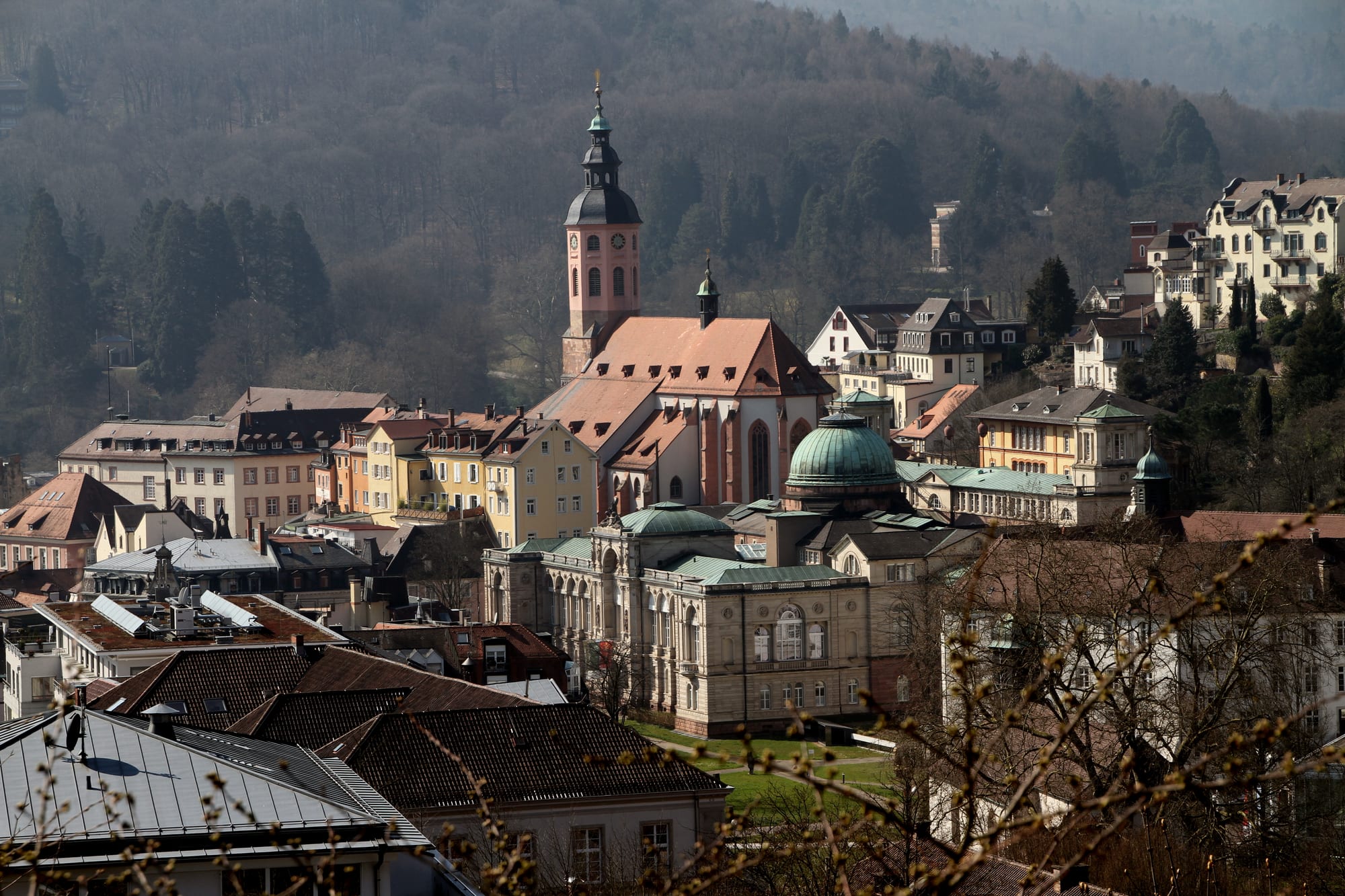
Pastel town houses, a red church with a tall tower and a green-domed bathhouse below wooded hills

Baden-Württemberg, Germany

Baden-Baden

The spa district and the collegiate church of Baden-Baden, seen from the Annaberg. (Gerd Eichmann / Wikimedia Commons · CC BY 4.0)

A spa town in the valley of the Oos at the north-western edge of the Black Forest, built on hot springs the Romans called Aquae. Seat of the margraves of Baden for centuries, it became 'Europe's summer capital' in the 19th century, and with its baths, Kurhaus casino, festival hall and gardens it is now part of the Great Spa Towns of Europe World Heritage Site.

Neighbourhoods

  • Old town and spa district
    • First-time visitors
    • Historic district
    • Spas

    The old town climbs the hillside on the right bank of the Oos below the New Castle, around the collegiate church, the Roman bath ruins and the Friedrichsbad and Caracalla baths. Across the river lie the 19th-century resort quarter, the Kurhaus with its casino, the Trinkhalle and the theatre.

    Open in Maps
  • Lichtental
    • Quiet and residential
    • Parks

    The residential district in the south-west of the town at the far end of the Lichtentaler Allee, around the Cistercian nunnery of Lichtenthal Abbey, founded in 1254, and the house where Johannes Brahms spent his summers.

    Open in Maps
  • Oos
    • Close to public transport

    The northern district on the edge of the Rhine plain, home to the main railway station, which took the name Baden-Baden after the branch line into the centre closed in 1977.

    Open in Maps

Things to do

Baths and spa buildings

  • Friedrichsbadattraction

    A Neo-Renaissance Roman-Irish bathhouse completed in 1877, with a circular pool under a 17.5-metre dome modelled on the caldarium of the Baths of Caracalla.

    Open in Maps
  • Kurhaus and casinolandmark

    The white columned spa house of the 1820s, home to the casino whose profits helped turn the town into a meeting place for Europe's nobility.

    Open in Maps
  • Trinkhallelandmark

    The pump room built in 1839–42 by Heinrich Hübsch, with a 90-metre arcade lined with frescoes and benches.

    Open in Maps
  • Lichtentaler Alleepark

    A 2.3-kilometre park avenue along the Oos, laid out mainly in 1850–70, with about 300 kinds of native and exotic trees and shrubs and a dahlia garden at its far end.

    Open in Maps

Music, art and history

  • Festspielhaus Baden-Badenattraction

    Germany's largest opera and concert house, with 2,500 seats, opened in 1998 behind the town's former railway station of 1904.

    Open in Maps
  • Brahms Housemuseum

    The Lichtental house where Johannes Brahms lived and composed in the attic rooms, now a small museum about him.

    Open in Maps
  • Lichtenthal Abbeylandmark

    A Cistercian nunnery founded in 1254 at the southern end of the Lichtentaler Allee.

    Open in Maps

Castles and viewpoints

  • Hohenbaden Castleviewpoint

    The Old Castle, built around 1100 on the flank of the Battert rock and home of the margraves for almost 400 years, burned in 1599 and now a ruin above the town.

    Open in Maps
  • Merkurviewpoint

    The town's own mountain, 668 metres high, reached by funicular, with an observation tower at the top.

    Open in Maps

Short trips from the town

  • Schloss Rastattlandmark

    The Baroque palace and garden built in 1700–07 for Margrave Louis William when he moved his court from Baden-Baden, with restored interiors open to visitors.

    Open in Maps
  • Black Forest High Roadtrail

    The oldest themed drive in Germany, running about 60 km along the ridges from Baden-Baden to Freudenstadt.

    Open in Maps
  • Mummelseepark

    The largest, deepest and highest of the Black Forest's cirque lakes, beside the High Road below the Hornisgrinde, said in legend to be home to a water spirit.

    Open in Maps

Seasonal events

  • Iffezheim race meetingsMay, August and October

    International flat racing has been held at the course in nearby Iffezheim since 1858, first organised by the casino's leaseholder Edouard Bénazet.

  • Grosser Preis von Badenearly September

    One of Germany's most important horse races, a Group 1 race over 2,400 metres whose winner often runs in the Prix de l'Arc de Triomphe a month later.

Eat and drink

Long-standing places and food districts in Baden-Baden. Hours, ratings and directions come from your maps app, always current.

Baden-Baden classics

  • Cafés of the spa districtcafe

    Coffee-house terraces near the Kurhaus and the Lichtentaler Allee, the place to try Schwarzwälder Kirschtorte, the Black Forest cherry gâteau.

    Open in Maps
  • Restaurants of the old townneighborhood

    Inns and wine bars in the steep streets of the old town, serving Baden dishes such as Flammkuchen and Black Forest ham with wines from the surrounding region.

    Open in Maps

Experience Baden-Baden

History

The Romans knew the hot springs as Aquae, and later as Aurelia Aquensis; the ruins of a Roman bath from the reign of Caracalla, who came to ease his arthritis, were found below the New Castle in 1847. By 1112 the town was the seat of the margraves of Baden, who lived in the hilltop castle of Hohenbaden until Christopher I moved down to the New Castle in 1479. When the margraviate was divided in 1535, the town became capital of the Margraviate of Baden-Baden. Witch trials in 1627–31 produced hundreds of verdicts, French troops plundered the town in the Thirty Years' War and burned it in 1689, and in 1706 Margrave Louis William moved his court to Rastatt.

Recovery came with refugees from the French Revolution and the visit of the Prussian queen in the early 19th century. The Grand Duchy of Baden subsidised the resort, and with the Kurhaus, the casino, the Trinkhalle of 1842, horse racing and the Lichtentaler Allee, the town became a meeting place for nobility and wealthy families. Under Napoleon III in the 1850s and 1860s it was called Europe's summer capital, and its population of about 10,000 could quadruple in the season. Queen Victoria, Wilhelm I and Berlioz visited, and Dostoyevsky gambled here while writing The Gambler.

The town took its double name formally in 1931. About 3 per cent of its houses were destroyed in the Second World War, a third of the Oos district among them in December 1944. Afterwards it became the headquarters of the French occupation forces and of the Südwestfunk broadcaster, now part of SWR. The Olympic Congress met in the Kurhaus in 1981, the Festspielhaus opened in 1998, and in 2021 the town joined the Great Spa Towns of Europe World Heritage Site.

Culture & Customs

Baden-Baden presents itself as a town of baths, media, art and international festivals. Bathing culture comes first: 29 springs rise at between 46 and 67°C, and their salty water is piped from deep under the Florentine Hill to the Friedrichsbad and the Caracalla baths. The Trinkhalle, where the waters were drunk, and the Kurhaus with its casino recall the 19th-century resort.

Music has deep roots here. Johannes Brahms spent his summers in Lichtental from 1865 to 1876, Clara Schumann lived in the town, and a bust of Clara Schumann stands in the dahlia garden at the end of the Lichtentaler Allee. The Festspielhaus, built behind the old railway station, is the largest opera and concert house in Germany and the first in Europe to be privately financed, and the theatre, completed in 1861, is a playhouse with its own company. Literature remembers the town through Turgenev's Smoke and Dostoyevsky's The Gambler, and museums along the Allee and in the town show modern art and Fabergé.

The town's other passion is horse racing, held at nearby Iffezheim since 1858, with the Grosser Preis von Baden in early September among the most important races in Germany. The German Media Prize has been awarded here since 1992.

Daily Life

About 57,000 people lived in the town at the end of 2025, making it the smallest urban district in Baden-Württemberg. Its eleven districts range from the spa centre to the residential valleys of Lichtental and Oos and the villages of Steinbach, Neuweier and Varnhalt on the edge of the Rhine plain.

The economy rests on health, tourism and culture — the spas, clinics, hotels, casino, festival hall and conference trade — and on the media: the Südwestfunk, now part of the regional public broadcaster SWR, has been based here since the war. The town's wealth shows in its villas and gardens. The nearby airport and the motorway link it to Karlsruhe, Strasbourg and the wider Upper Rhine.

Life is quiet and green, with forest reaching down to the edge of the town and paths leading up from the Oos valley into the hills. Less than half the population now belongs to the two main churches, and the town has been governed since 2022 by an independent mayor.

Food

Baden-Baden eats in the style of Baden, which leans towards neighbouring France. Flammkuchen, a speciality shared with Alsace and Baden, is bread dough rolled very thin, spread with fromage blanc or crème fraîche, topped with sliced onions and lardons and baked in a wood-fired oven. From the Black Forest come Schwarzwälder Schinken, a dry-cured smoked ham protected in the European Union since 1997, and the Schwarzwälder Kirschtorte, a layer cake of cocoa, cherries, Kirsch and whipped cream decorated with dark chocolate, served in the cafés of the spa district.

The town lies in the historical region of Baden, which gives its name to Germany's third-largest wine region, where cooperatives make most of the wine. The local wine taverns and the inns of the old town pour Baden wines alongside regional dishes.

The coffee and cake of the afternoon remain a resort ritual, taken on terraces near the Kurhaus or along the Lichtentaler Allee after a bath.

Planning tools

Budget

Baden-Baden is one of the pricier towns in the state, built around upmarket hotels, spas, the casino and the festival hall. Bath and concert tickets are the main extras; the Lichtentaler Allee, the Trinkhalle and the walks into the hills are free, and simple meals in the old town are not much dearer than elsewhere in the region.

Daily Budget Midrange
USD 180–300 (mid-range hotel, restaurant dinners, a thermal bath and a concert or casino visit)
Daily Budget Shoestring
USD 80–120 (guesthouse or hostel bed, bakery and café food, local buses)

Race weeks at Iffezheim and big festival-hall productions fill hotels, so book ahead for those dates.

Best Time to Visit

The baths are open all year, so there is no bad season. May to October is best for the gardens, the hills and the Black Forest High Road, with race meetings in May, August and October and the big race in early September. Winter suits a spa visit, with snow on the higher Black Forest roads.

Suggested Number of Days

One or two days cover the compact centre and a long bath. Three or four allow for the northern Black Forest, its lakes and ridge road, and the palace towns of the Rhine plain; a car or the regional buses make the difference in reaching the hills.

First Visit
1–2 days
With Surroundings
3–4 days

Transportation

Buses link the station in Oos with the centre and Lichtental and run up to the Merkur funicular. The centre itself is small and walkable. A car is the easiest way to reach the Black Forest High Road and the lakes on the ridge, which can be icy or snowy in winter.

The main station lies in Oos, a bus ride from the centre — the old branch line into town closed in 1977.

Airport & Station Connections

Baden-Baden station, the most important of the town's three stations, is in the Oos district; buses run from there into the centre. Karlsruhe/Baden-Baden Airport, mostly for low-cost and leisure flights, is in the Rhine plain about 10 km west of the centre. The A5 motorway passes about 10 km from the town.

Walkability

The spa district, the Kurhaus, the theatre and the Lichtentaler Allee are all within a short level walk of each other along the Oos. The old town climbs steeply up the hillside towards the New Castle, and paths lead on up to the Old Castle and the Merkur for those with stamina.

Safety

Germany is a safe country with low levels of violent crime. Baden-Baden is a quiet, prosperous resort; the usual precautions with valuables apply in the casino and the busiest streets. In the hills the hazards are steep paths, ticks in summer and winter ice on the mountain roads.

Carry winter equipment for the mountain roads in the cold months and check for ticks after forest walks. Check current official travel advice before travelling.

Climate

An oceanic climate with fairly mild differences between summer and winter and rain spread through the year. The town sits low in a sheltered valley, while the Black Forest heights above it are cooler and snowier.

Summer
warm, sometimes hot — the town's highest recorded temperature is 38.0°C, in July 2019
Winter
cool and damp, with occasional snow and frost; the record low is −21.3°C, set in February 1956

Local Customs

Bathing has its own etiquette: the Caracalla baths have areas with and without swimwear, and the Friedrichsbad, a Roman-Irish bath, is used mostly without it, so the rules are worth reading first. Close to half the population is Catholic or Protestant. Shops close on Sundays.

Tips are usual in restaurants, bars and taxis but rarely exceed 10 per cent; most people round up, stating the total while paying. Bottles and cans carry a deposit (Pfand) that is refunded at shops.

Common Payment Methods

The currency is the euro. Cards are accepted in hotels, the baths and larger restaurants, but many places still prefer cash — some bakeries, bars and smaller restaurants do not take cards at all — so it is worth carrying some.