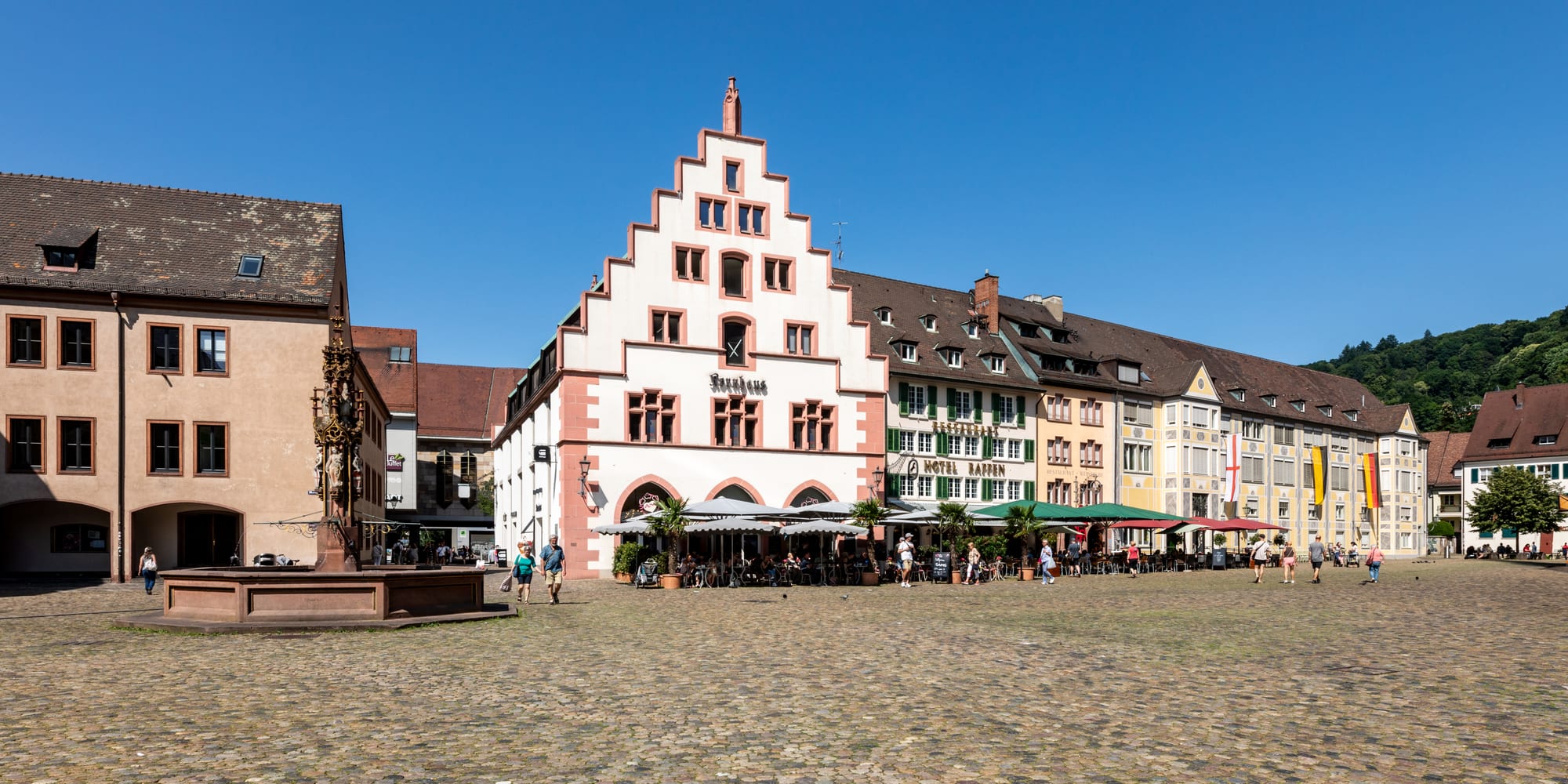
A cobbled square with a carved fountain, a white stepped-gable Kornhaus, café umbrellas and wooded hills behind

Baden-Württemberg, Germany

Freiburg im Breisgau

The Münsterplatz in Freiburg im Breisgau, with the fish fountain and the Kornhaus. (Dietmar Rabich / Wikimedia Commons · CC BY-SA 4.0)

A university city on the Dreisam at the south-western edge of the Black Forest, close to France and Switzerland. Founded by the Zähringen dukes in 1120 and enriched by silver from the Schauinsland, it was rebuilt on its medieval plan after wartime bombing and is now known for its red sandstone minster, its street-side Bächle and its green politics.

Neighbourhoods

  • Altstadt
    • First-time visitors
    • Historic district
    • Close to public transport

    The old town, rebuilt on its medieval street plan after 1944, inside the line of the old walls. The minster and its market square, the Martinstor and Schwabentor gates, the Augustinerplatz and the little Bächle channels running beside almost every street lie within a short walk of each other, much of it in a car-free pedestrian zone.

    Open in Maps
  • Wiehre
    • Quiet and residential
    • Historic homes

    A desirable residential district across the Dreisam to the south of the old town, with comparatively quiet streets and well-preserved old houses. It runs out to the woods of the Sternwald, where many people gather on summer evenings.

    Open in Maps
  • Vauban
    • Sustainable living
    • Families

    A model sustainable district built from 1998 on a former French military base south of the centre, planned around a car-free concept. Much of it was built by community-led housing groups, and many of its buildings carry solar collectors or photovoltaic cells.

    Open in Maps
  • Herdern
    • Quiet and residential
    • Gardens

    A residential district on the slopes north of the old town, home to the university's botanical garden, one of the first in Germany.

    Open in Maps
  • Stühlinger
    • Students and nightlife
    • Close to public transport

    The district across the railway from the old town, behind the main station and the bus station, with student bars and the square around the Herz Jesu church, where a nostalgic fair is held each year.

    Open in Maps

Things to do

Famous landmarks

  • Freiburg Minsterlandmark

    The red sandstone cathedral, built between about 1200 and 1513, whose 116-metre openwork tower is the only Gothic church tower in today's Germany completed in the Middle Ages.

    Open in Maps
  • Historical Merchants' Halllandmark

    A late Gothic hall on the south side of the Münsterplatz, built between 1520 and 1530, with statues and coats of arms of four Habsburg emperors on its arcaded front.

    Open in Maps
  • Martinstorlandmark

    One of two surviving medieval town gates, standing over the main shopping street, Kaiser-Joseph-Straße.

    Open in Maps
  • Schwabentorlandmark

    The other surviving medieval gate, on the east side of the old town near Oberlinden, the old road towards Swabia.

    Open in Maps
  • Freiburg Bächleattraction

    The narrow channels of water diverted from the Dreisam that flow beside almost every old-town street, once a water supply and used to fight fires — local lore says anyone who steps in one will marry a Freiburger.

    Open in Maps

Museums

  • Augustiner Museummuseum

    Art from the Middle Ages to the Baroque and 19th-century painting in the former Augustinian monastery, a museum since 1923.

    Open in Maps
  • Colombischlössle Archaeological Museummuseum

    A villa in the Gothic Tudor style, set in a park in the old town, holding finds from the Stone Age to the early Middle Ages.

    Open in Maps

Parks and viewpoints

  • Schlossbergviewpoint

    The wooded 456-metre hill above the old town, reached on foot or by the Schlossbergbahn funicular, with castle ruins, a lookout tower built in 2002 and views over the roofs to the Rhine plain.

    Open in Maps
  • Freiburg Botanical Gardenpark

    The university's research and teaching garden in Herdern, first founded in 1620 and one of the first botanical gardens in Germany.

    Open in Maps
  • Vaubanneighborhood

    The car-free model district on a former army base, known for its community-built housing and solar buildings.

    Open in Maps

Markets and sport

  • Münsterplatz marketmarket

    The farmers' market around the minster, held every day except Sunday, where Freiburgers buy local flowers, fruit and vegetables and eat a sausage in a bread roll.

    Open in Maps
  • Europa-Park Stadionattraction

    The home ground of SC Freiburg, the city's Bundesliga football club, beside the city's airfield in the west of Freiburg.

    Open in Maps

Short trips from the city

  • Schauinslandviewpoint

    The 1,284-metre Black Forest summit inside the city limits, whose silver mines made medieval Freiburg rich, reached by the Schauinslandbahn of 1930, the longest circulating cable car in Germany.

    Open in Maps
  • Kaiserstuhlviewpoint

    A small range of hills of volcanic origin west of the city, one of the warmest places in Germany and covered in vineyards.

    Open in Maps
  • Breisachattraction

    A small town on the Rhine at the French border, on the old Freiburg–Colmar railway, whose Rhine bridge was destroyed in the Second World War.

    Open in Maps
  • Titiseepark

    A glacial lake in the southern Black Forest, formed by the Feldberg glacier, with a resort town on its north shore.

    Open in Maps
  • Europa-Parkattraction

    A large theme park at Rust on the Rhine plain north of the city.

    Open in Maps

Seasonal events

  • Freiburger FasnetFebruary or March, before Lent

    The city's carnival, which folklorists describe as a mix of Swabian-Alemannic Fastnacht and Rhineland club carnival, with masks and costumes shown in a Fasnet museum.

  • Zelt-Musik-FestivalJune and July

    A festival of music, art, theatre and cabaret in a circus tent, a spiegeltent and open-air stages, held every summer since 1983.

  • Oberlindenhocklast weekend of June

    A street festival in the old town around Oberlinden, held since 1969.

  • Freiburger WeinfestJuly

    The city's wine festival, held since 1970, pouring wines from the surrounding Baden vineyards.

  • Freiburger Weihnachtsmarktlate November to December

    The Christmas market in the old town, held since 1973, with stalls of decorations and mulled wine.

Eat and drink

Long-standing places and food districts in Freiburg im Breisgau. Hours, ratings and directions come from your maps app, always current.

Freiburg classics

  • Münsterplatz sausage standsmarket

    The market stalls at the foot of the minster, where a grilled Bratwurst in a bread roll is the traditional snack between shopping for local produce.

    Open in Maps
  • Markthallemarket

    An indoor food hall near the Bertoldsbrunnen in the old town, with food counters under one roof.

    Open in Maps

Bars and wine

  • Augustinerplatzneighborhood

    The old-town square in front of the Augustiner Museum, with restaurants, bars and the beer garden of the local Feierling brewery, where hundreds of students gather on warm summer nights.

    Open in Maps
  • Kaiserstuhl wine villagesneighborhood

    The vineyard villages of the volcanic hills west of the city, one of the warmest wine areas in Germany.

    Open in Maps

Experience Freiburg im Breisgau

History

Freiburg was founded in 1120 by Konrad and Duke Berthold III of the House of Zähringen as a free market town, and its name means a free, or independent, town. It sat at a junction of trade routes between the Mediterranean and the North Sea, and silver from the mines of the Schauinsland made it one of the richest cities in Europe; it minted its own coin, the Rappenpfennig, from 1327. Work on the minster began around 1200. After a long feud with their counts — the townspeople wrecked the count's castle on the Schlossberg — the citizens bought their independence in 1368 and placed the town under Habsburg protection.

In 1457 the Habsburg regent Albrecht VI founded the university, and in 1520 Freiburg chose to stay Catholic, becoming a centre of Catholicism on the Upper Rhine; Erasmus moved here when Basel turned Protestant. The town suffered witch-hunts that peaked in 1599, and the Thirty Years' War cut its population from more than 10,000 to about 2,000. Between 1648 and 1805, when not under French occupation, it was the administrative seat of Further Austria. It passed to Baden in 1805 and became the seat of a Catholic archbishop in the 1820s.

Under the Nazis the synagogue was burned in 1938 and the city's Jews were deported in 1940 and 1942. On 27 November 1944 an RAF raid destroyed much of the centre, though the minster was only lightly damaged; the city was rebuilt on its medieval plan. After 1945 it lay in the French zone and was the seat of government of the state of Baden until the 1952 merger, and French troops stayed until 1991. Their former base became the Vauban district, a symbol of the city's green reputation.

Culture & Customs

The minster, the university and the Black Forest shape the city's identity. The university, one of Germany's oldest, has counted Max Weber, Edmund Husserl, Martin Heidegger and Friedrich Hayek among its members, and gives the city a young population and a lively student life around squares such as the Augustinerplatz. The Freiburger Barockorchester was co-founded here, and the Zelt-Musik-Festival has filled tents with music, theatre and cabaret every summer since 1983.

Freiburg remained Catholic when much of the surrounding countryside became Protestant, and the archbishop's see and the German headquarters of Caritas are here. The Fasnet before Lent, a mix of Swabian-Alemannic and Rhineland carnival traditions, is the big street festival of the year, followed by summer wine festivals and the Christmas market. The local dialect is Low Alemannic, close to Alsatian and Basel German, and people born in the city are nicknamed Bobbele.

Since the 1990s Freiburg has been known as an eco-city. It required low-energy construction on municipal land from 1995, built the Vauban and Rieselfeld districts on sustainable principles, and in 2010 was named European City of the Year by the Academy of Urbanism. The Greens have been the largest party on the city council since 2004. The stolpersteine set into the cobbles outside former homes remember Jewish victims of the Nazi era.

Daily Life

About 238,000 people lived in the city at the end of 2025, and the wider metropolitan area has about 660,000. Tens of thousands of them are students at the university and the city's other colleges, and the city has grown quickly in recent decades; housing is scarce and expensive.

The economy rests on the university and its medical centre, research institutes, the church and public administration, tourism as a gateway to the Black Forest, and solar industry and research; a branch of the Federal Office for Radiation Protection is here, as are international bodies such as ICLEI – Local Governments for Sustainability and the International Solar Energy Society. The Messe Freiburg hosts trade fairs and concerts.

Daily movement is by tram and bicycle more than by car: most residents live close to a tram stop, the centre is a pedestrian zone, and car journeys are projected to make up under a third of trips. Saturday mornings bring crowds to the Münsterplatz market, summer evenings fill the squares and the Wiehre's woods with students, and at weekends many residents head up into the hills. SC Freiburg's home matches are a fixture of city life.

Food

Freiburg eats in the Baden style, with an eye on France. The Münsterplatz market sells local fruit, vegetables and flowers from the surrounding countryside every day except Sunday, and a grilled Bratwurst in a bread roll from one of the stands around the minster is the classic snack. Flammkuchen, a speciality shared with Alsace and Baden, is bread dough rolled very thin and covered with fromage blanc or crème fraîche, sliced onions and lardons, and baked in a wood-fired oven.

From the Black Forest come Schwarzwälder Schinken, a dry-cured smoked ham whose name has had protected status in the European Union since 1997, and the Schwarzwälder Kirschtorte, a layer cake of cocoa, cherries, Kirsch and whipped cream decorated with dark chocolate, found in the city's cafés. The Markthalle in the old town gathers food counters under one roof.

The city lies in Baden, Germany's third-largest wine region, where cooperatives make most of the wine. The volcanic Kaiserstuhl to the west is one of the warmest wine areas in the country, and the Freiburger Weinfest each July and a smaller wine tasting in the courtyard of the Historical Merchants' Hall in August pour the local wines. The Feierling brewery's beer garden on the Augustinerplatz is the place for local beer.

Planning tools

Budget

Freiburg is a mid-priced German city with student prices in places: the market, bakeries and university-area bars keep eating cheap, while hotels in the old town are the main cost. Housing is scarce and dear for residents, and rooms fill up during big trade fairs and festivals. The city's tram and bus tickets cover the surrounding area too.

Daily Budget Midrange
USD 150–260 (mid-range hotel, restaurant dinners with Baden wine, museum tickets, the Schauinsland cable car)
Daily Budget Shoestring
USD 70–110 (hostel bed, bakery and market food, tram day tickets)

The market, bakeries and sausage stands around the minster are the cheapest places to eat in the old town.

Best Time to Visit

May to October, when the city is at its warmest and sunniest and the Black Forest walks, wine festivals and summer tent festival are on. July and August can be hot. November and December bring the Christmas market, and February or March the Fasnet carnival.

Suggested Number of Days

Two days cover the compact old town and its hill. Four or five days allow time for the Black Forest summits and lakes, the wine hills to the west and the French and Swiss borders, all within easy reach by tram, bus or regional train.

First Visit
2 days
With Surroundings
4–5 days

Transportation

The VAG runs an extensive tram network with feeder buses; about 70 per cent of residents live within 500 metres of a tram stop, and trams run all night at weekends. Tickets are valid on all buses, trams and local trains in the area. The Breisgau S-Bahn runs east into the Black Forest and west to Breisach, and cycling is a large part of local life.

Most visitors only need the central fare zone; the Schauinsland cable car is reached by tram 2 to Günterstal and then bus 21.

Airport & Station Connections

Freiburg Hauptbahnhof is on the main Frankfurt–Basel line, with frequent fast trains; Frankfurt Airport is about two hours away by train, and the tram stops directly above the station. The nearest airport is the EuroAirport Basel-Mulhouse-Freiburg in France, about 70 km south; Karlsruhe/Baden-Baden Airport is about 100 km north. The A5 motorway passes the city.

Walkability

The old town is very walkable: the inner city can be crossed on foot in 10–15 minutes, the minster is about 800 metres from the main station, and much of the centre is a pedestrian zone without cars. Cobbles and the open Bächle channels beside the pavements need watching underfoot. Trams cover the outer districts.

Safety

Germany is a safe country with low levels of violent crime. Freiburg is a calm university city; the usual risks are pickpocketing in crowds at the market and the Christmas market, bicycle theft, and the many cyclists sharing the streets.

Keep bags secure in crowds, lock bicycles well, watch for the Bächle channels and stay out of cycle lanes on foot. Check current official travel advice before travelling.

Climate

A temperate oceanic climate in one of the warmest parts of Germany: the city's average annual temperature is about 11.4°C, one of the highest of any large German city. Winters are moderate, and the city gets more rain through the year than the Rhine plain to the west.

Summer
warm to hot — July and August are, with Karlsruhe, the warmest in Germany, and the city recorded 40.2°C in August 2003
Winter
moderate, usually with some frost at night; the lowest temperature on record is −21.6°C, in February 1956

Local Customs

Freiburg is Catholic by tradition and the seat of an archbishop, though it is also one of the strongholds of the Greens and is known in Germany for its love of cycling and recycling. People born in the city are nicknamed Bobbele. The local dialect is Low Alemannic, related to Alsatian and Basel German. Shops close on Sundays.

Tips are usual in restaurants, bars and taxis but rarely exceed 10 per cent; most people round up, stating the total while paying. Bottles and cans carry a deposit (Pfand) that is refunded at shops.

Common Payment Methods

The currency is the euro. Cards are widely accepted in hotels and larger shops, but many places still prefer cash — some bakeries, bars and smaller restaurants do not take cards at all — so it is worth carrying some. Swiss francs are not generally used.