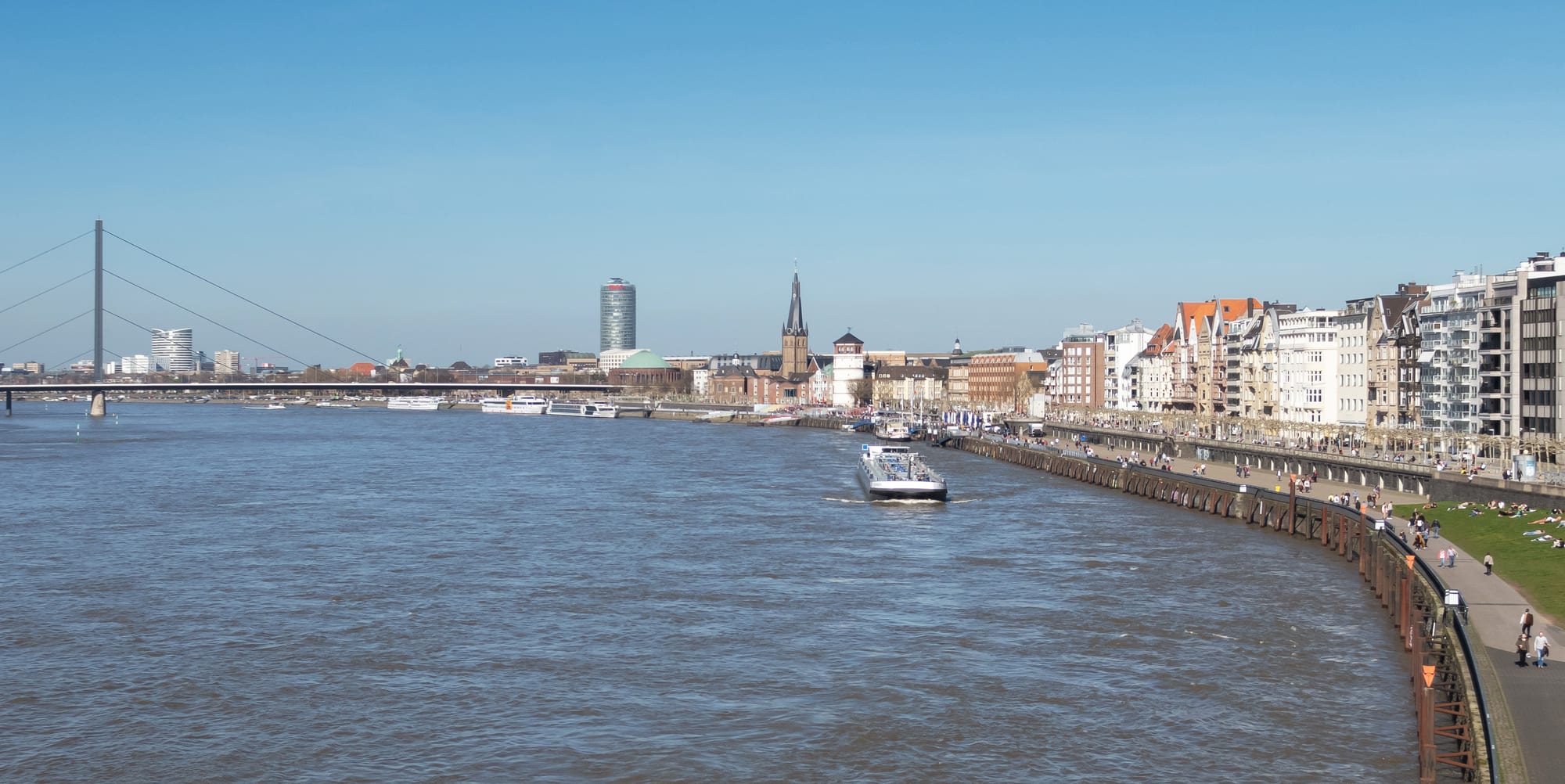
A barge on the wide Rhine beside a curving riverside promenade, with old-town gables, a church spire and a cable-stayed bridge

North Rhine-Westphalia, Germany

Düsseldorf

The Rhine and Düsseldorf's old town seen from the Rheinkniebrücke. (Michielverbeek / Wikimedia Commons · CC BY-SA 4.0)

The capital of North Rhine-Westphalia, on the right bank of the Rhine downstream from Cologne. A ducal residence and art city that grew rich on industry, trade fairs and finance, it is now known for the brewpubs of its compact old town, the shops of the Königsallee, the art academy, Frank Gehry's buildings in the Media Harbour and Germany's largest Japanese community.

Neighbourhoods

  • Altstadt
    • First-time visitors
    • Nightlife
    • Historic district

    The small old town between the Rhine and the Königsallee, known as 'the longest bar in the world' for its hundreds of pubs and bars. Brewpubs pouring Altbier, the castle tower on Burgplatz, the town hall and St Lambertus stand within a few minutes' walk of the riverside promenade.

    Open in Maps
  • Carlstadt
    • Best for food
    • Quiet and residential
    • Historic district

    The smallest quarter of the city, south of the old town and named after Elector Charles Theodore. It holds the Heinrich Heine Institute and the Carlsplatz, the city's main market square, open Monday to Saturday; Clara and Robert Schumann lived here for a few years.

    Open in Maps
  • Königsallee and Stadtmitte
    • Shopping
    • Close to public transport
    • First-time visitors

    The Kö, a boulevard divided by a tree-lined canal, is one of Germany's busiest upscale shopping streets. East of it, the business district around Immermannstraße is the Japanese quarter, with Japanese, Chinese and Korean restaurants and shops, and the main station lies at its far edge.

    Open in Maps
  • MedienHafen and Unterbilk
    • Architecture
    • Restaurants
    • Waterfront

    The old Rhine port south of the centre, redeveloped from the late 20th century with buildings by international architects, among them Frank Gehry's leaning Neuer Zollhof. Offices, media firms, restaurants and bars line the basins below the Rhine Tower.

    Open in Maps
  • Oberkassel
    • Quiet and residential
    • Views of the old town

    A prosperous residential quarter on the left bank, across the river from the centre, with some of the city's most expensive homes and the Rhine meadows where the summer fair is held.

    Open in Maps
  • Kaiserswerth
    • Historic district
    • Quiet and residential

    One of the oldest parts of the city, on the Rhine in the far north, with the ruins of an imperial palace, a quiet old centre and the deaconesses' institute where Florence Nightingale worked.

    Open in Maps

Things to do

Famous landmarks

  • Rhine Towerviewpoint

    A concrete telecommunications tower 240.5 metres high, finished in 1981, with an observation deck and revolving restaurant and a light sculpture on its shaft that works as a giant clock.

    Open in Maps
  • Königsalleelandmark

    The city's grand boulevard, with a landscaped canal down its centre between fashion showrooms and luxury shops.

    Open in Maps
  • Neuer Zollhoflandmark

    Frank Gehry's curving office buildings in the MedienHafen, the best-known images of the redeveloped harbour.

    Open in Maps
  • Castle Towerlandmark

    The only surviving part of the dukes' riverside palace on Burgplatz, now home to a shipping museum; the castle's outline is marked in the paving around it.

    Open in Maps
  • St. Andreaslandmark

    The Dominican priory church in the old town, whose mausoleum holds the tombs of several Electors Palatine, among them Jan Wellem.

    Open in Maps

Museums

  • K20 and K21museum

    The state art collection, with Picasso, Matisse, Mondrian and around a hundred works by Paul Klee in the black granite K20, and contemporary art in the former parliament building, K21.

    Open in Maps
  • Kunstpalastmuseum

    The city's art museum, formerly the Kunstmuseum Düsseldorf, covering painting, sculpture, design and glass.

    Open in Maps
  • Goethe Museum at Schloss Jägerhofmuseum

    A hunting lodge of 1752–63 built for Elector Charles Theodore at the end of the Hofgarten, home since 1987 to the Goethe-Museum.

    Open in Maps

Parks and the river

  • Benrath Palacelandmark

    A baroque pleasure palace built in 1755–70 for Elector Charles Theodore by Nicolas de Pigage, in the southern borough of Benrath.

    Open in Maps
  • Kaiserswerthneighborhood

    A riverside quarter in the north with the ruins of an imperial palace and a quiet historic centre, a pleasant destination for a walk or cycle along the Rhine.

    Open in Maps

Music, sport and nights out

  • Tonhalle Düsseldorfattraction

    A concert hall designed by Wilhelm Kreis, where the Düsseldorfer Symphoniker play their symphonic programme.

    Open in Maps
  • Merkur Spiel-Arenaattraction

    The retractable-roof stadium of Fortuna Düsseldorf, which hosted the Eurovision Song Contest in 2011 and matches of Euro 2024.

    Open in Maps

Short trips from the city

  • Neanderthal Museummuseum

    A museum of human evolution in Mettmann, at the site in the Neander valley where the first Neanderthal remains were found.

    Open in Maps
  • Landschaftspark Duisburg-Nordpark

    A former ironworks in Duisburg turned into a public park, keeping three of its blast furnaces; old gas tanks have become diving pools and concrete walls are used by climbers.

    Open in Maps
  • Zollvereinlandmark

    The UNESCO-listed colliery in Essen, with the Ruhr Museum in its coal washery, at the heart of the Ruhr's industrial heritage.

    Open in Maps
  • Cologne Cathedrallandmark

    The twin-spired Gothic cathedral of Düsseldorf's rival city upstream, begun in 1248 and finished in 1880.

    Open in Maps

Seasonal events

  • CarnivalFebruary or early March

    The city's carnival, one of the three most prominent in Germany, peaks with the Rose Monday parade; the local cry is 'Helau'.

  • Japan Daylate spring

    Europe's largest festival of Japanese culture and encounter, held each year in the city.

  • Largest Fair on the Rhinethird week of July

    One of Germany's largest fairs, with beer and food tents and rides on the left bank of the Rhine at Oberkassel.

Eat and drink

Long-standing places and food districts in Düsseldorf. Hours, ratings and directions come from your maps app, always current.

Düsseldorf classics

  • Altstadt brewpubsneighborhood

    The brewpubs — Uerige, Füchschen, Zum Schlüssel and Kürzer in the old town and Schumacher nearby — brew their own Altbier.

    Open in Maps
  • Carlsplatz marketmarket

    The city's main market square in Carlstadt, open Monday to Saturday, with produce, meat, fish, baked goods and food stalls.

    Open in Maps

Food districts

  • The Japanese quarterneighborhood

    Japanese restaurants and shops around Immermannstraße, alongside Chinese and Korean places, serving the city's large Japanese community.

    Open in Maps

Experience Düsseldorf

History

Düsseldorf began as a small settlement at the mouth of the Düssel, a stream that enters the Rhine here. A lowland castle was built on the riverbank in 1260, and on 14 August 1288, after the Battle of Worringen, Count Adolf VIII of Berg granted the village town privileges. Under the Dukes of Berg it grew into a regional political and cultural centre and then the capital of the United Duchies of Jülich-Cleves-Berg. Its golden age came under the Elector Johann Wilhelm II, known as Jan Wellem, and his wife Anna Maria Luisa de' Medici, whose patronage gave the city its first significant cultural flowering in the late 17th and early 18th centuries.

Napoleon made Berg a grand duchy with Düsseldorf as its capital, and visited the city in November 1811, but the wars left it poor, and in 1815 it passed to Prussia. It lost its status as a capital but became the seat of a regional government and of the Rhenish provincial diet. Industry then transformed it: the population grew from 40,000 in 1850 to 100,000 in 1882. Allied bombing devastated the city in the Second World War, above all in 1943, when more than 700 bombers attacked in a single night.

In 1946 the British occupiers made Düsseldorf capital of the new state of North Rhine-Westphalia. The population peaked at just over 705,000 in 1962. From the 1950s Japanese companies opened their European offices here, and by the 1980s the city had Germany's largest Japanese community. Since the late 20th century the old Rhine port has been redeveloped as the MedienHafen, and after decades of decline the population has been slowly rising again since the late 1990s.

Culture & Customs

Art is central to the city's image. The Kunstakademie Düsseldorf gave its name to the Düsseldorf School of painting in the 19th century and counts Joseph Beuys, Gerhard Richter, Sigmar Polke and August Macke among its members. Heinrich Heine was born here in 1797, and the university bears his name; Robert and Clara Schumann and Felix Mendelssohn worked in the city. Kraftwerk made Düsseldorf a name in electronic and experimental music.

Carnival is the city's great festival, ranked behind only Cologne and Mainz in Germany, and the rivalry with Cologne, about 35 kilometres upstream, extends to the carnival cry — "Helau" here — football, ice hockey and beer. The Radschläger, boys turning cartwheels, are a city symbol, and a society founded in 1920 organised the first cartwheeling competition in 1937. Fortuna Düsseldorf plays at the Merkur Spiel-Arena, one of the venues of the 2024 European Championship.

Düsseldorf and its surroundings have the largest Japanese community in Germany, about 11,000 people, with a Japanese club founded in 1964, a Japanese school, a Japanese garden in the Nordpark, and, in Niederkassel, Europe's only Jōdo Shinshū Buddhist temple. Japan Day, held each spring, is Europe's largest festival of Japanese culture. The city is also markedly secular: by 2006 people who belonged to no religious community already formed the largest group.

Daily Life

About 620,000 people lived in the city at the end of 2025, making it Germany's seventh-largest, and it has grown together with neighbours such as Neuss, Ratingen, Krefeld and Meerbusch. Around a quarter of residents hold a foreign citizenship. Most of the city lies on the right bank of the Rhine; the left-bank quarters such as Oberkassel are among its most prosperous.

The economy is built on services: Düsseldorf is a business and financial centre, known for fashion, advertising and its trade fairs, and is home to the headquarters of Henkel, Rheinmetall, Metro and Uniper. Many Japanese banks and companies have their European headquarters here. Unemployment averaged 7.7 per cent in 2024. Heinrich Heine University, founded in 1965 on the base of a medical academy of 1907, has more than 36,000 students, and the city has 22 institutions of higher education in all.

The rhythm of the city follows the river. On fine evenings the Rhine promenade and the meadows on the left bank fill with people, and the old town's pubs and bars are busiest at weekends. Trade fairs fill hotels and trams for days at a time. In September 2025 Stephan Keller of the CDU was re-elected mayor.

Food

Altbier is the city's drink: a copper-coloured, top-fermented beer, whose name was first used by the Schumacher brewery, opened in 1838, to set it apart from bottom-fermented beers. Five brewpubs still brew it on site — Füchschen, Schumacher, Zum Schlüssel, Uerige and Kürzer — and in the old town, with over 250 pubs and bars, it is served in 0.25-litre glasses. Killepitsch, a herbal liqueur, is the local spirit.

Brewpub menus keep the Rhenish classics. Rheinischer Sauerbraten is beef marinated in vinegar and served with a raisin-sweetened gravy; Düsseldorfer Senfrostbraten is steak roasted with the city's mustard and an onion crust; the Halve Hahn, despite its name, is not half a chicken but half a double rye roll with Gouda and mustard. Mustard is a local pride, and Löwensenf is one of the best-known brands.

The Japanese community has given the city a strong presence of authentic Asian cooking, with Japanese restaurants and shops around Immermannstraße alongside Chinese and Korean places. The Carlsplatz in Carlstadt, the oldest market square still in use in the city, holds a market six days a week with produce, meat, fish, baked goods and food stalls.

Planning tools

Budget

Düsseldorf is one of the dearest cities in the state, and hotel rates multiply during the big trade fairs and at carnival. Eating and drinking in the old town's brewpubs is reasonable by German big-city standards, and the riverside promenade, the old town, the Kö and the parks cost nothing.

Daily Budget Midrange
USD 150–270 (mid-range hotel, brewpub and restaurant dinners, museum tickets, trams and regional trains)
Daily Budget Shoestring
USD 70–120 (hostel or budget hotel, brewpub snacks and market lunches, a day ticket for trams and the S-Bahn)

Check the trade-fair calendar before booking; during a major fair a room in a nearby city a short train ride away can cost far less.

Best Time to Visit

May to September, when the Rhine promenade and beer gardens are full, Japan Day comes in late spring and the great Rhine funfair takes over the left bank in July. Carnival in February or early March is the city's biggest party, with crowds and higher prices. Winters are mild and grey, quiet outside the trade fairs.

Suggested Number of Days

Two days cover the centre, the river and the main museums. Allow four or five to add day trips to the Ruhr, Cologne or the Neander valley, all easily reached by train. A big fair or carnival can make rooms scarce, which changes where it makes sense to stay.

First Visit
2 days
With Surroundings
4–5 days

Transportation

Light-rail lines run through a tunnel under the centre, with Heinrich-Heine-Allee station as the main transfer point, and trams, buses and the S-Bahn cover the rest of the city and its neighbours. Regional expresses link the city with Cologne, Duisburg and Essen. Much of the centre is a low-emission zone, and parking is expensive.

Validate paper tickets in the stamping machines or risk an on-the-spot fine; a 24-hour ticket is good value for more than two journeys.

Airport & Station Connections

Düsseldorf Airport, Germany's fourth-busiest, lies about 8 km north of the centre at Lohausen. S-Bahn trains run from the terminal station, and the SkyTrain people mover links the terminals to a long-distance station served by ICE and regional trains. The Hauptbahnhof has fast trains to Cologne, the Ruhr, Frankfurt and Amsterdam.

Walkability

The centre is compact and flat: the old town, the Rhine promenade, the Königsallee, Carlstadt and the Hofgarten lie within a short walk of each other, and the promenade continues south towards the Rhine Tower and the MedienHafen. Oberkassel is a walk across a Rhine bridge. Benrath and Kaiserswerth need the tram or S-Bahn. Cyclists use marked lanes, which pedestrians should keep out of.

Safety

Germany is a safe country with low levels of violent crime. The old town is busy and loud on weekend nights and at carnival, with dense crowds. The area around the main station is less pleasant than the rest of the centre.

Keep phones and wallets secure in old-town and carnival crowds, stay out of marked cycle lanes on foot, and never swim in the Rhine. Check current official travel advice before travelling.

Climate

An oceanic climate shaped by Atlantic air from the west makes this one of the warmest parts of Germany, with an average annual temperature of about 11°C, mild winters with little snow and warm, humid summers.

Summer
warm and often humid; in nearby Cologne the July mean is about 19°C, with occasional heatwaves
Winter
mild and damp, with little snow; in nearby Cologne the January mean is about 3°C

Local Customs

Rounding up the bill in restaurants and pubs is usual. In brewpubs Altbier comes in small 0.25-litre glasses, and a fresh one arrives unasked when the glass is empty. The rivalry with Cologne is a running joke — ordering Kölsch in an old-town brewpub draws comment. Greetings are a handshake and surname until invited otherwise.

Most shops close on Sundays and public holidays.

Common Payment Methods

The currency is the euro. Cards and contactless payment are widely accepted, though some brewpubs, kiosks and market stalls still prefer cash, and cash machines are easy to find.