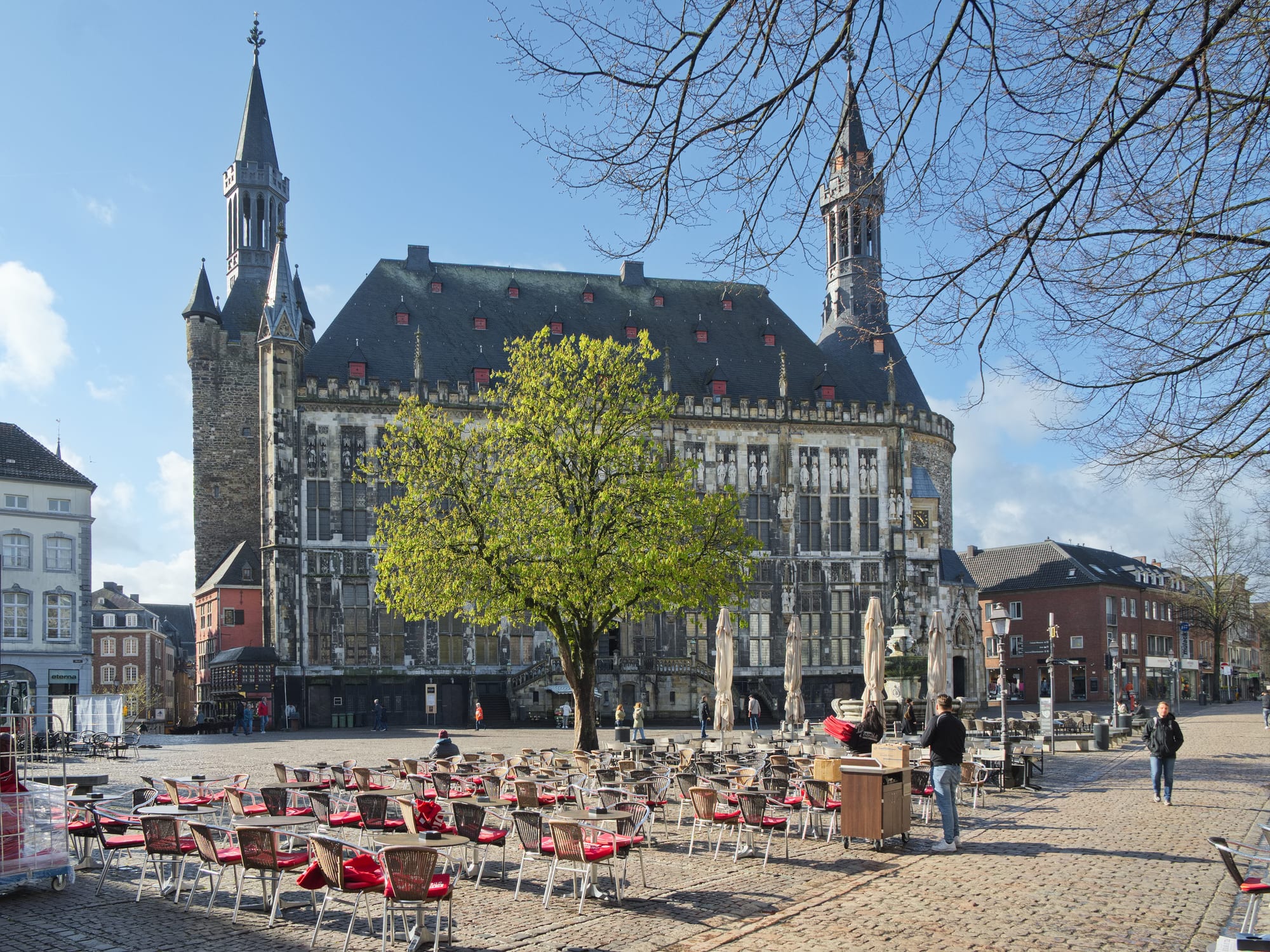
The Gothic town hall with two towers and a row of statues behind café tables on a cobbled market square

North Rhine-Westphalia, Germany

Aachen

The market square and the Gothic town hall in the centre of Aachen. (Armin Kleiner / Wikimedia Commons · CC BY-SA 4.0)

Germany's westernmost major city, bordering Belgium and the Netherlands, built around warm mineral springs used since Roman times. Charlemagne made it the chief residence of his empire and was buried in its palace chapel, where German kings were crowned for six centuries. Today it is a technical university city with a compact historic centre and a spa tradition.

Neighbourhoods

  • Altstadt
    • First-time visitors
    • Historic district

    The historic centre around the cathedral and the Gothic town hall, a few steps apart. Narrow streets lead to the Elisenbrunnen, the Couven Museum, Printen bakeries on Münsterplatz and Krämerstraße, and the market square's cafés.

    Open in Maps
  • Pontviertel
    • Students and nightlife
    • Cheap eats

    The student quarter along Pontstraße, running from the market square north-west to the medieval Ponttor gate, close to the main university buildings. Snack bars, pubs and restaurants line the street, and it is the liveliest part of town at night.

    Open in Maps
  • Frankenberger Viertel
    • Local life
    • Best for food
    • Alternative scene

    An alternative area in the south of the city, with Turkish and Arab diners for lunch or dinner.

    Open in Maps
  • Burtscheid
    • Quiet and residential
    • Spa town

    A former abbey territory south of the centre, merged with Aachen in 1897 and still a health resort, where hot springs rise and the Romans built bathhouses.

    Open in Maps

Things to do

Famous landmarks

  • Aachen Cathedrallandmark

    Charlemagne's palace chapel, modelled on San Vitale in Ravenna, where he was buried in 814 and where thirty-one German kings were crowned between 936 and 1531, later extended with a soaring Gothic choir.

    Open in Maps
  • Aachen Town Halllandmark

    A Gothic town hall of the first half of the 14th century, built on the site of Charlemagne's audience hall, where the Charlemagne Prize is awarded each year.

    Open in Maps
  • Elisenbrunnenlandmark

    One of the city's best-known sights, on Friedrich-Wilhelm-Platz, whose fountains are among the remains of the Roman bathhouses found in the city.

    Open in Maps
  • Ponttorlandmark

    One of the two surviving gates of the medieval city wall, built in the 14th century at the end of Pontstraße.

    Open in Maps

Museums

  • Cathedral Treasurymuseum

    One of the most important collections of medieval church art in Europe, listed with the cathedral in 1978 as the first World Heritage Site in Germany.

    Open in Maps
  • Couven Museummuseum

    A 17th-century pharmacy house redesigned by Jakob Couven in 1786, with period rooms, the historic pharmacy and kitchen, and a collection of faience tiles.

    Open in Maps
  • Suermondt-Ludwig-Museummuseum

    An art museum founded in 1877, with works by Aelbrecht Bouts, Joos van Cleve, Anthony van Dyck, Otto Dix and Max Beckmann.

    Open in Maps
  • Ludwig Forum for International Artmuseum

    A museum of modern art based on the collection of the Aachen collectors Irene and Peter Ludwig.

    Open in Maps

Parks, springs and sport

  • Lousbergpark

    A 264-metre hill on the northern edge of the centre, laid out as a forest park in the early 19th century, with an old water tower and views over the city.

    Open in Maps
  • Carolus Thermenattraction

    The city's modern thermal spa, fed by the hot springs that made Aachen a spa town visited by Handel, Dürer, Voltaire and Peter the Great.

    Open in Maps
  • Kornelimünster Abbeylandmark

    A Benedictine abbey in the southern district of Kornelimünster/Walheim.

    Open in Maps
  • New Tivoliattraction

    The 32,920-capacity football stadium of Alemannia Aachen in the Sportpark Soers, opened in 2009.

    Open in Maps

Short trips from the city

  • Vaalserbergviewpoint

    A hill just over the Dutch border, 322 metres high, the highest point of the European Netherlands, where Germany, Belgium and the Netherlands meet.

    Open in Maps
  • Maastrichtattraction

    The capital of Dutch Limburg on the Meuse, a Roman foundation turned medieval trade and religious centre, known for the treaty that created the euro.

    Open in Maps
  • Monschauattraction

    A small resort town in the Eifel to the south, in the Aachen district.

    Open in Maps

Seasonal events

  • CHIO Aachensummer

    The biggest equestrian sporting event in the world, held in the city each summer.

  • Aachen Christmas Marketlate November to 23 December

    Stalls fill the Katschhof, the Münsterplatz and the market square between the cathedral and the town hall, lit up at night.

Eat and drink

Long-standing places and food districts in Aachen. Hours, ratings and directions come from your maps app, always current.

Aachen classics

  • Printen bakeriesneighborhood

    Bakeries around the cathedral, among them Nobis on Münsterplatz and Klein on Krämerstraße, selling Aachener Printen, the city's spiced gingerbread.

    Open in Maps

Food streets

  • Pontstraßeneighborhood

    The students' street, with snack bars, grills and restaurants of many kinds between the market square and the Ponttor.

    Open in Maps
  • Frankenberger Viertelneighborhood

    Turkish and Arab diners in the alternative quarter in the south of the city.

    Open in Maps

Experience Aachen

History

People were drawn to Aachen's warm mineral springs as early as the Neolithic, and Iron Age Celts worshipped Grannus, a god of light and healing, at the hot sulphur springs in the marshy basin. The Romans channelled the springs into baths in the 1st century AD, and their spa town took the name Aquae Granni, the waters of Grannus; the baths were destroyed around 375 at the start of the migration period. Pepin the Short built a residence here, and Charlemagne spent most winters in Aachen from 792 until his death in 814. His palace, completed around the turn of the 9th century, made it the main royal residence of the Frankish Empire, and he was buried in his palace chapel.

From 936, when Otto I was crowned there, until 1531, thirty-one German kings were crowned in Charlemagne's chapel. Emperor Frederick Barbarossa granted city rights in 1166, making Aachen an imperial city, and in 1330 the town hall replaced the old audience hall. When the coronations moved to Frankfurt, the springs kept the town prosperous as a spa where Handel, Dürer, Voltaire and Peter the Great took the waters. The Peace of Lunéville gave Aachen to France in 1801. Under Prussia it industrialised, merged with Burtscheid in 1897 and passed 100,000 inhabitants in 1890.

Two air raids in April and May 1944 devastated the city, and in autumn 1944 it was besieged by American forces from 12 September until the German garrison surrendered on 21 October; only about 4,000 inhabitants remained. After the war the city looked to Europe: the Charlemagne Prize for service to European unity has been awarded here since 1950, and in 1978 the cathedral was the first German monument entered on the World Heritage list. RWTH Aachen has since made the city a technology hub.

Culture & Customs

Charlemagne is the city's founding figure and its emblem. His chapel at the heart of the cathedral and his shrine are the main draw for visitors, the treasury holds one of Europe's finest collections of medieval church art, and the town hall, where the Charlemagne Prize is presented each year, is a station on the Route Charlemagne, a programme presenting the city's historic sites. The prize, given for work toward European unification, reflects a city that sees itself as European as much as German.

Aachen sits where three countries meet, and the borders with Belgium and the Netherlands run through its outskirts. Its French name, Aix-la-Chapelle, recalls Charlemagne's chapel; its own dialect is Öcher Platt, a Ripuarian speech in which the city is called Oche. The spa tradition survives in the thermal springs of the centre and Burtscheid, more than thirty in all.

Sport means horses and football. The CHIO, held each summer, is the world's biggest equestrian event and is spoken of by riders as the Wimbledon of showjumping. Alemannia Aachen, whose old Tivoli stadium was famous for its atmosphere, now play in the New Tivoli in the Soers, opened in 2009. The Christmas market around the cathedral and the town hall draws visitors from across the border regions every December.

Daily Life

About 261,000 people lived in Aachen in mid-2025, and the wider Städteregion Aachen, formed in 2009, has about 580,000. Aachen has been Germany's westernmost large city since it passed 100,000 inhabitants in 1890. Many foreign residents are students, and the city lies in the cross-border Meuse–Rhine Euroregion, with neighbouring towns in Belgian Liège province and Dutch Limburg.

RWTH Aachen University dominates working life. One of Germany's leading technical universities, it is known especially for mechanical engineering, automotive and manufacturing technology, and has spun off a cluster of technology firms. Its university hospital, the Uniklinikum, is Europe's largest single-building hospital. Students set the tone of the Pontviertel and much of the centre in term time.

The rhythm of the city is that of a mid-sized university town: shoppers and students in the pedestrian streets by day and the bars of Pontstraße by night, with Maastricht and the Dutch and Belgian border towns close at hand. The Lousberg and the forests to the south provide green space close to the centre.

Food

Aachen's best-known speciality is Aachener Printen, a type of Lebkuchen. Unlike most German gingerbread, which is sweetened with honey, Printen are now generally sweetened with a syrup made from sugar beets, and they were originally hard, baked in large flat loaves. The name is a protected geographical indication, so all makers must be in or near Aachen. Bakeries around the cathedral, among them Nobis on Münsterplatz and Klein on Krämerstraße, are known for them.

The student city keeps food cheap. Pontstraße, between the market square and the Ponttor, is the street students prefer for snack bars and light meals, with grills and restaurants, Turkish and Japanese among them, and the Frankenberger Viertel, an alternative quarter in the south, is known for its Turkish and Arab diners.

The market square, facing the Gothic town hall, has restaurants and café tables that spill onto the cobbles in fine weather, and from late November to 23 December the Christmas market fills the Katschhof, the Münsterplatz and the square itself with stalls.

Planning tools

Budget

Aachen is cheaper than Cologne or Düsseldorf, and its student population keeps plenty of food inexpensive. Rooms are scarce and dear during the CHIO and the Christmas market. The cathedral, the old town and the Lousberg cost nothing to enjoy; the thermal spa and the museums charge admission.

Daily Budget Midrange
USD 130–240 (mid-range hotel, restaurant dinners, museum and spa tickets, a train to Maastricht or Cologne)
Daily Budget Shoestring
USD 60–105 (hostel or budget hotel, Pontstraße snack bars, buses)

For the Christmas market and the CHIO, book rooms well in advance or stay in a neighbouring town on the rail line.

Best Time to Visit

May to September is pleasant for the old town and walks on the Lousberg and at the three-country point, and the CHIO brings the world's showjumpers in summer. The Christmas market, from late November to 23 December, is the busiest time of year. The thermal spa makes Aachen a good winter destination too.

Suggested Number of Days

The compact centre fits into one or two days. Three or four allow time for the countryside and towns across the Dutch and Belgian borders and to the south. Big events such as the Christmas market make the centre slower to get around.

First Visit
1–2 days
With Surroundings
3–4 days

Transportation

Buses cover the city and run across the border, including a line from Maastricht. The main station has trains to Cologne, Mönchengladbach and Liège, and four smaller stations serve other districts. The centre has pedestrian shopping zones, and parking can get expensive.

Check that a bus or rail ticket is valid across the border before travelling to Belgium or the Netherlands.

Airport & Station Connections

Aachen Hauptbahnhof is on the line between Cologne and Brussels: ICE trains from Brussels to Frankfurt and Eurostar trains from Paris to Cologne stop here. Maastricht Aachen Airport, a major cargo hub with a small regional passenger service, is about 28 km north-west in the Netherlands; most air travellers use Düsseldorf, Cologne Bonn or Brussels and finish by train.

Walkability

The historic centre is small, and the cathedral, the town hall, the Elisenbrunnen and Pontstraße are a few minutes apart. The main station is a short walk south. The Lousberg involves a climb, and Burtscheid, Kornelimünster and the Soers are reached by bus.

Safety

Germany is a safe country with low levels of violent crime. Aachen is a calm city, but Christmas-market and big-event crowds call for care with bags and phones.

Keep bags secure in crowds and on public transport, and stay out of marked cycle lanes on foot. Check current official travel advice before travelling.

Climate

A mild, temperate climate, much gentler than continental places at the same latitude, with rain spread through the year. Frost can occur from mid-October to late April.

Summer
mild to warm; July averages about 18.5°C, with occasional hot spells
Winter
cool and damp; January averages about 3°C, with some frost and occasional snow

Local Customs

Rounding up the bill in restaurants and pubs is usual. The local dialect is Öcher Platt, a Ripuarian variety — Aachen itself is Oche. The cathedral is a working church: dress modestly, keep quiet during services and check whether photography is allowed inside.

Most shops close on Sundays; across the border, shops in Dutch Vaals keep different hours.

Common Payment Methods

The currency is the euro, as in neighbouring Belgium and the Netherlands. Cards and contactless payment are widely accepted, though some bakeries, snack bars and kiosks still prefer cash, and cash machines are easy to find.