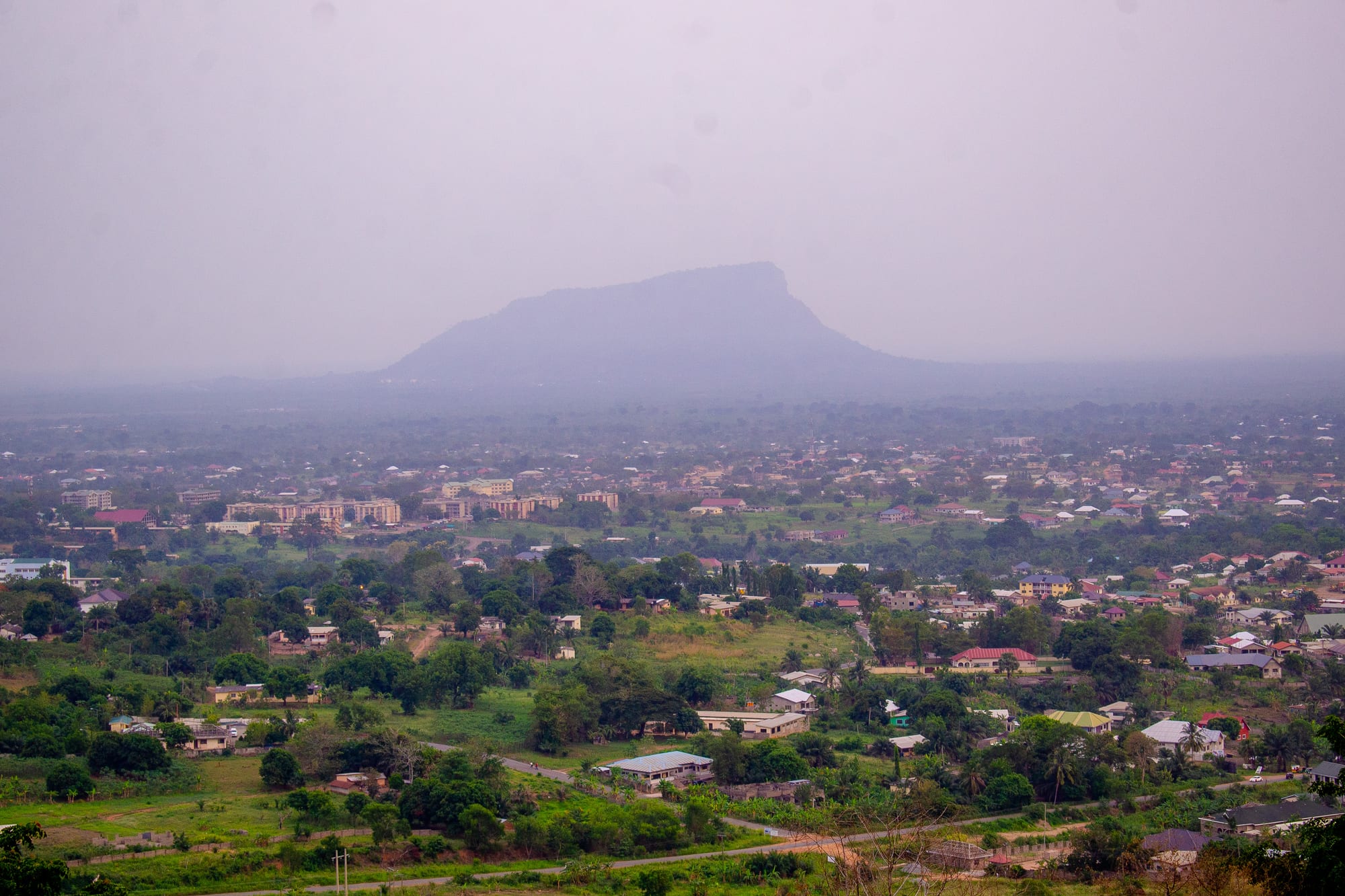
A low green town of scattered houses and trees under haze, with a long flat-topped mountain rising behind it

The Volta, Ghana

Ho

Ho spread out below the flat-topped ridge of Mount Adaklu, in Ghana's Volta Region. (Amuzujoe / Wikimedia Commons · CC BY-SA 4.0)

The capital of Ghana's Volta Region, set in a bowl of green hills close to the Togo border with the flat-topped bulk of Mount Adaklu to the south. A mission station that became an administrative town under German and then British rule, it is now a quiet university and government centre and the usual base for the Volta highlands.

Neighbourhoods

  • Ho central
    • First-time visitors
    • Markets
    • Close to transport

    The working centre, where the main market, the lorry park, banks, churches and government offices sit within a few streets of each other. It is busiest in the morning, when traders and tro-tros fill the roads, and quiet by mid-evening.

    Open in Maps
  • Bankoe and the old quarters
    • Historic district
    • Local life

    One of the traditional divisions of Ho, with chief's houses, old mission churches and compound homes on the slopes above the centre. The town's Ewe ceremonial life, including the yam festival durbars, is anchored in quarters like this.

    Open in Maps
  • Ho-Dome and the university side
    • Students
    • Quiet and residential

    The spreading eastern and northern edges of town, where the university's faculties, the teaching hospital and student hostels have pulled new building out along the main roads, with food stalls, printing shops and small bars alongside.

    Open in Maps
  • Ahoe
    • Quiet and residential
    • Views

    A residential district on higher ground towards the hills, with newer bungalows, church compounds and views back over the town. It is a calm place to stay a short shared-taxi ride from the centre.

    Open in Maps

Things to do

In town

  • Volta Regional Museummuseum

    A museum opened in 1973 and run by the Ghana Museums and Monuments Board, holding Ewe drums, stools, kente, pottery and masks, the chair of state of the last German colonial governor, and material from the Togoland years.

    Open in Maps
  • University of Health and Allied Sciencesattraction

    Ghana's health-sciences university, founded in Ho in 2011, whose campuses and teaching hospital have reshaped the eastern side of the town.

    Open in Maps

Hills and viewpoints

  • Mount Adakluviewpoint

    The flat-topped ridge that closes the view south of Ho, about 12 km from the town and some 580 metres high, venerated by the Ewe villages ringing it and climbed from them for wide views over the plain.

    Open in Maps
  • Amedzofeviewpoint

    A hill village about 26 km north of Ho, at some 680 metres in the Avatime hills, with short walks to the Ote falls and to the cross on Mount Gemi.

    Open in Maps

Short trips from the town

  • Tafi Atome Monkey Sanctuaryattraction

    A village-run forest north of Ho where mona monkeys, long regarded as sacred, come close to visitors and guides are provided by the community.

    Open in Maps
  • Tagbo Fallsattraction

    A waterfall near Mount Afadjato, reached on a guided walk from Liati Wote in the hills towards the Togo border north of Ho, dropping in stages with a final fall of about 60 metres.

    Open in Maps
  • Kalakpa Game Production Reservepark

    A game reserve of some 320 square kilometres on the foothills of the Togo mountains about 30 km south of Ho, established in 1975 and little visited.

    Open in Maps

Seasonal events

  • Asogli Yam FestivalSeptember

    The Asogli state's harvest festival in Ho, with drumming, a durbar of chiefs in state and the ritual eating of the new yam.

  • Christmas and the homecoming seasonDecember

    Families return from Accra and abroad, churches hold long services and carol nights, and funerals and weddings are concentrated into the same weeks.

  • Ewe drumming and dance displaysthrough the dry season, November to March

    Agbadza and borborbor groups perform at festivals, funerals and school competitions across the town and surrounding villages.

Eat and drink

Long-standing places and food districts in Ho. Hours, ratings and directions come from your maps app, always current.

Ho classics

  • Akple with fetri detsi at the chop barsrestaurant

    The Ewe staple — smooth maize dough eaten by hand with okra soup, often with fish or goat — served at plain kitchens across the town.

    Open in Maps
  • Grilled tilapia and banku spotsrestaurant

    Whole tilapia charred over coals with fermented maize dough and hot pepper shito, the standard evening meal at open-air spots.

    Open in Maps
  • Khebab and drinking spotsrestaurant

    Roadside grills sell pepper-dusted beef skewers beside the bars where people drink beer, palm wine and akpeteshie after work.

    Open in Maps

Markets and food streets

  • Ho central marketmarket

    The town's main market, strongest on its market day, with yams, cassava, maize, palm oil, smoked fish from the lagoon and lake, and cloth.

    Open in Maps
  • Food stalls around the lorry parkneighborhood

    Waakye, rice and stew, fried yam and kelewele are sold from pans and glass cases where the tro-tros load for Accra and Hohoe.

    Open in Maps

Experience Ho

History

Ho is an Ewe town, founded by families who moved west from Notsé, in present-day Togo, in the wave of migrations that Ewe tradition dates to the seventeenth century and explains as an escape from the tyranny of King Agokoli. The settlers of the Asogli state established themselves among the hills below Adaklu, in quarters — Bankoe, Ahoe, Heve and Dome among them — that still structure the town's chieftaincy. It was a farming place rather than a trading port, inland from the lagoon states of the coast and well away from the European forts.

The nineteenth century brought the missionaries. The North German Missionary Society, the Bremen mission, began work among the Ewe from the 1840s, reducing the language to writing, translating scripture and founding schools and congregations that became the Evangelical Presbyterian Church — an institution that still marks Ho's skyline and its school system. Political control followed trade and mission: the hinterland here was claimed by Germany as part of Togoland in 1884, and Ho was administered from Germany's district stations until the First World War.

British and French forces took Togoland in 1914, and the western part, Ho included, passed to Britain as a mandate and later a UN trust territory. In the plebiscite of 1956 the territory voted to join the Gold Coast, and Ho entered independent Ghana in 1957. It was made the capital of the Volta Region, and government offices, a regional hospital, secondary schools and, from 2011, a university built around health sciences have made administration and education the town's business ever since. The Oti Region, approved by referendum in December 2018 and inaugurated in 2019, cut away the region's northern half.

Culture & Customs

Ho is the seat of the Asogli state, and its chieftaincy is visible in a way the quiet streets are not: the Agbogbomefia, the paramount chief, presides over a hierarchy of divisional chiefs and queen mothers whose ceremonial year peaks at the Asogli Yam Festival in September, when a durbar fills a field with umbrellas, palanquins, linguists' staffs and drumming, and the new yam is ritually eaten.

Ewe is the language of the town, and Ewe cultural forms are its pride. Agbadza, danced with a bent back and beating arms, and borborbor, a brighter recreational dance with brass and bells, are performed at funerals, festivals and church occasions alike. Drumming schools and cultural troupes work through the region, and Ewe drumming is studied well beyond Ghana.

Christianity is strong and mostly Presbyterian and Catholic in older families, a legacy of the Bremen and Catholic missions, with Pentecostal churches growing alongside; traditional shrines and vodu practice persist in and around the town without much publicity. Funerals are the biggest social events of all, announced on posters and held weeks after a death, with matching cloth, all-night wakes and hundreds of guests. Ewe kente, woven in narrow strips at Agotime Kpetoe east of Ho, is worn for these occasions and is distinct in pattern from the Asante cloth.

Daily Life

About 180,000 people lived in the Ho municipality at the 2021 census, which makes it a middling Ghanaian town rather than a city, and it feels that way: low buildings, a lot of trees, and hills at the end of most streets. Government is the main employer, followed by the university and the teaching hospital, schools, banks and trade; farming — maize, cassava, yams, vegetables and some cocoa and coffee in the hills — supports the villages that ring the town and supplies its market.

People live in the old quarters on the slopes and in newer bungalow districts spreading along the Accra, Aflao and Hohoe roads, with student housing clustering near the campuses. Shared taxis and motorbikes cover the distances; car ownership is higher among the civil-service households than in the surrounding countryside.

The day starts before six, with market trading and office hours done by early afternoon and the evening given to grilled food, drinking spots, church meetings and football on television. Young people leave for Accra in numbers, and remittances and returning families are part of the local economy. Water and power interruptions, the state of the feeder roads into the hills and the cost of living are the standing complaints; Ho's ambitions to draw more of the region's tourist traffic are a regular subject of local debate.

Food

Ho eats Ewe food. The staple is akple, a smooth, slightly sour dough of maize flour that is pinched off by hand and dipped into soup — most often fetri detsi, an okra soup thickened until it draws, or a palm-nut or groundnut soup, with goat, beef or fish. Abolo, a lightly sweet steamed maize bread, and yakayake, steamed cassava grains, are eaten with the same stews, and kenkey and banku appear everywhere.

Fish comes inland from the Keta lagoon and Lake Volta, smoked, salted or fried; abɔbitadi, a herring stew with tomatoes and pepper, is a household standard. Beyond the Ewe dishes, the town eats the national repertoire: waakye for breakfast and lunch, jollof rice, red red with fried plantain, fufu in light soup, and grilled tilapia with banku and shito in the evening. Kelewele, spiced fried plantain cubes, is sold from braziers after dark.

Palm wine is tapped in the surrounding country and drunk fresh; because it ferments within a day it is also distilled into akpeteshie, the strong local gin, poured at funerals and libations as well as in bars. Sobolo, the deep red hibiscus drink, and sachet water are what most people carry through the heat.

Planning tools

Budget

Ho is inexpensive even by Ghanaian standards. Guesthouses and small hotels are cheap, chop-bar meals cost little, and shared taxis within the town are a matter of a few cedis. The costs that add up are transport into the hills and the community guide fees charged at village sites, which are modest but are paid at each one separately.

Daily Budget Midrange
USD 70–150 (a better hotel, a hired car with driver for the hills, guides and community fees)
Daily Budget Shoestring
USD 25–50 (guesthouse, chop-bar food, tro-tros and shared taxis)

Cash and mobile money are used for nearly everything; banks and cash machines in the centre are more reliable than those in the villages.

Best Time to Visit

November to March, the dry season, is best for walking and for the hill roads, though Harmattan haze can flatten the views. The waterfalls in the hills are fullest late in the rains, around July to October, when paths are muddy. September brings the Asogli yam festival and the town fills.

Suggested Number of Days

The town itself is small and a day or two is enough for it. Most people give three to five days in all, because the hills, waterfalls and village sanctuaries around Ho are spread out and slow to reach without a car.

First Visit
1–2 days
With Surroundings
3–5 days

Transportation

Shared taxis run fixed routes through the town for a few cedis and can be chartered by the trip or the day; motorbike taxis cover the rest. Tro-tros and coaches leave the lorry park for Accra, Hohoe, Aflao and the villages, generally filling up and departing in the morning. Hiring a taxi for a day is the practical way to combine sights in the hills.

Set a price before a charter or a motorbike ride, and start early: rural services thin out badly after the middle of the day.

Airport & Station Connections

Ho is about 160 km from Accra by road, generally three to four hours, crossing the Volta on the Adomi bridge at Atimpoku. Tro-tros and coaches run the route through the day, and Hohoe lies a little over an hour further north. The airport outside the town opened to commercial traffic in 2021, but scheduled flights were suspended in 2022, so almost everyone arrives by road.

Walkability

The centre is compact and walkable — the market, the lorry park, offices and churches are within a few hundred metres — but the town is set on slopes and spreads a long way along its main roads, so the university side, Ahoe and the outer quarters usually mean a shared taxi. Pavements are intermittent and the sun is hard in the middle of the day.

Safety

Ho is a calm, low-key town with little crime aimed at visitors; the usual care with bags in the market and the lorry park is enough. The greater risks are road accidents on the hill roads, steep and slippery paths at the waterfalls, and heat. Storms in the rainy season can wash out village tracks quickly.

Change money at banks rather than with street changers at Aflao, use a guide on mountain trails, and swim only where locals advise. Check current official travel advice before travelling.

Climate

Tropical, with two rainy seasons like the rest of southern Ghana and more rain than the coast because of the hills. The main rains fall from about April to July, a shorter wet spell comes in September and October, and the dry months from November to March bring Harmattan haze.

Summer
the main rains, about April to July: roughly 23–31°C, humid, with heavy afternoon storms
Winter
the dry season, about November to March: roughly 22–34°C, hazy and dusty, cooler at night in the hills

Local Customs

This is an Ewe town where chieftaincy, church and family obligation order the week. Greetings come before business and are made with the right hand; hats come off and shoulders are covered before a chief or in church. Funerals are large public events and photographs of mourners, shrines or festival ritual need permission. Sunday mornings belong to church, and much of the town closes.

Tipping is not expected in chop bars, and village guides at the waterfalls and sanctuaries are paid a set community fee at the visitor centre.

Common Payment Methods

The currency is the Ghanaian cedi. Cash and mobile money are used for almost everything, cards only at a few hotels, and the cash machines in central Ho are the most dependable in the region — the hill villages and community sites take cash only.