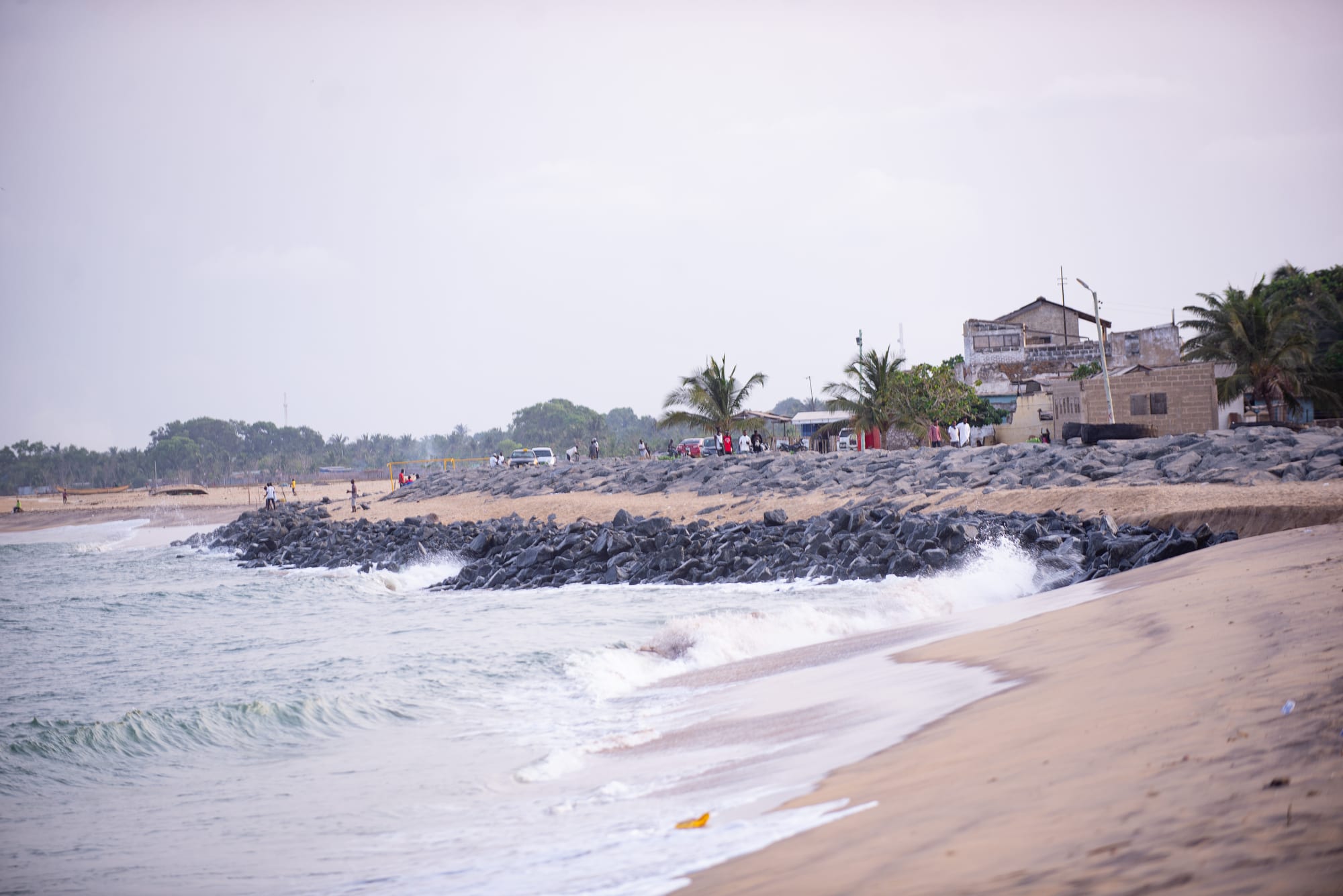
Surf breaking on a sandy shore beside a long bank of dark rock armour, with palms and low houses behind

The Volta, Ghana

Keta

The rock sea defence along the shore at Keta, on the sand bar between the Atlantic and the Keta Lagoon. (Amuzujoe / Wikimedia Commons · CC BY-SA 4.0)

A town on a narrow sand bar between the Atlantic and the Keta Lagoon in south-eastern Ghana, in the Anlo Ewe country near the Togo border. Once a busy trading port with a Danish fort, it lost streets and whole quarters to the sea during the twentieth century, and now lives on fishing, salt and lagoon farming behind a long sea defence.

Neighbourhoods

  • Keta town and the fort
    • First-time visitors
    • Historic district
    • Beaches

    The old centre at the eastern end of the sand bar, where the ruins of Fort Prinzenstein stand above the beach among colonial-era buildings, churches and the market. The sea is on one side and the lagoon on the other, a few minutes apart on foot.

    Open in Maps
  • The sand bar towards Anloga
    • Beaches
    • Quiet and residential

    The strip of land west of town, a single road between ocean and lagoon lined with fishing villages, shallot gardens, coconut palms and a scattering of simple beach lodges. Nets are hauled on the ocean side, canoes worked on the lagoon side.

    Open in Maps
  • Anloga
    • Local life
    • Festivals
    • Markets

    The traditional capital of the Anlo state at the western end of the bar, a farming and market town known for shallot growing and as the home of the Hogbetsotso festival, with the paramount chief's court and a large market.

    Open in Maps

Things to do

History on the shore

  • Fort Prinzensteinlandmark

    The Danish fort built at Keta in 1784 and used in the Atlantic slave trade, listed with Ghana's other forts and castles as a World Heritage Site and now a part-ruined shell on the beach, much of it taken by the sea.

    Open in Maps
  • Cape St. Paul Lighthouselandmark

    The lighthouse built in 1901 near Woe, west of Keta on the sand bar, a skeletal tower that is a landmark on this low, featureless coast.

    Open in Maps

Lagoon, beach and salt

  • Keta Lagoonattraction

    Ghana's largest lagoon, a shallow brackish sheet stretching west behind the sand bar from the edge of the town, listed since 1992 as a wetland of international importance and worked for fish and salt.

    Open in Maps

Short trips along the coast

  • Anloganeighborhood

    The Anlo traditional capital west along the bar, a shallot-growing and market town and the setting for the Hogbetsotso festival.

    Open in Maps
  • Aflaoneighborhood

    The border town east of Keta where the coast road crosses into Togo at Lomé, busy with traders, money changers and cross-border traffic.

    Open in Maps

Seasonal events

  • HogbetsotsoNovember

    The Anlo Ewe festival at Anloga commemorating the migration from Notsé, held on the first Saturday of November with a durbar of chiefs, drumming and dancing.

  • The shallot harveststhrough the dry season, November to March

    The gardens on the sand bar are worked hardest in the dry months, when beds are watered from shallow wells and lorries load shallots for Accra and beyond.

  • Christmas and the homecoming seasonDecember

    Families return from Accra, Lomé and abroad, churches hold night services, and funerals, weddings and village celebrations fill the same weeks.

Eat and drink

Long-standing places and food districts in Keta. Hours, ratings and directions come from your maps app, always current.

Keta classics

  • Akple with fetri detsi at the chop barsrestaurant

    The Anlo staple of smooth maize dough with okra soup, eaten by hand, usually with lagoon or sea fish rather than meat.

    Open in Maps
  • Grilled and fried fish by the beachrestaurant

    Tilapia, mackerel and whatever the canoes land, grilled over coals or fried, served with banku, kenkey and hot pepper shito.

    Open in Maps
  • Yakayake and abolo stallsrestaurant

    Steamed cassava grains and lightly sweet steamed maize bread, both Ewe coastal specialities, sold with fish stew from pots at the roadside.

    Open in Maps

Markets and food streets

  • Keta marketmarket

    The town market, strongest on market day, selling fish fresh, smoked and salted, shallots, cassava, maize and household goods.

    Open in Maps
  • Anloga marketmarket

    The bigger market at the western end of the bar, the trading point for the shallot gardens and for produce moving between the coast and Accra.

    Open in Maps

Experience Keta

History

Keta grew as a town of the Anlo, the Ewe group whose tradition brings them west from Notsé, in present-day Togo, to settle the lagoon country around Anloga in the seventeenth century. The sand bar gave access to both the ocean and a great brackish lagoon, and Keta became the Anlo state's trading beach, dealing with European ships that anchored offshore. The Danes built Fort Prinzenstein there in 1784, after the Sagbadre War against the Anlo; it served the Atlantic slave trade in its first decades, passed to Britain with the rest of the Danish Gold Coast in 1850, and was later used as a prison.

Through the nineteenth century Keta was one of the busiest trading towns of the eastern coast, with European and Ghanaian merchant houses, Bremen mission schools and churches, and a customs post that sat close to the German Togoland border a few kilometres east — a position that made smuggling as much a part of local business as legitimate trade. Fish, salt, copra and farm produce moved out; cloth and manufactures came in.

The sea then took the town. Erosion of the sand bar, worsened over the twentieth century, swallowed streets, schools, churches and much of the fort, and thousands of people moved away to Accra and elsewhere: the Bremen trading factory and coconut plantation that stood close to the high-water mark in 1907 had been swept away by 1924. Colonial attempts to hold the shore failed, and in 1999 work began on the sea defence and land reclamation scheme, halting the worst of the retreat and rebuilding part of the shoreline, but Keta today is a much smaller place than the port it once was.

Culture & Customs

Keta belongs to the Anlo traditional state, whose paramount chief, the Awoamefia, is enstooled at Anloga, the ritual capital a short way west along the bar. The Anlo year turns on Hogbetsotso, held at Anloga on the first Saturday of November, which commemorates the escape from Notsé and the migration to this coast: the chiefs sit in a durbar under umbrellas, there is a ritual cleansing of the state, and drumming and dancing run for days.

Ewe drumming and dance are taken seriously here. Agbadza, danced with the back bent and the arms beating, and the coastal styles performed at funerals and festivals, are learned from childhood, and many of Ghana's best-known drummers and choreographers have come from this stretch of coast. Funerals are the great social occasion, held weeks after a death with matching cloth, all-night wakes and hundreds of guests returning from Accra, Lomé and abroad.

Christianity, established early through the Bremen mission and Catholic schools, sits alongside a strong traditional religious life in which the lagoon, the sea and the shrines of particular deities all have their custodians and prohibitions. Anlo communities are known nationally for their emphasis on schooling, and Keta's old secondary schools have sent generations of pupils into the professions, which is one reason so many Anlo families are divided between the coast and the cities.

Daily Life

About 23,000 people live in Keta town itself, with the wider municipality along the sand bar holding many more, and the population has long been shaped by departure: erosion and the loss of the port pushed families to Accra and Tema, and remittances and returning retirees remain part of the local economy. Fishing is the visible work — canoes launched through the surf on the ocean side, nets hauled up the beach, and traps and small craft on the lagoon.

Salt is the other lagoon industry, won by evaporation in pans along the shallow margins, and shallot growing on the sand bar around Anloga is long established, worked in small irrigated beds watered by hand from shallow wells. Trade, teaching, health work and cross-border business at Aflao make up much of the rest, and the sea defence itself has reshaped where people build.

The day begins before dawn with the boats and ends early. Mornings belong to the market, the gardens and the school run; afternoons are hot, breezy and slow; evenings are for grilled fish, drinking spots and church meetings. Erosion, the state of the lagoon fishery, floods when the lagoon rises and the reliability of water and power are the constant local concerns.

Food

Keta eats from the lagoon and the sea. Akple, the smooth maize-flour dough of the Ewe, is eaten by hand with fetri detsi, an okra soup drawn out until it strings, or with palm-nut soup, almost always with fish: fresh tilapia and shrimp from the lagoon, mackerel, tuna and sardinella from the ocean, or the smoked and salted fish that is a trade of its own here. Abɔbitadi, a herring stew heavy with tomatoes and pepper, is a household standard.

Coastal specialities show up more here than inland: yakayake, steamed cassava grains eaten with fish stew; abolo, a lightly sweet steamed maize bread sold in wrapped bundles; and banku and kenkey with grilled tilapia and shito, the black pepper-and-fish sauce. Shallots from the sand-bar gardens go into nearly everything, with tomatoes, garden eggs and palm oil.

Coconut is everywhere on the bar, drunk fresh and grated into food, and palm wine is tapped nearby and distilled into akpeteshie, the local gin used in libations at festivals and funerals as well as sold in bars. Sobolo, the red hibiscus drink, sachet water and bottled beer round out the rest.

Planning tools

Budget

Keta is inexpensive. Guesthouses and beach lodges on the sand bar range from very basic to comfortable but stay cheap by coastal standards, meals of fish and banku cost little, and shared taxis along the bar are a few cedis. Getting to and from Accra, and hiring a canoe or a guide on the lagoon, are the main extra costs.

Daily Budget Midrange
USD 70–150 (a beach lodge, a hired car with driver, boat trips and guides)
Daily Budget Shoestring
USD 25–50 (simple guesthouse, chop-bar food, tro-tros and shared taxis)

Cash and mobile money are what work here; draw money in Keta or Aflao rather than counting on the villages.

Best Time to Visit

November to March is the driest and most comfortable season, with the shallot gardens in full work and migratory waterbirds on the lagoon. The coast here is among the driest parts of southern Ghana, but the main rains from about April to July bring heavy showers and rougher seas, and November brings the Hogbetsotso festival at Anloga.

Suggested Number of Days

The town is small and easily covered in a day. Two or three days suit a stay on the sand bar, allowing for the lagoon and the villages along it, and the pace depends mostly on how the transport there works out.

First Visit
1 day
With Surroundings
2–3 days

Transportation

One road runs the length of the sand bar, and shared taxis and tro-tros work it between Keta, Woe, Anloga and the junction towns on the mainland, with motorbike taxis for shorter hops. Services to Accra and Aflao leave from the lorry park, generally in the morning. Canoes cross and work the lagoon for fishing rather than as a scheduled service.

Agree fares before setting off, and travel earlier in the day, since transport along the bar thins out by evening.

Airport & Station Connections

Keta lies east of Accra, three to four hours by road through Ada and Sogakope or along the Aflao road and then down onto the sand bar. Tro-tros and coaches run from Accra and from Aflao, the Togo border crossing roughly 35 km east, which is also the nearest link to Lomé and its airport. There is no railway and no airport at Keta.

Walkability

The town is flat, small and easy to walk, with the fort, the beach, the market and the lagoon shore all within a few hundred metres. Sand, sun and little shade make the middle of the day heavy going, and the villages further along the bar are spread out enough to need a shared taxi or a motorbike.

Safety

Keta is a quiet town and crime against visitors is uncommon, though the usual care applies in the market and at the lorry park. The sea is the real hazard: the Atlantic here has a strong undertow and there are no lifeguards. Storm surges and erosion affect parts of the shore, and Aflao, as a busy border town, attracts touts and unofficial money changers.

Change money at banks rather than with street changers at Aflao, use a guide on mountain trails, and swim only where locals advise. Check current official travel advice before travelling.

Climate

Hot and humid year-round, but unusually dry for the West African coast: Keta sits in the dry coastal savanna belt, with less rain than Accra or the Volta hills. The main rains fall from about April to July, a shorter wet spell comes in September and October, and the Harmattan brings haze between November and February.

Summer
the main rains, about April to July: roughly 24–31°C, humid, with sea breezes and heavy showers
Winter
the dry season, about November to March: roughly 23–33°C, hazy, breezy and dusty

Local Customs

This is Anlo Ewe country, where chieftaincy, the lagoon and the sea all carry ritual weight. Greetings come before business and are made with the right hand; certain days are traditionally kept free of fishing or farming in some communities, and shrines, funerals and festival rituals should not be photographed without permission. Funerals are large public events and dress for them is formal.

Ask before taking photographs of people, shrines or the fishing crews, and respect requests not to enter sacred groves or shrine compounds.

Common Payment Methods

The currency is the Ghanaian cedi. Cash and mobile money cover almost everything, cards are accepted at few places beyond a lodge or two, and cash machines are in Keta and Aflao rather than in the villages along the bar. Togolese CFA francs circulate informally near the border.