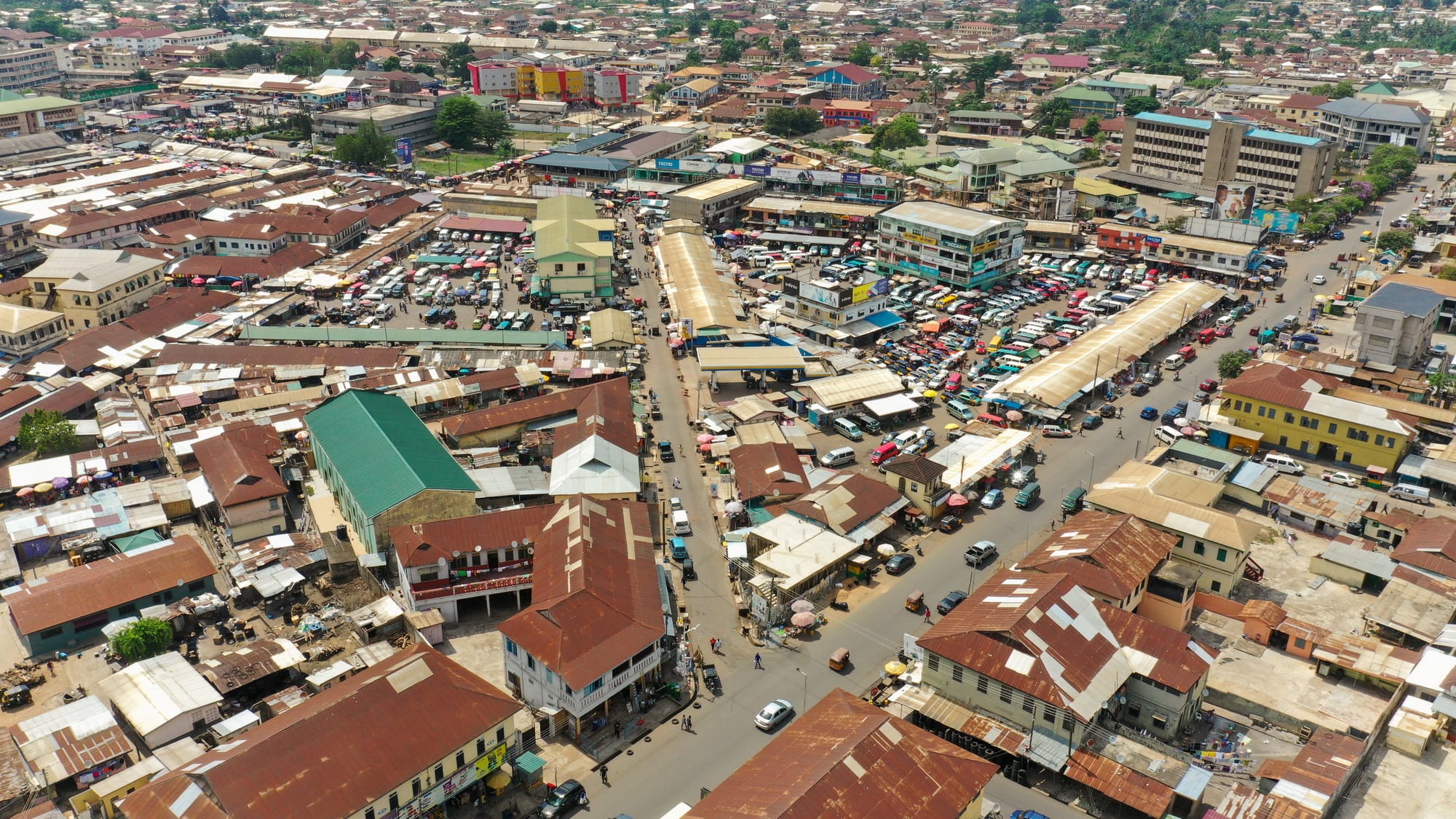
Aerial view of Koforidua, with rust-red and green metal roofs, market sheds, parked minibuses and a busy main street

Kumasi & the Ashanti Heartland, Ghana

Koforidua

Koforidua's central streets and market sheds seen from the air, in Ghana's Eastern Region. (Samson Craig McArthur Sik / Wikimedia Commons · CC BY-SA 4.0)

The capital of Ghana's Eastern Region, set in green hills north of Accra. It was founded in 1875 by Akan migrants from Juaben in Asante, on Akyem land, and prospered on cocoa, and is now a trading and administrative town of markets, churches and college campuses, used as a base for the waterfalls and ridge villages around it.

Neighbourhoods

  • The town centre
    • First-time visitors
    • Markets
    • Close to transport

    The compact grid around the central market and the lorry parks, where the banks, shops, chop bars and most of the town's traffic are concentrated. Everything here is within a short walk, and the tro-tro stations for Accra, Kumasi and the surrounding villages sit on its edges.

    Open in Maps
  • Adweso
    • Quiet and residential
    • Hotels

    A residential district on higher ground north of the centre, with wide streets of family houses, guesthouses and small restaurants. It is calmer than the market quarter and has views across the town to the hills.

    Open in Maps
  • Effiduase
    • Local life
    • Markets

    A busy suburb on the northern side of Koforidua, with its own market, schools and a steady flow of shared taxis into the centre. Residential streets spread out from the main road towards the surrounding farmland.

    Open in Maps
  • The zongo
    • Street food
    • Local life

    The quarter settled by Muslim traders from northern Ghana and the wider Sahel, as in most southern Ghanaian towns. Mosques, tailors and grills selling khebab and waakye stand along its lanes, and Hausa is heard as much as Twi.

    Open in Maps

Things to do

Markets and the town centre

  • Koforidua Central Marketmarket

    The town's main market, a dense block of sheds and stalls selling produce from the surrounding farms, cloth, household goods and cooked food.

    Open in Maps
  • The Koforidua bead marketmarket

    The weekly Thursday bead market, which draws buyers and sellers from across the Eastern Region, selling recycled glass beads from the Krobo towns nearby, strung necklaces and loose strands, and the reason many visitors stop in the town at all.

    Open in Maps
  • Jackson Parkpark

    The open ground in the centre of Koforidua used for funerals, weddings, church gatherings, concerts and government functions.

    Open in Maps

Short trips from the town

  • Boti Fallsattraction

    Twin waterfalls dropping into a forested ravine north-east of the town, reached by a long flight of steps and fullest in and just after the rains.

    Open in Maps
  • Umbrella Rockviewpoint

    A rock about seven kilometres from Boti Falls whose overhang is broad enough to shelter a dozen people, and one of the best-known sights of the Eastern Region.

    Open in Maps
  • Aburi Botanical Gardenspark

    Gardens opened in March 1890 on the cool Akuapem ridge, on the site of an earlier government sanatorium, with avenues of old trees.

    Open in Maps

Short trips east to the Volta

  • Akosombo Damlandmark

    The hydroelectric dam completed in 1965 that holds back the Volta and supplies much of Ghana's electricity.

    Open in Maps
  • Lake Voltaattraction

    The world's largest reservoir by surface area, created by the dam, with boat trips and riverside eating places at its southern end.

    Open in Maps
  • Adomi Bridgelandmark

    A steel arch bridge opened in 1957 across the Volta below the dam, long a landmark of the road east.

    Open in Maps

Seasonal events

  • Akwantukeseonce a year, on a date set by the New Juaben chiefs

    The New Juaben festival recalling the migration of the town's founders from Juaben in Ashanti, marked with a durbar of chiefs in cloth and gold under umbrellas.

  • OdwiraSeptember or October

    The Akuapem purification festival held in the ridge towns south of Koforidua, with processions, drumming and the presentation of the new yam.

  • Easter in the eastern hillsEaster, March or April

    The long Easter weekend fills the region's hill towns and waterfalls with Ghanaian visitors, and road traffic through Koforidua rises sharply.

Eat and drink

Long-standing places and food districts in Koforidua. Hours, ratings and directions come from your maps app, always current.

Markets and food streets

  • Koforidua Central Marketmarket

    Plantain, cassava, cocoyam, garden eggs, smoked fish and palm oil from the surrounding farms, with cooked-food sellers among the stalls.

    Open in Maps
  • Chop bars in the town centreneighborhood

    Small open kitchens around the market and the lorry parks serving fufu with light or palm-nut soup, ampesi with kontomire stew, and rice dishes at midday.

    Open in Maps
  • The zongo grillsneighborhood

    Evening stalls in the Muslim quarter selling khebab skewers dusted with groundnut and pepper, waakye with its sides, and koko porridge in the early morning.

    Open in Maps
  • Adweso eating placesneighborhood

    The quieter residential district north of the centre, where most of the town's sit-down restaurants and hotel dining rooms are found.

    Open in Maps

Experience Koforidua

History

Tradition traces the town's name to a hunter called Kofi and the tree, dua in Twi, under which he settled — Kofi's tree. The site lay in Akyem Abuakwa country, and the settlement that grew into modern Koforidua was founded in 1875 by people from Juaben in Ashanti, who left their home after the wars with Britain and the upheavals of that decade and were granted land here. Their community became known as New Juaben, and its paramount chief still has his palace in the town, a small Ashanti state transplanted into Akyem land.

Cocoa made the place. Seed brought into the Akuapem ridge late in the nineteenth century spread quickly through the eastern forests, and within a generation these were among the Gold Coast's main cocoa districts. Koforidua sat at the meeting of the buying routes, filled with brokers, storekeepers and transport owners, and the railway completed in 1923 made it an important road and rail junction. Colonial offices, schools and mission churches followed, and the town became the administrative centre of the eastern districts.

Swollen shoot disease later tore through the Eastern Region's farms and infected trees were cut out in great numbers; the cocoa belt's centre of gravity moved west, and Koforidua's fortunes flattened. It kept its role as capital of the Eastern Region after independence, and has grown steadily since on government offices, schools and colleges, trade with the villages around it and the traffic passing between Accra, Kumasi and the Volta.

Culture & Customs

Koforidua is an Akan town that speaks Twi, and its public life follows Akan custom: chiefs are enstooled rather than crowned, linguists carrying gold-topped staffs speak for them, and the New Juaben court keeps the drums, umbrellas and regalia its founders carried from Ashanti. The Akwantukese festival, which recalls that migration, brings the chiefs out in state and draws people home from Accra and abroad. Funerals are the other great gathering: printed invitations, matching cloth, brass bands and canopies filling the streets from Friday to Sunday.

The town is best known outside Ghana for beads. The Krobo towns a short way east — Odumase, Somanya and the villages around them — have made powder-glass beads for generations, and Koforidua's market is where much of that work is traded, alongside imported and antique strands. Bead-making is bound up with Krobo custom, above all the Dipo rites that mark a girl's passage to adulthood, when beads are worn in quantity.

Christianity is strong, from the Presbyterian congregations descended from Basel Mission work on the ridge to large charismatic churches whose services fill Sunday mornings and whose crusades take over open ground. The zongo keeps a Muslim minority with its own mosques and schools. Koforidua Technical University and several colleges give the town a student population, and highlife, gospel and hiplife carry from shops and drinking spots in the evenings.

Daily Life

Koforidua had an estimated 151,255 people in 2025, which makes it a medium-sized Ghanaian town: big enough for regional offices, a regional hospital and a university, small enough that most journeys are made by shared taxi for a few cedis. Government, health and education employ much of the salaried workforce, while trade, transport and workshops occupy far more people informally.

The centre is given over to the market and the lorry parks, and residence spreads outward to Adweso, Effiduase and the newer estates on the hills, where land has been built on quickly as people priced out of Accra move up the road. Farming continues on the edges — cocoa, oil palm, plantain, cassava and vegetables — and the town is the point where that produce is bought and sent south.

Days start early, with market sellers and schoolchildren on the road by six and trading at its peak in the mid-morning cool. Thursday, the bead-market day, is the busiest of the week. The standing complaints are the state of the roads, the cost of living, and water and power supply. Illegal small-scale gold mining, galamsey, is argued over bitterly across the Eastern Region for what it has done to rivers and farmland.

Food

Koforidua eats the food of the Akan forest. Fufu, cassava and plantain pounded together in a wooden mortar, is the centrepiece, served in light soup with goat, chicken or fish, in abenkwan, the palm-nut soup made from boiled palm fruit, or in nkatenkwan, groundnut soup. Ampesi, boiled yam, plantain or cocoyam, comes with nkontomire, a stew of cocoyam leaves with melon seeds and smoked fish. Kokonte, a dark dough of dried cassava flour, is the cheaper everyday staple.

The street food is much the same as Accra's: waakye, rice cooked with beans and served with spaghetti, egg, gari and shito pepper sauce, sold from dawn; kenkey and banku, fermented maize doughs, with fried fish and ground pepper; red red, bean stew with fried plantain; kelewele, plantain cubes fried with ginger and chilli, in the evenings. Khebab skewers grill at the zongo stalls and along the main roads after dark.

Palm wine is tapped in the villages around the town and drunk fresh, and akpeteshie, the strong spirit distilled from it, is poured at wakes and in drinking spots. Sobolo, a chilled hibiscus drink spiced with ginger, and fresh coconut are sold from barrows, and the cocoa grown in the district now also reaches the town as locally made chocolate.

Planning tools

Budget

Koforidua is inexpensive by Ghanaian standards and much cheaper than Accra. Guesthouses, chop-bar meals and shared taxis cost little; the real expense is transport to the waterfalls and the ridge, since a hired taxi for a day usually beats waiting for tro-tros to the villages.

Daily Budget Midrange
USD 70–140 (mid-range hotel, restaurant meals, a hired taxi for day trips)
Daily Budget Shoestring
USD 25–45 (guesthouse, chop-bar meals, tro-tros and shared taxis)

Draw cash in town before heading out to the falls and villages, where card payment is rare and mobile money is the usual alternative.

Best Time to Visit

November to March is the driest and easiest time for roads and walking, with Harmattan haze in December and January. The waterfalls run strongest during and just after the rains of about April to July, when paths are slippery. The Thursday market and the festival season in the autumn are the town's busiest moments.

Suggested Number of Days

The town itself is small enough for a day. Two or three more allow for the hills, waterfalls and ridge villages nearby, and for the slow shared transport that reaching them involves. Visitors based in Accra often come for a single night.

First Visit
1–2 days
With Surroundings
3–4 days

Transportation

Shared taxis run fixed routes between the centre, Adweso, Effiduase and the outer suburbs for a few cedis, and tro-tro minibuses leave the lorry parks for Accra, Kumasi, Nkawkaw and the surrounding villages when full. Private taxis can be hired by the trip or by the day, and motorbikes are common on the village roads.

Agree the fare before setting off in a dropping taxi, and start village trips early, as return transport thins out in the afternoon.

Airport & Station Connections

Koforidua lies north of Accra, roughly two to three hours by road over the Akuapem ridge through Mamfe, and buses and tro-tros run all day from stations in Accra. The nearest airport is Kotoka International in Accra. Roads also lead west to Nkawkaw and Kumasi and east to Akosombo and the Volta.

Walkability

The centre is easily walked: the market, the lorry parks, the banks and the main offices sit within a few hundred metres of one another. Pavements are patchy, traffic is heavy around the market and the town is hilly, so walks to the outer neighbourhoods are longer and hotter than they look. Shared taxis fill the gaps cheaply.

Safety

Koforidua is a quiet regional town and violent crime against visitors is uncommon. Crowded market days and lorry parks bring the usual risk of pickpocketing and phone snatching, and road accidents on the Accra highway are the most serious hazard. Waterfall paths are slippery in the rains, and illegal gold-mining pits are a danger in parts of the countryside.

Keep phones and cash secure in the market, ask permission before photographing chiefs or ceremonies, and follow guides on waterfall paths in the wet. Check current official travel advice before travelling.

Climate

Hot and humid forest-belt climate, tempered slightly by the town's height in the hills. There are two rainy seasons, a long one from about April to July and a shorter one in September and October, with a dry spell between them and a longer dry season from November to March.

Summer
the main rains, about April to July: 22–31°C, humid, with heavy afternoon storms
Winter
the dry season, about November to March: 21–33°C, with Harmattan haze in December and January

Local Customs

This is a Twi-speaking Akan town where chieftaincy matters: the New Juaben paramount chief and his elders appear at durbars in cloth and gold, and permission is expected before photographing them. Churches are full on Sundays and funerals dominate the weekends, with mourners in red, black or brown. Greetings come before business, and the right hand is used for giving, receiving and eating.

Dress modestly in town and at the zongo mosques, greet people before asking directions, and ask before photographing individuals, funerals or market traders.

Common Payment Methods

The currency is the Ghanaian cedi. Cash and mobile money run almost everything; cards work at some hotels and at bank ATMs in the centre but not at markets, chop bars or village sites. Small notes are needed for shared taxis and stalls, and ATMs are far fewer outside the town.