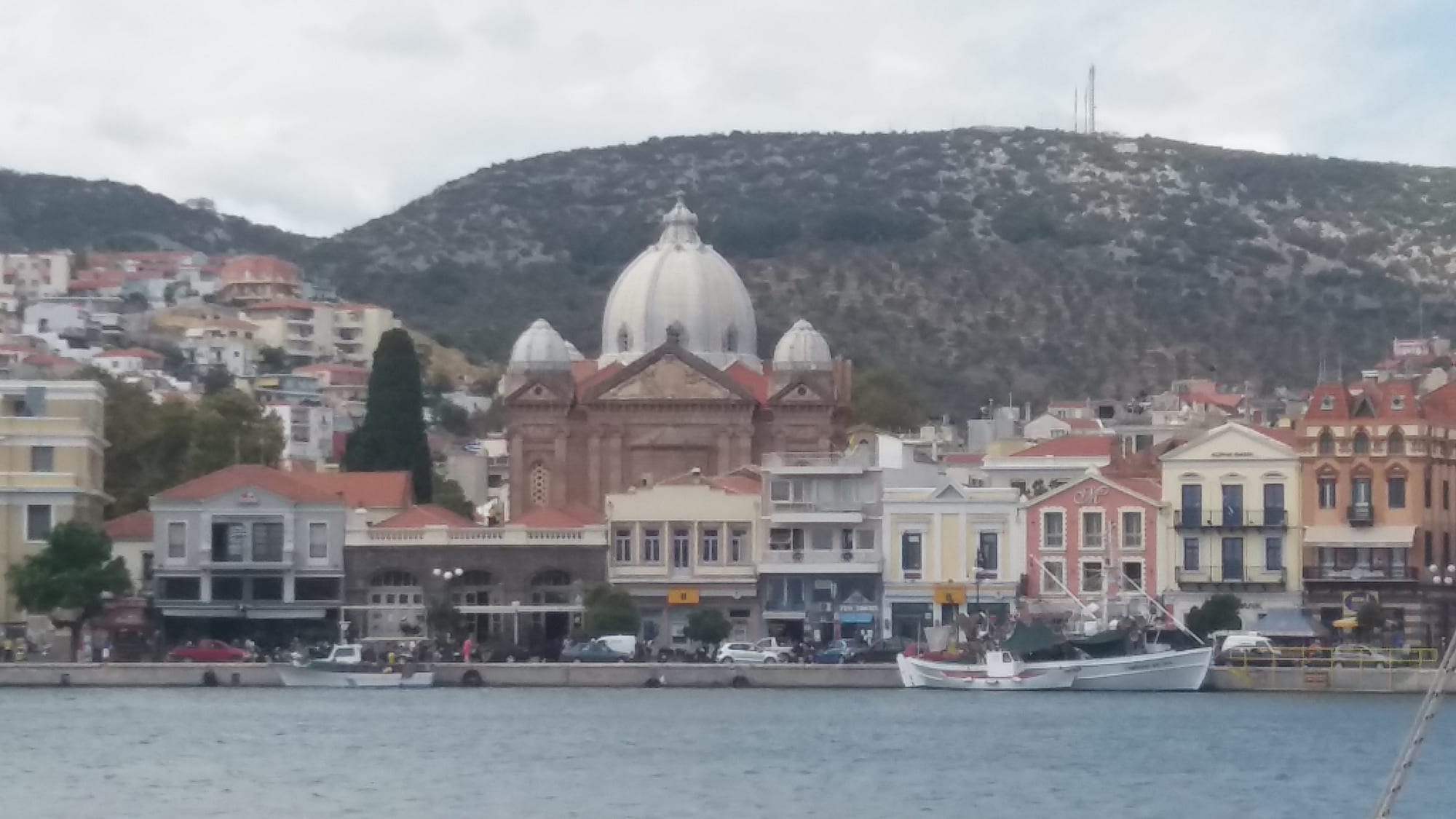
Harbour-front buildings and moored boats in the port of Mytilene

The North Aegean Islands, Greece

Lesbos

The port of Mytilene, the capital of Lesbos. (Timeheritage / Wikimedia Commons · CC BY-SA 4.0)

Greece's third-largest island, in the north-eastern Aegean off the Turkish coast, with its capital Mytilene on the south-east shore. Home of Sappho and Alcaeus, later a Genoese lordship and a busy Ottoman port, it is now an island of olive groves, ouzo distilleries and neoclassical harbour streets, and the seat of the University of the Aegean.

Neighbourhoods

  • Mytilene harbour and Ermou Street
    • First-time visitors
    • Close to the ferries
    • Shopping

    The southern harbour is the town's heart, with the ferry port, Sappho Square and the baroque church of Saint Therapon on its inner basin. Behind it runs Ermou Street, the old market street, along the line of the ancient channel that once divided the city.

    Open in Maps
  • Epano Skala and the north harbour
    • Historic district
    • Quiet harbour
    • Food

    The old market quarter at the northern end of Ermou Street, near the Yeni Mosque, the Ottoman market bath and the castle. The ancient north harbour is now a quiet place where a few small fishing boats moor.

    Open in Maps
  • Varia
    • Art museums
    • Quiet and residential

    A suburb on the southern edge of Mytilene, home to the Tériade Museum, which opened in 1979 in a building made for it.

    Open in Maps
  • Plomari
    • Ouzo
    • Seaside town

    The only sizable coastal town on the south of the island, between the openings of its two gulfs, and the home of ouzo, with several well-known distilleries and two ouzo museums.

    Open in Maps

Things to do

Mytilene landmarks

  • Castle of Mytilenelandmark

    One of the largest castles in the Mediterranean, covering about 60 acres on the headland between the two harbours; Francesco I Gattilusio made the first major alterations in 1373, and the Ottomans later added round towers for cannon and new walls.

    Open in Maps
  • Saint Therapon Churchlandmark

    The baroque Orthodox church beside the harbour, begun in the early 19th century and completed in 1935, a trademark sight of the town.

    Open in Maps
  • Statue of Libertylandmark

    A bronze statue 15 metres tall with its marble base, cast in Germany in 1922 to a design by the local painter Georgios Jakobides and dedicated at the harbour in 1930.

    Open in Maps
  • Yeni Mosquelandmark

    A former mosque built in 1825 and now in partial ruins, in the old market quarter near the north harbour.

    Open in Maps
  • Çarşı Hamamlandmark

    The Ottoman market bath, probably of the early 19th century, part of the Yeni Mosque complex, with the typical three-part sequence from cold to warm rooms.

    Open in Maps

Museums

  • Archaeological Museum of Mytilenemuseum

    Two buildings, an old mansion by the south harbour and a purpose-built museum two hundred metres to the north, the newer one rich in mosaics, among them the floor from the House of Menander with scenes from his plays.

    Open in Maps
  • Tériade Museummuseum

    The museum in Varia of the Mytilene-born publisher Tériade, displaying his illustrated books with work by artists such as Picasso, Matisse and Chagall in sixteen rooms.

    Open in Maps
  • Theophilos Museummuseum

    A museum in Varia devoted to the naive painter Theophilos, who painted murals in the island's villages illustrating Greek folklore and history.

    Open in Maps

Short trips on the island

  • Plomarineighborhood

    The south-coast town of the ouzo distilleries, with the World of Ouzo and Barbayannis ouzo museums.

    Open in Maps
  • Agiasosneighborhood

    A small town and former municipality, now part of the Mytilene municipality.

    Open in Maps
  • Kallonineighborhood

    The town at the head of the island's inner gulf and seat of West Lesbos, known for the sardines caught in its bay.

    Open in Maps
  • Molyvosneighborhood

    Ancient Methymna, a stone town climbing to a Gattilusio fortress, one of the coastal towns at the centre of the island's tourism.

    Open in Maps
  • Skala Eresoubeach

    A seaside village with a beach almost three kilometres long near Eresos, the traditional birthplace of Sappho, and a destination for lesbian travellers since the 1980s.

    Open in Maps
  • Lesvos Petrified Forestpark

    Fossilised trees and plants scattered across the west of the island, among them a 19.5-metre tree complete with some roots and branches, a major site of the Lesvos Geopark.

    Open in Maps

Eat and drink

Long-standing places and food districts in Lesbos. Hours, ratings and directions come from your maps app, always current.

Lesbos classics

  • Ouzomarket

    The dry anise-flavoured aperitif for which Lesbos is famous, made by several distilleries, the best known in Plomari.

    Open in Maps
  • Ladotyri Mytilinismarket

    A hard table cheese of sheep's and goats' milk, preserved in extra virgin olive oil and protected as a PDO product since 1996.

    Open in Maps
  • Kalloni sardinesrestaurant

    Sardines from the Bay of Kalloni, one of the island's exports, eaten with ouzo.

    Open in Maps

Food districts

  • Harbour-front barsneighborhood

    Bars near the wharf where the ferries dock, the town's usual place for an ouzo.

    Open in Maps
  • Ermou Street marketmarket

    The agora of Ermou Street, the old market street running through the centre of the town.

    Open in Maps

Experience Lesbos

History

Mytilene was founded in the 11th century BC on a small island just off the coast, later joined to Lesbos; a channel 700 metres long once linked its north and south harbours along the line of today's Ermou Street. In the 7th century BC it won the leadership of the island from Methymna, and its most famous citizens were the poets Sappho and Alcaeus and the statesman Pittacus. When the city revolted against Athens in 428 BC, the Athenian assembly voted to kill all its men, then changed its mind the next day; a fast trireme carried the reprieve, though a thousand rebels were executed. Aristotle lived here from 337 to 335 BC, and Rome took the city in 81 BC in a siege in which a young Julius Caesar served.

In 1355 the Byzantine emperor gave Lesbos to the Genoese Francesco Gattilusio, whose family rebuilt the castle and held it until Mehmed the Conqueror captured the city in 1462. Under the Ottomans Mytilene was considered the busiest Ottoman port in the Aegean, exporting olive oil, wheat, wine and soap, and its population grew five-fold. Greek forces took it in November 1912, during the First Balkan War. After 1922 the island's Muslims left in the population exchange and refugees from Asia Minor arrived, remembered by the Statue of the Asia Minor Mother in the town.

By 2015 Mytilene had become a main entry point for refugees and migrants heading for Europe, and over half a million people arrived on Lesbos that year. The Moria camp outside the town, once the largest in Europe, burned down in September 2020 and was closed; a new closed reception centre was planned at Vastria near Nees Kydonies.

Culture & Customs

Sappho is the island's emblem: her statue stands in Sappho Square on the harbour, and Eresos in the west, her traditional birthplace, has made Skala Eresou a destination for lesbian travellers since the 1980s. Longus set his novel Daphnis and Chloe in the countryside around Mytilene, and the island's later artistic names include the naive painter Theophilos, whose museum stands in Varia, and the publisher Tériade, a native of Mytilene who commissioned Picasso, Matisse and Chagall for his publications in Paris and whose museum opened in Varia in 1979.

Mytilene's streets show its layers. Neoclassical public buildings and mansions line the centre, the baroque church of Saint Therapon dominates the harbour, and the ruined Yeni Mosque and the Çarşı Hamam recall the Ottoman town. The Catholic church of the Theotokos keeps part of the relics of Saint Valentine.

Many island families trace their roots to the towns of the Anatolian coast across the strait, and ferries to Ayvalık keep the link alive. Ouzo is the island's drink and its pride: Lesbos is considered one of the places where it originated, and it is sold in every village coffee shop.

Daily Life

The municipal unit of Mytilene had 41,379 people in 2021, out of 83,755 on the whole island. The town is the capital of the North Aegean region, the seat of a metropolitan bishop, and the headquarters of the University of the Aegean, whose six schools here teach about 3,700 undergraduates. Students, government offices, the hospital, the courts and the port keep it busy all year.

The island's economy is essentially agricultural, and olive oil is its main source of income: eleven million olive trees cover 40 per cent of Lesbos. Fishing and the making of soap and ouzo follow, and tourism, encouraged by the airport and the coastal towns of Petra, Plomari, Molyvos and Eresos, contributes substantially. Mytilene also exports Kalloni sardines, olive oil, ladotyri cheese and woodwork.

Since 2019 the island has been divided into two municipalities, Mytilene and West Lesbos, with its seat at Kalloni. Life in the capital revolves around the harbour, Ermou Street and the squares, while the villages of the interior are quieter and older; the handling of migration remains a sensitive subject.

Food

Ouzo, the dry anise-flavoured aperitif, is the island's signature, and Lesbos is considered one of the places where it originated. Plomari on the south coast is its home, with famous distilleries and two museums, the World of Ouzo and the Barbayannis Ouzo Museum. Alcohol is sold in every village coffee shop and in the bars by the wharf in Mytilene.

The classic partner is the sardine of the Bay of Kalloni, one of the island's exports, celebrated each July at a festival in Skala Kalloni where it is grilled and served with plenty of ouzo. Ladotyri Mytilinis, a hard table cheese of sheep's milk or sheep's and goat's milk preserved in extra virgin olive oil, has been made since ancient times and holds Protected Designation of Origin status. Olive oil from the island's groves runs through all its cooking, and the island's sweets are a speciality of their own.

In Mytilene, the bars near the ferry wharf are the place for an ouzo, and the market streets of the agora around Ermou Street, just behind the quay, are the centre for shopping.

Planning tools

Budget

Lesbos is cheaper than the Cyclades and the busy Ionian islands. Rooms in Mytilene are good value, and prices barely rise outside August. The real costs are getting there and a hire car, which is almost essential for seeing the island's far-flung towns.

Daily Budget Midrange
USD 100–210 (mid-range hotel, restaurant meals, a hire car, occasional flights)
Daily Budget Shoestring
USD 50–85 (rented room, taverna and ouzeri meals, local buses)

Flying from Athens is much quicker than the ferry from Piraeus.

Best Time to Visit

May to June and September to October are the most comfortable months, when the island is green or being harvested. Lesbos is also one of the best islands in the world for birdwatching. July and August are the hottest months and bring Greek families.

Suggested Number of Days

Three or four days allow time in Mytilene and the nearer towns. The island is large and its roads are slow, so a week or more is needed to reach the north and west coasts without rushing; staying in two places rather than one saves long drives.

First Visit
3–4 days
With Surroundings
6–8 days

Transportation

Two national roads cross the island: one from Mytilene to Kalloni and an east-coast road from Thermi through Mytilene to Kratigos. Local buses from the main bus station in Mytilene reach the bigger villages, with tickets bought on board, but a hire car is the practical way to see the island. Mytilene itself is best explored on foot.

Drive carefully on mountain roads, which are steep, narrow and often unlit.

Airport & Station Connections

Mytilene International Airport, named after the poet Odysseas Elytis, is 8 kilometres from the town, with an urban bus from Sappho Square roughly every hour. Flights from Athens and Thessaloniki arrive all year, with summer charters. Ferries link the port with Piraeus, Thessaloniki, Lemnos and Chios, and car ferries cross to Ayvalık on the Turkish coast in about 90 minutes.

Walkability

Mytilene is compact around the harbour. The harbour front, Ermou Street, the castle and the north harbour are all within walking distance of each other, and walking is the best way to see the town's mix of architecture.

Safety

Greece is a safe country for visitors, with low levels of violent crime. On Lesbos the main hazards are steep, narrow mountain roads, summer heat and wildfires. The island hosts reception facilities for asylum seekers arriving by sea from Turkey; this rarely affects visitors, though it is a sensitive subject locally.

Drive carefully on mountain roads, obey fire bans and closures in summer, and carry a passport for any day trip to Turkey. Check current official travel advice before travelling.

Climate

A hot-summer Mediterranean climate, with hot, dry summers and cool, rainy winters. The island's mean annual temperature is 18°C and its mean annual rainfall about 750 millimetres.

Summer
hot and dry — well above the island's mean annual temperature of 18°C
Winter
cool and rainy — below the annual mean of 18°C, though snow and very low temperatures are rare

Local Customs

Tipping is not traditionally expected, though leaving a little in restaurants is now common. Ouzo is sold in village coffee shops and harbour bars. Churches and monasteries expect modest dress.

Cover shoulders and knees at monasteries and churches, and keep beachwear to the beach.

Common Payment Methods

Greece uses the euro. Cards are widely accepted in Mytilene and the resorts, and ATMs are found in the towns; cash is useful in the hill villages and at small tavernas.