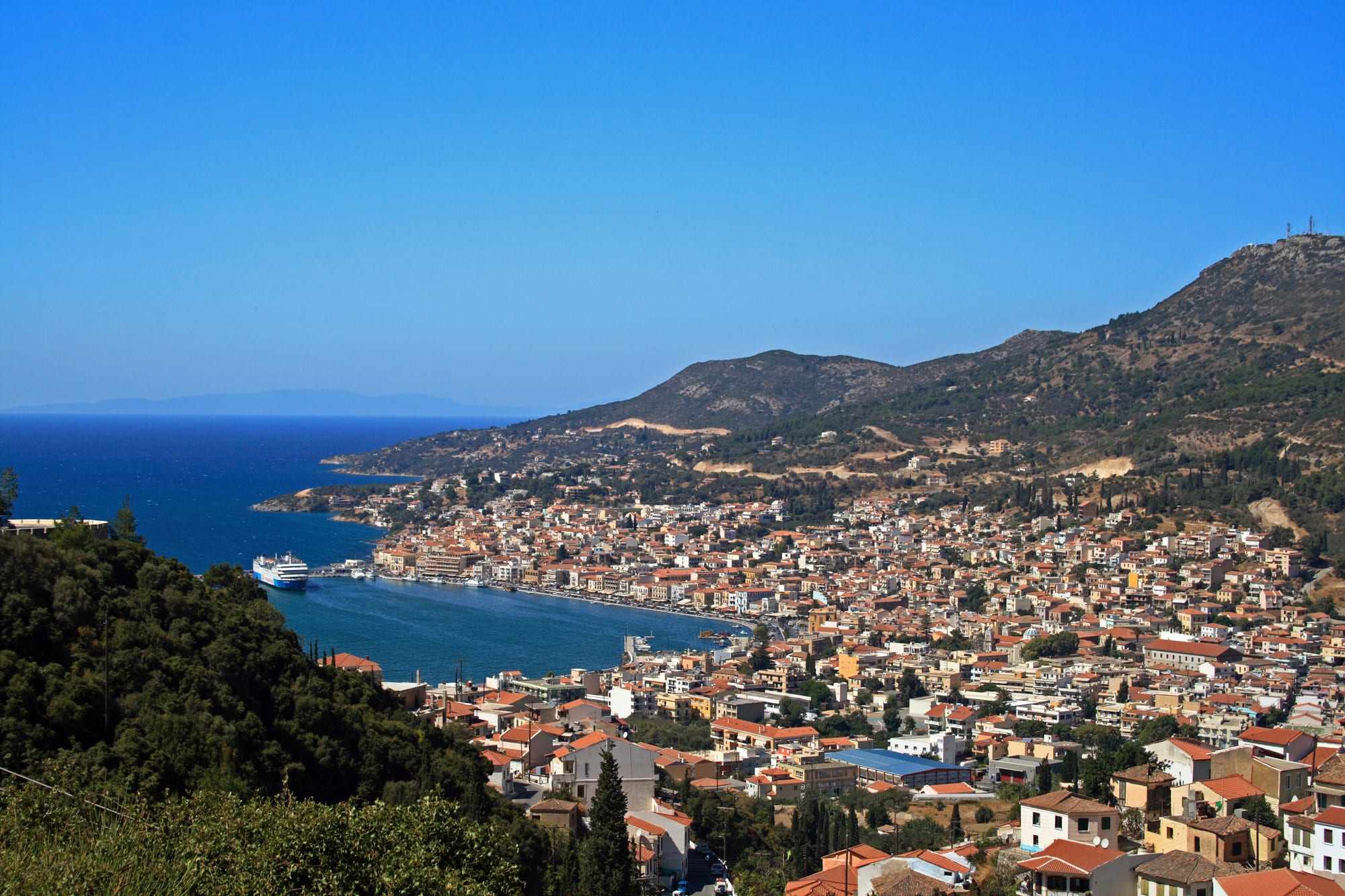
Red-roofed houses of Samos town spreading around a deep blue bay, with a ferry at the quay and dry hills behind

The North Aegean Islands, Greece

Samos

Samos town and the bay of Vathy on the north-east coast of Samos. (Pe-sa / Wikimedia Commons · CC BY-SA 3.0)

A green, mountainous island in the eastern Aegean, separated from the Turkish coast by the narrow Mycale Strait. Ancient Samos was a rich city-state and the birthplace of Pythagoras; today its capital, Samos town, long known as Vathy, curves around a deep northern bay, and the island lives from Muscat wine, olives, farming and tourism.

Neighbourhoods

  • Samos town waterfront
    • First-time visitors
    • Close to the ferries
    • Cafés

    The port town at the head of the bay, its houses built in an amphitheatre around the water. The seafront holds the quay, cafés and tavernas, the main square with its large lion statue, the town hall and the archaeological museum, and the old churches of Agios Nikolaos and Agios Spiridon.

    Open in Maps
  • Ano Vathy
    • Historic district
    • Quiet and residential
    • Walks

    The old hillside settlement above the port, from which the town took its former name of Vathy. Its steep lanes of older houses climb away from the sea, and it was joined with the lower town in 1958 under the single name of Samos.

    Open in Maps
  • Pythagoreio
    • Archaeology
    • Harbour life
    • Near the airport

    A harbour town on the south-east coast built over the ancient city of Samos, renamed in 1955 after Pythagoras. Ancient walls, the tunnel of Eupalinos and the Heraion are close by, and the airport lies within a few kilometres.

    Open in Maps
  • Kokkari
    • Beaches
    • Village atmosphere

    A fishing village on the north coast about 10 kilometres from Samos town, whose traditional architecture is protected. It has a pebble beach beside its small harbour, and further pebble beaches such as Lemonakia and Tsamadou lie close by.

    Open in Maps
  • Karlovasi
    • Students and nightlife
    • Second ferry port

    The island's second town and ferry port, on the north-west coast and the seat of the West Samos municipality. University students give it the island's liveliest bars and cafés, especially in winter.

    Open in Maps

Things to do

Ancient Samos

  • Tunnel of Eupalinoslandmark

    An aqueduct tunnel more than a kilometre long, dug from both ends through Mount Kastro in the mid-6th century BC, in the age of the tyrant Polycrates; Herodotus counted it among the greatest engineering feats of the Greek world.

    Open in Maps
  • Pythagoreionlandmark

    The archaeological site of the ancient city of Samos, with Greek and Roman remains around the modern harbour town of Pythagoreio, part of a UNESCO World Heritage Site since 1992.

    Open in Maps
  • Heraion of Samoslandmark

    The great sanctuary of Hera west of Pythagoreio, where a vast temple was begun in the age of Polycrates; the site shares the World Heritage listing with Pythagoreion.

    Open in Maps

Museums and churches

  • Archaeological Museum of Samosmuseum

    The museum in Samos town holds finds from the Heraion, among them a colossal 6th-century BC marble kouros, 5.25 metres tall, found on the Sacred Way of the sanctuary.

    Open in Maps
  • Byzantine Ecclesiastical Museummuseum

    The collection of the Metropolis of Samos in the town, showing a large number of Byzantine and post-Byzantine church treasures.

    Open in Maps
  • Panagia Vrontianilandmark

    A monastery near the village of Vourliotes, founded in 1476 and rebuilt in 1566, known for its carved iconostasis, frescoes and icons.

    Open in Maps

Beaches

  • Gagkou beachbeach

    The nearest major beach to Samos town, less than 2 km away on the north-east coast, about a 15-minute walk from the ferry port.

    Open in Maps
  • Psili Ammosbeach

    A small beach of very fine sand and shallow, clear water on the south-east coast.

    Open in Maps
  • Lemonakia and Tsamadoubeach

    Two neighbouring beaches just west of Kokkari, each reached by a short path from the coast road, with clear water that deepens quickly at Tsamadou.

    Open in Maps

Mountains and villages

  • Kerkistrail

    The marble mountain that forms the western end of the island, rising to 1,433 metres at its peak of Vigla, the highest point on Samos, and part of the Natura 2000 network.

    Open in Maps
  • Karlovasineighborhood

    The north-west port town, linked to Samos town by the coast road, with beaches such as Potami a short way beyond it.

    Open in Maps

Seasonal events

  • Samos Wine FestivalAugust

    A festival in Samos town organised by the island's wine cooperatives and the municipality, pouring the local wines, above all the sweet Muscat, with local musicians and dance groups.

  • Transfiguration in Pythagoreioearly August

    A re-enactment of the 1824 naval battle of the Mycale Strait, with explosions and fireworks at sea, followed the next day by a religious fair with folk dancing.

  • HeraeaAugust

    A three-day arts festival in Pythagoreio with ancient music, poetry and dance, a women's torch race and a procession carrying a woven veil for Hera.

  • Village festivalsall year, especially summer

    Saints' day fairs and food festivals in the villages, with traditional food, music and dancing that lasts into the early hours.

Eat and drink

Long-standing places and food districts in Samos. Hours, ratings and directions come from your maps app, always current.

Samos classics

  • Muscat of Samosmarket

    The island's famous sweet white wine, made from the Muscat grapes that cover much of Samos and exported around the world; Nectar and Anthemis, the latter aged five years before bottling, are the superior bottlings.

    Open in Maps
  • Moustalevriacafe

    A local speciality pudding of grape must mixed with flour and boiled until thick, known on Samos as kourkouta.

    Open in Maps

Food districts

  • Samos town seafrontneighborhood

    The quay and the streets just behind it hold the town's tavernas, pizzerias and bars, busiest in the evening.

    Open in Maps
  • Pythagoreio harbourneighborhood

    The tavernas and cafés lining the small harbour of Pythagoreio, a town known for its fishermen's festival.

    Open in Maps
  • Karlovasineighborhood

    The student town's cafés, tavernas, bars and clubs, livelier than the capital's after dark and busy through the winter term.

    Open in Maps

Experience Samos

History

Ancient Samos lay on the south-east coast, where Pythagoreio stands today. In the 6th century BC, reaching its height under the tyrant Polycrates, it was one of the richest city-states of the Greek world: in this period two teams led by the engineer Eupalinos dug a water tunnel through Mount Kastro from both ends, and a vast temple was raised to Hera. Persian conquest followed Polycrates' death; later the island held a privileged place in the Delian League and stayed loyal to Athens until the Samian War of 440 BC, when it held out against Pericles before surrendering after a long siege.

The town that is now the capital is much younger. It was built in the middle of the 18th century as the port of Vathy, the hillside village above the bay, and was first called Kato Vathy, lower Vathy. In 1834 Samos became a principality paying tribute to the Ottoman Empire, governed by a Christian prince with a senate and a chamber of deputies, and the port of Vathy became the seat of government. The town grew through the 19th century as the island's administrative centre and kept that role when Greek troops landed in March 1913 and Samos joined Greece.

The Second World War brought Italian occupation in 1941 and a famine in the winter of 1941–42 that killed 2,000 Samians. After Italy's surrender in 1943 Vathy was heavily bombed and the island passed to the Germans; the occupation ended in October 1944. In 1958 the port and Ano Vathy were joined under the name Samos. In recent years a crowded migrant camp beside the town, holding about 6,800 people in April 2020, was to be replaced by a closed reception centre near Zervou, announced that year, and a magnitude 7.0 earthquake in October 2020 damaged buildings in the town.

Culture & Customs

Samians are proud of the island's ancient names. Pythagoras was born here, as were the philosophers Epicurus and Melissus and the astronomer Aristarchus, the first known person to propose that the Earth goes round the Sun; the airport is named after him, and the town of Tigani took the name Pythagoreio in 1955. The historian Herodotus lived on Samos for a time; the Samian sculptor Theodorus is said to have helped invent the casting of statues in bronze, and Samian vases were among the most characteristic Ionian pottery of the 6th century.

The year is marked by festivals. Village saints' days and food fairs bring traditional dishes, music and dancing that lasts until the early hours. August is the busiest month: Pythagoreio re-enacts the 1824 naval battle of the Mycale Strait with fireworks on the eve of the Feast of the Transfiguration, the Heraea revives ancient music, poetry and a women's torch race, and Samos town holds its wine festival, where local groups dance in a circle, the women in the chain and the men at its ends.

The island looks across to Asia Minor. The Mycale Strait is less than two kilometres wide, and Samos has long been a crossing point between Greece and Turkey for travellers, traders and, in recent years, people seeking asylum.

Daily Life

Samos had 32,642 inhabitants at the 2021 census. Samos town had about 5,900 residents in the 2021 census, and over 9,000 with Ano Vathy. It is the capital of the regional unit and of the East Samos municipality, while Karlovasi is the seat of West Samos; the two municipalities were created in 2019.

The economy depends mainly on agriculture and tourism, which grew steadily from the early 1980s and peaked at the end of the 1990s. Grapes, honey, olives and olive oil, citrus fruit, dried figs, almonds and flowers are the main crops, and the Muscat grape is the main grape for wine. In 2026 the European Investment Bank approved financing to connect the north-east Aegean islands to the Greek electricity grid.

Samos town is the place of government offices, the main port and year-round shops, with houses climbing in tiers from the quay to the old lanes of Ano Vathy. Karlovasi has a younger feel thanks to its university students. Life slows after the summer season, but the towns stay inhabited all year, and village festivals keep people moving around the island.

Food

Wine has defined Samos since antiquity, when Samian wine was already well known. A great part of the island is covered with vineyards of Muscat grapes, and the sweet Samos Muscat, sold as Samos Vin Doux, is a popular dessert wine exported around the world; Nectar and Anthemis, the latter aged five years before bottling, are the superior bottlings. The wine cooperatives' August festival in Samos town pours all of them.

The island's listed specialities include bourekia, its version of börek, the family of pastries made with a thin, flaky dough such as filo and fillings such as cheese; katimeria; armogalo cheese; tiganites, listed as pancakes, while the village of Mytilinii holds a festival of tiganita, fried dough; and moustalevria, a pudding of grape must mixed with flour and boiled until thick. Honey, olive oil, dried figs and almonds come from the island's farms.

Eating out centres on the seafront of Samos town, with tavernas serving typical Greek food alongside pizzerias, on the harbour of Pythagoreio, home of a fishermen's festival, and on the student-filled squares of Karlovasi.

Planning tools

Budget

Samos is cheaper than the Cyclades and the busiest Ionian islands. Rooms in Samos town are good value, and prices rise most in August. The main extra costs are the long ferry or the flight from Athens, and a hire car or scooter, since buses are infrequent.

Daily Budget Midrange
USD 100–200 (mid-range hotel, restaurant meals, a hire car or scooter, site tickets)
Daily Budget Shoestring
USD 50–85 (rented room, taverna meals, local buses and deck-class ferries)

Rental agencies near the port in Samos town hire out cars, motorbikes and scooters, and many stay open late.

Best Time to Visit

May to June and September to October are the most comfortable months, when the hills are green or the grapes are being picked. July and August are the hottest and driest months and bring Greek holidaymakers, the meltemi wind and the island's biggest festivals, including the wine festival in Samos town.

Suggested Number of Days

Three or four days allow a stay in Samos town with time on the south-east coast. Six or seven suit those who want the western mountains, more beaches and the villages. Having a car or scooter shortens what buses would make a slow trip.

First Visit
3–4 days
With Surroundings
6–7 days

Transportation

Buses link the towns and many villages but are infrequent and do not run on Sundays or some public holidays. Most visitors hire a car, motorbike or scooter, and with one much of the island can be covered in a day or two. Taxis are available. The main coast road runs along the north coast between Samos town and Karlovasi.

Mountain roads are steep and narrow; drive carefully and allow extra time.

Airport & Station Connections

Samos International Airport, named after Aristarchos of Samos, lies on the south coast within 5 kilometres of Pythagoreio, with flights of about an hour from Athens and from Thessaloniki and seasonal flights from much of Europe. Ferries from Piraeus take much of a night and call at both Samos town and Karlovasi, and ferries to and from Turkey use the port of Samos town.

Walkability

Samos town is easily explored on foot along its long seafront, though streets and steps climb steeply away from the water towards Ano Vathy. The nearest beach is a short walk from the ferry port. Pythagoreio is small enough to walk, and its archaeological sites can be reached on foot or by bicycle.

Safety

Greece is a safe country for visitors, with low levels of violent crime. On Samos the main hazards are steep, narrow mountain roads, summer heat and wildfires. The island lies on an active fault zone: a magnitude 7.0 earthquake offshore in October 2020 damaged buildings in Samos town and Karlovasi. Asylum seekers arriving across the strait are housed in a reception centre; this rarely affects visitors.

Drive carefully on mountain roads, obey fire bans and closures in summer, and carry a passport for any trip to Turkey. Check current official travel advice before travelling.

Climate

A hot-summer Mediterranean climate, with mild, rainy winters and hot, dry summers. Humidity is lowest in summer and highest at the end of autumn, and the island receives about 705 millimetres of rain a year, with an average annual temperature of 18.4°C.

Summer
hot and dry — July is the hottest and driest month, followed by August; the highest temperature recorded is 43°C
Winter
mild and rainy — February is the coldest month and December the wettest; the lowest temperature recorded is −3.4°C

Local Customs

Tipping is not traditionally expected, though leaving a little in restaurants is now common. Dinner is late, village festivals run into the early hours, and churches and monasteries expect modest dress.

Cover shoulders and knees at monasteries and churches, and keep beachwear to the beach.

Common Payment Methods

Greece uses the euro. Cards are widely accepted in the towns and resorts, and ATMs are found in the towns; cash is useful in the hill villages and at small tavernas.